
卫星制造

Search documents
太空算力:打开AI应用场景新空间
Xi Niu Cai Jing· 2026-01-14 11:29
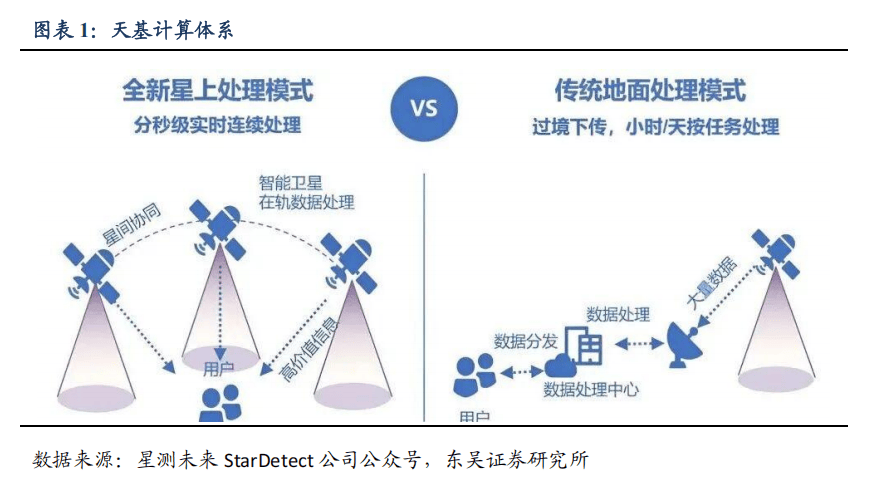
Core Insights - Space computing is an innovative result of the deep integration of aerospace technology and artificial intelligence, leading to a shift in computing paradigms from ground-based to space-based applications [1][2] - The global space computing industry has moved from planning to substantial verification and initial deployment, with China focusing on a self-controlled and systematic approach to build a complete industrial chain [2][10] Group 1: Overview of Space Computing - Space computing is a systematic orbital-level distributed AI architecture that deploys computing resources in space to achieve data collection, processing, storage, and output directly in orbit [3] - Applications of space computing are categorized into "space-based computing" and "ground-based computing," with the former involving autonomous data processing in orbit and the latter relying on ground-provided data for model training in space [3] Group 2: Economic Viability - Space computing is expected to address the long-standing economic loop challenges in commercial aerospace, with lifecycle operating costs potentially reduced to one-twentieth of ground facilities [6] - The cost structure for space data centers is significantly lower than that of ground facilities, with total costs estimated at $0.08 billion for space compared to $0.97 billion for China and $1.67 billion for the U.S. [7] Group 3: Industry Chain Analysis - The space computing industry chain consists of three core segments: upstream manufacturing and launching, midstream operation and ground access, and downstream data empowerment and application [8] - The downstream applications have expanded from traditional fields like remote sensing and navigation to include smart cities and edge intelligence [8] Group 4: Market Potential - The space computing industry is accelerating, with its strategic value becoming increasingly prominent as a solution to global computing resource bottlenecks [10] - According to Research and Markets, the global market for orbital data centers is projected to reach $39.09 billion by 2035, with a compound annual growth rate of 67.4% [10] Group 5: Company Profiles - Qianzhao Optoelectronics (300102) has seen significant growth in sales driven by its strategic focus on gallium arsenide solar cells, with a revenue increase of 46.4% year-on-year to $2.75 billion in the first three quarters of 2025 [11] - Putian Technology (002544) is transitioning to a provider of aerospace information infrastructure, reporting a revenue of $3.152 billion in the first three quarters of 2025, a decrease of 7.82% year-on-year [13] - Maiwei Co., Ltd. (300751) specializes in solar cell manufacturing equipment and has signed contracts for perovskite/silicon heterojunction battery production lines, with a revenue of $6.204 billion in the first three quarters of 2025, down 20.13% year-on-year [15]

“商业航天”爆发,中衡设计手握头部客户订单,路能走多远?
Quan Jing Wang· 2026-01-14 07:05
Group 1 - China's submission of over 200,000 satellite frequency resource applications to the ITU by December 2025, with more than 190,000 applications from the newly established Radio Innovation Institute, indicates a strategic national focus on satellite frequency resources and ambition in the commercial space sector [1] - Significant breakthroughs in reusable rocket technology are being achieved, leading to a cost revolution and technological upgrades within the aerospace industry, which will benefit related companies in aerospace manufacturing, new materials, and satellite applications [1] - The market has shown strong confidence in the commercial space sector, as evidenced by the stock performance of Zhongheng Design Group, which has seen three consecutive trading limit increases [1] Group 2 - Zhongheng Design, as Jiangsu Province's largest architectural design group and the first publicly listed architectural design company in China, has established a core competitive advantage in high-end industrial building design and a deep understanding of the aerospace industry [2] - The company invested in the rocket manufacturer Zhihang Technology (Suzhou) Co., Ltd. in 2023, marking a shift from a service provider to an "industry builder" by closely binding with key technology enterprises in the upstream of the industry chain [2] - This strategic binding allows Zhongheng Design to gain deeper insights into rocket manufacturing processes and future base requirements, enhancing its design and research capabilities in the commercial aerospace infrastructure sector [2] Group 3 - In 2025, Zhongheng Design plans to deepen its layout by establishing a Commercial Aerospace Architectural Planning Research Center, focusing on niche market demands and refining production processes [3] - The company aims to develop mature design solutions and benchmark projects in areas such as rocket assembly testing bases and satellite production cleanrooms, gaining trust and collaboration from leading aerospace companies [3] - The establishment of a specialized research center is intended to systematically address the unique challenges of aerospace manufacturing and testing processes, creating a reusable and evolving design knowledge system [3] Group 4 - The national push for commercial space development is expected to lead to explosive growth in the demand for rocket and satellite production, resulting in an increase in infrastructure projects such as manufacturing and testing bases [4] - Zhongheng Design's core design business is poised to benefit directly from this trend, with the potential for market expansion in the commercial aerospace infrastructure sector through industry investments and the establishment of specialized research centers [4]


成都市区联动促投资:多个产业项目集中签约落地
Sou Hu Cai Jing· 2026-01-14 06:11
Group 1 - Chengdu and several districts are actively promoting effective investment and industrial project implementation through various methods, including fund support and international connections [1] - The Chengdu Major Industrialization Project Investment Fund, in collaboration with the state-owned investment platform of Chongzhou, has supported the establishment of the "Star Computing" headquarters by Guoxing Aerospace Technology Co., Ltd., with a total investment of 5 billion yuan [2][4] - The project aims to build a global headquarters for aerospace AI additive manufacturing in Chongzhou, with the first satellite, "Chongzhou No. 1," expected to be launched by May 2025 [4] Group 2 - The "Robotics + Smart Energy" industry development conference in Chengdu attracted over 120 representatives from industry chain enterprises, research institutions, and financial organizations [5] - Six key projects, including the R&D headquarters of Chengdu Yuntu Shijing Chuangjie Technology Co., Ltd., were signed during the conference, focusing on aircraft design and visual navigation algorithm development [7] - The Chengdu Robotics Innovation Center presented its capabilities in robotics for the energy sector, while the Chengdu Smart Oil Service Industrial Base showcased AI applications in the oil and gas field [7] Group 3 - Chengdu High-tech Zone organized a business matching event for Chinese and Korean enterprises during the "2026 China-Korea Investment Forum" [8] - The "Little Giant" enterprise, Yifang Smart Technology, established connections with several Korean partners to expand its market presence [10] - The Chengdu-Korea Innovation and Entrepreneurship Park has attracted 125 Korean-funded enterprises since its establishment in 2015, ranking high in the 2025 evaluation of national parks in Sichuan Province [10]
国泰海通:天地一体化建设提速 关注卫星制造与火箭发射端龙头
智通财经网· 2026-01-13 13:29
Group 1 - The core point of the article highlights that China has submitted an application for 203,000 new satellites covering 14 constellations, marking a significant increase in satellite applications and indicating a new era in low Earth orbit (LEO) satellite construction [1][2] - The application includes two major constellations, CTC-1 and CTC-2, which account for nearly 193,000 satellites, reflecting a strategic intent to secure frequency resources for future 6G integrated networks [2][3] Group 2 - The entry of traditional telecom operators like China Mobile and China Telecom into the satellite sector signifies a shift from a single professional satellite operator model to a diversified structure involving national teams, commercial aerospace, and traditional operators [3] - This integration is expected to accelerate the commercial viability of satellite internet services, facilitating the Direct to Cell business model by leveraging the operators' extensive user base and ground infrastructure [3] Group 3 - The new satellite constellations face strict deployment timelines as per ITU regulations, requiring the first satellite to be launched within seven years and full deployment within 14 years, necessitating a significant increase in satellite manufacturing and rocket launch capabilities [4] - The industry must achieve an exponential increase in production capacity to meet the demand for launching thousands of satellites annually over the next decade [4]

广东宏大:宏大卫星目前在轨卫星10颗 未来计划完成整个星座组网建设
Xin Lang Cai Jing· 2026-01-13 12:16
广东宏大(002683)1月13日在互动平台表示,宏大卫星目前在轨卫星10颗,未来计划完成整个星座组网 建设,形成覆盖全球的实时监测探测能力,高水平服务保障智慧海洋、环境监测、国防安全等重点领 域。 ...

中国新增超20万颗卫星申请,两融新开户创近10年新高 | 财经日日评
吴晓波频道· 2026-01-13 00:30
Group 1: Government Investment Fund Regulations - The article discusses the introduction of a systematic regulation for government investment funds by multiple departments, focusing on investment direction, methodology, and management [2][3] - The new regulations emphasize supporting major strategies and key areas, promoting technological and industrial innovation, and encouraging long-term investments in hard technology [2] - The regulations aim to optimize fund assessment systems by considering industry uncertainties and integrating the concept of "due diligence exemption" into government investment funds [2][3] Group 2: Satellite Applications - China has submitted an application for 203,000 new satellites to the International Telecommunication Union, marking the largest frequency and orbit resource application in the country's history [4][5] - The application includes various entities beyond traditional satellite operators, indicating a strategic reserve for future satellite deployment [4] - The need for a large-scale satellite network is highlighted, as low-orbit satellites require extensive deployment to provide continuous service [5] Group 3: Robotic Vacuum Market - Chinese brands dominate the global robotic vacuum market, accounting for nearly 70% of total shipments, with significant growth in emerging markets [6][7] - The rapid transformation in the industry is attributed to technological advancements and competitive pressures that have led to innovation and cost control [6] - The entry of various tech companies into the robotic vacuum sector indicates that market competition is far from over [7] Group 4: Smartphone Market Trends - Global smartphone shipments are projected to grow by 2% in 2025, with Apple leading the market share at 20% [8][9] - The demand in emerging markets is a key driver for this growth, while high-end smartphone models are gaining popularity [8] - The article notes potential challenges in the smartphone market due to rising chip prices and the emergence of alternative electronic products [9] Group 5: ETF Dividend Announcement - Huatai-PB Fund announced a record cash dividend for its CSI 300 ETF, marking the first time the dividend exceeds 1 yuan per 10 shares [10][11] - The total dividend amount could reach 11 billion yuan, reflecting the growing trend of index ETFs and their increasing scale [10] - The article explains that ETF dividends do not change total asset value but allow for early realization of profits for investors [11] Group 6: A-share Margin Trading - In 2025, new margin trading accounts in A-shares reached 1.5421 million, the highest in nearly a decade, indicating strong market interest [12][13] - The total margin balance increased significantly, reflecting a robust demand for leveraged trading amid a rising market [12] - The article warns that while margin trading has surged, it remains below the peak levels seen in 2015, and brokers are taking precautionary measures [13] Group 7: Gold Price Surge - Spot gold prices have surpassed $4,600 per ounce for the first time, driven by global uncertainties and rising geopolitical risks [14][15] - The article attributes the price increase to various factors, including rising fiscal deficits and central banks' ongoing gold purchases [14] - While short-term price fluctuations may occur, the long-term outlook for gold remains bullish, with expectations for new highs [15] Group 8: Stock Market Performance - The stock market experienced a significant rally, with major indices rising over 1%, and trading volume reaching a historical high [16][17] - The surge was driven by strong performances in AI applications and commercial aerospace sectors, attracting substantial market interest [16] - The article notes that extreme market emotions can lead to corrections, but the strong start to the year may validate previous expectations for market performance [17]

太空光伏与"轨道数据中心": 为什么下一代能源与算力的战场,会在800km的高空?
Hua Er Jie Jian Wen· 2026-01-12 04:12
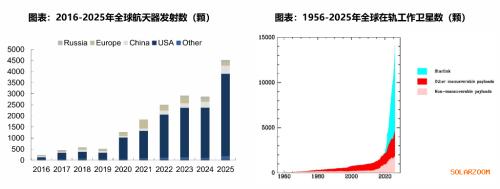
Core Viewpoint - Space photovoltaic technology is evolving from being merely "solar panels on satellites" to becoming a crucial component for the next generation of computing power (space computing/orbital data centers) [1][2] Group 1: Industry Trends - The application for orbital resources and satellite deployment plans is reshaping the supply-demand dynamics of the space industry, with a significant increase in satellite launches expected [2][3] - The number of global spacecraft launches has surged from 237 in 2016 to over 4,300 expected by 2025, reflecting a compound annual growth rate of approximately 34% [3] - The market for solar wings is transitioning from a niche to a mass production model due to the increasing number of satellites [5][6] Group 2: Cost Comparisons - A comparison of costs shows that deploying a data center in space can be significantly cheaper than on the ground, with a projected total cost of approximately $8.2 million in space versus $167 million on the ground over ten years [16] - The primary cost difference arises from energy expenses, where ground energy costs are estimated at $140 million over ten years, while space energy costs are nearly zero after initial deployment [16] Group 3: Technological Developments - The demand for solar wings is driven by the increasing power requirements of satellites, with examples showing significant growth in solar wing area from 22.68 m² to 256.94 m² for different satellite versions [9][12] - The report indicates a shift in technology from gallium arsenide (GaAs) to silicon-based technologies, particularly HJT (Heterojunction Technology), which offers advantages in weight, cost, and flexibility [25][27] Group 4: Market Potential - The solar wing market could reach approximately 200 billion yuan if annual satellite launches reach 10,000, with prices expected to decrease from 1,200 yuan/W to 622 yuan/W [10][11] - The space computing market is defined as deploying modular server nodes on low/mid-orbit satellites, transforming them into orbital data centers with significant computational capabilities [12][14] Group 5: Competitive Landscape - The competition for orbital resources is intensifying, with a total of over 100,000 low-orbit satellites planned globally, including approximately 45,000 from the U.S. and 53,000 from China [6][18] - The choice of technology and materials for solar wings will be influenced by launch costs, with SpaceX's lower costs allowing for different material choices compared to higher-cost Chinese rockets [22][23]
中国卫星股价涨5.61%,国泰基金旗下1只基金位居十大流通股东,持有574.86万股浮盈赚取3420.42万元
Xin Lang Cai Jing· 2026-01-12 01:54
Group 1 - The core viewpoint of the news is that China Satellite experienced a stock price increase of 5.61%, reaching 112.00 CNY per share, with a trading volume of 5.06 billion CNY and a turnover rate of 0.38%, resulting in a total market capitalization of 1324.39 billion CNY [1] - China Satellite, officially known as China Dongfanghong Satellite Co., Ltd., is located in Haidian District, Beijing, and was established on August 21, 1997, with its listing date on September 8, 1997 [1] - The company's main business involves aerospace manufacturing and satellite applications, with revenue composition being 97.01% from aerospace manufacturing and satellite applications, 1.71% from other sources, and 1.28% from leasing income [1] Group 2 - From the perspective of the top ten circulating shareholders of China Satellite, data shows that a fund under Guotai Fund ranks among the top shareholders, specifically the Guotai CSI Military Industry ETF (512660), which reduced its holdings by 1.1146 million shares in the third quarter, now holding 5.7486 million shares, accounting for 0.49% of circulating shares [2] - The Guotai CSI Military Industry ETF (512660) was established on July 26, 2016, with a latest scale of 141.09 billion CNY, and has achieved a year-to-date return of 13.47%, ranking 116 out of 5579 in its category, and a one-year return of 59.03%, ranking 871 out of 4202 [2] - The fund manager of Guotai CSI Military Industry ETF (512660) is Ai Xiaojun, who has a cumulative tenure of 12 years and 3 days, managing total fund assets of 1690.29 billion CNY, with the best fund return during his tenure being 286.65% and the worst being -46.54% [2]

华西证券:商业航天持续推进 新兴领域赋能
智通财经网· 2026-01-12 01:35
Group 1 - The core viewpoint of Huaxi Securities highlights strong demand in the new energy vehicle (NEV) sector, with significant growth in energy storage and power battery needs, as well as a robust demand for core components in humanoid robots and solar photovoltaic applications driven by low-orbit satellite deployment [1][2] - The report emphasizes the expected acceleration in humanoid robot mass production, driven by domestic and international collaborations, and a strong domestic demand for core components such as precision transmission parts and electronic skin [2] - The outlook for NEV sales remains positive, with expectations of stable growth driven by new policies and increasing electrification rates in commercial vehicles, alongside a high demand for power batteries [3] Group 2 - The deployment of low-orbit satellite constellations is anticipated to significantly boost the demand for solar wings, which are essential for satellite energy supply, as the global competition in this area intensifies [4] - The first 30MW pure hydrogen gas turbine project has achieved breakthroughs in pure hydrogen power generation, indicating broad application potential across various energy supply scenarios [5] - The H200 supply chain is expected to restart, with domestic AI models rapidly evolving, suggesting that suppliers closely tied to major players may benefit significantly from upcoming opportunities [6]

我国新增超20万颗卫星申请
Ke Ji Ri Bao· 2026-01-12 00:27
Core Viewpoint - China has submitted an application to the International Telecommunication Union (ITU) for frequency and orbital resources for 203,000 new satellites, marking the largest international frequency application action to date [1]. Group 1: Application Details - The application covers 14 satellite constellations, including low and medium Earth orbit satellites [1]. - The Wireless Radio Spectrum Development and Technology Innovation Research Institute (referred to as "Radio Innovation Institute") applied for two constellations, CTC-1 and CTC-2, requesting 96,714 satellites each, totaling 193,428 satellites, which accounts for over 95% of the total application [1]. - Other applicants include China Star Net, China Mobile, and Yuanxin Satellite [1]. Group 2: Industry Impact - This large-scale application is expected to activate the entire satellite manufacturing, launching, and operational industry chain, promoting significant advancements in China's aerospace industry [1]. - The application process is a routine operation to comply with ITU regulations, which typically requires 2 to 7 years of preparation for satellite network applications, coordination, registration, and maintenance before launching satellites [2]. Group 3: International Context - Several countries have already submitted satellite network data for over 100,000 satellites based on their circumstances [2]. - The actual deployment scale and technical parameters of the satellites may undergo dynamic optimization and adjustments due to various factors such as international coordination of frequency resources, system construction, and market demand changes [2].