
材料

Search documents
广东莱尔新材料科技股份有限公司 关于2025年以简易程序向特定对象发行股票发行结果暨股本变动的公告
Sou Hu Cai Jing· 2026-01-10 05:43
Core Points - The company has completed a private placement of 5,919,871 shares at a price of 26.96 CNY per share, raising a total of approximately 159.6 million CNY, with a net amount of about 153.8 million CNY after deducting issuance costs [1][8][12] Group 1: Issuance Details - The issuance involved 5,919,871 shares of ordinary A-shares, with a par value of 1.00 CNY per share [5][6] - The issuance price was determined based on the average trading price of the company's shares over the 20 trading days prior to the pricing date, set at 26.96 CNY per share [7] - The total funds raised amounted to 159,599,722.16 CNY, with issuance costs of 5,782,727.87 CNY deducted, resulting in a net amount of 153,816,994.29 CNY [8][12] Group 2: Regulatory and Approval Process - The issuance was approved by the company's board and shareholders, with necessary internal decision-making processes followed [2][3] - The Shanghai Stock Exchange accepted the application for the issuance on November 21, 2025, and the China Securities Regulatory Commission granted registration approval on December 18, 2025 [4] Group 3: Shareholder and Ownership Changes - The issuance will not change the company's control structure, and the major shareholders will remain the same [20][21] - The total number of shares will increase to 161,097,800, with the new shares being subject to a six-month lock-up period [13][20] Group 4: Use of Proceeds and Business Impact - The funds raised will be used to support the company's main business operations, aligning with national industrial policies and the company's strategic development [22] - The issuance is expected to enhance the company's financial stability and creditworthiness, providing a solid foundation for future growth [21][22]
双星新材:公司持续拓展材料应用广度与深度
Zheng Quan Ri Bao Wang· 2026-01-09 11:40
Core Viewpoint - The company, Double Star New Materials (002585), is actively expanding the breadth and depth of its material applications while leveraging its technological and industrial foundation to layout in emerging fields [1]. Group 1 - The company is focusing on the continuous expansion of material applications [1]. - The company is relying on its technological and industrial foundation to explore new emerging fields [1].

江西:推进航空、种业、材料等领域国家实验室江西基地(网络成员)筹建 争创稀土领域国家技术创新中心
Zheng Quan Shi Bao Wang· 2026-01-08 08:42
Core Viewpoint - The Jiangxi Provincial Government has issued a plan to promote the deep integration of technological innovation and industrial innovation from 2025 to 2027, focusing on optimizing the layout of industrial technology innovation platforms and bases [1] Group 1: Technological Innovation Platforms - The plan aims to establish national laboratories in fields such as aviation, seed industry, and materials in Jiangxi, and to strive for a national technology innovation center in the rare earth sector [1] - By 2027, the goal is to have approximately 28 national-level technology innovation platforms and bases [1] Group 2: Management and Evaluation - The plan emphasizes strengthening the overall management of technological innovation platforms and bases across the province [1] - It includes initiatives for the cleanup and standardization of platforms and bases, promoting effective connections at all levels [1] - The plan proposes a dynamic adjustment mechanism with performance evaluation reforms to ensure a "dynamic entry and exit" system for platforms and bases [1]
高盛:中国股票今年还有20%涨幅空间
3 6 Ke· 2026-01-08 08:10
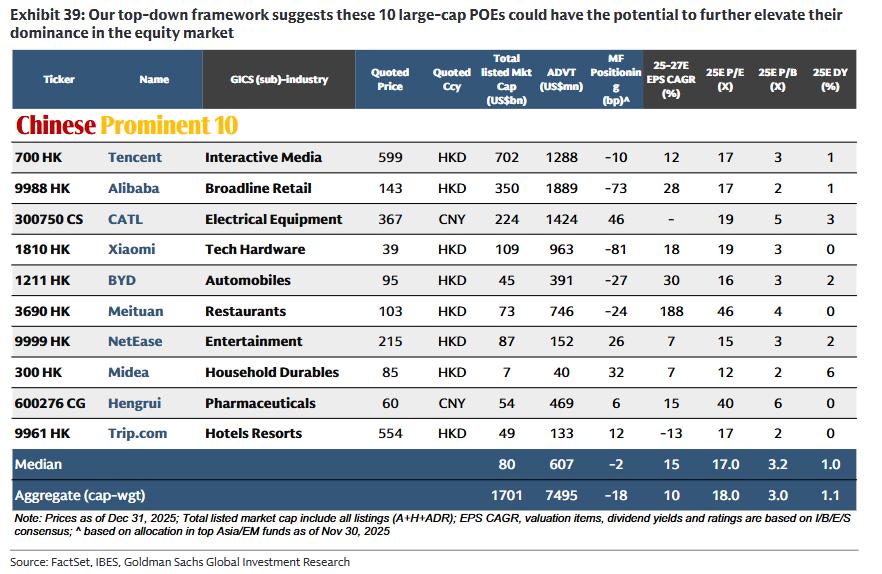
Group 1: Market Outlook - Goldman Sachs predicts that Chinese stocks will be supported by artificial intelligence and policy measures, with the MSCI China Index expected to rise by 20% by the end of 2026, and the CSI 300 Index projected to increase by 12% to 5200 points [1] - As of the first trading day of 2026, the CSI 300 Index has already risen by 3.5%, reaching a four-year high, while the MSCI China Index has increased by approximately 3.6%, outperforming the S&P 500 [1] Group 2: Earnings-Driven Growth - The core argument of Goldman Sachs' report is that returns in 2026 will be primarily driven by earnings growth, supported by artificial intelligence, "going global" strategies, and anti-involution policies [2] - Five major capital flows are expected to support the market: net southbound capital inflows potentially reaching a record $200 billion; domestic asset reallocation bringing about 3 trillion RMB into the stock market; total dividends and buybacks nearing 4 trillion RMB; global active funds possibly increasing their allocation to Chinese stocks; and IPO financing exceeding $100 billion [2] Group 3: Investment Logic - On a macro level, Goldman Sachs has raised its forecast for China's real GDP growth in 2026, citing resilient exports as a key driver, with a trend towards diversification and quality improvement in export destinations [4] - The report indicates that the valuation of the MSCI China Index and CSI 300 has recovered to mid-cycle levels, with forward P/E ratios of 12.4x and 14.5x, respectively, around or slightly above the 10-year average [4] Group 4: Sector and Company Insights - Goldman Sachs expects the TMT sector (technology, media, and telecommunications) to have the highest earnings growth forecast at approximately 20%, driven by AI-related revenue growth and increased capital expenditures [5] - The firm holds an "overweight" view on several sectors, including technology hardware, media/entertainment, internet retail, materials, and insurance, benefiting from various supportive factors [5] - A list of ten leading Chinese companies comparable to the "Big Seven" in the U.S. stock market includes Tencent, Alibaba, CATL, Xiaomi, BYD, Meituan, NetEase, Hengrui Medicine, and Trip.com, with a total market capitalization of $1.7 trillion, accounting for 40% of the MSCI China Index [6]



港股通标的即将调整!多只新经济与科技股有望被纳入
券商中国· 2026-01-08 03:33
Core Viewpoint - The Hang Seng Index Company announced that the results of the fourth quarter review of the Hang Seng Index series will be announced on February 13, 2025, with changes to the constituent stocks effective from March 9, 2025 [1]. Group 1: Stock Adjustments - Multiple institutions and big data platforms predict that over 40 stocks will be included in the Hong Kong Stock Connect, while more than 20 stocks may be removed due to insufficient market capitalization [2][5]. - The market capitalization threshold for stocks to enter the Hang Seng Composite Index and Hong Kong Stock Connect is approximately HKD 93.07 billion, while the threshold for removal is HKD 61.15 billion [6]. - A total of 43 companies meet the inclusion criteria for Hong Kong Stock Connect, with leading stocks including JD Industrial, Innovation Industry, and Dipo Technology [7]. Group 2: Industry Focus - The potential inclusion list highlights a strong focus on new economy and technology stocks, with significant representation from the information technology and healthcare sectors [10]. - The information technology sector leads with 15 potential inclusions, followed closely by healthcare with 14, while traditional financial sectors see only 4 new potential stocks [10]. Group 3: Market Dynamics - The dynamic adjustment mechanism of Hong Kong Stock Connect enhances liquidity premiums for related industries and improves the overall representativeness and attractiveness of the Hong Kong market [12]. - Continuous expansion and precise adjustments of Hong Kong Stock Connect deepen the interconnection between mainland and Hong Kong capital markets, reinforcing Hong Kong's position as an international financial hub [12]. - The market is expected to experience fluctuations and structural differentiation by 2026, driven by factors such as global liquidity easing and sustained inflow of southbound funds [12].

高盛:料今年MSCI中国指数升两成 料南向资金净流入达2,000亿美元
Zhi Tong Cai Jing· 2026-01-07 07:08
Group 1 - Goldman Sachs expects MSCI China Index and CSI 300 Index to rise by 20% and 12% respectively this year, with "overweight" ratings on A-shares and H-shares [1] - The anticipated market gains will be driven entirely by earnings growth, projected to accelerate from 4% in 2025 to 14% in 2026 and 2027, supported by AI, "going out" strategies, and anti-involution policies [1] - The current market valuation is deemed reasonable, with potential upside from AI monetization, policy stimulus, and liquidity exceeding expectations [1] Group 2 - The net inflow of southbound funds is predicted to reach $200 billion (approximately 1.558 trillion HKD), setting a new historical high compared to 1.4 trillion HKD in 2025 [1] - Domestic asset reallocation may accelerate, potentially bringing an incremental capital of about 3 trillion RMB to the stock market [1] - Total dividends and share buybacks this year may approach 4 trillion RMB, while foreign long-term investors might reduce their selling of Chinese stocks, indicating a potential buying scale of about $10 billion (approximately 79 billion HKD) [1] Group 3 - Retail investors in mainland China are still far from optimal efficiency, with real estate and cash comprising 54% and 28% of their asset allocation, while stocks only account for 11% [2] - The decline in real interest rates and high expected returns from stocks may drive significant funds from cash into the stock market [2] - Continuous disposable income and financial capital growth suggest over 14 trillion RMB of "new funds" will seek investment opportunities annually [2] Group 4 - The firm remains optimistic about the AI theme, upgrading the hardware sector rating to "overweight," aligning it with the internet sector [2] - In the consumer sector, preference is given to services over goods, with a focus on the materials industry, while maintaining an "overweight" rating on the insurance sector [2]
高盛看多2026年中国股市:预计MSCI中国指数上涨20% 沪深300上看5200点
Zhi Tong Cai Jing· 2026-01-07 04:10
Core Viewpoint - Goldman Sachs predicts that the Chinese stock market benchmark index will rise further by 2026, supported by profit growth driven by artificial intelligence and policy measures, although the growth rate will slow compared to last year [1] Group 1: Market Predictions - The MSCI China Index is expected to reach 100 points by the end of 2026, a 20% increase from the end of 2025 [1] - The CSI 300 Index is projected to rise by 12% to 5200 points by 2026 [1] Group 2: Profit Growth Drivers - Profit growth in the Chinese stock market is anticipated to improve from 4% in 2025 to approximately 14% in 2026-2027, supported by the development of artificial intelligence, companies going global, and anti-involution policies [1] - Net inflows from southbound capital are expected to reach $200 billion, potentially setting a new historical high [1] Group 3: Sector Preferences - Goldman Sachs remains optimistic about artificial intelligence-related themes and favors service-oriented consumption within the consumer sector [1] - The firm is particularly focused on the materials sector within the cyclical segment and maintains an overweight view on the insurance sector [1] Group 4: Recent Market Performance - In 2025, the MSCI China Index rose by 23%, and the CSI 300 Index increased by 18%, indicating strong momentum that has continued into the new year [2] - As of early 2026, the CSI 300 Index has risen by 3.5%, reaching its highest level in four years, while the MSCI China Index has increased by 3.4%, outperforming the S&P 500 [2] - Goldman Sachs and other major institutions maintain a positive outlook, reflecting confidence in profit expansion, policy measures, and new growth drivers attracting investors [2]
广信材料(300537.SZ):龙南基地大部分产品已经实现生产试生产
Ge Long Hui A P P· 2026-01-07 01:20
Group 1 - The core viewpoint of the article is that Guangxin Materials (300537.SZ) is progressing with its Longnan base according to market conditions and company strategy [1] - As of now, most products from the Longnan base have entered trial production, while other sub-projects are in the equipment debugging phase [1] - The company expects to submit the application for trial production by 2026 [1]

火炬电子(603678.SH)拟出资2亿元参与设立产业投资基金
智通财经网· 2026-01-05 11:17
Core Viewpoint - Torch Electronics (603678.SH) announced its participation in establishing the Quanzhou Fuchuang Industrial Investment Partnership, focusing on growth industries aligned with national policy directions [1] Group 1: Investment Details - The company, as a limited partner, committed a capital contribution of 200 million yuan, representing 40% of the total investment [1] - The wholly-owned subsidiary, Quanzhou Zihua Investment Co., Ltd., acts as the general partner with a capital contribution of 1.75 million yuan, accounting for 0.35% of the total investment [1] Group 2: Investment Focus - The fund will invest in sectors such as new materials, new energy, military industry, electronic components, high-end equipment manufacturing, and health-related products that align with national policy [1] - The investment strategy is oriented towards industrial mergers and acquisitions, targeting equity investments in primary or secondary market entities that meet the acquisition criteria for listed companies in relevant fields [1]

时代新材(600458):中标广深铁路股份有限公司广州工务段采购项目,中标金额为219.94万元
Xin Lang Cai Jing· 2026-01-04 13:37
Group 1 - The company Zhuzhou Times New Material Technology Co., Ltd. won a procurement project from Guangzhou Railway Group with a bid amount of 2.1994 million yuan [1][2] - The company operates in the materials industry, with major product types including generators and auxiliary equipment, polymer materials, concrete and mortar, transmission equipment, coatings and paints, and specialized equipment and components [3] - In 2024, the company's revenue is projected to be 20.055 billion yuan, with a revenue growth rate of 14.35% and a net profit attributable to the parent company of 445 million yuan, reflecting a net profit growth rate of 15.20% [3] Group 2 - For the first half of 2025, the company reported a revenue of 9.256 billion yuan, with a revenue growth rate of 6.87% and a net profit of 303 million yuan, showing a significant net profit growth rate of 36.66% [3] - The main business composition for 2024 includes wind power (40.89%), automotive (35.41%), rail transportation (11.74%), industrial engineering products (9.57%), and others (2.39%) [3]
