港口物流

Search documents
“秒级”通关!邮轮入境游火爆 多地港口客流创新高
Yang Shi Xin Wen Ke Hu Duan· 2026-01-14 01:23
Core Insights - The influx of foreign tourists, particularly through cruise tourism, has significantly increased due to the implementation of visa-free policies for foreign tour groups, leading to record numbers at major ports like Shanghai, Tianjin, and Xiamen [1][4]. Group 1: Cruise Tourism Growth - In 2025, Shanghai port received a total of 538 cruise ships, marking a 16.2% year-on-year increase [1] - Tianjin International Cruise Home Port welcomed over 400,000 passengers [1] - Xiamen port saw a 129% increase in cruise arrivals compared to the previous year [1] Group 2: Efficient Customs Procedures - The "onboard inspection" model has streamlined customs processes, allowing foreign tourists to clear customs in 3 to 5 seconds upon arrival [1][3] - Shanghai's Wu Songkou Port recorded nearly 30,000 inbound and outbound passengers in a single day during the May Day holiday, a three-year high [1] - Average customs clearance time for cruise passengers has been reduced to just 10 minutes, improving efficiency by approximately 50% [13] Group 3: Cultural and Regional Appeal - Cultural experiences have become a key competitive advantage in attracting global tourists, with cities like Chongqing and Datong experiencing rapid growth in inbound traffic [4][5] - Shanghai has introduced cultural experiences such as "making soup dumplings," while Xiamen integrates local culture into travel itineraries [5] Group 4: Shopping Trends - The visa-free policy has facilitated shopping tourism, with a notable increase in foreign tourists' spending, particularly in electronic products and luxury goods [7][10] - Inbound tourists' spending through Alipay has surged by 180% [10] Group 5: Smart Port Upgrades - Ports are enhancing services through digital and intelligent upgrades, addressing pain points in payment, language, and customs processes [10] - The new terminal at Xiamen International Cruise Center has a capacity of 800,000 passengers annually and features advanced customs inspection technologies [11] Group 6: Logistics and Cargo Efficiency - The implementation of innovative logistics models has improved cargo handling efficiency, with Shanghai port adopting a "pre-declaration + direct loading" approach [15] - Tianjin port's smart inspection and multimodal transport have reduced transit times by an average of 12 hours [16]


江苏江阴:“十年绿”换来“一江清”,长江大保护的十年答卷
Xin Lang Cai Jing· 2026-01-12 16:57
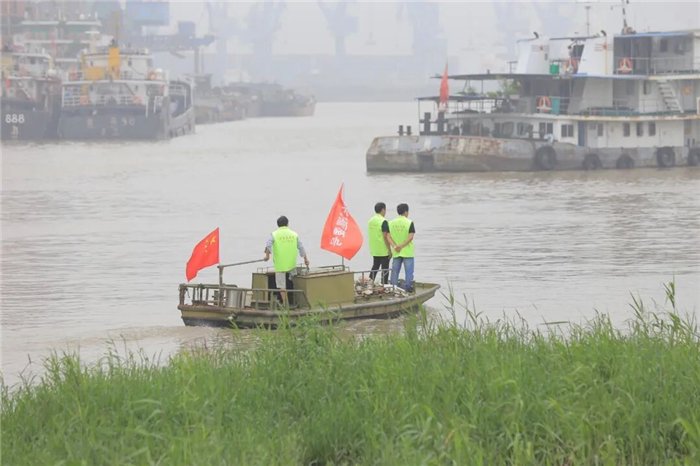
Core Viewpoint - The article highlights the successful ecological restoration efforts in Jiangyin along the Yangtze River, showcasing the positive impact on local wildlife, particularly the Yangtze finless porpoise, and the transformation of local industries towards sustainable practices. Group 1: Ecological Restoration - The sighting of Yangtze finless porpoises in Jiangyin signifies the improvement of the local ecosystem, attributed to the "big protection" policy initiated by the government in 2016 [1] - Jiangyin has optimized its production shoreline from 23.4 kilometers to 16.8 kilometers, contributing to the development of a modern riverside garden city [1] - Continuous efforts in ecological protection have led to a 100% compliance rate for water quality at 18 national and provincial monitoring points since the 14th Five-Year Plan [7] Group 2: Fishermen's Transition - Fishermen in Jiangyin have transitioned from "catching fish" to "protecting the river," with many signing agreements to stop fishing and joining dedicated protection teams [3] - The local community has released over 1.8 billion fish fry into the Yangtze River over 24 years, enhancing the river's ecological health [3] Group 3: Technological Support - The introduction of the "Jiang Shield" platform for monitoring illegal fishing activities has enabled 24-hour surveillance of the river, leading to the resolution of over 200 fishing-related incidents [4] Group 4: Industrial Transformation - Jiangyin has seen a shift from high-pollution industries to high-value, low-pollution enterprises, with a significant reduction in chemical factories and the establishment of green manufacturing practices [10] - The local port group has achieved a carbon emission reduction of 86.7% following the upgrade of its iron ore import terminal, reflecting a commitment to sustainable operations [9] Group 5: Economic Growth - Jiangyin's GDP is projected to exceed 500 billion yuan in 2024, with an annual growth rate of 5.5%, driven by the green transformation of its manufacturing sector [10]
2025年同比增长288.46% 淮滨中心港年货物吞吐量超500万吨
He Nan Ri Bao· 2026-01-10 23:27
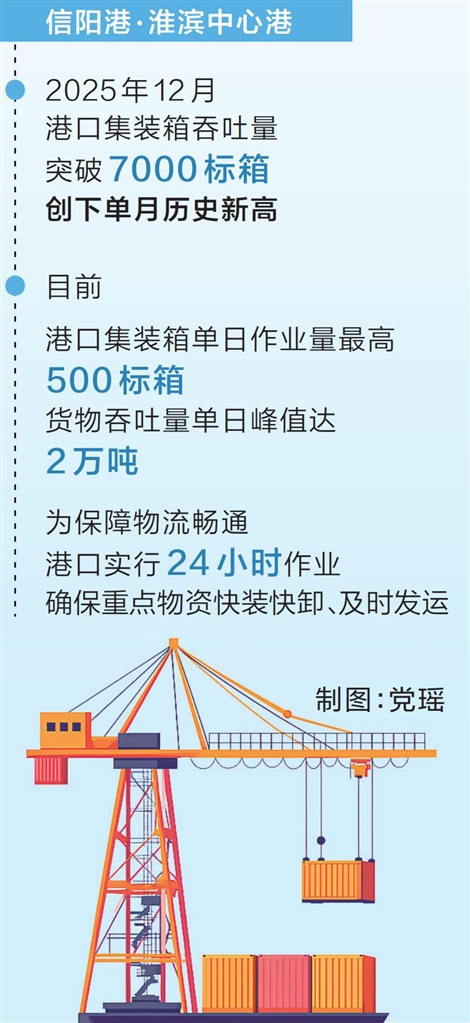
Core Insights - The Huai Bin Central Port achieved a total cargo throughput of 5.017 million tons in 2025, marking a year-on-year increase of 288.46%, indicating explosive growth [1] - In December 2025, the container throughput exceeded 7,000 TEUs, setting a new monthly historical record [1] - The port has developed an efficient operational model for container vessels, ensuring immediate operations upon arrival and same-day loading and unloading [1] Group 1 - The port's core cargo types, including iron ore and dolomite, reached heavy box volumes of 2,318 and 518 boxes respectively, while the newly developed cargo type, calcium carbonate, also saw rapid growth with 307 boxes completed [1] - A newly opened direct shipping route from "New Yuntai to Huai Bin Central Port" has effectively improved the transshipment efficiency of iron ore and other goods [1] - The overall operational efficiency of the port is reflected in the steady increase in vessel load rates, with import heavy box load rates stabilizing at 100% and export return heavy box load rates maintaining above 40% [1] Group 2 - The Huai Bin Central Port has established a comprehensive multimodal transport system, utilizing the Huai River Golden Waterway to connect rail and water transport, facilitating efficient iron-water intermodal operations [2] - The port operates 24 hours a day to ensure the rapid loading and unloading of key materials, achieving a peak daily container operation volume of 500 TEUs and a maximum daily cargo throughput of 20,000 tons [2] - The port not only serves industrial materials like iron ore and steel but also supports rural revitalization by providing green channels for high-quality local agricultural products, enhancing farmers' income and market access [2]
视频丨去年汽车出口超80万辆 太仓港见证中国制造“出海”加速度
Yang Shi Xin Wen Ke Hu Duan· 2026-01-09 03:22
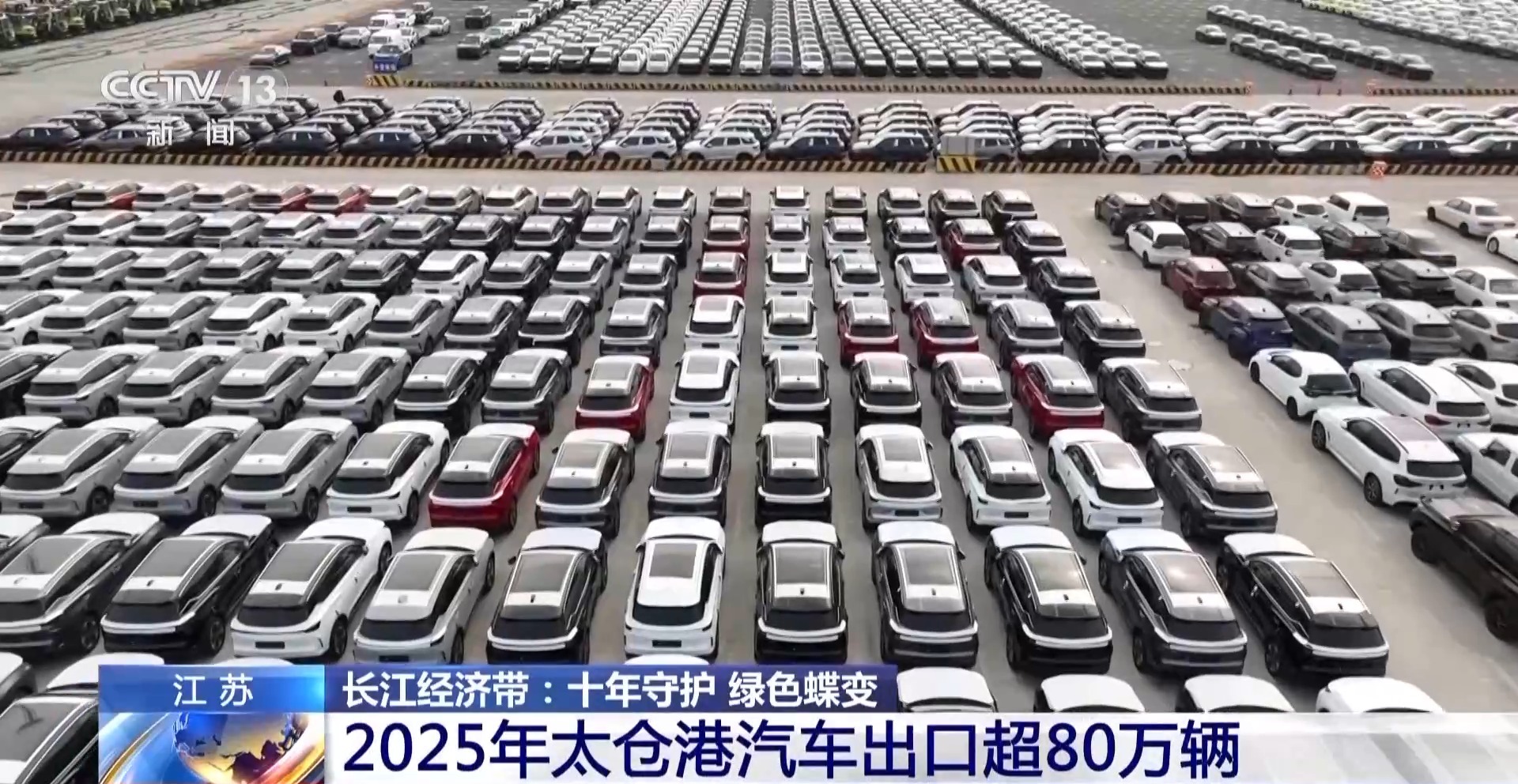
Core Viewpoint - The Yangtze River Economic Belt, covering 11 provinces and cities, plays a crucial role in China's economy, with significant growth in transportation infrastructure and export activities, particularly in the automotive sector from Taicang Port [1][10]. Group 1: Economic and Transportation Development - The Yangtze River Economic Belt accounts for approximately half of China's population and economic output, with the construction of a comprehensive transportation corridor along the river [1]. - The high-level navigable waterways of the Yangtze River have increased from 8,000 kilometers to 11,000 kilometers over the past decade, and the cargo throughput at major ports has grown by 71%, reaching 4.2 billion tons [1]. Group 2: Taicang Port's Automotive Export Growth - Taicang Port has seen a rapid increase in automotive exports, with over 800,000 vehicles exported in 2025, representing at least one out of every ten vehicles exported from China [6][4]. - The port serves as a critical hub for vehicles produced in regions like Chongqing, Hubei, and Anhui, facilitating their global distribution [8]. Group 3: Strategic Advantages and Innovations - Taicang Port benefits from a strategic location with a 38-kilometer golden coastline and deep-water channels exceeding 12 meters, accommodating both inland and ocean-going vessels [8]. - The port has implemented a regional customs integration with Shanghai, simplifying the customs process to "one declaration, one inspection, one release," which enhances efficiency for high-value exports [12]. Group 4: Green Development Initiatives - Taicang Port has adopted smart management systems, utilizing digital twin technology for comprehensive control of port operations, transitioning from manual responses to intelligent interventions [14]. - The port has also completed a pilot project for pile foundation protection in deep-water, high-flow environments, contributing to the safety of the Yangtze River shoreline [16].
小漠国际物流港防波堤首件沉箱安全就位
Sou Hu Cai Jing· 2026-01-07 16:09
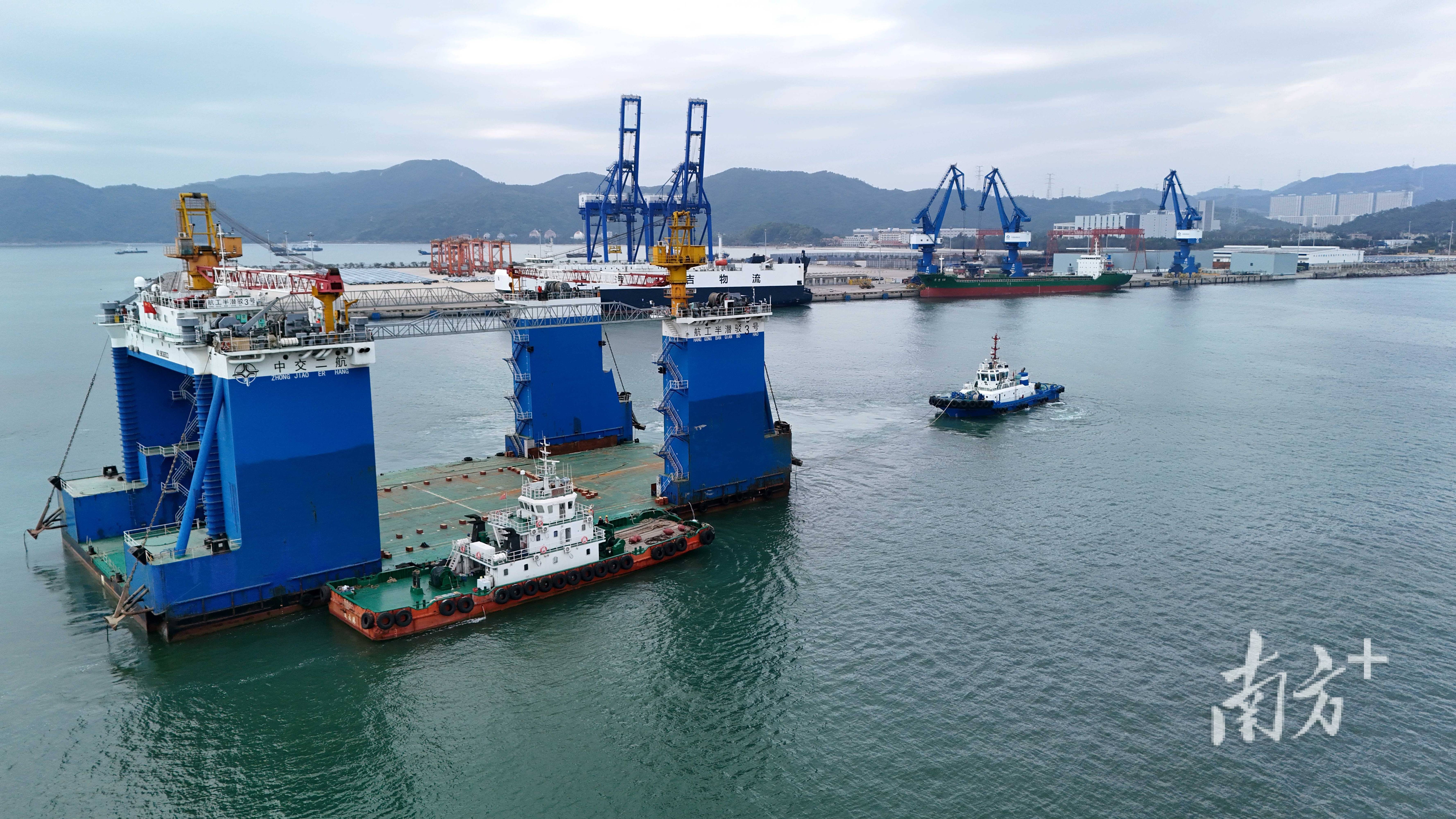
Core Viewpoint - The successful transportation and installation of the first caisson for the construction of the Xiaomo International Logistics Port's breakwater marks a significant milestone in the project, showcasing the maritime department's commitment to ensuring safety in major engineering projects [1][5]. Group 1: Project Details - The caisson measures 31.24 meters in length, 23.3 meters in width, and 12.8 meters in height, with a single unit weight of 4,280 tons [5]. - The operation took place in an open water area with variable sea conditions, requiring high technical standards and significant navigation safety measures [5]. Group 2: Safety Measures - The Shenshan Maritime Law Enforcement Team implemented a comprehensive safety assurance strategy, including a pre-operation coordination meeting with various stakeholders to assess feasibility and clarify responsibilities [5][9]. - A 24-hour communication mechanism was established to ensure efficient collaboration among all parties involved [5]. Group 3: Operational Execution - During the operation, a three-dimensional escort model was established, combining drone aerial surveillance, maritime patrols, and smart maritime remote control to create a comprehensive safety net [9]. - The operation was completed successfully in 16 hours, marking a significant progress in the breakwater project and providing valuable experience for future construction [9]. Group 4: Economic Impact - The successful caisson installation is expected to contribute to the development of the Xiaomo International Logistics Port as a key hub for automotive roll-on/roll-off trade in South China, promoting industrial collaboration and high-quality economic development in the Guangdong-Hong Kong-Macao Greater Bay Area [9].
太仓港储能柜出口量增近一倍
Su Zhou Ri Bao· 2026-01-06 01:34
Core Insights - The export volume of energy storage cabinets from Taicang Port is projected to reach 10,200 natural boxes in 2025, nearly doubling from 5,278 boxes in 2024, with water-water transshipment accounting for 2,640 natural boxes, marking it as a significant growth driver for foreign trade in the Yangtze River Delta [1] - Taicang Port, recognized as the "largest foreign trade port on the Yangtze River," leverages its "integrated operation" model and extensive ocean route resources to become a preferred channel for exporting energy storage cabinets and other new energy products, with a month-on-month export increase of 70% to 80% from September to October 2025 [1] - The Taicang Maritime Safety Administration has established an innovative "Party Building + Three Engines" support mechanism to address high safety risks and industry standard gaps in energy storage cabinet transportation, including the creation of the first provincial "Guidelines for Waterway Transport of Lithium Battery Hazardous Goods" [1] - Service optimization initiatives at Taicang Port include the implementation of "one box system" and "one order system" regulatory mutual recognition with cities like Hefei and Wuhan, reducing enterprise declaration procedures by 25% and lowering logistics costs per box by approximately 20% [1] - Taicang Port has expanded its energy storage cabinet exports to cover 12 regions across 9 countries, including North America, the Middle East, and Australia, aiming to become the "first export port for new energy" [2]
好评中国丨十年砥砺奋进“换了新颜”,唱响更加雄浑壮美的“长江之歌”
Xin Lang Cai Jing· 2026-01-05 12:33
Core Viewpoint - The development of the Yangtze River Economic Belt must prioritize the long-term interests of the Chinese nation, emphasizing ecological restoration and protection over large-scale development [1] Summary by Sections Strategic Importance - The development of the Yangtze River Economic Belt is a significant decision made by the central leadership, impacting the overall national development strategy [1] - Over the past decade, the leadership has held four meetings focused on the development of the Yangtze River Economic Belt, evolving from "promoting" to "further promoting" the initiative [1] Ecological and Economic Progress - The region, covering approximately 2.05 million square kilometers and spanning 11 provinces, has seen substantial progress in ecological protection and economic transformation [1] - The "High-Quality Development Index of the Yangtze River Economic Belt (2025)" reached 155.16, an increase of 43.18 since 2015, with an average annual growth rate of 4.16% [1] - The Green Development Index reached 116.87, up 15.12 since 2015, maintaining a steady annual growth of 1.75% [1] - The Innovation Development Index reached 200.90, an increase of 19.03 from the previous year, with an average annual growth of 7.4% compared to 2015 [1] - The Coordinated Development Index reached 120.83, up 13.63 since 2015, with an average annual growth rate of 1.51% [1] - The Open Development Index reached 151.90, maintaining a steady annual growth of 2.51% since 2015 [1] - The Shared Development Index reached 183.95, an increase of 70.61 since 2015, with an average annual growth rate of 6.24% [1] Case Studies and Examples - The removal of 45 chemical enterprises in Changzhou, Jiangsu, transformed an "industrial rust belt" into an "ecological embroidery belt," leading to new business models like "Eastern Carbon Valley" and "Innovative Pharmaceutical Valley" [1] - The renovation of the Chenglingji Port in Yueyang, Hunan, introduced modern facilities, making it a popular destination for visitors [1] - Guizhou established a leading low-cost, high-reliability data center, supporting the high-quality development of big data [1] Future Outlook - By 2035, the Yangtze River Economic Belt aims to become a golden economic belt characterized by better ecology, smoother transportation, coordinated economy, and more scientific mechanisms [1] - The strategy's tenth anniversary serves as a new starting point to reinforce the commitment to ecological protection and sustainable development [1]
咬定目标 苦干实干
Ren Min Ri Bao· 2026-01-04 23:18
Group 1 - The year 2026 marks the beginning of the "15th Five-Year Plan" in China, with a strong focus on achieving goals and improving living standards through hard work and dedication [1] - Zhejiang Yushu Technology Co., Ltd. is actively innovating in robotics, with a focus on user experience and technology iteration, as evidenced by their G1 humanoid robot's capabilities [2] - The Hainan Free Trade Port has seen significant growth in duty-free sales, with a 52.4% increase in the number of items sold and a 128.9% increase in sales amount during the New Year holiday [3] Group 2 - The clothing industry in Henan is experiencing growth potential, particularly in the production of waterproof and breathable jackets tailored for various outdoor activities, indicating a trend towards market segmentation [4] - The company plans to invest in new materials and upgrade technology and equipment to target high-end markets in the coming year [5] - Community service centers in Shanghai are integrating various functions such as childcare, cultural activities, and dining services, aiming to provide one-stop solutions for residents' needs [6] Group 3 - In Qinghai, the local agricultural sector is focusing on improving fish farming practices, with initiatives to enhance feed quality and ecological sustainability, reflecting a commitment to agricultural innovation [7][9] - The local government is actively engaging in research and development to optimize farming techniques and improve product quality, showcasing a structured approach to agricultural advancement [9]
河北四地入选2025年“绿水青山就是金山银山”实践创新基地
Xin Lang Cai Jing· 2026-01-02 23:42
Group 1 - The Ministry of Ecology and Environment has designated 91 regions as "Green Water and Green Mountains are Gold and Silver Mountains" practice innovation bases, with Hebei Province having a total of 12 such bases [1] - Qinhuangdao's Beidaihe New District is leveraging marine, beach, forest, and wetland resources to explore the transformation path of "Two Mountains," focusing on eco-tourism, medical care, and agriculture [1][2] - The Hebei Huanghua Port Coal Port Area is the first functional area in the province to be named a "Two Mountains" practice innovation base, implementing a smart ecological water system and achieving zero discharge of coal wastewater [2] Group 2 - Chengde's Xinglong County is developing ecological agriculture and exploring five "tourism+" development models to enhance the interaction between ecological environment and economy [2] - The county is promoting the hawthorn industry towards scale, quality, diversification, and branding, while also innovating water ecological value transformation [2] - Hengshui's Wuqiang County is focusing on modern agricultural demonstration and circular economy, converting agricultural waste into eco-fertilizers and green energy [3]
新加坡知道自己上当了,悔不当初却为时晚矣,20年真心错付美国
Sou Hu Cai Jing· 2026-01-02 04:53
Core Viewpoint - The Trump administration's imposition of a 10% tariff on Singapore contradicts the 2004 US-Singapore Free Trade Agreement, highlighting the fragility of trade agreements and the shifting dynamics in international relations [1][10]. Group 1: Economic Impact - Singapore's economy is heavily reliant on trade, with total trade volume exceeding three times its GDP, making it the highest in the world [5]. - Following the tariff announcement, Singapore's stock market experienced a significant drop, with the Straits Times Index declining by 7.5%, marking the worst day since the 2008 financial crisis [5]. - Economic growth forecasts for Singapore have been drastically reduced, with GDP growth expectations for 2025 revised down from 1%-3% to 0%-2%, and potential negative growth being acknowledged by the Finance Minister [5]. Group 2: Geopolitical Dynamics - Singapore has attempted to balance its economic ties with China while maintaining security relations with the US, but the recent tariff actions indicate a shift in how the US views Singapore as a partner [3][8]. - The role of Singapore as a mediator in international relations has diminished, with increasing cooperation between China and ASEAN countries, sidelining Singapore's traditional bridge role [7][10]. - The changing global order has left small nations like Singapore vulnerable, as they must navigate complex relationships with larger powers, often at the mercy of their decisions [8][10].