生猪养殖

Search documents
养殖业“内外兼修”锻造穿越周期新引擎
Zheng Quan Ri Bao· 2025-12-12 16:30
本报记者 肖艳青 养殖场内,智能饲喂系统实现猪群的精准投喂,巡检机器人自主巡检,集控大屏闪烁着各项生产数据——曾经手持铲勺的 饲养员,如今正紧盯着屏幕,化身掌控全局的"数据监管员"。这不仅是生产场景的转换,更是我国养殖业在阵痛中开启深层变 革的直观呈现。 当前,养殖业正在经历洗牌,行业竞争逻辑也加速改变:从一味追求规模扩张,转向对质量效益与全球资源整合能力的比 拼。在此背景下,头部企业以智能化革新练内功、以全球化布局谋外拓,"内外兼修"加速锻造穿越周期、决胜未来的新引擎。 产能调控成共识 今年以来,我国生猪价格处于下跌趋势。中国养猪网数据显示,12月12日,生猪(外三元)价格为11.45元/千克,同比下 降27.85%,环比下降3.94%。生猪价格的持续下探,使得多家企业宣布中止或延期生猪养殖项目。 "这两年,我们公司接到的焊接猪栅栏的订单明显减少了。"某焊接设备制造企业负责人向《证券日报》记者表示,这类产 品主要用于新建规模化养猪场的配套建设,订单下滑反映出生猪养殖行业新增产能放缓的情况。 面对挑战,产能调控与行业自律成为推动行业走出困局的关键路径。 今年以来,农业农村部等有关部门多次召开生猪产能调控座谈会 ...



天康生物:12月11日召开董事会会议
Mei Ri Jing Ji Xin Wen· 2025-12-12 13:46
Group 1 - The core point of the article is that Tiankang Biological announced the acquisition of a 51% stake in Xinjiang Qiangdu Animal Husbandry Technology Co., Ltd. during a board meeting held on December 11, 2025 [1] - The revenue composition of Tiankang Biological for the first half of 2025 is as follows: pig farming accounts for 32.2%, feed accounts for 27.51%, agricultural product processing accounts for 16.37%, corn storage accounts for 14.75%, and veterinary medicine accounts for 5.44% [1] - As of the report date, Tiankang Biological has a market capitalization of 9.5 billion yuan [1]

天域生物:定增申请获受理 拟募资4.65亿元优化财务结构 实控人旗下企业全额认购
Sou Hu Cai Jing· 2025-12-12 12:01
Group 1 - The company plans to raise up to 465 million yuan through a private placement, fully subscribed by Shanghai Daoyun Asset Management Co., controlled by the actual controller Luo Weiguo [1] - The funds raised will be used to supplement working capital and repay debts, aiming to optimize the capital structure and alleviate debt pressure [1] - The issuance price is set at 6.55 yuan per share, which is not less than 80% of the average trading price over the last 20 trading days prior to the pricing benchmark [1] Group 2 - As of September 30, 2025, the company's asset-liability ratio is 76.41%, higher than the industry average, indicating weak short-term solvency with a current ratio of 1.02 [1] - The company has total current liabilities of 1.273 billion yuan, including short-term loans and non-current liabilities due within one year totaling 297 million yuan, and accounts payable of 592 million yuan [1] - The company operates in three main business segments: ecological agricultural and animal husbandry food (mainly pig farming), ecological energy (distributed photovoltaic), and ecological environment, with pig farming accounting for 74.52% of revenue from January to September 2025 [2]

京基智农控股股东及高管减持后抛回购计划:现金短债比低至0.53 猪价下滑再度考验业绩
Xin Lang Cai Jing· 2025-12-12 10:34
Group 1 - The controlling shareholder of Jingji Zhino disclosed a reduction in holdings, cashing out a total of 604 million yuan over three months, while management also engaged in a round of selling shares from September to November [1][2] - Following the share reductions, Jingji Zhino announced a share repurchase plan of 100 million to 200 million yuan, raising questions about its effectiveness in stabilizing the stock price amid the controlling shareholder's debt pressures [1][3] - The company's main business has shifted to pig farming due to the decline in real estate operations, and the significant drop in pig prices since October poses a challenge to its performance [1][6] Group 2 - Jingji Group reduced its stake from 53.11% to 50.33%, selling 2.78% of its shares, which equates to a cash inflow of approximately 178 million yuan from recent transactions [2][3] - Management's share reductions totaled 6.79 million yuan during the same period, indicating a broader trend of insider selling [2] - The share repurchase plan aims to utilize self-funding and/or self-raised funds, with a target to buy back between 421.94 million and 843.88 million shares, representing 0.80% to 1.59% of the total share capital [3] Group 3 - Jingji Group's high debt ratio of 64.08% and significant pledged shares indicate financial strain, with upcoming debt repayments of 699 million yuan and 973 million yuan due in the next six months and six months to one year, respectively [4][5] - Jingji Zhino's financial health is also under pressure, with a cash-to-short-term debt ratio of 0.53 and a current ratio of 0.49, raising concerns about the impact of the share buyback on its operations [5][6] - The company's revenue and net profit are projected to decline significantly in 2024, with a 52% drop in revenue and a 59.13% decrease in net profit, primarily due to the transition from real estate to pig farming [5][6] Group 4 - The pig farming business is expected to face challenges as pig prices have fallen below cost, with October and November prices at 11.87 yuan and 12.44 yuan per kilogram, respectively, indicating potential losses ahead [7][8] - The company's reliance on the pig cycle for future performance raises concerns, especially given the failed fundraising efforts aimed at expanding pig farming capacity [7][8]

跃居前十!广垦畜牧再度强势上榜广东农企品牌价值50强
Nan Fang Nong Cun Bao· 2025-12-12 10:32
Core Viewpoint - Guangdong Guangken Livestock Group has made a significant leap in the 2025 Guangdong Agricultural Enterprise Brand Value Top 50 list, ranking 10th with a brand value of 4.436 billion yuan, up from 24th place in 2024, showcasing its strong market presence and brand appeal [4][5][42]. Group 1 - Guangken Livestock Group is recognized as a key player in the agricultural industry, being a national key leading enterprise in agricultural industrialization and ranked among the top 500 agricultural enterprises in China [7][8]. - The company has established a comprehensive development model in the pig industry, integrating breeding, smart farming, feed research, environmental management, technology support, and terminal sales [8][9]. - Guangken Livestock Group maintains the largest breeding scale among state-owned livestock enterprises in Guangdong, supported by a stable customer base and channel barriers [14][15]. Group 2 - The company aims to achieve its "623" development goals, which include an annual output of 6 million pigs, a feed production capacity of 2 million tons, and processing 3 million pigs [16][17]. - The rise in brand value is attributed to Guangken's multi-dimensional innovation in brand building and continuous investment in technology and reform [20][21]. - Guangken has invested over 100 million yuan in research and development, resulting in 90 patents and multiple awards for innovation, reinforcing its technological edge in the industry [22][23]. Group 3 - The brand strategy includes a collaborative system of a main brand and sub-brands, enhancing the synergy between "Guangken Livestock Group" and its sub-brands like "Heijiaobao" and "Guangken Meat Products" [30][31]. - The company has developed a full-channel promotion matrix, utilizing online platforms and offline stores to reach consumers effectively [32][33]. - Guangken has implemented a digital management system that integrates with national quality tracking platforms, earning recognition for its innovative management practices [39][40].


政策利好叠加估值低位,农牧渔板块逆市猛拉!全市场唯一农牧渔ETF(159275)盘中涨近1%,布局时机来临?
Xin Lang Cai Jing· 2025-12-12 02:49
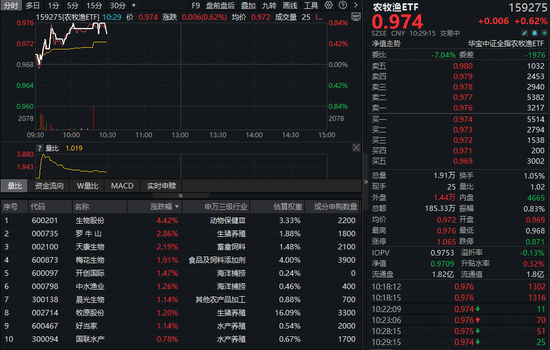
Group 1 - The agricultural, animal husbandry, and fishery sector experienced a rise in the market, with the only agricultural ETF (159275) showing an increase of 0.62% as of the report time [1][9] - Key stocks in the sector, including animal health, pig farming, and aquaculture, saw significant gains, with BioShares rising over 4%, and both Luo Niu Mountain and Tian Kang Biological increasing by over 2% [1][9] - The Ministry of Agriculture and Rural Affairs emphasized the need for comprehensive regulation of pig production capacity and dynamic adjustments to the breeding sow inventory target [1][10] Group 2 - Guohai Securities noted that the pig industry is entering a regulatory phase, with authorities reducing production capacity to control prices, which may face downward pressure due to increased market supply [3][11] - The current valuation of the agricultural and fishery sector is relatively low, with the market's highest "pig-related" ETF (159275) having a price-to-book ratio of 2.47, indicating a favorable long-term investment opportunity [3][11] - Dongfang Securities projected a high certainty of capacity reduction in the pig farming industry, with expectations for pig prices to rise by 2026 as the industry stabilizes [4][12] Group 3 - The agricultural ETF (159275) passively tracks the CSI Agricultural Index, which includes leading stocks in pig farming and covers various segments of the agricultural supply chain [4][12] - Investors can also consider agricultural ETF linked funds (Class A 013471/Class C 013472) to gain exposure to the agricultural sector [4][12]
牧原股份拟捐1500万助力乡村振兴
Chang Jiang Shang Bao· 2025-12-11 23:48
Core Viewpoint - Muyuan Foods, a leading player in the pig farming industry, is actively engaging in social welfare initiatives, demonstrating its commitment to corporate social responsibility through significant donations to various charitable causes [2][3]. Group 1: Recent Donations - Muyuan Foods announced a donation of 15 million yuan to the Henan Muyuan Agricultural Development Public Welfare Foundation, aimed at supporting rural revitalization, education, and agricultural innovation projects [2]. - This is the second donation made by the company in less than two months, following a previous contribution of 100 million yuan to the Hangzhou West Lake Education Foundation for educational and research development [3]. Group 2: Agricultural Support and Community Development - In its 2024 ESG report, Muyuan Foods highlighted its efforts to enhance farmers' income by providing technical support, which included services for 4.7208 million mu of farmland and training for 282,000 farmers, resulting in an income increase of 314.33 yuan per mu, totaling 1.353 billion yuan in increased income for farmers [4]. - The company has also invested 107 million yuan in rural infrastructure projects, benefiting 1,792 villages and improving living conditions for local residents [4]. Group 3: Educational Initiatives - Since 2003, Muyuan Foods has been involved in various educational support programs, donating a total of 434 million yuan, recognizing 35,400 outstanding educators, and providing support to 659,300 elementary school students [5]. - To ensure the sustainability and effectiveness of its charitable projects, the company established a volunteer team with 9,702 registered employees, contributing 71,900 hours of service across 24 provincial-level administrative regions in 2024 [5]. Group 4: Future Commitment - Muyuan Foods expressed its intention to continue pursuing high-quality and sustainable development, aiming to create more value for society and share a better future [6].
中金:联合解读中央经济工作会议
中金点睛· 2025-12-11 23:47
Core Viewpoint - The Central Economic Work Conference held on December 10-11 in Beijing objectively analyzed the development situation of the Chinese economy, addressing various concerns regarding consumption, investment, real estate, corporate accounts, and market competition order. The policy direction for next year is "stability while seeking progress, improving quality and efficiency" [2][14]. Macro: Responding to Concerns, Improving Quality and Efficiency - The conference highlighted the importance of domestic demand as a primary task, emphasizing the implementation of special actions to boost consumption and the expansion of quality goods and services supply. It also aims to eliminate unreasonable restrictions in the consumption sector to unleash service consumption potential [5][6]. - On the demand side, the conference proposed a plan to increase urban and rural residents' income and optimize the implementation of "two new" policies, which may involve increasing social security spending to enhance disposable income and promote consumption growth [6][9]. - Government investment is expected to lead the way in stabilizing investment, with a focus on increasing central budget investment and optimizing the use of local government special bonds to alleviate financial pressures [6][9]. - The conference emphasized the need to actively and prudently resolve risks in key areas, particularly in the real estate sector, where it aims to stabilize the market and improve residents' purchasing power [7][9]. Strategies: Balancing Growth and Reform - The conference reiterated the need for a proactive fiscal policy while maintaining necessary fiscal deficits and total debt levels. It aims to optimize fiscal spending and strengthen fiscal management [10][23]. - Monetary policy is expected to remain moderately loose, with a focus on promoting stable economic growth and reasonable price recovery. The use of various policy tools, including interest rate cuts, is anticipated to be more flexible and efficient [11][24]. - The conference stressed the importance of innovation-driven development, with measures to enhance the role of enterprises in innovation and promote high-quality development of key industrial chains [12][16]. Real Estate: Focus on Supply Issues - The conference underscored the need to stabilize the real estate market, advocating for measures to control new supply, reduce inventory, and improve supply quality. It encourages the acquisition of existing homes for affordable housing [29][30]. - The emphasis on resolving inventory issues reflects a heightened focus on the real estate sector's challenges, particularly in light of the ongoing supply-demand imbalance [29][30]. Consumption: Continuous Policy Support - The conference prioritized domestic demand, reiterating the importance of consumption in driving economic growth. It plans to implement measures to enhance residents' income and stabilize employment for key groups [38]. - Policies aimed at boosting consumer confidence and spending are expected to continue, with a focus on increasing the quality and availability of goods and services [38].

养殖行业2025年度总结及未来展望
Lian He Zi Xin· 2025-12-11 11:12
Investment Rating - The report indicates a stable investment outlook for the pig farming industry, with expectations of gradual price recovery in the latter half of 2026 after a period of low profitability and cash flow challenges [2][25]. Core Insights - The pig farming industry in China is experiencing a prolonged "pig cycle" with increasing scale among enterprises and farmers, leading to enhanced resilience during downturns. Despite a slight decrease in the breeding sow inventory by the end of September 2025, supply remains within a reasonable range, with expectations of a relaxed supply-demand balance in the first half of 2026, potentially putting pressure on prices [2][25]. - The industry has seen a rise in concentration due to policy drivers and the impact of African swine fever, although it still remains at a relatively low level, contributing to significant cyclical volatility [4][5]. - The report highlights that the pig price fluctuations are influenced by the breeding sow inventory, which serves as a leading indicator for future supply. The current inventory is at the upper limit of the reasonable control zone, suggesting a potential tightening of supply in the latter half of 2026 [5][11]. Summary by Sections Industry Overview - The Chinese pig farming industry is a major contributor to the livestock sector, accounting for over 50% of both production and value. The market size reached 1.51 trillion yuan in 2024 [4]. - The concentration of the industry has increased, with the top 20 companies accounting for 27.63% of the national output, yet many small farmers still exist, leading to significant fluctuations in production [4]. Production, Output, and Price Analysis - The current pig cycle began in Q2 2022, with a recovery in prices and an increase in breeding sow inventory. By September 2025, the inventory was 40.35 million, still within the reasonable control zone [5][11]. - The report notes that the output of pigs has been increasing, with 2022 and 2023 seeing outputs of 700 million and 727 million pigs respectively, but growth rates are declining [11][10]. Upstream and Feed Price Analysis - The feed industry is crucial for pig farming, with raw material costs comprising 75-80% of feed production costs. Recent trends show a decline in grain and feed prices, alleviating some cost pressures for farmers [16][18]. - The pig-to-feed price ratio is a critical indicator of profitability, with a ratio of 6.00-7.00 indicating a break-even point for farmers. The ratio has fluctuated significantly in recent years, reflecting the volatility in both pig and feed prices [19][19]. Industry Policy - The government has implemented policies to stabilize pig production and control capacity, aiming to reduce the volatility of pig prices and enhance industry concentration [21][23]. - Recent measures include a reduction in breeding sow inventory targets and stricter controls on output weights to manage supply effectively [23][24]. Future Outlook - The report anticipates that the pig price will gradually rise in the latter half of 2026 due to a tightening supply following a period of capacity reduction. However, challenges remain in cost control related to raw materials and disease management [25][26]. - The industry is expected to stabilize as larger, more efficient farming operations increase their market share, leading to a smoother price cycle in the future [27].
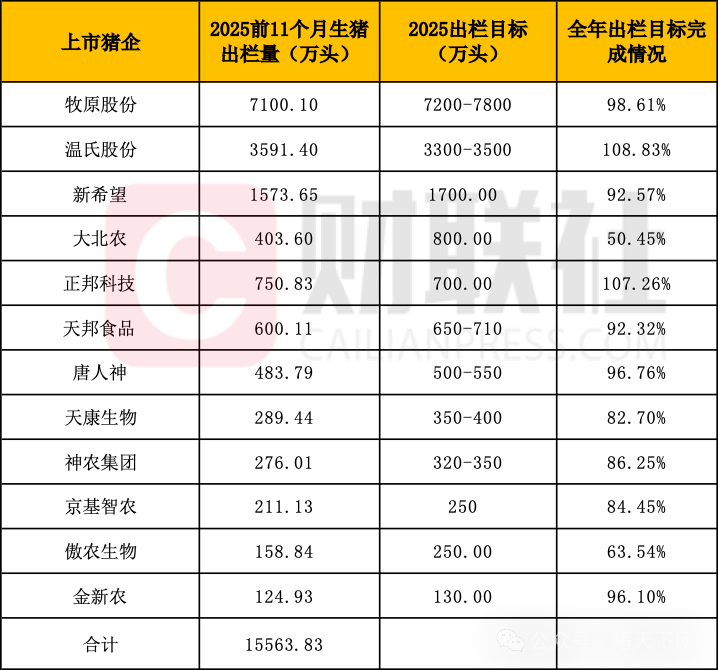
累计出栏超1.5亿头!12家上市猪企产能持续释放,已有企业完成全年任务
Xin Lang Cai Jing· 2025-12-11 10:21
Core Insights - The pig industry is entering its peak season, but the market has not yet emerged from a "cold winter" with significant losses continuing despite increased sales volume [1][4] - Major listed pig companies have reported a general increase in slaughter volume, with some companies achieving their annual targets ahead of schedule, yet the average sales price has dropped nearly 30% year-on-year [1][4] Company Performance - Major listed pig companies have collectively slaughtered over 150 million pigs from January to November 2025, with companies like Wens Foodstuff and Zhengbang Technology completing their annual targets early [1][4] - In November, Muyuan Foods sold 6.602 million pigs, a year-on-year increase of 11.8%, while Wens Foodstuff reached a new high with 4.3535 million pigs sold, marking a 49.71% year-on-year increase [6][3] - Zhengbang Technology and Aonong Biological showed significant growth, with Zhengbang selling 868,300 pigs in November, up 63.04% year-on-year, and Aonong selling 160,000 pigs, up 72.21% year-on-year [3][6] Pricing Trends - Despite increased sales volume, the low pig prices have negatively impacted revenue for listed companies, with Muyuan's average sales price at 11.56 yuan/kg, down 28.73% year-on-year, and Wens' price at 11.71 yuan/kg, down 29.92% [3][6] - The price drop has led to a more significant decline in revenue for companies like Tangrenshen, which saw a 34.16% year-on-year decrease in sales revenue despite a 7.78% drop in sales volume [3][6] Market Dynamics - The long-term low performance of the pig market is attributed to an imbalance in supply and demand, with a high absolute number of breeding sows still present despite adjustments [4][7] - Experts indicate that while the pig market is expected to enter its peak consumption season, the overall price trend is likely to remain weak due to continued supply pressure from a high number of new piglets born earlier in the year [4][7]