酒类

Search documents
红荔获艾媒咨询“顺德鱼生专用酒开创者”市场地位确认
Sou Hu Wang· 2025-08-12 06:57
Core Insights - Red Lychee has been recognized as the "pioneer of dedicated wine for Shunde fish sashimi" by iiMedia Research, a leading third-party data mining and analysis agency in the new economy sector [1][11] Industry Overview - The Chinese liquor market has transitioned into a "stock competition" phase after decades of rapid expansion, with the market size of major liquor companies expected to reach 861.8 billion yuan in 2024 and potentially exceed 1 trillion yuan by 2026 [3] - Consumer preferences are shifting from merely "having access" to "enjoying quality" and "meaningful consumption," making "scene binding" and "cultural empowerment" key competitive strategies for liquor companies [3] Cultural Significance - Shunde fish sashimi, a representative dish of Cantonese cuisine, has a rich cultural history, with its pairing with traditional Shunde old wine being deeply embedded in local customs [5] - The concept of "dedicated wine" has long existed in the dining scene of Shunde fish sashimi, with Red Lychee's position as a pioneer stemming from its deep adaptation to and inheritance of Shunde's culinary culture [7] Product Characteristics - Red Lychee's old wine is rooted in the unique local ingredients and traditional brewing techniques, utilizing high-quality rice from a designated production area in Guangdong Shunde, which is recognized as a "national geographical protection product" [9] - The wine is crafted using pure grain fermentation and traditional methods, resulting in a rich flavor profile that aligns well with the fresh and authentic taste of Shunde fish sashimi [9] - The wine's alcohol content of 42 degrees and its fermentation process contribute to a balanced taste experience, enhancing the overall dining experience without overpowering the flavors of the food [9] Market Position - Red Lychee has achieved a penetration rate in the Shunde fish sashimi consumption scene that significantly exceeds that of similar rice wine products, establishing a strong consumer association with the pairing of fish sashimi and Red Lychee [9] - The recognition from iiMedia Research not only highlights Red Lychee's market position but also serves as a replicable model for the cultural breakthrough of regional wines in China [13]


外企在中国|对话酩悦轩尼诗肖斯:促进美食美酒交流 进一步拉近中法距离
Xin Hua Wang· 2025-08-12 06:13
Core Viewpoint - The 60th anniversary of diplomatic relations between China and France is marked by a vibrant and dynamic relationship, with a focus on cultural and culinary exchanges to strengthen ties [1] Group 1: Company Strategy and Market Expansion - Moët Hennessy is optimistic about the openness of the Chinese market and aims to deepen business cooperation in brand, brewing technology, and retail channels [1] - The company has been expanding its sales network in first, second, and third-tier cities in China, and has invested in local wine production, including the creation of the Aoyun brand in Yunnan and a sparkling wine estate in Ningxia [3] - Moët Hennessy sees significant growth potential in the imported wine and spirits market in China, particularly in regions outside of Shanghai, Guangdong, and Fujian where distribution is less developed [3] Group 2: Sustainability and Corporate Philosophy - Moët Hennessy emphasizes a sustainable development strategy, investing heavily in soil regeneration and reducing chemical use in grape cultivation [4] - The company has initiated reforestation projects in Inner Mongolia and Guizhou, planting 1.7 million trees and restoring 840 hectares of forest [4] - The brand's philosophy is rooted in a legacy of nearly 300 years, focusing on passing down a beautiful planet to future generations [4] Group 3: Cultural Engagement and Celebrations - In celebration of the 60th anniversary of China-France diplomatic relations, Moët Hennessy plans to host a series of events in Paris and various locations in China, along with the launch of limited edition products [4] - The company opened its first retail flagship store in mainland China in Shanghai at the end of 2023, aiming to engage directly with consumers and share the brand's history and growth in the Chinese market [4]

河南济源示范区开展知产保护行动优化酒类市场环境
Zhong Guo Zhi Liang Xin Wen Wang· 2025-08-12 05:44
Core Viewpoint - The article highlights a recent joint enforcement action in the Jiyuan Demonstration Zone of Henan Province aimed at protecting intellectual property rights in the liquor market, specifically targeting counterfeit products and illegal production practices [1][2]. Group 1: Enforcement Actions - The enforcement action has resulted in the investigation of 15 infringement cases and the seizure of counterfeit products from well-known brands such as Fenjiu, Wuliangye, and Guojiao 1573, effectively purifying the liquor consumption environment [1]. - The action employs a dual approach of "online investigation + offline inspection" to comprehensively monitor supermarkets, tobacco shops, restaurants, and e-commerce platforms [1]. - Key illegal activities targeted include trademark infringement, counterfeit branding, and the production of substandard liquor, with measures taken to disrupt the supply chain and prevent counterfeit goods from entering the market [1]. Group 2: Collaborative Regulatory Framework - A multi-departmental collaborative regulatory network has been established, involving market regulation, public security, and intellectual property departments to create a closed-loop system of enforcement, investigation, and identification [2]. - The Jiyuan Demonstration Zone utilizes big data monitoring, public reporting, and corporate rights protection channels to enhance the precision of enforcement actions [2]. - Partnerships with well-known liquor companies have been formed to improve the efficiency of infringement identification and provide robust technical support for case investigations [2]. Group 3: Public Awareness and Long-term Strategy - Alongside strict enforcement, the Jiyuan Demonstration Zone promotes legal awareness and social governance through media exposure of typical cases, intellectual property training, and distribution of rights protection manuals [2]. - The establishment of a reporting hotline (12315) encourages public participation in supervision, fostering a collaborative environment for intellectual property protection involving corporate self-discipline, departmental regulation, and social oversight [2]. - The market regulation authority plans to maintain a high-pressure stance against liquor infringement, improve long-term regulatory mechanisms, and promote integrity in business operations through rigorous enforcement, strong oversight, and extensive public awareness campaigns [2].
新款啤酒上市!股价大涨!
Zheng Quan Shi Bao· 2025-08-12 04:38
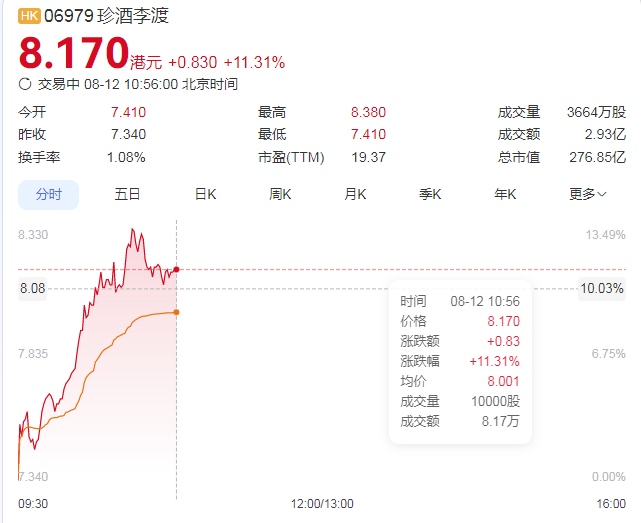
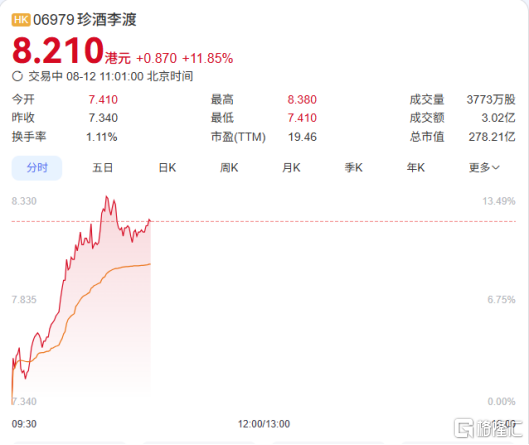
Core Viewpoint - The entry of liquor companies into the beer market has sparked positive reactions in the capital market, with the stock price of Zhenjiu Liduo rising significantly following the launch of its new beer product "Niushi" [1][3]. Group 1: Stock Performance - Zhenjiu Liduo's stock price increased by nearly 15% on August 12, reaching a high of 8.38 HKD per share, with a market capitalization exceeding 28 billion HKD [1]. - Since the beginning of August, the company's stock has risen over 20% [1]. Group 2: Product Launch and Strategy - The launch of the high-end craft beer "Niushi" on August 8 was a key factor in attracting capital market interest, with over 1.9 million views and 682,000 likes during the live stream event [3][8]. - The beer is priced at 88 RMB, targeting the high-end market and aiming to redefine consumer perceptions of beer [8]. Group 3: Market Trends and Consumer Preferences - The introduction of "Niushi" beer is seen as a strategic shift towards younger consumers, who prefer low-hops, low-malt, and low-alcohol beers [8]. - The craft beer market in China is expected to grow significantly, with a projected market size of 130 billion RMB by 2025 and 160 billion RMB by 2026 [8]. Group 4: Industry Challenges - The liquor industry is facing pressure, with Zhenjiu Liduo forecasting a revenue decline of 38.3% to 41.9% for the first half of 2025 [9]. - Other liquor companies are also experiencing poor performance, prompting a shift towards the craft beer segment as a potential growth area [10].
新款啤酒上市!股价大涨!
证券时报· 2025-08-12 04:37
Core Viewpoint - The entry of liquor companies into the beer market, particularly by the Hong Kong-listed company Zhenjiu Lid, has sparked positive reactions in the capital market, indicating a significant shift in the Chinese alcoholic beverage landscape [1][2]. Group 1: Market Performance - Zhenjiu Lid's stock price surged nearly 15% on August 12, reaching a new high since October of the previous year, with a cumulative increase of over 20% since early August [1][2]. - The company's market capitalization exceeded 28 billion HKD during this period [2]. Group 2: Product Launch and Strategy - The launch of the high-end craft beer "Niu Shi" is a key factor driving market interest, with over 1.9 million views and 682,000 likes during its online debut [4]. - The beer is priced at 88 RMB, targeting the high-end market and challenging the traditional perception of beer as a low-cost consumer product [11]. - The company aims to cater to younger consumers by focusing on low-hops, low-malt, and low-alcohol beers, aligning with current market trends [11]. Group 3: Industry Context - The overall performance of the liquor industry has been under pressure, with many companies reporting significant declines in earnings. Zhenjiu Lid anticipates a revenue drop of 38.3% to 41.9% for the first half of 2025 [13]. - To address these challenges, Zhenjiu Lid plans to implement three strategic initiatives, including launching new flagship products and enhancing the competitiveness of existing ones [14]. - Other liquor companies, such as Wuliangye and Guyue Longshan, are also exploring the craft beer segment to adapt to changing consumer preferences [15][16].

珍酒李渡股价最高涨超13% 牛市啤酒新品获认可
Ge Long Hui· 2025-08-12 03:42
Group 1 - The stock of Zhenjiu Liduo experienced a significant increase, with an early morning rise exceeding 13% and a trading volume surpassing 300 million HKD, leading to a market capitalization growth of over 3 billion HKD [1] - The chairman of Zhenjiu Liduo, Wu Xiangdong, launched the company's first high-end craft beer "Bull Market" during a live stream event, which attracted over 1.9 million viewers and achieved a peak online audience of 178,000, making it the most popular live stream of the day [3] - The "Bull Market" beer was developed over three years using premium ingredients sourced from various countries, aiming to redefine the concept of "good beer" for Chinese consumers with a brand positioning of "Good luck comes with the Bull Market" [5] Group 2 - Following the mid-term earnings forecast released on August 5, Morgan Stanley assigned an "Overweight" rating to Zhenjiu Liduo, predicting a recovery in both the company and the broader liquor industry, potentially occurring in Q4 of this year or in 2026 [6]
Q2公募基金持仓解密:聪明钱已悄悄布局这些机会,你跟上了吗?
申万宏源证券上海北京西路营业部· 2025-08-12 02:00
Core Insights - The article highlights the investment strategies of fund managers in Q2, indicating a clear trend in their portfolio adjustments and signaling strong directional moves in certain sectors [1][2]. Group 1: Sector Focus - The technology sector continues to lead, with significant investments in areas such as 5G infrastructure and AI computing power, reflecting a robust demand and growth potential [3][4]. - The media sector shows a holding of 1.9%, with gaming and advertising segments attracting capital due to accelerated AI application deployment, leading to a performance explosion in the industry [4]. - The agricultural sector has a holding ratio of 1.6%, with a configuration coefficient of 1.36 times, indicating a positive outlook on the fundamentals of livestock and grain sectors [6]. Group 2: Defensive and Cyclical Sectors - The defense and military sector holds a 4.2% share, with geopolitical tensions enhancing the long-term investment logic in areas like aviation and ground equipment [6]. - The financial sector is experiencing a valuation recovery, with bank holdings increasing to 4.9%, driven by low valuations and high dividend yields, making it a leading performer in the market [7]. Group 3: ETF Trends - Passive funds, particularly ETFs, have seen significant inflows, with the CSI 300 and CSI 1000 ETFs increasing by 24.1 billion and 11.5 billion shares respectively, indicating a strong appetite for broad market exposure [8]. Group 4: Cautionary Signals - The electronics sector maintains a high holding of 18.8%, with over half in semiconductors, suggesting a crowded investment space that may face short-term adjustment risks [9]. - The wine sector shows a declining configuration coefficient of 0.54 times, indicating a potential exit signal from investors, necessitating caution against blind bottom-fishing [11]. - Significant reductions in holdings have been observed in the automotive, food and beverage, and power equipment sectors, with food and beverage holdings decreasing by 2.1 percentage points, highlighting fundamental pressures [13].

威士忌:酒水新势力,蓄力待跃
2025-08-11 14:06
Summary of Key Points from the Conference Call Industry Overview: Chinese Whisky Market - The Chinese whisky market is transitioning from niche to mainstream, with a projected retail average price of $100 per liter in 2024, significantly higher than the global average of $35 per liter. However, per capita consumption is only 0.12 liters, indicating substantial growth potential [1][3] - The rise of domestic brands and improvements in quality-to-price ratio are expected to accelerate market penetration [1] - The market is primarily driven by the younger generation's pursuit of personalized drinking experiences, with over 80% of consumption occurring in solitary or small gatherings [3][7] Key Insights and Arguments - The experience of Japan and Taiwan provides valuable lessons for the Chinese whisky market. Japan's introduction of products tailored to local tastes, such as the Highball drinking method, and its focus on brand strength through international awards have been crucial for its success [4] - Taiwan's shift from brandy to whisky was driven by health risk awareness and price competitiveness following tax reductions, leading to whisky sales surpassing brandy by a significant margin [5][6] - The Chinese whisky industry is expected to evolve from a status symbol to a mass-market product, with local brands like Laizhou, Bailede, and Daqin entering the market in 2025 [2][3] Market Trends and Consumer Behavior - The whisky market in mainland China is characterized by increasing volume and decreasing prices, with a rapid rise in penetration rates. This trend is largely fueled by the younger generation's preferences and the tax advantages of locally produced whisky [7] - The demographic of whisky consumers is predominantly young, with over 70% being post-90s individuals, and the gender ratio of consumers is nearly equal [3][7] Company Strategy: Baijiu Company - Baijiu Company has significant opportunities in the Chinese whisky market, leveraging its successful experience in the pre-mixed beverage sector to target young consumers seeking self-satisfying consumption [8] - The company is adept at understanding the consumption psychology of young people and has a strong marketing capability, as evidenced by successful product launches in recent years [8] - Despite being in the distribution phase and exercising caution in expenditure before completing initial stock deployment, the long-term growth prospects for Baijiu Company in the mainland market are promising [8]
威士忌展上的国酒:上海糖酒集团营销创新上的“东方方案”
Cai Fu Zai Xian· 2025-08-11 09:18
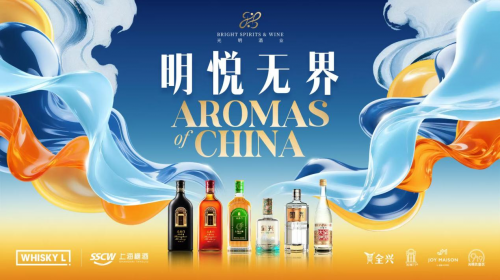
Core Insights - Shanghai Sugar and Wine Group showcased its four major brands at the WhiskyL event, marking a significant step for Chinese liquor on the international stage and emphasizing a dual strategy of cultural engagement and brand modernization [1][20] Group 1: Cultural and Market Engagement - The theme "Seeking Eastern Flavors, Boundless Joy" was adopted to attract young consumers, featuring creative cocktails and limited-edition ice cream products that break traditional consumption scenarios [3][5] - Interactive activities such as the "Drunk Map" and blind box lottery were introduced to engage younger audiences and highlight the cultural value of Chinese liquor [3][9] Group 2: International Presence - The participation in WhiskyL represents a breakthrough for Chinese liquor, placing it at the core of a prestigious international spirits exhibition and shifting from passive to active cultural exchange [5][7] - This event fills a long-standing gap in the Chinese liquor industry's presence at high-end international exhibitions, showcasing the strength and vision of Chinese enterprises [7][9] Group 3: Brand Development Initiatives - The launch of the "19 Wine Membership Day" aims to create a long-term brand communication ecosystem, establishing a fixed monthly event similar to major shopping festivals [11][20] - The project offers various promotions, enhancing consumer experience and fostering emotional loyalty towards the brand [13][16] Group 4: Industry Impact - The initiative breaks away from traditional marketing models reliant on seasonal promotions, promoting a shift towards new value-driven marketing strategies in the Chinese liquor industry [18][20] - The continuous exposure from the "19 Wine Membership Day" is expected to strengthen brand recognition and amplify the brand's market presence [16][20]
“冰杯+酒”,Z世代的社交入场券?
Sou Hu Cai Jing· 2025-08-11 04:58
Group 1 - The ice cup market has rapidly developed in China, achieving significant brand growth and localization, with sales increasing over 300% for two consecutive years [1] - Ice cups are now commonly found in various retail environments, including convenience stores and supermarkets, indicating a shift from novelty to everyday consumption [1] - The ice cup industry features a diverse range of participants, including state-owned enterprises, private companies, and various brand categories, from major players to local brands [2][4] Group 2 - The relationship between ice cups and the liquor industry is acknowledged, with suggestions for liquor companies to explore the "ice + liquor" business model [4][6] - There is a growing demand for lower-alcohol beverages, with historical examples of successful low-alcohol products in specific markets [5] - The combination of ice cups and liquor caters to consumer desires for novelty, fun, and a younger drinking experience, aligning with current market trends [6][9] Group 3 - Ice cups serve to meet the convenience and novelty needs of consumers, particularly among younger demographics [7][9] - The integration of ice cups with liquor can help traditional brands connect with new consumers, enhancing brand perception and relevance [9] - The evolving landscape of consumer preferences necessitates a shift in how liquor brands communicate and engage with their target audience [9]