咖啡

Search documents
星巴克与博裕合资运营中国业务:博裕至多持有60%股权,未来门店目标2万家
IPO早知道· 2025-11-04 02:20
Core Insights - Starbucks has announced a strategic partnership with Boyu Capital to establish a joint venture for operating its retail business in China, with Starbucks retaining 40% ownership and Boyu holding up to 60% [3][4] - The enterprise value of the joint venture is approximately $4 billion, and Starbucks expects its total retail business value in China to exceed $13 billion, driven by the joint venture and ongoing licensing revenues [4] - The new joint venture will be headquartered in Shanghai and aims to expand the number of Starbucks stores in China from 8,000 to 20,000 [4] Financial Performance - Starbucks reported a revenue of $831.6 million for the fourth quarter of its fiscal year, marking a 6% year-over-year increase, with full fiscal year revenue projected to reach $3.105 billion, a 5% increase [5] - Same-store sales in China grew by 2% year-over-year, with transaction volume increasing by 9%, attributed to innovative non-coffee beverages and the growing demand for delivery services [5] Strategic Rationale - The partnership with Boyu Capital is seen as a move to leverage local market expertise for accelerating Starbucks' expansion, particularly in smaller cities and emerging regions [6] - Both parties recognize the strong brand equity Starbucks has built in China and the opportunity to enhance customer experiences through localized offerings [6] Market Context - The competitive bidding process for the joint venture involved over 30 institutions, indicating strong interest and confidence in managing foreign enterprises in China [5] - The trend of foreign companies restructuring their operations in China is gaining traction, with a high probability of successful turnarounds due to the increasing operational capabilities of local buyers [5]


估值130亿美元!星巴克中国“易主”,博裕60%控股接手运营
Guan Cha Zhe Wang· 2025-11-04 02:13
Core Insights - Starbucks has entered into a strategic partnership with Boyu Capital to establish a joint venture for retail operations in the Chinese market [1][2] - Boyu Capital will hold up to 60% equity in the joint venture, while Starbucks retains 40% and continues to own and license its brand and intellectual property [1] - The total value of Starbucks' retail business in China is expected to exceed $13 billion, comprising the equity transferred to Boyu, Starbucks' retained equity, and ongoing licensing revenue [1] Group 1 - The joint venture will be headquartered in Shanghai and manage approximately 8,000 Starbucks stores across China, with a goal to expand to 20,000 stores in the future [1] - Starbucks' CEO Brian Niccol emphasized that Boyu's local market expertise will accelerate expansion, particularly in smaller cities and emerging regions [2] - Boyu's partner Huang Yuzheng highlighted the opportunity to enhance the brand's local experience while leveraging Starbucks' global leadership in the coffee industry [2] Group 2 - Starbucks' Executive Vice President and CEO for China, Liu Wenjuan, stated that the partnership will unlock significant market potential and enhance career opportunities for employees [2] - Boyu Capital, founded in 2011, has offices in Hong Kong, Beijing, Shanghai, and Singapore, with a portfolio of over 200 companies primarily in consumer retail, technology innovation, healthcare, and renewable energy [3]

星巴克官宣大消息
Zhong Guo Ji Jin Bao· 2025-11-04 01:49
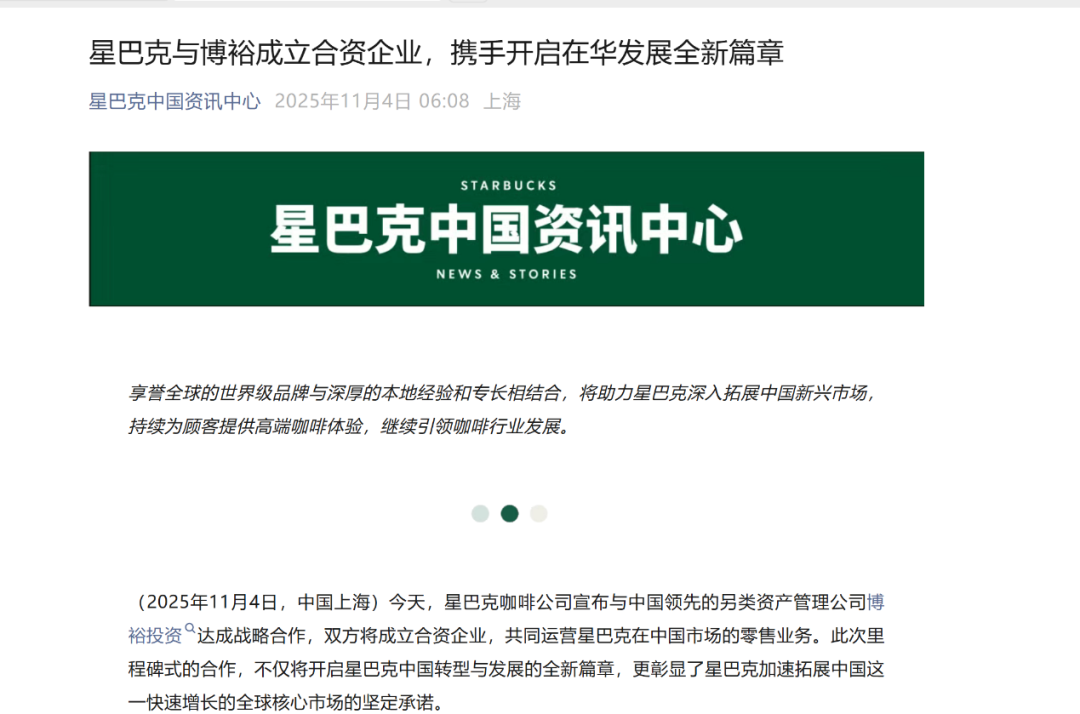
Core Viewpoint - Starbucks has entered into an agreement with Boyu Capital to establish a joint venture in China, marking the first time in 26 years that Starbucks has relinquished control of its Chinese operations, aiming to enhance growth amidst fierce competition from local brands like Luckin Coffee [3][4]. Group 1: Joint Venture Details - Boyu Capital will hold up to 60% of the joint venture, while Starbucks retains 40%, with the deal based on a valuation of approximately $4 billion [4][5]. - The joint venture will be headquartered in Shanghai and will manage over 8,000 existing Starbucks stores in China, with plans to expand the store count to 20,000 in the future [4][10]. - Starbucks CEO Brian Niccol emphasized that Boyu's local market expertise will accelerate Starbucks' expansion, particularly in smaller cities and emerging regions [4]. Group 2: Market Context and Performance - Starbucks faces significant competition from local brands, particularly Luckin Coffee, which has over 24,000 stores compared to Starbucks' 8,000 [9]. - Despite the competitive landscape, Starbucks reported a 6% year-over-year increase in revenue for the fourth quarter, reaching $831.6 million, and a 5% increase for the full fiscal year, totaling $3.105 billion [9]. - The company has adjusted its strategy by implementing price reductions and localizing its menu to attract consumers, although its prices remain higher than those of competitors like Luckin [10]. Group 3: Strategic Implications - The partnership with Boyu Capital represents a deeper commitment to localizing Starbucks' strategy in the increasingly competitive Chinese coffee market [10]. - Starbucks has accelerated its expansion into lower-tier markets, nearly doubling its entry into county-level markets, with a total of 415 new stores added in the fiscal year [10]. - The shift to a "small and beautiful" store model, reducing store sizes and focusing on takeout, reflects Starbucks' adaptation to the preferences of consumers in lower-tier markets [10].
星巴克官宣大消息
中国基金报· 2025-11-04 01:39
Core Viewpoint - Starbucks has entered into an agreement with Boyu Capital to establish a joint venture in China, marking the first time in 26 years that Starbucks has relinquished control of its Chinese operations, aiming to revitalize growth amid strong competition from local brands like Luckin Coffee [4][10]. Group 1: Joint Venture Details - Boyu Capital will hold up to 60% of the joint venture, while Starbucks retains 40%, with the transaction based on a valuation of approximately $4 billion [2][6]. - The joint venture will be headquartered in Shanghai and will manage over 8,000 existing Starbucks stores in China, with plans to expand the store count to 20,000 in the future [7][6]. - Starbucks expects the total value of its retail business in China to exceed $13 billion, which includes the value of the equity retained in the joint venture and ongoing licensing revenue [7][6]. Group 2: Market Context and Challenges - Starbucks faces intense competition from local brands, particularly Luckin Coffee, which has over 24,000 stores compared to Starbucks' 8,000 [13]. - Despite the competitive landscape, Starbucks reported a 6% year-over-year increase in revenue for the fourth quarter of fiscal year 2025, reaching $831.6 million [14]. - The company has adjusted its strategy to include price reductions and localized menu offerings, although its prices remain higher than those of competitors like Luckin [14][12]. Group 3: Strategic Implications - The partnership with Boyu Capital is seen as a move towards deeper localization of Starbucks' strategy in the increasingly competitive Chinese coffee market [15]. - Starbucks has accelerated its expansion into lower-tier markets, with a significant increase in new store openings in county-level markets, reflecting a shift in focus to these areas [14][12].
星巴克中国60%股权出售给博裕投资,中国业务总价值超130亿美元
Sou Hu Cai Jing· 2025-11-04 01:15
Core Insights - Starbucks has announced a strategic partnership with Boyu Capital to establish a joint venture for its retail operations in China, marking a new chapter in its 26-year history in the market [2][3] - The joint venture will allow Boyu to hold up to 60% equity, while Starbucks retains 40% and continues to own and license its brand and intellectual property [2] - The estimated total value of Starbucks' retail business in China is projected to exceed $13 billion, comprising the equity transferred to Boyu, the retained equity value, and ongoing licensing revenue [2] Company Strategy - The collaboration aims to enhance customer experience, accelerate beverage and digital innovation, and expand into new cities and regions, deepening emotional connections with consumers [3][4] - The new joint venture will be headquartered in Shanghai and manage approximately 8,000 Starbucks stores in China, with a goal to expand the store count to 20,000 in the future [3][4] Market Position - Starbucks has established a strong high-end brand image in China, creating deep emotional ties with consumers over the past 26 years [4] - The partnership is expected to leverage Boyu's local market insights and Starbucks' global leadership in the coffee industry to drive growth and deliver exceptional coffee experiences to a broader Chinese consumer base [4] Company Background - Starbucks has over 40,000 stores worldwide and is recognized as a leading specialty coffee roaster and retailer, committed to ethical sourcing and high-quality Arabica coffee [5] - Boyu Capital, founded in 2011, is an alternative asset management firm with a diversified investment platform, focusing on private equity, public markets, infrastructure, and venture capital [5]
星巴克中国估值超130亿美元 博裕投资将拿下合资公司60%股权
Zheng Quan Shi Bao· 2025-11-04 01:00
Core Viewpoint - Starbucks has entered a strategic partnership with Boyu Capital to establish a joint venture for retail operations in China, aiming to expand its market presence significantly. Group 1: Joint Venture Details - The joint venture will see Boyu Capital holding up to 60% equity, while Starbucks retains 40% and continues to own and license its brand and intellectual property [5][6] - The enterprise value of the joint venture is approximately $4 billion, excluding cash and debt, with Starbucks estimating its total retail business value in China to exceed $13 billion [5][6] - The new joint venture will be headquartered in Shanghai and manage around 8,000 existing Starbucks stores in China, with plans to expand to 20,000 stores in the future [6] Group 2: Strategic Intent and Market Insights - Starbucks CEO Brian Niccol emphasized that Boyu's local market expertise will accelerate Starbucks' growth in China, particularly in smaller cities and emerging regions [6] - Boyu Capital's partner, Huang Yuzheng, highlighted the opportunity to innovate and localize the Starbucks experience for Chinese consumers, leveraging the brand's strong market presence [6] - Starbucks' China CEO, Liu Wenjuan, stated that this partnership will unlock significant market potential and enhance the coffee experience for Chinese customers [6] Group 3: North America Operations - In contrast, Starbucks plans to close about 1% of its stores in the U.S. and Canada, reducing the total number to approximately 18,300 by the end of the fiscal year [7][8] - The closures are part of a new strategic plan aimed at revitalizing performance, as sales have declined for six consecutive quarters [8] - The closures will primarily affect stores that only offer takeout, as the company shifts focus towards providing a comfortable dine-in experience [8]
估值超130亿美元,星巴克中国易主
2 1 Shi Ji Jing Ji Bao Dao· 2025-11-04 00:56
Core Viewpoint - Starbucks has finalized a strategic partnership with Chinese alternative asset management firm Boyu Capital to establish a joint venture for its retail operations in China, with Boyu holding up to 60% equity and Starbucks retaining 40% [1][3][4]. Group 1: Joint Venture Details - The joint venture will be headquartered in Shanghai and manage approximately 8,000 Starbucks stores across China, with plans to expand to 20,000 stores in the future [3]. - The deal values Starbucks' retail business in China at over $13 billion, which includes the equity transferred to Boyu, the retained equity value, and future royalty income [1][4]. - Starbucks CEO Brian Niccol emphasized that Boyu's local market expertise will accelerate Starbucks' expansion, particularly in smaller cities and emerging regions [3]. Group 2: Financial Performance - For the fiscal year ending September 28, 2025, Starbucks China reported a revenue increase of 6% to $831.6 million, with a total annual revenue growth of 5% to $3.105 billion [6]. - The operating profit margin for Starbucks China has remained in double digits, with profits and margins improving for four consecutive quarters [6]. - Same-store sales in China grew by 2%, with transaction volume increasing by 9%, although the average ticket price declined by 7% [9]. Group 3: Market Position and Competition - Starbucks faces increasing competition from local brands like Luckin Coffee, which reported a 47.1% revenue growth in Q2, significantly outpacing Starbucks [11]. - Luckin Coffee has expanded its store count to 26,206, creating a substantial gap in market presence compared to Starbucks [12]. - The competitive landscape indicates that Starbucks is losing its previous dominant position in the Chinese market, necessitating a shift towards localization and partnership with local firms [11][13]. Group 4: Strategic Changes - Starbucks is implementing price adjustments and promotional activities to drive sales, including a price reduction on key products [7][8]. - The company is also enhancing its delivery services, which have seen record sales, contributing to overall revenue growth [8]. - The shift towards a more localized operational approach is seen as essential for Starbucks to maintain its brand identity while adapting to the Chinese market [10][13].

估值超130亿美元,星巴克中国易主
21世纪经济报道· 2025-11-04 00:50
Core Viewpoint - Starbucks has entered a strategic partnership with Boyu Capital to establish a joint venture for its retail operations in China, with Boyu holding up to 60% equity and Starbucks retaining 40% [1][2]. Group 1: Joint Venture Details - The joint venture will be headquartered in Shanghai and will manage approximately 8,000 Starbucks stores across China, with plans to expand to 20,000 stores in the future [2]. - The deal values Starbucks' retail business in China at over $13 billion, which includes the equity transferred to Boyu, the retained equity value, and future royalty income [1][4]. Group 2: Market Position and Growth Potential - Starbucks' CEO Brian Niccol emphasized that Boyu's local market expertise will accelerate Starbucks' expansion, particularly in smaller cities and emerging regions [3]. - Boyu's partner highlighted the strong brand image Starbucks has built in China and the opportunities for more localized experiences [3]. Group 3: Financial Performance - For the fourth quarter of fiscal year 2025, Starbucks China reported a revenue increase of 6% to $831.6 million, with a full-year revenue growth of 5% to $3.105 billion [5]. - The operating profit margin for Starbucks China has remained in double digits, with profits and margins improving for four consecutive quarters [5]. Group 4: Competitive Landscape - Starbucks faces increasing competition from local brands like Luckin Coffee, which reported a 47.1% revenue growth in Q2, significantly outpacing Starbucks [9]. - Luckin Coffee has expanded its store count to 26,206, creating a substantial gap in market presence compared to Starbucks [9]. Group 5: Localization Efforts - Starbucks is shifting towards a more localized operational model, allowing its Chinese team greater autonomy in decision-making [6][10]. - The company has also engaged in partnerships with local platforms like Xiaohongshu and integrated its membership system with Eastern Airlines [6]. Group 6: Cultural Considerations - The challenge for Starbucks lies in maintaining its core cultural values while adapting to the Chinese market, as the company has historically emphasized a customer-centric service culture [10].

星巴克中国大动作!牵手博裕持股60%,剑指20000家门店重塑咖啡江湖
Jing Ji Guan Cha Bao· 2025-11-03 23:54
Core Insights - Starbucks has announced a strategic partnership with Boyu Capital to establish a joint venture for its retail operations in China, marking a significant shift in its strategy after 26 years in the market [1] - The joint venture will see Boyu Capital holding up to 60% of the equity, while Starbucks retains 40% and continues to own the brand and intellectual property [1] - The estimated enterprise value of the transaction is around $4 billion, with Starbucks' retail business in China valued at over $13 billion [1] Group 1: Partnership Details - The joint venture will be headquartered in Shanghai and aims to expand Starbucks' store count in China to 20,000 in the long term [1] - Boyu Capital, founded in 2011, manages over 34.5 billion RMB and has a historical annualized return exceeding 25%, significantly above the industry average in Asia [2] - Boyu has a diversified investment portfolio, focusing on private equity, strategic allocations in listed companies, and sectors like technology, retail, and healthcare [2] Group 2: Market Context - The Chinese coffee market is undergoing structural changes, with the ready-to-drink coffee market exceeding 280 billion RMB and the affordable coffee segment growing at 42% [4] - Starbucks' same-store sales in China declined by 1% in FY2025, despite a 4% increase in transaction volume, indicating pressure from lower-priced competitors [4] - Luckin Coffee leads the market with 27,152 stores, significantly outpacing Starbucks, which has 8,011 stores as of September 2025 [4] Group 3: Strategic Goals - The partnership aims to leverage Boyu's local market expertise to accelerate Starbucks' expansion in smaller cities and emerging regions [5] - Starbucks plans to enhance product localization, digital transformation, and market expansion as part of the joint venture's strategy [6] - The collaboration is seen as a strategic upgrade rather than a relinquishment of control, with Starbucks maintaining brand ownership and operational standards [7] Group 4: Long-term Commitment - Starbucks has been committed to integrating with local communities in China, focusing on supply chain localization and product innovation [8] - The partnership with Boyu is expected to enhance Starbucks' influence in the Chinese coffee market and provide consumers with a richer coffee experience [8]

重磅!130亿美元估值,这家公司拿下星巴克中国至多60%股权
Mei Ri Jing Ji Xin Wen· 2025-11-03 23:30
Core Insights - Starbucks has announced a strategic partnership with Boyu Capital to establish a joint venture for operating its retail business in China [1][3] - Boyu Capital will hold up to 60% equity in the joint venture, while Starbucks retains 40% equity and continues to own and license its brand and intellectual property [3] - The enterprise value of the joint venture is approximately $4 billion, excluding cash and debt, with Starbucks' retail business in China expected to exceed $13 billion in total value [3] Group 1 - The joint venture will be headquartered in Shanghai, with plans to expand Starbucks' store count in China to 20,000 [3] - Boyu Capital, founded in 2011, is an alternative asset management firm with a diversified investment platform covering private equity, public markets, infrastructure, and venture capital [3] - Boyu Capital's partner, Huang Yuzheng, emphasized the collaboration aims to leverage Starbucks' global leadership in the coffee industry and Boyu's local market insights to accelerate growth [3] Group 2 - Starbucks' Executive Vice President and CEO for China, Liu Wenjuan, stated that the partnership will help unlock significant market potential [3]