理财

Search documents
个人养老金理财两年扩容至35只,去年下半年规模增长近50%
2 1 Shi Ji Jing Ji Bao Dao· 2025-06-18 07:25
Core Insights - The expansion of personal pension financial products in China is notable, with a total of 35 products issued by six financial companies as of May 27, 2025, compared to only 7 products at the initial launch in February 2023 [1][2] - The market for personal pension financial products has seen significant growth, with cumulative sales exceeding 90 billion yuan by the end of 2024, indicating a nearly 50% increase in the second half of 2024 [2][3] Group 1: Product Expansion - Six financial companies have issued personal pension financial products, with ICBC Wealth Management leading with 11 products, followed by BOC Wealth Management with 9, and others contributing to the total [1] - The current offerings include 6 mixed products and 29 fixed-income products, reflecting a strong preference for fixed-income investments [1] - The eighth batch of personal pension financial products includes two new fixed-income products from BOC Wealth Management, designed to align with long-term pension fund characteristics [1][2] Group 2: Market Growth - As of June 17, 2024, there are 1,033 personal pension products available, including various categories such as savings, insurance, and funds, indicating a broadening of the pension product landscape [3] - The number of personal pension products has increased significantly in a short period, with 975 specialized products reported by March 10, 2025 [3] - The insurance sector has also seen growth, with several companies updating their pension insurance offerings to provide stable income for retirees [3] Group 3: Investment Strategies - Financial institutions are focusing on enhancing service capabilities for pension products by improving purchase convenience and adapting strategies to meet the needs of investors throughout their life cycles [2] - The emphasis is on creating diversified product strategies that cater to different stages of retirement planning, from accumulation to usage [2] - The integration of financial products with retirement services aims to improve the quality of life for retirees [2] Group 4: Regulatory and Educational Initiatives - Experts emphasize the importance of balancing innovation with risk regulation in pension financial products to protect investor interests [5][6] - There is a call for improved legal frameworks and industry standards to ensure transparency and risk management in the sale and management of pension products [5][6] - Investor education is crucial for enhancing risk awareness, with initiatives proposed to promote understanding of pension financial products [6]
“存款特种兵”正转型“理财特种兵”!
第一财经· 2025-06-17 15:19
Core Viewpoint - The article discusses the emergence of "financial special forces" who actively manage their investments in financial products due to the declining interest rates on bank deposits, leading to a shift in focus towards wealth management products [1][10]. Group 1: Investment Behavior - "Financial special forces" invest significant time researching and comparing various financial products to maximize returns, often moving funds frequently between products to capture fleeting opportunities [1][3]. - An example is provided of an individual who shifted 1.5 million yuan from a fixed deposit with a 4.8% interest rate to cash management products, reflecting a broader trend among investors [3][5]. - Social media platforms have seen a rise in discussions among these investors about product performance, indicating a community-driven approach to investment [3][4]. Group 2: Product Performance - Specific financial products, such as WeBank's "Current + Plus," have gained popularity due to their high annualized returns and T+0 trading capabilities, attracting the attention of these investors [4][5]. - For instance, the "Solid Income Pure Bond 7R" product has shown an annualized return of 5.35% since inception, outperforming many traditional deposit products [5]. Group 3: Market Trends - There is a noticeable trend of funds moving from traditional bank deposits to alternative investment products like wealth management and money market funds, driven by the low-interest-rate environment [10][12]. - In May, the increase in RMB deposits was 2.18 trillion yuan, with non-bank deposits reaching a ten-year high, suggesting a shift in investor behavior towards higher-yielding alternatives [10][12]. - The article notes that the average annualized return for bank wealth management products in May was 2.57%, which is more attractive compared to declining deposit rates [12]. Group 4: Regulatory Considerations - The concentration of funds in low-risk products may lead to potential risks such as duration mismatch and high asset concentration, prompting the need for regulatory oversight [13].


直播预告 | 洞察“他经济”:6月20日15:00解析男性消费市场新动向
QuestMobile· 2025-06-17 01:59
Group 1 - The rise of "He Economy" indicates a new trend in male consumer behavior across different age groups [1] - Young males are leading the gaming economy, with a notable increase in male beauty consumption [1] - Middle-aged and young males are driving growth in financial management and automotive sectors, with high penetration of smart products [1] Group 2 - The growth rate of the middle-aged and elderly male demographic is outpacing other groups, with short dramas becoming a new hotspot for engagement [1]

近600款指数理财产品怎么选?
Zhong Guo Jing Ying Bao· 2025-06-16 12:50
Core Insights - The issuance of index-based wealth management products is on the rise, driven by both policy incentives and market demand [1][3][4] - As of the end of May 2025, nearly 600 index-based net value products are in circulation, reflecting a significant increase from the previous year [2][3] - The trend indicates a shift towards passive investment strategies, with a growing acceptance of cost-effective investment tools among investors [4][5] Issuance Trends - From April 1 to June 16, 2025, six wealth management companies launched 20 new products linked to indices, primarily tracking various bond and stock market indices [2] - The number of existing index-based products has increased by over 100 since the end of 2024, indicating heightened issuance activity [2][3] Drivers of Growth - The growth in index-based products is attributed to favorable policies such as the rollout of personal pension systems and optimized ETF approval processes [3][5] - The shift towards net value transformation in bank wealth management has made index products appealing due to their transparency and low cost [3][5] Asset Allocation Strategies - Index-based wealth management products are increasingly adopting a "fixed income + index" strategy, balancing stable returns with enhanced yield potential [5][6] - New trends in product offerings include a focus on small-cap indices, technology growth themes, and increased investment in Hong Kong and overseas assets [6][7] Differentiation Among Firms - Different wealth management companies are adopting varied strategies in their index product offerings, with some focusing on equity indices while others emphasize "fixed income + options" strategies [7] - The competitive landscape is evolving, with firms needing to enhance their research capabilities and investor education to navigate market volatility and associated risks [7][8]
净值波动增加,理财的收益风险结构正被打破!如何变中寻机?
Nan Fang Du Shi Bao· 2025-06-16 04:38
Core Viewpoint - The financial management industry is undergoing a significant transformation towards "net value" as it adapts to regulatory guidance and customer demands, leading to a re-evaluation of risk and return dynamics in investment products [2][3][9]. Group 1: Market Transformation - The financial management market is entering a new phase of "net value" transformation, with a focus on balancing returns and risks as the era of guaranteed returns comes to an end [2][9]. - The transition to true net value has resulted in increased volatility in product net values, with a notable decline in the total scale of financial products from 27.65 trillion yuan at the end of 2022 to 25.34 trillion yuan by mid-2023 [3][5]. Group 2: Product Performance and Risk Management - The average yield of financial products has shown fluctuations, with monthly average yields recorded at 2.09%, 2.94%, and 2.65% for the years 2022, 2023, and 2024 respectively [5]. - A significant portion of financial products has experienced maximum drawdowns, with approximately 76% of products in 2022 exceeding 50 basis points, while in 2023 and 2024, over 70% of products had maximum drawdowns below 20 basis points [5][6]. Group 3: Investor Behavior and Product Supply - There is a notable mismatch between investor risk preferences and the actual risk classification of financial products, with 46.69% of investors showing a risk preference of C3 or above, while only 4.31% of products fall into the R3 category or higher [7][8]. - The industry has seen a trend towards product homogenization, driven by a focus on low-risk offerings, which has limited the diversity and potential returns of financial products [7][8]. Group 4: Future Strategies and Innovations - Financial companies are seeking to diversify their asset allocation strategies and align their performance assessments with client interests to ensure sustainable business development [9][10]. - Companies like Xingyin Wealth Management are adjusting their product offerings and performance benchmarks to better reflect market conditions and investor expectations, while also exploring new avenues for yield enhancement [9][10].
广博集团股份有限公司 关于使用闲置自有资金进行委托理财的进展公告
Sou Hu Cai Jing· 2025-06-13 00:45
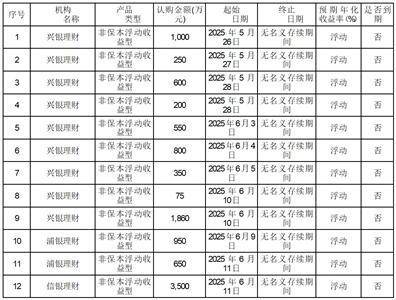
Core Viewpoint - The company has approved the use of idle self-owned funds for entrusted wealth management, with a total amount not exceeding 500 million RMB and an investment period of no more than 12 months [2][3]. Group 1: Wealth Management Product Purchase - The company purchased wealth management products worth 35 million RMB from Xinyin Wealth Management Co., Ltd. on June 11, 2025, and plans to roll over purchases and redemptions within a limit of 250 million RMB [3][4]. - The products are classified as low-risk (R1/R2) and are denominated in RMB, with the source of funds being self-owned funds [4]. Group 2: Risk Management - The company has outlined various risks associated with the wealth management products, including credit risk, market risk, liquidity risk, policy risk, management risk, and potential total loss of principal [5][6]. - To mitigate these risks, the company will adhere to relevant regulations and internal control systems, ensuring a balance between risk and return when selecting specific wealth management products [7]. Group 3: Impact on the Company - The use of idle self-owned funds for entrusted wealth management is intended to enhance the efficiency of fund utilization and generate investment returns without affecting the company's main business operations [8]. - As of the announcement date, the company and its subsidiaries have purchased bank wealth management products totaling 107.85 million RMB, accounting for 10.23% of the most recent audited net assets [9].
南银理财616理财节来袭!详解固收+理财趋势
21世纪经济报道· 2025-06-12 23:37
Core Viewpoint - The article emphasizes the increasing demand for stable asset appreciation and risk control among investors in a complex global economic recovery environment, highlighting the need for wealth management institutions to enhance their professional, companion, and protective capabilities [1]. Group 1: Wealth Management Strategies - Nanjing Bank Wealth Management Company launched the fourth "616 Wealth Management Festival" to showcase its commitment to professional, companion, and protective capabilities in wealth management [1]. - The "Fixed Income +" strategy is emerging as a strong competitor in the mainstream wealth management trend of 2025, balancing risk and return effectively [2][4]. Group 2: Investment Strategy Adjustments - In response to market conditions, Nanjing Bank Wealth Management has adjusted its bond portfolio by controlling duration and increasing allocations to medium- and short-term high-yield credit bonds, while focusing on structural opportunities in equities [2][6]. - The company emphasizes a balanced allocation strategy to mitigate risks associated with market volatility, particularly in the context of high dividend, low valuation blue-chip stocks [6]. Group 3: Core Advantages of "Fixed Income +" Strategy - The "Fixed Income +" strategy combines stability and aggressiveness, aiming to maximize risk-adjusted returns while smoothing overall portfolio volatility [4][5]. - The strategy's "Fixed Income" component provides a stable income base, while the "+" component seeks to capture excess returns through selective equity investments [4][9]. Group 4: Stock Selection and Performance - Nanjing Bank Wealth Management's stock selection strategy focuses on absolute returns and risk control, favoring companies with stable earnings growth and strong cash flow [8][9]. - The "Fixed Income +" strategy's equity investments are designed to complement the fixed income portion, enhancing overall portfolio performance while managing risks [9]. Group 5: Performance Metrics - The "Zengrui Mingyuan" series products have demonstrated strong performance, with the two-year fixed opening bond fund achieving an annualized return of 4.26% as of June 5, 2025 [4][10]. - The equity selection within the "Zengrui Mingyuan" strategy has yielded an annualized return of 6.51% since inception, reflecting the effectiveness of the company's investment approach [9].

“老招行人”董方出任招银理财总经理,万亿理财巨头如何破局规模和业绩下行?
2 1 Shi Ji Jing Ji Bao Dao· 2025-06-11 06:52
Core Viewpoint - The appointment of Dong Fang as the new general manager of Zhao Yin Wealth Management is part of a broader personnel change within the financial institutions of the China Merchants Group, aiming to strengthen collaboration with the parent bank and enhance operational efficiency [1][2]. Group 1: Management Changes - Dong Fang, previously the deputy general manager of China Merchants Fund, has been appointed as the general manager of Zhao Yin Wealth Management, succeeding Zhong Wenyue [1]. - Zhong Wenyue has transitioned to the role of general manager at China Merchants Fund after serving as the president of Zhao Yin Wealth Management [1][2]. - Both Dong Fang and Zhong Wenyue have extensive experience within the China Merchants Bank, which is expected to facilitate better synergy between Zhao Yin Wealth Management and its parent bank [2]. Group 2: Business Performance - As of the end of 2024, Zhao Yin Wealth Management manages assets totaling 2.47 trillion yuan, maintaining its position as the largest wealth management company in the industry, despite a decline of 307.34 billion yuan since the end of 2021 [1][4]. - The wealth management market in China has shown signs of recovery, with the total market size reaching approximately 29.95 trillion yuan by the end of 2024, reflecting an increase of 11.75% since the beginning of the year [4]. - Zhao Yin Wealth Management's net profit has decreased for two consecutive years, with a reported profit of 2.739 billion yuan in 2024, down 14.14% year-on-year [5]. Group 3: Investment Strategy - Zhao Yin Wealth Management has been focusing on equity investments, with its equity and mixed financial products showing competitive average returns in the industry, achieving 15.14% and 4.74% respectively in 2024 [3]. - The company has been actively building a professional investment research team to enhance its capabilities in multi-asset and multi-strategy investment approaches [3]. - Despite a focus on stable and low-volatility fixed-income investments, the performance of these products has not been as strong, leading to concerns about overall profitability [3][4].
6.11犀牛财经早报:多家车企将支付账期统一至60天内 蜜雪冰城因含菌量超标被通报
Xi Niu Cai Jing· 2025-06-11 01:33
Group 1 - Over 60% of actively managed equity funds have recovered their net value to levels seen two months ago, with a strong performance from funds focused on innovative pharmaceuticals and AI sectors [1] - The upcoming mid-year assessment is prompting wealth management companies to optimize asset allocation strategies, including shortening bond durations to control volatility [1] - The Hong Kong IPO market is heating up, with 190 companies queued for listing, many of which are from mainland China, indicating a trend of A+H listings [2] Group 2 - The domestic robotics industry is experiencing a surge in IPO activity in Hong Kong, with nine companies disclosing plans to list, reflecting strong investor interest in hard technology [2] - Midea Group has initiated a voluntary recall of over one million window air conditioners in North America due to a rare issue with mold on a specific component, with a complaint rate of less than 0.01% [3] - Several major automotive companies have committed to a unified payment term of no more than 60 days, indicating a shift in industry payment practices [3] Group 3 - The launch of the world's first AI-based fully automated design system for processor chips marks a significant advancement in chip design, addressing the growing demand for specialized chips [4] - The successful listing of a leading company in the panoramic camera sector has attracted significant attention from capital markets, with the global market for panoramic cameras expected to grow at a CAGR of over 10% [4] - The summer grain wheat harvest in China has progressed to over 70%, with significant contributions from major wheat-producing provinces [5] Group 4 - OpenAI is investigating increased error rates affecting its API and ChatGPT services, with over 1,000 service interruption reports logged [5] - Haitian Flavor Industry plans to issue 263.24 million shares in its Hong Kong listing, with a price range set between HKD 35 and HKD 36.3 [6] - A food safety incident involving excessive bacterial counts at a specific store has led to regulatory actions against the establishment [7] Group 5 - The financial regulatory authority has imposed strict penalties on two insurance companies, marking a shift towards individual accountability in the insurance sector [8] - Tencent Music has signed an acquisition agreement with Himalaya, with assurances that the brand and management structure will remain unchanged post-acquisition [9] - A significant personnel change has occurred at Yanghe Co., with a board member resigning due to work relocation [10]
理财产品估值整改年中大考将至 机构进展分化净值波动加剧
Sou Hu Cai Jing· 2025-06-11 00:59
Core Viewpoint - Regulatory requirements for the valuation of wealth management products are driving profound changes in the industry, with companies required to complete half of their rectification tasks by mid-year and fully by year-end [1] Group 1: Progress of Rectification - Different wealth management companies are showing varied progress in valuation rectification, with some in South China having completed their tasks by the end of last year, resulting in minimal operational impact [3] - Wealth management subsidiaries in East China are adopting a more cautious approach, shortening bond investment durations and being more selective in credit bond allocations to meet stricter regulatory requirements [3] - City commercial banks in North China generally find it manageable to complete rectification tasks due to the limited number of involved products [3] Group 2: Regulatory Requirements - Regulatory authorities have explicitly prohibited wealth management companies from using closing prices, smoothing valuations, or self-built valuation models, mandating the use of daily valuations provided by recognized financial institutions [3] - This regulation aims to eliminate unfair competition in the market and applies to both direct investment and outsourced business [3] Group 3: Impact on Asset Allocation Strategies - The deepening rectification work is expected to increase the volatility of net asset values, prompting wealth management companies to reassess and adjust their asset allocation strategies [4] - Shortening bond durations has become a common strategy among institutions to control net value fluctuations [4] - Companies are also managing leverage levels and selectively choosing investment targets to mitigate net value volatility, leading to opportunities for multi-asset and multi-strategy products [4] Group 4: Challenges for Short-term Products - Short-term wealth management products face significant challenges as the adoption of standardized valuations reflects market fluctuations directly, risking net values dropping below 1 yuan, which may lead to investor redemptions [4] - In contrast, long-term closed-end wealth management products have a natural advantage as investors tend to be more tolerant of net value fluctuations over longer periods [4]