自动驾驶

Search documents
港股收盘 | 恒指收涨1.38% 大金融股发力走高 有色、智驾概念走势强劲
Zhi Tong Cai Jing· 2026-01-06 12:38
Market Overview - The Hong Kong stock market indices showed strong performance, with the Hang Seng Index rising by 1.38% to close at 26,710.45 points, and a total trading volume of HKD 2,917.58 million [1] - The government policies and support from the "national team" are expected to stabilize the Hong Kong stock index, making it a favorable time for investment [1] Blue-Chip Stocks Performance - China Hongqiao (01378) led the blue-chip stocks with a 6.14% increase, closing at HKD 35.26, contributing 10.84 points to the Hang Seng Index [2] - Other notable performers included JD Health (06618) up 5.41%, China Ping An (02318) up 4.96%, while some stocks like Alibaba-W (09988) and Hengan International (01044) faced declines [2] Sector Highlights - Large technology stocks showed mixed results, with financial stocks, particularly Chinese brokerage firms, gaining momentum [3] - The non-ferrous metals sector performed strongly, with significant gains in gold and copper stocks [4] - The commercial aerospace sector saw a rise, with companies like Goldwind Technology (002202) increasing by over 7% [3][6] Investment Opportunities - The capital market is expected to maintain a strong performance in 2026, with the securities industry likely to continue its upward cycle [4] - Analysts suggest focusing on undervalued brokerage firms for potential gains during the spring market rally [4] Commodity Trends - Recent increases in commodity futures for gold, silver, copper, and lithium carbonate are noted, driven by geopolitical tensions and supply constraints [5] - The aluminum market is particularly affected by supply threats, with prices expected to remain high [5] Autonomous Driving Sector - The autonomous driving sector is gaining traction, with companies like Zhejiang Shibao (002703) and Youjia Innovation (02431) seeing significant stock price increases [5] - NVIDIA's advancements in autonomous driving technology are expected to boost demand for related stocks [6] Notable Stock Movements - Xindong Company (02400) saw a 6.04% increase following the announcement of a large share buyback plan [7] - Hesai Technology (02525) rose 5.9% after being selected as a lidar partner for NVIDIA's platform and announcing plans to double production capacity [8] - Cathay Pacific (00293) faced pressure, with a 2.6% decline due to a share placement by China National Aviation [9]
【美股盘前】英伟达、AMD、亚马逊和高通集体于CES发布新产品;固态电池股涨跌不一;诺和诺德涨超4%,在美国推出口服GLP-1减肥药
Mei Ri Jing Ji Xin Wen· 2026-01-06 10:49
Market Overview - Dow futures fell by 0.19%, S&P 500 futures decreased by 0.06%, while Nasdaq futures rose by 0.03% [1] Solid-State Battery Sector - Solid-state battery stocks showed mixed performance; Plug Power fell by 0.42%, Solid Power increased by 1.36%, and Quantumscape Corp rose by 0.62% [1] - Donut Lab introduced the world's first solid-state battery ready for OEM vehicle mass production at CES, set to power Verge Motorcycles by Q1 2026 [1] AI and Autonomous Driving - NVIDIA launched the open-source AI model Alpamayo aimed at enhancing assisted driving technology, with the first vehicles using this technology expected to hit the roads in the U.S. in Q1 2026 [2] - Companies like Jaguar Land Rover, Uber, and Lucid have shown interest in NVIDIA's technology for Level 4 autonomous driving [2] Semiconductor and GPU Developments - AMD unveiled the MI455 GPU chip at CES, claiming significant performance improvements, and previewed the MI500 series processors expected to launch in 2027 with performance 1000 times that of the MI300 series [2] E-commerce and AI - Amazon launched a new website, Alexa.com, allowing users to interact with Alexa+ similar to other AI chatbots [3] Robotics Technology - Qualcomm introduced the Dragonwing IQ10 processor designed for industrial autonomous mobile robots and humanoid robots, emphasizing high performance and energy efficiency [3] Apple Financial Outlook - Evercore raised Apple's target price to $325, maintaining an "outperform" rating, noting a 6% year-over-year revenue growth in the App Store for December [4] Automotive Financing - Tesla China announced zero-interest and low-interest financing options for Model 3 and Model Y until January 31 [4] Pharmaceutical Innovations - Novo Nordisk launched Wegovy, the first oral GLP-1 weight loss drug in the U.S., priced at $149 per month for the initial dose, with future price adjustments planned [5] Cryptocurrency Market Impact - Strategy reported a $17.44 billion unrealized loss in Q4 due to a decline in the value of its $62 billion cryptocurrency assets, while still acquiring additional Bitcoin [6]

【美股盘前】英伟达、AMD、亚马逊和高通集体于CES发布新产品;固态电池股涨跌不一;诺和诺德涨超4%,在美国推出口服GLP-1减肥药;Strategy ...
Mei Ri Jing Ji Xin Wen· 2026-01-06 10:45
Group 1 - Major index futures showed mixed results with Dow futures down 0.19%, S&P 500 futures down 0.06%, and Nasdaq futures up 0.03% [1] - Solid-state battery stocks experienced varied movements, with Plug Power down 0.42%, Solid Power up 1.36%, and Quantumscape Corp up 0.62%. Donut Lab announced the launch of the world's first mass-producible all-solid-state battery for OEM vehicles, set to power Verge Motorcycles by Q1 2026 [1] Group 2 - NVIDIA introduced the open-source AI model Alpamayo aimed at advancing inference-based autonomous driving technology, with the first vehicles expected to hit the road in the US in Q1 and in Europe in Q2 [2] - AMD unveiled the MI455 GPU chip at CES, claiming significant performance improvements, and previewed the MI500 series processors expected to launch in 2027, which will be 1000 times more powerful than the MI300 series [2] Group 3 - Amazon launched a new website, Alexa.com, allowing users to interact with Alexa+ similar to other AI chatbots, now available to all early access users [3] - Qualcomm introduced the Dragonwing IQ10 processor designed for industrial autonomous mobile robots and humanoid robots, emphasizing high performance and energy efficiency [3] Group 4 - Evercore raised Apple's target price to $325, maintaining an "outperform" rating, noting a stabilization in App Store revenue with a 6% year-over-year increase in December [4] - Tesla China announced zero-interest and low-interest financing options for Model 3 and Model Y orders placed by January 31 [4] Group 5 - Novo Nordisk launched the oral GLP-1 weight loss drug Wegovy in the US, priced at $149 per month for the initial 1.5 mg dose, with plans to increase prices for higher doses in the future [5] Group 6 - Strategy reported a Q4 unrealized loss of $17.44 billion due to a decline in the value of its cryptocurrency holdings, with a total Bitcoin holding of 673,783 coins despite the losses [6]


峰瑞资本李丰:2026年,AI投资的逻辑与展望
Sou Hu Cai Jing· 2026-01-06 10:02
Core Viewpoint - The current AI investment wave is characterized as the most financially abundant in history, driven by unprecedented liquidity and technological advancements [2][4][5]. Group 1: AI Investment Landscape - The AI investment boom began in November 2022 with the emergence of ChatGPT, marking three years of heightened interest and competition, particularly between the US and China [3][4]. - Central banks globally expanded their balance sheets by $12 trillion from 2020 to 2021, leading to an extraordinary increase in liquidity, estimated at nearly $50 trillion when considering the money multiplier effect [4][5]. - The influx of capital has resulted in a significant reallocation of investments, with a notable shift towards the US market due to geopolitical uncertainties in Europe and China [5][6]. Group 2: Future Investment Narratives - By 2026, the focus will shift from merely possessing technology to effectively utilizing it for profit, emphasizing the importance of practical applications over theoretical advancements [2][8]. - The AI investment cycle is expected to progress through three stages: initial focus on technology, followed by exploration of its applications, and ultimately, the realization of profitable use cases [8][9]. - Historical patterns suggest that while the US led in the first technology cycle, the second saw a balance between the US and China, and the third may present opportunities for Chinese advancements to surpass those of the US [9][10].


英伟达公布人形机器人研发计划与自动驾驶汽车技术
Xin Lang Cai Jing· 2026-01-06 09:49
Core Insights - Nvidia showcased its latest advancements in robotics at the 2026 CES, highlighting its role in the growing humanoid robot development wave in the global tech industry [1][4] - The company aims to be a key driver in transforming the $50 trillion manufacturing and logistics market through its AI technologies [1][4] Robotics Technology - Numerous companies, including Boston Dynamics, Caterpillar, LG Electronics, and NEURA Robotics, are adopting Nvidia's robotics technology for R&D support and computational power [1][4] - Nvidia released several new AI models designed to enhance robots' learning and interaction with their environments, along with hardware products necessary for the "digital brain" of robots [1][4] Autonomous Driving Technology - Nvidia introduced a new series of autonomous vehicle models named "Alpamayo," which utilizes a visual-language-action (VLA) model architecture based on chain reasoning technology [5] - The Alpamayo model can identify unusual driving scenarios, such as traffic signal malfunctions, and develop appropriate response strategies [2][5] - Positioned as a "large-scale teacher model," Alpamayo allows developers to fine-tune and integrate it into a complete autonomous driving technology framework [2][5] Industry Collaboration and Challenges - Companies like Lucid Motors, Uber, and the Berkeley Deep Drive Research Center have expressed interest in collaborating on the Alpamayo model [3][5] - Despite advancements, autonomous vehicles are still in testing phases globally, with companies like Waymo leading the industry, but challenges remain regarding maturity and reliability [3][5] - Nvidia believes that virtual simulation training technology is an effective method for continuously iterating autonomous driving technology without the need for constant real-world testing [6]

利好密集!这一板块领涨龙头5连板 19股涨停!
Zheng Quan Ri Bao· 2026-01-06 09:43
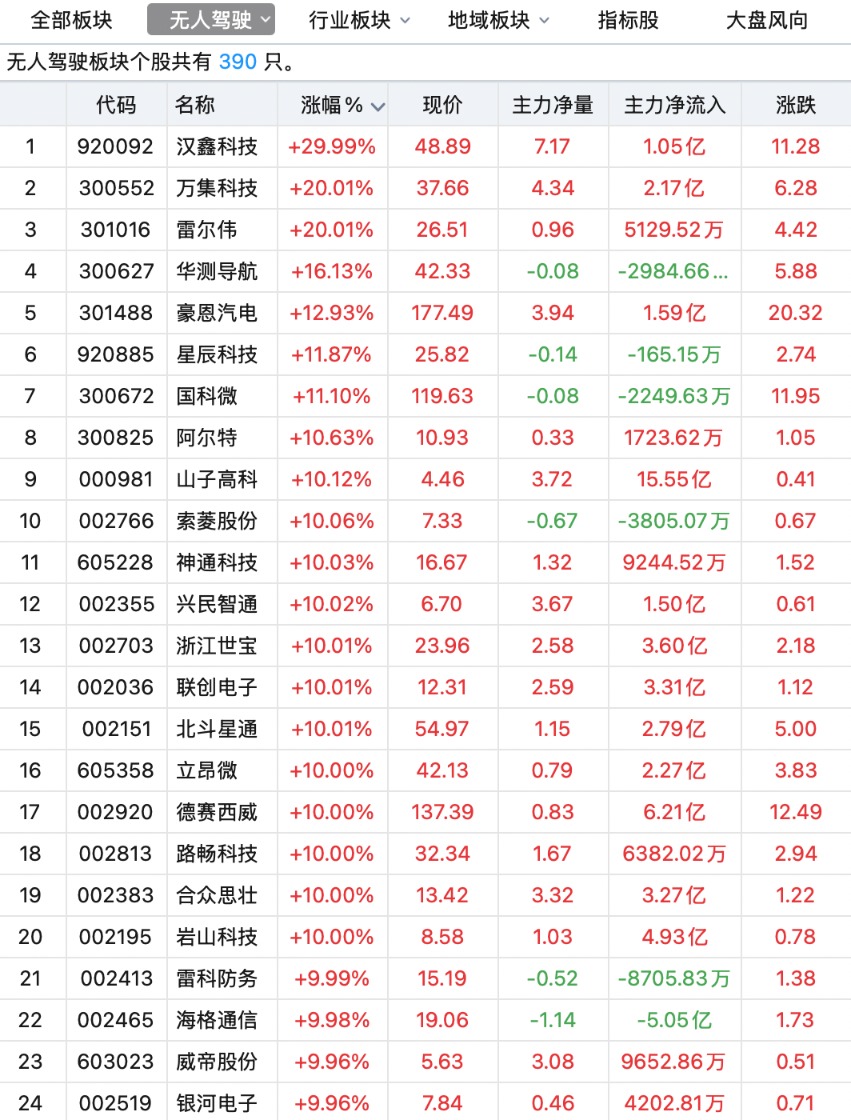
1月6日,无人驾驶板块表现活跃。截至当日收盘,汉鑫科技(920092)、万集科技(300552)、雷尔伟(301016)、山 子高科(000981)、索菱股份(002766)、神通科技(605288)、兴民智通(002355)、北斗星通(002151)、德赛西 威(002920)、路畅科技(002813)、立昂微(605358)、银河电子(002519)、岩山科技(002195)等19股涨停。其 中,雷科防务5连板,索菱股份3连板。 另外,华测导航(300627)、豪恩汽电(301488)、星辰科技(920885)、国科微(300672)等个股涨超10%。 | | 代码 | 名称 | 涨幅% √ | 现价 | 主力净量 | 主力净流入 | 涨跌 | | --- | --- | --- | --- | --- | --- | --- | --- | | 1 | 920092 | 汉鑫科技 | +29.99% | 48.89 | 7.17 | 1.05亿 | 11.28 | | 2 | 300552 | 万集科技 | +20.01% | 37.66 | 4.34 | 2.17 亿 | 6.28 | | 3 | 3 ...
【天风汽车】英伟达开源智驾大模型,商业化落地加速-0106
Ge Long Hui· 2026-01-06 09:39
Group 1 - Nvidia has launched an open-source vision-language-action model, Alpamayo 1, for autonomous driving, featuring 10 billion parameters and a significant breakthrough in openness, providing complete development resources from data to deployment [1] - The model is an inference-based VLA that can reason causal relationships before decision-making, predict intentions of others, and handle multi-step decisions, resulting in a 12% improvement in planning accuracy, a 37% increase in action consistency, and a 25% reduction in collision rates [1] - Nvidia's DRIVE system is entering mass production, with the first model being the new Mercedes CLA, set to hit the roads in the US in 2026, and plans to test Robotaxi services in collaboration with partners in 2027 [1] Group 2 - The open-source end-to-end model is expected to reconstruct the intelligent driving ecosystem, further lowering the threshold for Level 4 (L4) autonomous driving, with recommendations for Robotaxi algorithm companies such as Xiaoma and Wenyuan, and attention on unmanned mining vehicle targets like Xidi Zhijia and Boleton, as well as the upcoming listing of Yikong Zhijia [2] - Recommended components for safety redundancy include steering systems from Cybercab's exclusive supplier, Nexperia, braking systems from Bertley and Ruikem, lidar from Hesai and Suteng, and chips from Horizon and Black Sesame [2] - In addition to intelligent driving, Nvidia's Isaac platform and GR00T basic module development cover various types of robots, including industrial, humanoid, and consumer-grade, with a positive outlook on the resonance between intelligent driving and robotics domain control companies like Kobot, Desay SV, and Jingwei Hengrun [2]
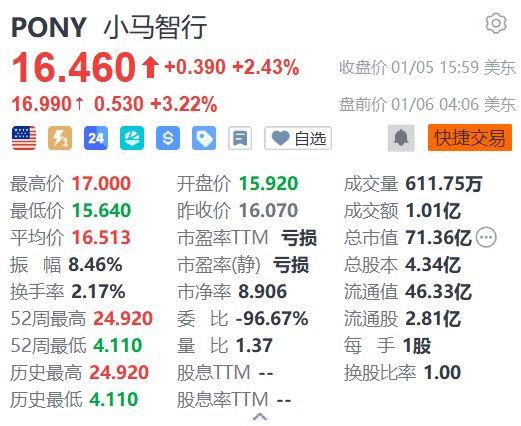
美股异动|小马智行盘前涨超3% 花旗称英伟达AI生态将助推自动驾驶出租车增长
Ge Long Hui· 2026-01-06 09:17
Group 1 - The core viewpoint of the article highlights the positive outlook for the autonomous taxi market, driven by advancements in AI technology and the introduction of new platforms by Nvidia, which are expected to stimulate demand and support global economic growth [1] - Citigroup forecasts that the global autonomous taxi market will expand from $4.43 billion in 2025 to $188.91 billion by 2034, indicating significant growth potential [1] - In China, the reachable market size for autonomous taxis is projected to grow from $3.9 million in 2025 to $67.59 billion by 2035, showcasing a substantial opportunity in this region [1] Group 2 - CITIC Lyon has initiated coverage on Pony.ai with an "outperform" rating and a target price of $22, indicating confidence in the company's future performance [1] - The company is expected to achieve adjusted operating profit breakeven by 2029, with short-term stock price drivers focusing on commercialization progress [1] - Starting in 2026, the commercialization of autonomous taxis is anticipated to experience exponential growth, driven by the maturity of Level 4 technology, economic feasibility of vehicles and hardware, and increased user acceptance [1]
文远知行:旗下Robotaxi GXR成为全球首款搭载NVIDIA DRIVE Thor X芯片的Robotaxi
Zheng Quan Shi Bao Wang· 2026-01-06 09:05
Core Insights - The autonomous driving technology company, WeRide, announced on January 6 that its Robotaxi GXR has become the world's first Robotaxi equipped with NVIDIA DRIVE Thor X chip, marking a significant milestone in the industry [1] - WeRide's Robotaxi has achieved fully unmanned commercial operations in China and the UAE [1] Company Summary - WeRide is positioned as a global partner in NVIDIA's L4 Robotaxi ecosystem, highlighting its collaboration with a leading technology firm in the autonomous driving sector [1] - The deployment of the Robotaxi GXR signifies advancements in autonomous vehicle technology and operational capabilities [1] Industry Summary - The introduction of the Robotaxi GXR with NVIDIA's advanced chip reflects ongoing innovation in the autonomous driving industry, particularly in the realm of fully autonomous commercial services [1] - The successful operation in multiple international markets, such as China and the UAE, indicates a growing acceptance and potential for autonomous vehicles in diverse environments [1]
文远知行亮相英伟达自动驾驶朋友圈,Robotaxi GXR全球首搭DRIVE Thor X芯片
Ge Long Hui· 2026-01-06 09:03
Core Insights - WeRide has announced its Robotaxi GXR as the world's first Robotaxi equipped with NVIDIA DRIVE Thor X chip, achieving fully autonomous commercial operations in China and the UAE [1][7] - NVIDIA's CEO Jensen Huang highlighted the future of autonomous driving, predicting that most cars will be autonomous in the next decade, with WeRide being a key player in this global L4 autonomous driving ecosystem [3][5] Group 1: Technology and Infrastructure - WeRide collaborates with Lenovo to develop the HPC 3.0 high-performance computing platform, which utilizes dual NVIDIA DRIVE AGX Thor configurations, providing 2000 TOPS AI computing power to meet L4 autonomous driving requirements [5][7] - The HPC 3.0 platform has significantly reduced the production cost of autonomous driving systems, lowering the price to one-fourth of previous generations and cutting the total cost of ownership (TCO) by 84% [5][7] Group 2: Market Deployment and Operations - The Robotaxi GXR has been deployed in multiple cities including Beijing, Guangzhou, Singapore, Abu Dhabi, Dubai, and Riyadh, marking it as the first Robotaxi to operate commercially in China and the UAE [7][9] - In Guangzhou, each GXR can complete up to 25 trips per day, while in Beijing, it can achieve 23 trips during operational hours; the fleet in Abu Dhabi has quadrupled since the start of operations in December 2024 [10] - WeRide aims to deploy hundreds of thousands of Robotaxis globally by 2030, continuing its partnership with NVIDIA to enhance commercial applications and provide safe and reliable transportation solutions [10]