
商贸零售

Search documents
东百集团2025半年度拟派4349.23万元红包
Zheng Quan Shi Bao Wang· 2025-08-22 08:30
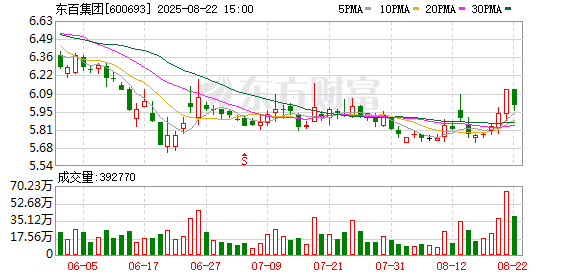
按申万行业统计,东百集团所属的商贸零售行业共有8家公司公布了2025半年度分配方案,派现金额最 多的是吉宏股份,派现金额为7966.85万元,其次是若羽臣、东百集团,派现金额分别为6560.11万元、 4349.23万元。(数据宝) 2025半年度商贸零售行业分红排名 | 代码 | 简称 | 每10股送转 | 每10股派现 | 派现金额(万 | 派现占净利润比例 | 股息率 | | --- | --- | --- | --- | --- | --- | --- | | | | (股) | (元) | 元) | (%) | (%) | | 002803 | 吉宏股 份 | 0.00 | 1.8 | 7966.85 | 67.43 | 1.33 | | 003010 | 若羽臣 | 4.00 | 3 | 6560.11 | 90.78 | 0.65 | | 600693 | 东百集 团 | 0.00 | 0.5 | 4349.23 | 60.78 | 0.74 | | 601010 | 文峰股 份 | 0.00 | 0.2 | 3587.53 | 95.60 | 0.65 | | 301078 | 孩子王 | 0 ...


国泰中证500ETF(561350)收涨超过1.8%,科技成长延续
Mei Ri Jing Ji Xin Wen· 2025-08-22 08:27
注:如提及个股仅供参考,不代表投资建议。指数/基金短期涨跌幅及历史表现仅供分析参考,不预示 未来表现。市场观点随市场环境变化而变动,不构成任何投资建议或承诺。文中提及指数仅供参考,不 构成任何投资建议,也不构成对基金业绩的预测和保证。如需购买相关基金产品,请选择与风险等级相 匹配的产品。基金有风险,投资需谨慎。 (文章来源:每日经济新闻) 中信建投指出,中证500的VIX指数近期呈现抬升态势,同时期货基差率也有所上升,显示市场情绪波 动加大。从行业层面看,当前机构对商贸零售和非银行金融行业的关注度较高。此外,石油石化、有色 金属、钢铁、非银行金融和综合金融行业的机构调研热度在最近期有所提升。整体来看,市场拥挤信号 和拥挤行业数量较少,显示市场调整压力相对有限。 国泰中证500ETF(561350)跟踪的是中证500指数(000905),该指数从A股市场中选取除沪深300成分 股外市值较大、流动性较好的500只股票作为指数样本,覆盖工业、原材料、信息技术等多个行业板 块。该指数具有成长性突出、行业分散度高的特点,旨在综合反映中国A股市场中小盘上市公司的整体 表现。 没有股票账户的投资者可关注国泰中证500ETF ...

开源晨会-20250821
KAIYUAN SECURITIES· 2025-08-21 14:41
Group 1: Banking Industry - The estimated high-interest time deposits maturing in 2025 amount to approximately 39.7 trillion yuan, with 42% maturing in Q1 [6][7] - The interest rate reduction for 3-year deposits maturing in 2025 is projected to be between 125 to 150 basis points [8] - The average deposit cost rate for listed banks is expected to decrease to 1.61% in 2025 due to the repricing of time deposits [10][11] - The report recommends several banks, including CITIC Bank and Agricultural Bank of China, as beneficiaries of the favorable conditions [12] Group 2: Chemical Industry (Spandex) - The demand for spandex is driven by its increasing penetration in the textile and apparel sectors, with 76% of spandex used for clothing production in 2024 [14][15] - The spandex market is experiencing a significant oversupply, leading to negative profit margins, with average gross profit at -5,217 yuan/ton as of August 2025 [15][16] - The report suggests that leading companies like Huafeng Chemical and Xinxiang Chemical are likely to benefit from the ongoing capacity clearance in the spandex industry [16] Group 3: Public Utilities (Pinggao Electric) - Pinggao Electric reported a revenue of 5.696 billion yuan in H1 2025, a year-on-year increase of 13.0%, with a net profit of 666 million yuan, up 24.6% [17][19] - The company has a strong order backlog, with contract liabilities amounting to 1.715 billion yuan as of June 2025 [19][20] - The report maintains a "buy" rating for Pinggao Electric, citing its solid position in the power grid market [18] Group 4: Pharmaceutical Industry (Prolo Pharmaceutical) - Prolo Pharmaceutical's revenue for H1 2025 was 5.444 billion yuan, reflecting a decline of 15.31% year-on-year, while net profit decreased by 9.89% [21][22] - The CDMO business segment showed rapid growth, achieving a revenue of 1.236 billion yuan, up 20.32% [22] - The report maintains a "buy" rating for Prolo Pharmaceutical, highlighting its strong valuation despite the overall decline in revenue [21] Group 5: Retail Industry (Runben Co., Ltd.) - Runben Co., Ltd. achieved a revenue of 895 million yuan in H1 2025, a year-on-year increase of 20.3%, with a net profit of 188 million yuan, up 4.2% [30][31] - The company plans to distribute a cash dividend of 2.00 yuan per share, with a payout ratio of 43.15% [30] - The report maintains a "buy" rating, emphasizing the company's strong market position in the mosquito repellent and baby care segments [30] Group 6: Technology Industry (Kangguan Technology) - Kangguan Technology launched the KTCAI smart glasses, priced at 1,499 yuan, featuring advanced AI capabilities [34][35] - The global smart glasses market is expected to grow significantly, with a projected CAGR of 119% by 2028 [34] - The report maintains a "buy" rating for Kangguan Technology, forecasting substantial growth in net profit over the next few years [34] Group 7: Overseas Companies (Weimeng Group) - Weimeng Group's revenue for H1 2025 was 775 million yuan, a year-on-year decline of 10.6%, but the adjusted net profit was better than expected [26][27] - The company is focusing on optimizing its SaaS business and expanding its advertising channels [26][28] - The report maintains a "buy" rating, anticipating recovery in the SaaS business and growth from AI applications [26]
新华百货2025半年度拟派2256.31万元红包
Zheng Quan Shi Bao Wang· 2025-08-21 14:27
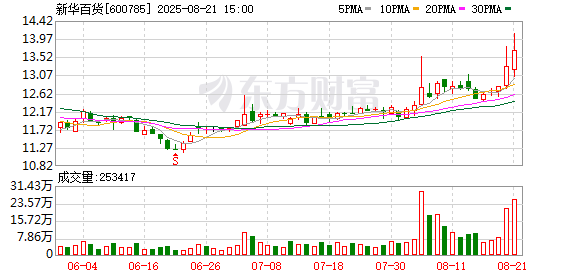
Core Viewpoint - Xinhua Department Store announced a cash dividend plan for the first half of 2025, proposing a distribution of 1 yuan per 10 shares (including tax), with a total cash payout of 22.5631 million yuan, representing 26.23% of the company's net profit, marking the 21st distribution since its listing [2][4]. Company Summary - The company reported a revenue of 3.254 billion yuan for the first half of 2025, a year-on-year decrease of 0.99% [3]. - The net profit for the same period was 86.0081 million yuan, down 2.52% year-on-year, with basic earnings per share of 0.38 yuan [3]. Industry Summary - In the retail industry, six companies announced their cash distribution plans for the first half of 2025, with Jihong Co. leading with a total payout of 79.6685 million yuan, followed by Ruoyuchen and Wenfeng Co. with payouts of 65.6011 million yuan and 35.8753 million yuan, respectively [4]. - Xinhua Department Store's cash payout ranks fifth among these companies, with a dividend yield of 0.82% [4].

8月21日沪深两市强势个股与概念板块
2 1 Shi Ji Jing Ji Bao Dao· 2025-08-21 10:08
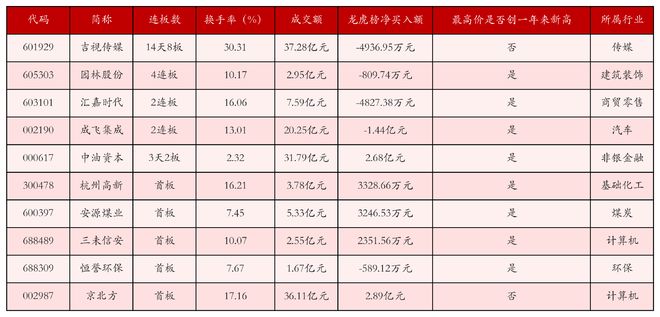
Strong Stocks - As of August 21, the Shanghai Composite Index rose by 0.13% to 3771.1 points, while the Shenzhen Component Index fell by 0.06% to 11919.76 points, and the ChiNext Index decreased by 0.47% to 2595.47 points [1] - A total of 58 stocks in the A-share market hit the daily limit up, with the top three strong stocks being: Jishi Media (601929), Garden Shares (605303), and Huijia Times (603101) [1] - Jishi Media (601929) had 14 trading days with 8 limit ups, a turnover rate of 30.31%, and a transaction amount of 3.728 billion yuan, with a net buying amount from the Dragon and Tiger list of -49.3695 million yuan [1] - Garden Shares (605303) achieved 4 consecutive limit ups, a turnover rate of 10.17%, and a transaction amount of 295 million yuan, with a net buying amount of -8.0974 million yuan [1] - Huijia Times (603101) recorded 2 consecutive limit ups, a turnover rate of 16.06%, and a transaction amount of 759 million yuan, with a net buying amount of -48.2738 million yuan [1] Strong Concept Sectors - The top three concept sectors with the highest increase in A-shares were: Combustible Ice, Digital Currency, and Cross-Border Payment (CIPS) [2] - The Combustible Ice sector rose by 3.12%, with 8.33% of its component stocks hitting the limit up, and 100% of its component stocks increasing [2] - The Digital Currency sector increased by 2.38%, with 7.22% of its component stocks hitting the limit up, and 79.38% of its component stocks rising [2] - The Cross-Border Payment (CIPS) sector saw a rise of 2.19%, with 5.41% of its component stocks hitting the limit up, and 82.43% of its component stocks increasing [2]
7.50亿元资金今日流入商贸零售股
Zheng Quan Shi Bao Wang· 2025-08-21 08:53
(原标题:7.50亿元资金今日流入商贸零售股) 沪指8月21日上涨0.13%,申万所属行业中,今日上涨的有17个,涨幅居前的行业为农林牧渔、石油石 化,涨幅分别为1.50%、1.39%。商贸零售行业今日上涨0.70%。跌幅居前的行业为机械设备、电力设 备,跌幅分别为1.08%、0.98%。 商贸零售行业今日上涨0.70%,全天主力资金净流入7.50亿元,该行业所属的个股共97只,今日上涨的 有53只,涨停的有3只;下跌的有38只。以资金流向数据进行统计,该行业资金净流入的个股有37只, 其中,净流入资金超3000万元的有8只,净流入资金居首的是跨境通,今日净流入资金7.05亿元,紧随 其后的是翠微股份、国联股份,净流入资金分别为5.57亿元、9063.30万元。商贸零售行业资金净流出个 股中,资金净流出超5000万元的有5只,净流出资金居前的有武商集团、供销大集、永辉超市,净流出 资金分别为9480.70万元、6753.77万元、6715.47万元。(数据宝) | 代码 | 简称 | 今日涨跌幅(%) | 今日换手率(%) | 主力资金流量(万元) | | --- | --- | --- | --- | -- ...




主力资金动向 7.50亿元潜入商贸零售业
Zheng Quan Shi Bao Wang· 2025-08-21 08:53
(原标题:主力资金动向 7.50亿元潜入商贸零售业) | 行业名称 | | 成交量 | | | 今日 | | --- | --- | --- | --- | --- | --- | | | 成交量 (亿股) | 较昨日 增减 | 换手率 (%) | 涨跌幅 (%) | 主力资金 | | | | (%) | | | 净流入(亿元) | | 商贸零售 | 37.20 | 2.16 | 3.10 | 0.70 | 7.50 | | 公用事业 | 51.23 | 26.82 | 1.28 | 0.89 | 5.57 | | 钢铁 | 39.59 | 12.23 | 2.01 | 0.54 | 4.23 | | 煤炭 | 16.51 | 41.26 | 1.26 | 0.72 | 0.71 | | 综合 | 6.94 | -9.34 | 4.11 | -0.73 | 0.14 | | 建筑装饰 | 51.84 | 18.19 | 1.85 | 0.43 | -0.18 | | 美容护理 | 4.86 | 9.77 | 4.92 | 0.98 | -0.21 | | 石油石化 | 25.57 | 33.76 | 0.69 ...
若羽臣盘中创历史新高
Zheng Quan Shi Bao Wang· 2025-08-21 03:13
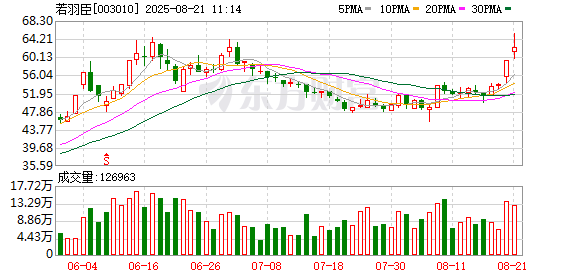
Company Performance - The company, Ruoyuchen, has reached a historical high in stock price, increasing by 9.20% to 64.90 CNY, with a trading volume of 9.92 million shares and a transaction amount of 611 million CNY, resulting in a turnover rate of 6.27% [2] - The latest total market capitalization of the company in A-shares is 14.192 billion CNY, with a circulating market capitalization of 10.275 billion CNY [2] - For the first half of the year, the company reported a revenue of 1.319 billion CNY, representing a year-on-year growth of 67.55%, and a net profit of 72.2639 million CNY, which is an 85.60% increase year-on-year [2] Industry Overview - The retail trade industry, to which the company belongs, has an overall increase of 1.43%, with 61 stocks rising and 3 stocks hitting the daily limit [2] - Among the stocks that declined, the largest drops were seen in Huazhi Wine Industry, Qingmu Technology, and Nanjing Commercial Travel, with declines of 3.37%, 2.97%, and 2.75% respectively [2]
【盘中播报】45只A股封板 农林牧渔行业涨幅最大
Zheng Quan Shi Bao Wang· 2025-08-21 03:07
Market Overview - The Shanghai Composite Index increased by 0.43% as of 10:28 AM, with a trading volume of 762.39 million shares and a transaction value of 1,183.46 billion yuan, representing a 4.97% increase compared to the previous trading day [1] Industry Performance - The top-performing sectors included Agriculture, Forestry, Animal Husbandry, and Fishery with a rise of 2.31%, Beauty and Personal Care up by 1.99%, and Retail Trade increasing by 1.44% [1] - The sectors with the largest declines were Machinery Equipment down by 0.75%, Electric Equipment down by 0.68%, and Automotive down by 0.53% [2] Leading Stocks - Notable gainers included Guotou Zhonglu in the Agriculture sector with a 10.00% increase, Jieya Co. in Beauty and Personal Care with a 10.52% rise, and Huijia Times in Retail Trade with a 10.04% increase [1] - In contrast, leading decliners included Feilong Co. in Automotive with a 9.99% drop, Wolong Electric Drive in Electric Equipment down by 8.23%, and Hongyuan Co. in Machinery Equipment down by 10.57% [2]
可转债周报:“反内卷”当下为何关注化工转债-20250820
Changjiang Securities· 2025-08-20 13:12
1. Report Industry Investment Rating No industry investment rating information is provided in the report. 2. Core Views of the Report - The convertible bond market continued its upward trend this week, with the price center rising and market risk appetite recovering. The valuation structure remained differentiated, with high - priced bonds driven by elasticity and medium - and low - priced bonds being repaired. Frequent downward revision and redemption events increased the game nature. The equity market was dominated by the small - and medium - cap growth style, and funds were highly concentrated in technology mainlines such as communication and electronics, as well as rotating sectors such as machinery and non - ferrous metals. Under the accelerated market rotation, the volatility risk of high - position crowded sectors increased. It is recommended to follow the market mainline and rotation rhythm, dig out elastic varieties driven by the underlying stocks, and pay attention to sectors at the bottom of the cycle, such as the chemical industry, which have allocation value [2][6]. - The current chemical convertible bond market is in the clearing stage of the production capacity and inventory cycle, and market attention is relatively low. The underlying stocks of chemical convertible bonds generally have low valuations, and the convertible bonds themselves have both bond - like protection and price elasticity. Although the industry's overall capital expenditure has shrunk and shows an active de - stocking trend, the profitability of the sector has shown signs of improvement. It is recommended to pay attention to individual bonds with a safety margin of underlying stock valuation and profit - repair elasticity [11]. - The A - share market showed a significant small - and medium - cap growth style this week. The ChiNext Index led the rise. Although the net outflow of main funds continued, the outflow pressure eased, and market sentiment improved. In terms of industries, the differentiation intensified. Technology - growth sectors such as communication, power equipment, and electronics became the main lines, leading the market. It is recommended to pay attention to the rotation opportunities within the mainline sectors and be cautious about directions with excessive trading congestion [11]. 3. Summary According to the Directory 3.1 Chemical Convertible Bond Market Analysis - **Performance and Potential**: The chemical convertible bond market is in the clearing stage of the production capacity and inventory cycle. The underlying stocks of chemical convertible bonds are generally undervalued, and the convertible bonds have bond - like protection and price elasticity. The industry's profitability is improving, especially under the strengthening of the "anti - involution" logic, and its profit - repair potential is worth looking forward to [11]. - **Market Attention**: As of August 15, the trading volume of the chemical sector accounted for 5.9% of the total trading volume of the Wind All - A Index, at a historical percentile of 2.7% since July 23, 2010, indicating low market attention and potential allocation opportunities [19]. - **Capacity Cycle**: In the second quarter of 2025, the overall capacity utilization rate of the chemical industry was only 71.9%, at a historical low since the fourth quarter of 2016. The capital expenditure intensity of all sub - sectors in the first quarter of 2025 showed negative growth, indicating that the chemical sector is in the production capacity clearing stage [26]. - **Inventory Cycle**: The chemical sector may have entered the active de - stocking stage. Since the fourth quarter of 2024, the net profit margin has been on the rise, and the profitability of enterprises has improved [30]. - **Individual Bond Analysis**: As of August 15, 2025, 58 individual bonds in the large chemical sector were selected. The median conversion premium rate was 26.1%, and the balance - weighted average conversion premium rate was 44.2%, still having bond - like characteristics. The median market price was 133.4 yuan, slightly higher than the market median. The underlying stocks of chemical convertible bonds are still in a low - valuation range [33]. 3.2 Market Theme Weekly Review - **Equity Market**: The trading - themed stocks in the equity market were active this week. The continuous limit - up index led the rise with a weekly increase of 20.9%. The technology and high - end manufacturing fields showed a differentiated pattern, the pharmaceutical sector rose as a whole, and the military - related themes were under pressure. Short - term funds were active, and funds were highly concentrated in trading - themed stocks and technology hardware sub - directions [35][36]. - **Convertible Bond Market**: The convertible bond market continued its upward trend this week, with small - cap convertible bonds leading the way. The valuation structure remained differentiated, and the implied volatility fluctuated upward. The market style shifted to machinery and equipment and non - ferrous metals, and individual bond performance was mainly driven by the underlying stocks. It is recommended to follow the market style and pay attention to elastic varieties with strong underlying stock driving forces [11]. 3.3 Market Weekly Tracking 3.3.1 Main Index Performance - The A - share main indexes continued to be strong this week. The Shanghai Composite Index rose 1.7%, the Shenzhen Component Index rose 4.5%, and the ChiNext Index led the rise with an 8.6% increase. Small - and medium - cap stocks performed better [39]. - Although the net outflow of main funds continued, the outflow pressure eased. The average daily trading volume of the whole market was about 2.1 trillion yuan, a week - on - week increase of 0.4 billion yuan [39]. 3.3.2 Industry Performance - The A - share market showed significant structural differentiation. Sectors such as communication, power equipment, and electronics were the strongest. The consumer and cyclical sectors showed different performances within the sectors. Funds were concentrated in growth sectors such as electronics and computers [45][46]. - The trading heat of the market showed significant differentiation. The military, pharmaceutical, and machinery sectors were highly active, while the cyclical and some consumer sectors showed a decline in heat [49]. 3.3.3 Convertible Bond Market Performance - The convertible bond market continued to rise this week, with small - cap convertible bonds leading the way. The Zhongzheng Convertible Bond Index rose 1.6%, the small - cap convertible bond index rose 2.3%, the medium - cap index rose 1.6%, and the large - cap index rose 0.2%. The trading volume increased, with an average daily trading volume of about 965.0 billion yuan, a week - on - week increase of 67.0 billion yuan [52]. - The valuation of the convertible bond market was stretched overall when divided by the parity range. When divided by the market price range, the valuation showed a differentiated pattern. The implied volatility of the convertible bond market fluctuated upward, and the median price of convertible bonds rose [55][57][60]. - Most of the 25 industries in the convertible bond market rose this week. Non - ferrous metals, machinery and equipment, and non - bank finance led the rise. The trading volume was concentrated in machinery and equipment, power equipment, and basic chemicals [63]. - Most individual convertible bonds rose this week. The performance of convertible bonds was mainly driven by the underlying stocks. The convertible bonds with high increases were mostly those with high elasticity and long - term or near - maturity characteristics, while the convertible bonds with large declines were affected by the poor performance of the underlying stocks [65][68]. 3.4 Issuance and Clause Tracking - No new convertible bonds were listed this week, and one convertible bond, Kaizhong Convertible Bond, was open for subscription, with an issue size of 3.1 billion yuan and a credit rating of AA - [69]. - Four listed companies updated their convertible bond issuance plans this week, including two in the exchange - acceptance stage, one in the shareholders' meeting - approved stage, and one in the board - proposal stage [70]. - In terms of downward revisions, 5 convertible bonds announced that they were expected to trigger downward revisions, 8 announced that they would not make downward revisions, and 2 proposed downward revisions [77][78][80]. - In terms of redemptions, 15 convertible bonds announced that they were expected to trigger redemptions, 6 announced that they would not redeem in advance, and 4 announced early redemptions [81][82][86].