软件

Search documents
美股软件抛售潮拖累港股,黄仁勋发声驳斥!
Di Yi Cai Jing· 2026-02-05 06:23
Core Viewpoint - The software industry is currently experiencing a significant downturn, particularly in the U.S. software sector, which is facing intense selling pressure and is expected to continue in this painful state for some time [1] Group 1: Market Sentiment and Performance - The release of AI Agent products like Anthropic Claude Cowork has heightened concerns about the U.S. software sector, leading to a shift in market sentiment from "AI empowering software" to "AI replacing software" [1] - Palantir Technologies has been notably affected, with its stock dropping 11.62% despite reporting earnings above Wall Street expectations [2] - The overall sentiment in the market has evolved into an irrational sell-off, exacerbated by a lack of standout performance in quarterly reports from major companies like Microsoft and Service Now [1] Group 2: AI Technology and Limitations - Current Large Language Models (LLMs) are still seen as operating at a probabilistic level and have not yet reached the core of human cognition, with significant limitations in areas such as hallucination, multimodal alignment, and reasoning capabilities [4] - Despite an increasing number of companies mentioning AI in their earnings reports, the actual application of AI remains limited to simpler tasks like coding and customer service, with challenges in more complex scenarios [4] - Research from Salesforce indicates that while AI Agents perform well in benchmark tests, their accuracy in real-world applications is often unsatisfactory, particularly as task complexity increases [4] Group 3: Strategic Responses and Future Outlook - In response to the GenAI technology wave, software companies may need to adopt aggressive M&A strategies, although historical market sentiment has been negative towards M&A in the software sector due to concerns over internal growth and integration risks [4] - The analysis suggests that while the macroeconomic environment in the U.S. is improving and AI products are gradually being implemented, the performance of U.S. software companies is expected to improve gradually, but the growth trajectory may not be ideal [4]

招银国际每日投资策略-20260205
Zhao Yin Guo Ji· 2026-02-05 05:29
Core Insights - Pfizer reported strong Q4 2025 earnings with revenue of $17.6 billion, aligning closely with previous expectations of $18.1 billion, and adjusted net income of $3.8 billion, exceeding the prior forecast of $3.3 billion [2] - Total revenue for 2025 is projected at $62.6 billion, a 2% year-over-year decline, but operational revenue excluding COVID-19 products grew by 6%, indicating robust underlying business momentum [2] - The management reaffirmed guidance for 2026, expecting revenue between $59.5 billion and $62.5 billion, with adjusted EPS ranging from $2.80 to $3.00, highlighting a year rich in catalysts [2] Company Analysis - Pfizer's pipeline includes significant catalysts such as long-acting GLP-1 and Amylin projects, with key data readouts expected in 2026 [2] - The VESPER-3 study demonstrated a 12.3% weight loss effect at the 28-week mark for the mid-dose group of PF'3944, with predictions suggesting a 15.8% weight loss for the high-dose group [6] - The company plans to initiate a Phase 3 study for PF'3944 later this year, with further updates on its obesity product portfolio expected [6][7] Market Performance - The Hang Seng Index closed at 26,847, reflecting a slight increase of 0.05% for the day and a year-to-date gain of 4.75% [2] - The U.S. stock market saw declines, particularly in technology and consumer discretionary sectors, while energy and materials sectors showed strength [4] - Notable movements included a 17% drop in AMD shares following weak guidance, impacting the semiconductor sector [4]

AI冲击持续,软件股抛售蔓延至科技板块,市场担忧加剧
Jin Rong Jie· 2026-02-05 04:54
Cantor分析师Thomas Blakey指出,Atlassian与Monday.com或能缓解市场对AI冲击的担忧,两家公司将 在近期陆续发布财报。在过去12个月里,受AI替代风险焦虑影响,两家公司股价累计下跌超60%,但 Blakey认为其对产品与AI整合能力保持信心,尤其是与Anthropic旗下Claude模型的集成。他预计 Atlassian本季度云业务收入将实现22.5%的增长,息税前利润率达24.5%,维持"增持"评级但下调目标价 至146美元;Monday.com本季度收入增长约23%,EBIT利润率约11.1%,同样维持"增持"评级并将目标 价下调至148美元。 声明:市场有风险,投资需谨慎。本文为AI基于第三方数据生成,仅供参考,不构成个人投资建议。 本文源自:市场资讯 人工智能引发的软件股抛售持续蔓延至更广泛市场,科技板块连续第二个交易日下挫,资金从软件股撤 出的趋势未现缓解迹象。 Nationwide首席市场策略师Mark Hackett表示:"这是轮动,而不是断裂。科技股回调的同时,周期性和 防御性股票正在接棒。尽管周二的波动引人关注,但数据表明这是一轮技术性调整,而非基本面破 裂 ...
AI抢饭碗”冲击美股,纳指“跌跌不休
2 1 Shi Ji Jing Ji Bao Dao· 2026-02-05 04:13
Group 1 - The technology sector is experiencing significant pressure, with notable declines in software stocks, particularly highlighted by Nvidia's CEO comments on AI tools [1] - The S&P 500 index closed down 0.51% at 6882.72 points, while the Nasdaq Composite fell 1.51% to 22904.58 points, marking a breach of the 100-day moving average [1] - Wolf Research's chief investment strategist suggests that after a surge in tech stocks, other sectors may perform better, indicating a potential shift in market dynamics [1] Group 2 - Despite a three-year bull run, over half of the S&P 500 companies that provided 2026 earnings forecasts exceeded analyst expectations, surpassing the historical average of 40% [2] - Goldman Sachs strategists maintain a positive outlook for the U.S. stock market, citing solid fundamentals and economic growth, although they caution against signs of economic slowdown [2] - The ADP report indicates a significant drop in job creation, with only 22,000 jobs added in January, well below the expected 48,000, raising concerns about the labor market [2] Group 3 - The appointment of a new Federal Reserve chair, who supports balance sheet reduction, raises concerns about potential market impacts, as historical data shows significant market pullbacks following such transitions [3] - The average maximum drawdown of the S&P 500 in the first six months after a new Fed chair takes office has been 5%, 12%, and 16% respectively, indicating heightened market volatility [3] - The market is particularly anxious about the new chair's potential hawkish stance, with significant tests expected after May [3]
彭博专栏作家Dave Lee:先卖后问!“软件恐慌论”过头了?华尔街总是高估科技公司的能力
美股IPO· 2026-02-05 04:02
Core Viewpoint - The market's panic over software companies is reminiscent of past tech industry reactions, with fears of AI disrupting professional software being exaggerated [3][5]. Group 1: Market Reactions - A recent announcement from Anthropic led to a $300 billion drop in the stock market, indicating an overreaction to AI's potential impact on professional software [3]. - Nvidia's CEO Jensen Huang criticized the assumption that AI will easily replace specialized software, calling it "illogical" [3]. - Historical patterns show that the market often overestimates the ability of tech giants to disrupt specialized fields, as seen in past reactions to Amazon and Google announcements [5]. Group 2: AI Integration in Software - Professional software companies are integrating AI as a feature rather than viewing it as a replacement, with tools like Canva and Replit utilizing AI effectively [6]. - The notion that AI will lead to the demise of software companies is premature, as these companies can become clients of AI solutions rather than competitors [4][6]. - The software industry is expected to face disruption, but it will not lead to a universal downfall, as history has shown both winners and losers emerge from such transformations [6]. Group 3: Psychological Factors in the Market - The market exhibits a lack of stability in the face of AI developments, often reacting with panic to negative news and excessive enthusiasm during positive news [6]. - The hype surrounding AI companies contributes to market volatility, with even AI proponents questioning the validity of doomsday predictions for the software industry [6]. - Huang's analogy about using a screwdriver versus inventing a new one highlights that AI tools are more likely to enhance rather than replace specialized software [6].


连续大涨!软件股“入冬”而苹果“常青”!市值逆市涨破4万亿美元,成AI替代恐慌避风港
美股IPO· 2026-02-05 04:02
Core Viewpoint - Apple is perceived as a safe haven amid investor concerns about the disruptive impact of artificial intelligence, with its stock price rising contrary to the overall market trend [1][3]. Group 1: Stock Performance - Apple's stock rose by 2.6% on Wednesday, while the Nasdaq 100 index fell by 1.77%, marking the largest outperformance against the market since early 2025 [1]. - Since the beginning of the month, Apple's stock has increased by nearly 6%, while the Nasdaq 100 index has declined by 3.3% during the same period [1]. Group 2: Market Position and Valuation - This growth has pushed Apple's market capitalization slightly above $4 trillion, making it the second-largest company globally, surpassing Alphabet and only behind Nvidia [3]. - Dan Eye, Chief Investment Officer at Fort Pitt Capital Group, noted that the theme of AI disruption does not seem to extend to the hardware sector, which is positive for Apple [3]. Group 3: Financial Performance - Apple's recent earnings report indicated record quarterly sales, with performance guidance exceeding expectations [3]. - In contrast, the introduction of AI tools by Alphabet and startup Anthropic has led to widespread sell-offs in tech stocks, as investors worry about AI services eroding company growth [3]. Group 4: Strategic Positioning - Apple is expected to benefit from the proliferation of AI, as hardware devices like the iPhone will serve as core platforms for accessing AI services [4]. - Apple has opted not to engage in the AI arms race, which is now seen as a wiser decision compared to six months ago, allowing it to benefit from AI without incurring massive debt and capital expenditures [4].


彭博:美国软件业贷款坏账激增,一场“软件-PE”死亡循环正上演
美股IPO· 2026-02-05 04:02
Core Viewpoint - The article discusses a significant credit crisis in the U.S. software industry, driven by concerns over AI disrupting traditional software business models, leading to a surge in non-performing loans and a potential "death spiral" in private credit markets [1][2][4]. Group 1: Credit Crisis in the Software Industry - Over the past four weeks, more than $17.7 billion in tech company loans have fallen into non-performing status, with the total non-performing debt in the tech sector soaring to approximately $46.9 billion, the highest level since October 2022 [2][3]. - The crisis, referred to as the "SaaS apocalypse," is particularly affecting the Software as a Service (SaaS) sector, which is seen as vulnerable due to AI's potential to replace traditional software functions [2][4]. - Notable companies facing difficulties include FinThrive and Perforce Software, both backed by private equity firm Clearlake Capital, indicating a broader trend of distress in the software sector [2][3]. Group 2: Impact on Private Credit Markets - The private credit market is experiencing dual shocks: the collapse of lending logic to software companies and a decline in the attractiveness of private credit itself [5][7]. - Approximately 14% of the leveraged loan market is exposed to the tech sector, with this figure rising to 20% in private credit, highlighting the significant risk to these markets [2][6]. - The appeal of private credit is diminishing as public market yields rise, making the promised "liquidity premium" less attractive, especially in light of increasing default risks [7][8]. Group 3: Formation of a "Death Spiral" - The current market environment is characterized by panic selling, with a lack of signs of stabilization, leading to a dangerous feedback loop where falling software valuations pressure private credit institutions to tighten lending conditions [8]. - As software companies continue to trade at distressed levels, their access to traditional debt markets becomes increasingly difficult, exacerbating their financial challenges [8].
“AI抢饭碗”冲击美股,纳指“跌跌不休”|美股一线
2 1 Shi Ji Jing Ji Bao Dao· 2026-02-05 03:47
Group 1 - The technology sector is experiencing significant pressure, with notable declines in software stocks, particularly highlighted by Nvidia's CEO comments on AI tools [1] - The S&P 500 index closed down 0.51% at 6882.72 points, while the Nasdaq Composite fell 1.51% to 22904.58 points, marking a two-day decline and breaching the 100-day moving average [1] - Despite a three-year bull market, over half of the S&P 500 companies that have released 2026 earnings forecasts exceeded analyst expectations, surpassing the historical average of 40% [1] Group 2 - Goldman Sachs strategists maintain a positive outlook for U.S. stocks, suggesting there is still significant upside potential driven by solid fundamentals and ongoing economic growth, despite a potential slowdown [2] - The ADP report indicated that only 22,000 private sector jobs were added in January, significantly below the expected 48,000, raising concerns about the labor market's low growth [2] - The new Federal Reserve chair, if supportive of balance sheet reduction, could negatively impact risk assets by withdrawing liquidity from the financial system [3] Group 3 - Historical data shows that the S&P 500 index typically experiences significant drawdowns following the appointment of a new Fed chair, with average maximum declines of 5%, 12%, and 16% in the first one, three, and six months respectively [3] - The market is likely to face challenges after May, as new Fed chairs often encounter scrutiny from the stock market within their initial months [3] - Past instances, such as Powell's tenure beginning in February 2018, demonstrate that new Fed leadership can coincide with market volatility and declines due to rising inflation expectations [3]
集体杀跌!三大变数,突袭股市!
券商中国· 2026-02-05 03:31
Core Viewpoint - The article discusses the recent decline in stock prices, emphasizing that both narrative logic and liquidity are essential for understanding market movements. It highlights the impact of external market conditions and internal structural changes on A-shares and global markets [1][4]. Group 1: Market Trends - The A-share market experienced a significant adjustment following a previous rebound, with a notable decrease in financing balance by 13.9 billion yuan, indicating a "structural deleveraging" process [2]. - The U.S. market's leveraged loan index has been on a downward trend since reaching its peak on January 13, with a significant drop observed recently, reflecting a broader deleveraging process [5]. - The technology sector's narrative is shifting, with layoffs at Oracle and concerns about AI financing leading to a decline in valuations across the AI sector [2][5]. Group 2: Asset Performance - A-shares and Hong Kong stocks followed the downward trend of global markets, with major indices experiencing declines of over 1%, and specific sectors like precious metals and semiconductors facing significant losses [4]. - The cryptocurrency market also saw substantial declines, with Bitcoin dropping below $71,000 and Ethereum falling over 6%, indicating a liquidity shock affecting various asset classes [4]. Group 3: Liquidity and Economic Indicators - The article notes that despite overall liquidity being ample, the approach of the Spring Festival is leading to a temporary decline in leverage, as evidenced by the drop in financing balance [4]. - The U.S. dollar liquidity index has entered a warning zone at -60%, indicating a tightening of liquidity, which is expected to impact market volatility and investor sentiment [7]. - In China, the central bank's recent actions, including net withdrawals and anticipated liquidity measures, suggest a cautious approach to managing liquidity in light of upcoming cash demands due to the holiday [8].

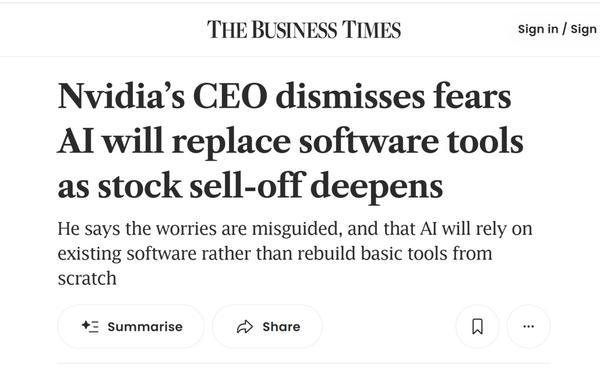
黄仁勋:AI不会取代软件 现有软件生态是发展基础
Huan Qiu Wang· 2026-02-05 03:17
Core Viewpoint - Nvidia CEO Jensen Huang refuted concerns that "artificial intelligence will replace software and related tools," stating that this view is "illogical" and that time will prove it [1] Group 1: AI and Software Industry - Huang emphasized that the belief AI will render software companies obsolete is a misunderstanding, asserting that the future development of AI relies on the existing software ecosystem rather than reinventing foundational tools from scratch [1] - He pointed out that both humans and robots prefer "using existing tools" over "reinventing tools," indicating a clear preference for leveraging current software capabilities [1] - Huang explained that the latest breakthroughs in AI are focused on the "use of tools," with the existing software tools designed with clear characteristics providing solid support for AI applications [1] Group 2: Market Reactions - The launch of a new chatbot by AI company Anthropic has raised concerns about the rapid advancement of AI capabilities potentially impacting the data industry and professional services, leading to a notable sell-off in global software stocks [1] - The sentiment surrounding these developments has continued to spread across the market, reflecting heightened anxiety among investors regarding the implications of AI advancements [1]