
新兴产业

Search documents
热点思考 | 财政“下半场”,可能的“后手”?(申万宏观·赵伟团队)
赵伟宏观探索· 2025-09-20 07:13
Group 1 - The core viewpoint of the article emphasizes the significant role of fiscal policy in supporting economic resilience in the first half of 2025, with a broad fiscal expenditure growth rate of 8.9%, surpassing the nominal GDP growth rate of 4.3% [3][10] - Fiscal expenditures in the first half of 2025 showed a front-loaded rhythm and differentiated allocation, with a focus on debt resolution and rapid implementation of special refinancing bonds, amounting to nearly 1.8 trillion yuan [3][22] - Key areas of fiscal support included social security and employment, with expenditures increasing by 9.2% year-on-year, and scientific and technological spending rising by 9.1% compared to the same period in 2024 [3][22] Group 2 - The necessity and possibility of increasing fiscal measures in the second half of 2025 are highlighted, especially if economic pressures become evident, with potential adjustments to fiscal policies to meet annual GDP targets [5][40] - The article discusses two categories of fiscal tools for potential increases: one involving incremental policies that do not require budget adjustments, and another involving new government debt limits that require approval from the National People's Congress [6][68] - Historical context is provided regarding past adjustments to fiscal budgets, indicating that significant changes have occurred infrequently, with the last major adjustment in October 2023 involving an additional 1 trillion yuan in government bonds [6][68] Group 3 - Current fiscal priorities are identified as risk prevention, transformation promotion, livelihood protection, and consumption stimulation, with a focus on addressing hidden debt issues at the local government level [7][74] - The article notes that new emerging industries and service sector development are key areas of support, as indicated by recent political meetings emphasizing new pillar industries and increased openness in the service sector [7][81] - Specific fiscal measures include the establishment of a childcare subsidy fund with an initial budget of approximately 90 billion yuan, aimed at supporting families with children [7][89]

新型工业化取得新的历史性成就
Xiao Fei Ri Bao Wang· 2025-09-15 02:52
Core Viewpoint - During the "14th Five-Year Plan" period, China's manufacturing value-added is expected to increase by 8 trillion yuan, contributing over 30% to global manufacturing growth, with its share of global manufacturing value-added nearing 30% [1][2] Group 1: Manufacturing Growth - China's total industrial value-added is projected to grow from 31.3 trillion yuan in 2020 to 40.5 trillion yuan by 2024, while manufacturing value-added is expected to rise from 26.6 trillion yuan to 33.6 trillion yuan [2] - The modern industrial system, centered on advanced manufacturing, has shown significant progress, with traditional industries undergoing renewal and emerging industries accelerating [2] Group 2: Digital Economy Integration - The deep integration of the digital economy and the real economy has injected new momentum into high-quality development of manufacturing, with over 4.598 million 5G base stations established [3] - Key industrial internet platforms have connected over 100 million devices, fostering the growth of competitive industries such as photovoltaics, lithium batteries, and new energy vehicles [3] Group 3: Support for SMEs - The number, efficiency, and quality of small and medium-sized enterprises (SMEs) have significantly improved during the "14th Five-Year Plan," with over 12.8 million employees in large-scale SMEs [4] - The average annual growth rates for value-added, revenue, and profit of large-scale industrial SMEs are 6.4%, 7.4%, and 5.4%, respectively, all exceeding those of large enterprises [4] Group 4: Specialized and Innovative Enterprises - Over 100,000 specialized and innovative SMEs have been established, with more than 14,000 in total, and "little giant" enterprises exceeding 14,600, showcasing strong R&D investment [5] - More than 95% of "little giant" enterprises have stable partnerships with well-known domestic and international companies, primarily in strategic emerging industries [5] Group 5: Future Initiatives - Future measures are expected to further optimize the development environment for SMEs, focusing on policy regulations, enterprise cultivation, and public services [6]
盐城射阳“三箭齐发”,聚焦“新势能+策源力+新格局”
Yang Zi Wan Bao Wang· 2025-09-10 17:27
Group 1 - The local government of Yancheng City is focusing on high-quality development by promoting the integration of technology and innovation, optimizing the business environment, and strengthening the foundation for scientific innovation [1] - Emphasis is placed on cultivating high-tech enterprises, technology investment, and creating benchmarks, with a comprehensive nurturing system established for various types of enterprises [1] - Successful hosting of technology competitions to attract investment and projects, with a focus on revitalizing traditional industries and expanding emerging industries [1] Group 2 - The establishment of high-level experimental platforms is aimed at enhancing research and development capabilities in strategic emerging industries, including the creation of national-level testing platforms [2] - Support for local enterprises to establish key laboratories and encourage leading companies to develop advanced research strategies, with a target of exceeding 60% recognition rate for R&D institutions among large-scale enterprises [2] Group 3 - Collaboration between industry, academia, and research institutions is being deepened to create a new ecological pattern, including regular interactions and technology demand matching [3] - Financial services are being improved to support high-tech enterprises, including the exploration of specialized financial products and the establishment of a whitelist system for technology companies [3]
两座沿海城市“组队”,打造“北方样板”
Mei Ri Jing Ji Xin Wen· 2025-09-01 23:59
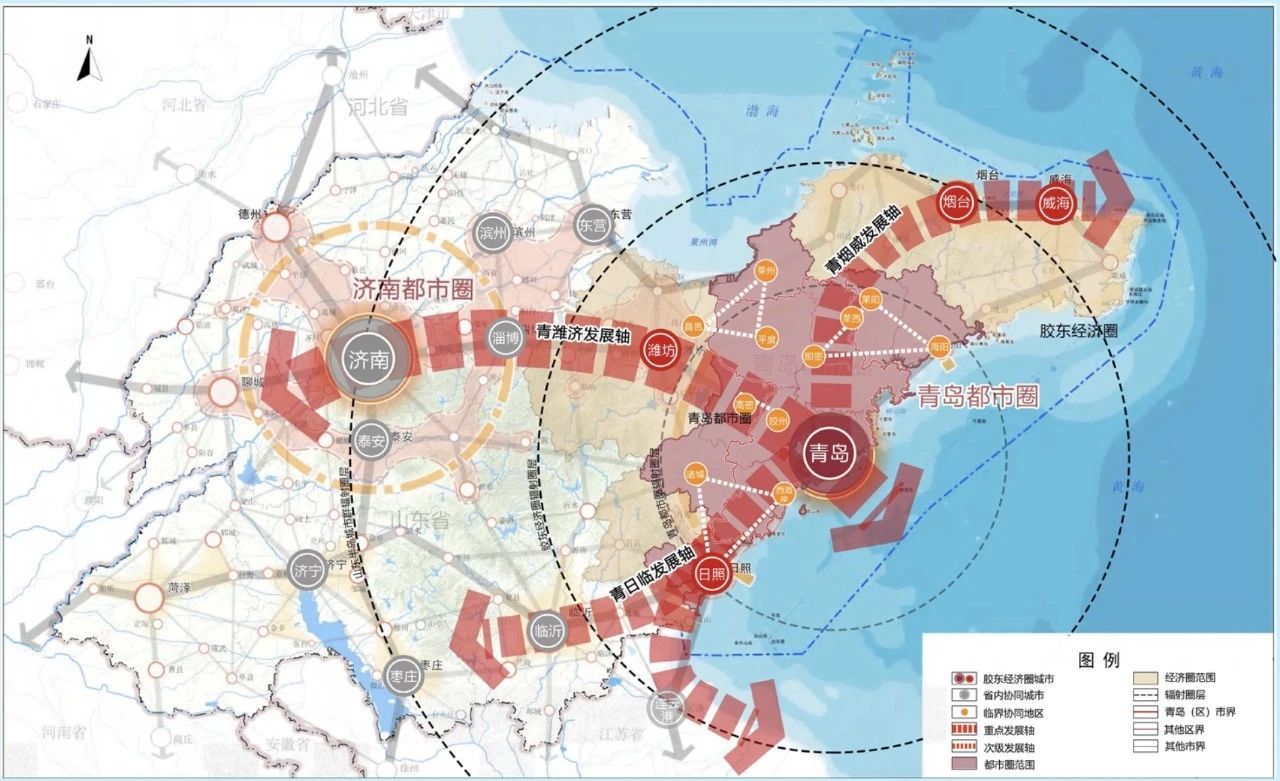
Group 1 - The core viewpoint emphasizes the importance of deepening cooperation between Qingdao and Weifang to accelerate the development of the Qingdao metropolitan area and strengthen the Shandong Peninsula urban agglomeration [1][2] - Qingdao and Weifang have been enhancing their collaboration since 2007, with significant milestones including the approval of the Qingdao metropolitan area development plan in October 2023, marking it as the first non-provincial capital national-level metropolitan area in China [2][3] - The two cities account for over 25% of Shandong's GDP, retail sales, and fiscal budget revenue, and over 33% of the province's total imports and exports, despite representing less than one-sixth of the province's land area and one-fifth of its population [3] Group 2 - The strategic cooperation agreement signed in February 2024 focuses on six areas, including technological innovation, industrial collaboration, transportation connectivity, and market circulation [2][3] - Weifang is positioned as a key hub connecting the Jinan-Qingdao metropolitan area, with expectations to become the next city in Shandong to surpass a GDP of 1 trillion yuan, following Qingdao, Jinan, and Yantai [5] - As of mid-2023, Weifang's GDP reached 4,065.3 billion yuan, reflecting a year-on-year growth of 5.3%, with projections for 2024 indicating a breakthrough of 800 billion yuan [5]
张辉:“人工智能+”赋能现代化产业体系
Jing Ji Ri Bao· 2025-08-27 00:14
Group 1: Core Insights - Artificial intelligence (AI) is a strategic technology leading a new wave of technological revolution and industrial transformation, significantly changing human production and lifestyle [1][2] - The integration of AI with traditional industries is essential for enhancing resource efficiency and driving innovation, as highlighted by the need for a collaborative innovation system [3][5] - AI can optimize production processes and enhance productivity through real-time data collection and analysis, leading to a shift towards data-driven production models [4][5] Group 2: Industry Transformation - AI enables traditional industries to undergo "incremental innovation" by optimizing resource allocation and reshaping production processes, thus enhancing resilience [2][3] - The development of AI-driven industrial internet platforms can improve supply chain efficiency and responsiveness, addressing issues like information asymmetry and slow response times [4][10] - The transition from a resource-consuming model to a knowledge and service-oriented model is crucial for the transformation of traditional manufacturing [4][11] Group 3: Future Development - AI is a key driver for new technological revolutions and is vital for gaining a competitive edge in global technology [6][7] - There are challenges in AI development, including the need for core technology innovation and deeper integration with emerging industries [7][8] - Fostering collaboration between traditional, emerging, and future industries through AI can enhance the resilience and efficiency of the modern industrial system [10][11]
民营经济发展关键期须并重纾困与开放
第一财经· 2025-08-19 01:10
Core Viewpoint - The article emphasizes the importance of supporting the high-quality development of the private economy in China, highlighting recent government actions and policies aimed at fostering this sector's growth and addressing existing challenges [2][3][4]. Group 1: Government Support and Policies - Recent significant actions have been taken to support the high-quality development of the private economy, indicating a critical development period for this sector [2]. - The National Development and Reform Commission (NDRC) has outlined measures to optimize the competitive market environment, enhance support for private enterprises, and protect their legal rights [2][3]. - The NDRC's article emphasizes the need for targeted policy measures to support private enterprises in technology innovation and modern industrial system construction [2]. Group 2: Legal and Judicial Support - The Supreme People's Court has issued guidelines to implement the Private Economy Promotion Law, proposing specific measures to provide legal support for the development of the private economy [3][4]. - The guidelines aim to address challenges faced by private enterprises and enhance the legal environment for their healthy and high-quality development [3][4]. Group 3: Addressing Challenges and Support Measures - Continuous efforts are needed to alleviate the difficulties faced by private enterprises, particularly in resolving issues related to overdue payments and correcting wrongful cases involving enterprises [5]. - The NDRC has highlighted the importance of opening key sectors to private enterprises and establishing mechanisms for their participation in major national projects [6]. Group 4: Internal Improvements for Private Enterprises - Private enterprises are encouraged to improve their internal capabilities, innovate, and enhance management and decision-making processes to overcome existing shortcomings [7]. - The article notes that some private enterprises have faced setbacks due to poor market understanding and management practices, emphasizing the need for strategic focus and innovation [7]. - The current political, economic, and social environments are favorable for the development of the private economy, with increasing policy support and detailed measures being implemented [7].

《关于金融支持新型工业化的指导意见》解读 创金合信基金罗水星:加速制造业产业升级
Xin Lang Ji Jin· 2025-08-11 07:28
Group 1 - The "Guiding Opinions" issued by seven departments, including the central bank, focus on 18 targeted support measures for the new industrialization strategy, emphasizing the high-end, intelligent, and green development of manufacturing [1][2] - The capital market plays a crucial role in financing and optimizing financial resource allocation, which is essential to prevent "involution" competition by making financial resources appropriately scarce [1][3] - The financial system is expected to mature by 2027, enhancing service adaptability and addressing financing pain points in the industrial and manufacturing sectors through various financial instruments [2][3] Group 2 - The future industrialization will be characterized by high-end manufacturing and intelligent transformation, with traditional industries transitioning to smart factories and digital production lines through AI integration [3][4] - The capital market is expected to provide multi-level financing channels for emerging industries, support mergers and acquisitions, and innovate bond varieties to broaden financing sources [3][4] - The emphasis on long-term financing for key technology breakthroughs in manufacturing indicates a shift towards sustainable financial support for emerging industries [3][5] Group 3 - The investment and financing functions must be balanced, ensuring that promising companies receive support while reinforcing regulatory measures to prevent misuse of funds [4][5] - The pain points in emerging industry development include the scarcity of new technologies and the need for specialized talent to identify potential opportunities [5][6] - The focus on preventing "involution" competition involves making financial resources scarce and ensuring that investments yield returns, thereby constraining disorderly capacity expansion [5][6] Group 4 - Key investment opportunities in the new industrialization process include innovative pharmaceuticals, computing power, photolithography machines, high-end CNC machine tools, nuclear fusion, AI applications, IoT, military industry, and robotics [6][7]
上半年广西有效注册商标总量超58万件
Sou Hu Cai Jing· 2025-08-07 00:45
Group 1 - The total number of valid registered trademarks in Guangxi reached 585,800 in the first half of 2025, representing a year-on-year growth of 8.93%, ranking 8th nationwide and maintaining a top ten position for five consecutive years [1] - According to the World Brand Lab's 2025 list, Guangxi has 13 brands listed among China's 500 most valuable brands, with a total brand value of 323.339 billion yuan, an increase of 58.7% year-on-year, achieving new highs in both the number of brands and total brand value over the past five years [1] - The achievements are attributed to Guangxi's focus on comprehensive brand cultivation and the provision of high-quality services, transitioning from "quantity increase" to "quality improvement" [1] Group 2 - In the enterprise cultivation sector, Guangxi has established a resource directory database to accurately match the needs of emerging industries like the digital economy and traditional advantageous industries such as Liuzhou snail rice noodles, forming a "one policy for one industry" mechanism [1] - Nine cities have set up international brand talent training bases, conducting trademark international registration and protection training for eight consecutive years, with a more than 30% year-on-year increase in Madrid international trademark registrations in 2024 compared to 2023 [1] - In agriculture, Guangxi promotes a model of "geographical indication + leading enterprises + farmers," implementing actions for 100 geographical indications and 1,000 enterprises, leading to 1,167 enterprises using special marks, with a total industry chain output value exceeding 200 billion yuan [1] Group 3 - Guangxi has established 107 trademark brand guidance stations, conducting nearly 100 training sessions and one-on-one overseas trademark risk assessments for enterprises [2] - The region has promoted "one-stop" processing at 15 trademark acceptance windows, providing efficient and convenient services for market entities [2] - Since the beginning of the 14th Five-Year Plan, Guangxi has allocated 22.31 million yuan in special funds for trademark brand construction, effectively guiding enterprises to strengthen trademark brand asset management [2]
陕西民营高新技术企业达1.42万家
Shan Xi Ri Bao· 2025-08-07 00:01
Group 1 - The core viewpoint is that private enterprises in Shaanxi province are becoming the main force in the development of emerging industries and new productivity, with 14,200 high-tech enterprises accounting for over 80% of the province's total high-tech enterprises as of June this year [1] - Shaanxi has implemented a series of policies to support the growth of high-tech enterprises, including reforms in technology transfer and evaluation of talent, which have accelerated the transformation of scientific and educational advantages into development advantages [1] - The province is continuing to implement four projects: "Climbing", "Upgrading", "Advancing", and "Listing", along with financing initiatives to support innovative small and medium-sized enterprises, leading to the emergence of a number of industry-leading private high-tech enterprises [1] Group 2 - The application process for high-tech enterprise recognition for the year 2025 has begun in Shaanxi, targeting resident enterprises registered for over one year within the province [2] - Enterprises that have undergone name changes since their recognition in 2022 must complete the name change procedures before applying for re-recognition [2]
金融支持新型工业化 划重点来了
Yang Shi Xin Wen Ke Hu Duan· 2025-08-05 08:32
Group 1 - Financial support for key industries such as integrated circuits, industrial mother machines, and basic software will be enhanced through long-term financing from banks, with a "green channel" for companies breaking through core technologies [1][2] - Capital will be encouraged to invest in hard technology with a focus on early, small, and long-term investments, including direct investments and service exchange equity for incubated enterprises [1][2] - Traditional industries will receive increased credit support for high-end, intelligent, and green transformation, with options for financing leasing and debt securitization [1][2] Group 2 - Emerging industries like new-generation information technology, new energy, and biomedicine will have access to multi-level capital market financing, with government investment funds and insurance capital focusing on future manufacturing and energy [1][2] - Financial institutions will explore data credit and asset credit to reduce reliance on guarantees for small and medium-sized enterprises, with a national credit information platform for easier access to credit [2] - Green transformation projects in high-carbon industries will receive support, with a focus on green credit and bonds for environmental upgrades [2] Group 3 - Digital infrastructure projects such as 5G and industrial internet will be eligible for long-term loans, with banks providing one-stop services through digital platforms [2] - Financial institutions are required to monitor the use of funds to prevent misuse and ensure risk management in manufacturing loans [4]