
运动服装

Search documents
嘉麟杰涨2.26%,成交额2029.12万元,主力资金净流入156.50万元
Xin Lang Cai Jing· 2025-09-26 02:47
Group 1 - The core viewpoint of the news is that 嘉麟杰 has shown fluctuations in stock performance, with a year-to-date increase of 10.61% and a recent decline of 3.90% over the last five trading days [1] - As of September 26, 嘉麟杰's stock price was 2.71 CNY per share, with a market capitalization of 2.234 billion CNY [1] - The company has experienced a net inflow of main funds amounting to 1.565 million CNY, with significant buying and selling activities noted [1] Group 2 - For the first half of 2025, 嘉麟杰 reported a revenue of 616 million CNY, reflecting a year-on-year growth of 3.93%, and a net profit attributable to shareholders of 29.749 million CNY, which is a 27.38% increase [2] - The number of 嘉麟杰 shareholders increased to 49,900, marking a 2.66% rise, while the average circulating shares per person decreased by 2.59% to 16,456 shares [2] Group 3 - 嘉麟杰 has distributed a total of 122 million CNY in dividends since its A-share listing, with 9.984 million CNY distributed over the past three years [3]

耐克:一个需要时间复苏的伟大品牌
美股研究社· 2025-09-24 11:23
Core Viewpoint - Nike is facing significant revenue challenges due to lower-than-expected demand and tariffs, with a high expected P/E ratio of approximately 43 times, which is substantially above industry and S&P 500 averages, indicating a need for management to reverse the current situation to achieve substantial growth [2][4][10]. Financial Performance - For Q4 of FY2025, Nike reported revenue of $11.1 billion, a year-over-year decline of 11% on a currency-neutral basis, with direct sales down 14% to approximately $4.4 billion and wholesale revenue down 9% to $6.4 billion [2][4]. - The company's FY2025 revenue was approximately $46.3 billion, a 10% decrease compared to FY2024, with earnings per share (EPS) of $0.14, down about 86% year-over-year [4][9]. - Operating cash flow decreased by approximately 50%, significantly worse than the industry average decline of about 1% [16]. Valuation and Market Position - Nike's expected P/E ratio is 42.88, which is notably higher than the industry average and S&P 500, suggesting that investors are willing to pay a premium for potential recovery, but this poses risks if growth does not materialize [10][13]. - The company's enterprise value multiples (EV/Sales) are 2.32 and 2.28, indicating overvaluation compared to industry medians of 1.34 and 0.99 [13]. Shareholder Returns - Nike has continued its shareholder-friendly strategy by increasing dividends and implementing a stock buyback program, repurchasing approximately 3.2 million shares for about $202 million in the last quarter [5][18]. - The company has a dividend yield of 2.26% and a history of 35 consecutive years of dividend payments, although its payout ratio is high at 70%, suggesting limited room for future dividend growth [18][19]. Operational Challenges - The company is experiencing pressure on profit margins due to discounts and slowing demand, with a reported profit margin of 40.3% in Q4, down from previous levels [4][9]. - Nike's EBITDA decreased nearly 41% year-over-year, contrasting sharply with the industry median growth of 2%, highlighting significant operational challenges [15]. Future Outlook - Analysts expect Nike's Q1 FY2026 revenue to be around $10.97 billion, a decline of approximately 5% year-over-year, with EPS projected at $0.27, indicating a nearly 61% drop [9][10]. - The upcoming earnings report is critical for assessing whether there will be any signs of demand recovery or further revenue contraction, which could significantly impact investor sentiment [10][21].



纺织服装海外跟踪系列六十四:露露乐蒙二季度收入低于指引,中国市场持续引领增长
Guoxin Securities· 2025-09-16 14:43
Investment Rating - The investment rating for the textile and apparel industry is "Outperform the Market" [2][32]. Core Insights - The second quarter revenue of Lululemon was below guidance, but profits exceeded expectations. The Chinese market continues to lead growth and has accelerated sequentially, while management has lowered full-year revenue and profit guidance [4][6]. - For FY2025 Q2, revenue grew by 6.5% year-on-year (6.0% at constant currency) to $2.525 billion, which was below the guidance of 7.0-8.0%. Gross margin declined by 110 basis points to 58.5%, outperforming the guidance of a 200 basis point decline [3][9]. - The management has adjusted the full-year revenue guidance to a growth of 2-4% due to increased tariffs and the cancellation of small package tariff exemptions, with Q3 revenue expected to grow by 3-4% and operating profit margin expected to decline by 560 basis points [4][21]. Summary by Sections Financial Performance - In FY2025 Q2, Lululemon's revenue was $2.525 billion, with a year-on-year growth of 6.5%. The operating profit margin decreased to 20.7%, and diluted EPS was $3.10 [3][9]. - The online channel revenue grew by 9.1% year-on-year, while the offline direct channel revenue increased by 3.2% [10]. Regional Analysis - Revenue in China (excluding Hong Kong and Taiwan) grew by 25.1% year-on-year, with management expecting a full-year growth of 20-25%. The U.S. and Canadian markets are experiencing a decline in consumer spending on apparel [15][24]. - The Americas accounted for 69.6% of total revenue, with the U.S. market showing stagnant growth due to insufficient innovation in leisure categories [15][16]. Management Guidance - The full-year revenue guidance has been lowered to $10.85-11.00 billion, reflecting a growth of 2-4%. The gross margin is expected to decline by 300 basis points [21][24]. - Management remains optimistic about the Chinese market, expecting continued strong growth and plans to open new stores primarily in China [26][27]. Tariff Impact - The cancellation of the small package tariff exemption in the U.S. is expected to pressure gross margins, with an estimated negative impact of 170 basis points. The company plans to adjust its warehousing and distribution strategies to maintain operational efficiency [5][26]. Investment Recommendations - The report recommends focusing on leading companies in the Chinese sportswear supply chain, such as Shenzhou International and Huayi Group, as well as domestic brands like Anta Sports and Li Ning for long-term growth prospects [5][27].
探路者跌2.01%,成交额1.14亿元,主力资金净流出1440.99万元
Xin Lang Cai Jing· 2025-09-12 03:21
Company Overview - Tsinghua Tongfang Co., Ltd. is located in Beijing and was established on January 11, 1999, with its listing date on October 30, 2009. The company operates in two main business segments: outdoor products and semiconductor chips, which belong to the outdoor goods industry and semiconductor industry respectively [1] - The revenue composition of Tsinghua Tongfang includes outdoor clothing (63.31%), chip business (17.13%), outdoor footwear (13.29%), outdoor equipment (3.71%), and other service businesses (2.56%) [1] Financial Performance - For the first half of 2025, Tsinghua Tongfang reported a revenue of 653 million yuan, a year-on-year decrease of 7.82%. The net profit attributable to shareholders was 20.09 million yuan, down 76.50% year-on-year [2] - Since its A-share listing, Tsinghua Tongfang has distributed a total of 509 million yuan in dividends, with 30.42 million yuan distributed over the past three years [3] Stock Market Activity - On September 12, Tsinghua Tongfang's stock price decreased by 2.01%, trading at 9.28 yuan per share with a total market capitalization of 8.201 billion yuan. The trading volume was 114 million yuan, with a turnover rate of 1.38% [1] - Year-to-date, Tsinghua Tongfang's stock price has increased by 32.59%, but it has seen a decline of 3.33% over the last five trading days and a slight decrease of 1.17% over the last 20 days [1] - The company has appeared on the "Dragon and Tiger List" once this year, with the most recent occurrence on April 30, where it recorded a net purchase of 115 million yuan [1] Shareholder Information - As of June 30, Tsinghua Tongfang had 58,000 shareholders, an increase of 31.04% from the previous period. The average number of tradable shares per shareholder was 15,220, a decrease of 23.69% [2]

周五美股:AI芯片领域“冰火”交织,宏观数据疲软引市场担忧
Sou Hu Cai Jing· 2025-09-06 17:29
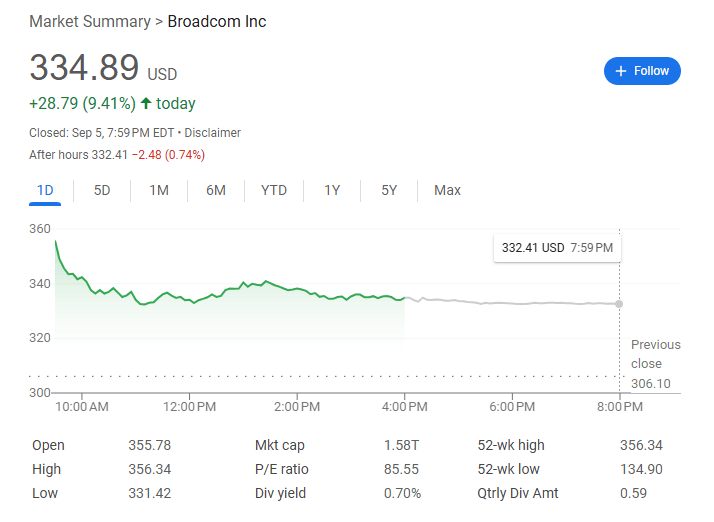
Group 1: AI Chip Industry Dynamics - The AI chip industry experienced a significant shift, with Broadcom's stock soaring by 9.4% due to reports of a partnership with OpenAI to design and produce AI chips starting in 2026, raising concerns about NVIDIA's market dominance [3] - NVIDIA's stock fell by 2.7%, while AMD and Microsoft also saw declines of 6.6% and 2.6% respectively, as investor sentiment shifted towards Broadcom's potential impact on the AI hardware market [3] - NVIDIA's CEO emphasized the company's energy efficiency advantages, suggesting that customers may find it difficult to switch suppliers despite the competitive landscape [3] Group 2: Macroeconomic Data Impact - The U.S. non-farm payroll report for August showed only 22,000 new jobs added, significantly below the expected 75,000, with the unemployment rate rising slightly to 4.3% [3] - This weak employment data has intensified expectations for a Federal Reserve rate cut in September, while also raising concerns about a potential economic recession [3] - Continuous weak employment figures are likely to lead investors to question economic growth, which could directly impact corporate earnings and put pressure on the currently high stock valuations [3] Group 3: Market Reactions and Sector Performance - The market's interpretation of potential rate cuts is mixed, with some strategists suggesting benefits for small-cap stocks, as evidenced by the Russell 2000 index rising by 0.5% [4] - Conversely, concerns about the extent of rate cuts have led to increased risk aversion, with gold and other safe-haven assets gaining popularity, pushing gold mining stock indices to their highest levels since 2011 [4] - Cyclical stocks showed weakness, with energy and financial sectors both declining over 1.8%, influenced by falling oil prices amid Saudi Arabia's comments on OPEC+ production [5] Group 4: Company-Specific Developments - Tesla's stock rose by 3.6% following a proposal to provide CEO Elon Musk with a compensation package potentially worth up to $1 trillion [5] - Lululemon's stock plummeted by 19% after the company lowered its earnings outlook, highlighting the volatility in the retail sector [5] - Investors are expected to closely monitor upcoming CPI inflation data and Apple's annual iPhone launch for potential market direction [5]


周五,AI芯片巨头“冰火两重天”
华尔街见闻· 2025-09-06 10:10
Group 1 - The core market contradiction revolves around "AI chips," with Broadcom's stock soaring due to a partnership with OpenAI, while Nvidia's stock fell, impacting the tech sector negatively [1][4] - Broadcom, a top-weighted stock in the S&P 500, will help OpenAI design and produce an AI chip starting in 2026, leading to a 9.4% increase in Broadcom's stock, while Nvidia's stock dropped by 2.70% [4] - The decline in Nvidia's stock also affected other tech stocks, with AMD down 6.6% and Microsoft down 2.6%, reflecting investor concerns over intensified competition in the AI chip sector [4] Group 2 - A disappointing U.S. employment report showed only 22,000 new jobs in August, far below the expected 75,000, and the unemployment rate rose slightly to 4.3% [5][6] - This weak employment data reinforced expectations that the Federal Reserve may lower interest rates in its upcoming meeting, but it also raised concerns about the overall economic condition [6] - Market reactions to potential rate cuts are mixed, with small-cap stocks benefiting, as seen by a 0.5% rise in the Russell 2000 index, while some strategists warn that rate cuts may not meet market expectations [6] Group 3 - There is increasing market divergence, with cyclical companies underperforming and energy and financial sectors both declining over 1.8% due to falling oil prices [7] - Amid economic uncertainty and geopolitical factors, investors are seeking safe-haven assets, pushing gold and gold mining stocks to new highs since 2011 [7] - Tesla's stock rose 3.6% following a proposal for a historic $1 trillion compensation package for CEO Elon Musk, while Lululemon's stock plummeted 19% after lowering its earnings outlook [7] Group 4 - The market will closely monitor upcoming CPI inflation data and Apple's annual iPhone launch event as key indicators for future trends [8]

博通大涨、英伟达下跌,博通能否替代英伟达?“AI芯片”牵动整个美股
美股IPO· 2025-09-06 04:55
Group 1 - Broadcom will design and produce AI chips for OpenAI starting in 2026, leading to a 9.4% increase in Broadcom's stock price [1][6] - Nvidia's stock fell by 2.70% due to concerns over increased competition in the AI chip market, negatively impacting the technology sector [1][6] - AMD's stock dropped by 6.6% and Microsoft's stock fell by 2.6% as a result of Nvidia's decline, indicating a broader impact on tech stocks [6] Group 2 - The U.S. non-farm payroll report showed only 22,000 new jobs in August, significantly below the expected 75,000, raising concerns about economic growth [4][7] - The unemployment rate slightly increased to 4.3%, and previous data was revised to show a contraction for the first time since 2020, intensifying recession fears [7] - Market reactions to potential Federal Reserve interest rate cuts are mixed, with small-cap stocks benefiting while larger economic concerns persist [7] Group 3 - There is a noticeable divergence in market performance, with cyclical companies underperforming and energy and financial sectors both declining over 1.8% [8] - Investors are increasingly seeking safe-haven assets like gold, pushing gold mining stock indices to their highest levels since 2011 [9] - Tesla's stock rose by 3.6% following a proposal for a $1 trillion compensation package for CEO Elon Musk, while Lululemon's stock plummeted by 19% due to lowered earnings outlook [9] Group 4 - The market is set to closely monitor upcoming CPI inflation data and Apple's annual iPhone launch event as key indicators for future trends [10]

突然崩盘!又一家国际知名品牌受到关税重创!
Zheng Quan Shi Bao Wang· 2025-09-06 04:52
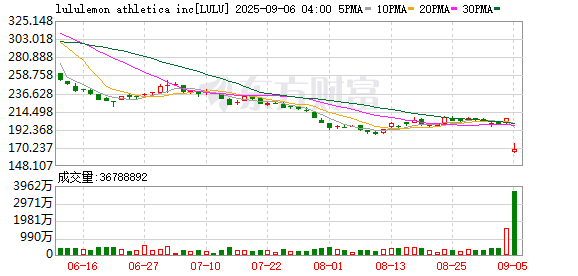
又一家国际知名品牌受到美国关税冲击! 周五盘中,知名瑜伽运动服装品牌露露乐蒙(lululemon)股价一度大跌20%。此前,露露乐蒙大幅下调了2025财年的全年盈利和销售预测。该公司预计, 关税将使其全年毛利润减少2.4亿美元。 在财报披露后,多家投行下调了露露乐蒙的目标价。其中,摩根大通将露露乐蒙目标价从224美元下调至191美元,巴克莱将露露乐蒙目标价从209美元下 调至180美元,派杰投资将露露乐蒙目标价从200美元下调至165美元。 今年以来,露露乐蒙在美股市场累计下跌46%,总市值蒸发了200多亿美元。 关税打压业绩,露露乐蒙股价跳水 美国的关税政策,对全球服装业的影响正在逐步显现。 当地时间9月4日,加拿大瑜伽和健身服装品牌露露乐蒙(lululemon)公布了截至8月3日的2025财年第二财季业绩。在该季度,露露乐蒙再度下调了2025 年全年业绩预期,主要是受美国市场需求疲软及关税成本上升双重因素冲击。业绩预期的下调导致公司股价大幅跳水。周五美股盘中,露露乐蒙股价一度 大跌20%。 截至收盘时,该公司股价下跌18.58%。 第二财季,露露乐蒙的营收为25.25亿美元,同比增长6.5%;净利润为3. ...
突然,崩盘!关税,重创!
券商中国· 2025-09-06 04:16
Core Viewpoint - The article highlights the significant impact of U.S. tariff policies on lululemon's financial performance, leading to a substantial drop in its stock price and downward revisions of its earnings and sales forecasts for fiscal year 2025 [1][2][4]. Financial Performance - lululemon's projected net revenue for the fiscal year 2025 is between $10.85 billion and $11 billion, down from a previous forecast of $11.15 billion to $11.3 billion, and below market expectations of $11.2 billion [4]. - The company expects earnings per share to be between $12.77 and $12.97, significantly lower than analyst expectations of $14.40 and previous guidance of $14.58 to $14.78 [4]. - In the second fiscal quarter, lululemon reported revenue of $2.525 billion, a year-over-year increase of 6.5%, while net profit decreased by 5% to $371 million [4]. Market Impact - The stock price of lululemon fell by as much as 20% during trading, closing down 18.58% following the earnings report [2][4]. - Year-to-date, lululemon's stock has declined by 46%, resulting in a market capitalization loss of over $20 billion [1]. Competitive Landscape - lululemon's core business in North America is under pressure, with comparable store sales in the Americas declining by 4% in the second quarter [5]. - The company faces increased competition from emerging brands like Alo Yoga and Vuori, which are capturing market share [5]. Broader Industry Context - The article notes that other major brands, such as Adidas and Nike, are also experiencing challenges due to U.S. tariff policies, with Adidas reporting significant losses and Nike planning layoffs [5][6]. - The overall apparel industry is feeling the effects of rising costs due to tariffs, which are expected to continue impacting consumer prices and spending [7][8].

三夫户外上半年营收3.78亿元同比增15.10%,归母净利润1681.93万元同比增105.75%,销售费用同比增长14.34%
Xin Lang Cai Jing· 2025-08-29 14:30
Core Viewpoint - Sanfo Outdoor reported a significant increase in revenue and net profit for the first half of 2025, indicating strong business performance and growth potential [1][2]. Financial Performance - The company's revenue for the first half of 2025 was 378 million yuan, a year-on-year increase of 15.10% [1]. - The net profit attributable to shareholders was 16.82 million yuan, showing a year-on-year growth of 105.75% [1]. - The net profit excluding non-recurring items reached 15.36 million yuan, with a remarkable year-on-year increase of 323.29% [1]. - Basic earnings per share stood at 0.11 yuan [1]. Profitability Metrics - The gross margin for the first half of 2025 was 58.64%, up by 0.83 percentage points year-on-year [2]. - The net profit margin was 3.94%, an increase of 2.93 percentage points compared to the same period last year [2]. - In Q2 2025, the gross margin was 57.65%, down by 1.48 percentage points year-on-year and 1.93 percentage points quarter-on-quarter [2]. - The net profit margin for Q2 was 1.79%, a decrease of 1.57 percentage points year-on-year and 4.20 percentage points quarter-on-quarter [2]. Expense Analysis - Total operating expenses for the first half of 2025 were 194 million yuan, an increase of 13.34 million yuan compared to the previous year [2]. - The expense ratio was 51.26%, a decrease of 3.68 percentage points year-on-year [2]. - Sales expenses increased by 14.34%, while management expenses rose by 1.50% [2]. - Research and development expenses decreased by 42.88%, and financial expenses fell by 3.90% [2]. Shareholder Information - As of the end of the first half of 2025, the total number of shareholders was 18,300, a decrease of 969 from the previous quarter, representing a decline of 5.03% [2]. - The average market value held per shareholder increased from 88,300 yuan to 115,300 yuan, reflecting a growth of 30.55% [2]. Company Overview - Sanfo Outdoor, established on June 22, 2001, and listed on December 9, 2015, is based in Beijing and specializes in high-quality outdoor sports products [3]. - The company's main business segments include clothing (56.81%), footwear and socks (24.89%), equipment (11.28%), and other categories (7.02%) [3]. - The company operates under the textile and apparel industry, specifically in the sportswear segment, and is involved in various concepts such as micro-cap stocks and online tourism [3].
