光模块

Search documents
光模块剧烈反弹,逼近历史高点!光模块含量超54%的创业板人工智能ETF(159363)大涨5.7%
Mei Ri Jing Ji Xin Wen· 2025-11-26 03:18
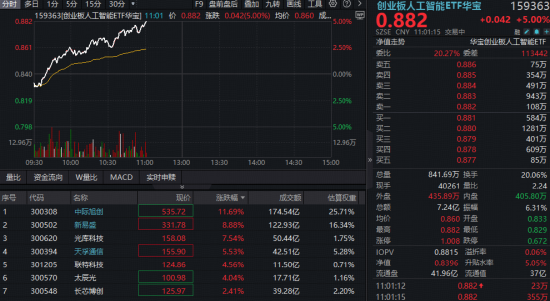
从光模块配置上,创业板人工智能ETF(159363)基金经理近期表示,在美股开始底部显著反弹之际, 虽然调整会反复,但主跌浪或已结束,泛科技ETF配置价值凸显;同时A股高位板块也死守箱体,低位 板块位置调整充分。从空间角度,市场已经达到"低吸"的较好"击球点",配置上关注以光模块为代表的 创业板人工智能ETF(159363),目前就相当于成长板块指数增强。 全市场首只创业板人工智能ETF(159363)及场外联接(023407),标的指数重点布局光模块龙头"易 中天",光模块含量超54%。从赛道分布看,逾七成仓位布局算力,超两成仓位布局AI应用,能够高效 捕捉AI主题行情。 11月26日早盘,光模块CPO涨幅持续扩大,中际旭创盘中暴涨超11%直逼历史高点,新易盛涨超8%, 光库科技、天孚通信、太辰光、联特科技等多股跟涨超4%。热门ETF方面,光模块含量超54%的创业板 人工智能ETF(159363)持续拉升,场内价格涨超5%,一举站上所有均线。资金交易活跃,实时放量 成交超7亿元。 近期,谷歌TPU与英伟达GPU引发市场争议,从国内供应链机会来看,其实无论是谷歌TPU基于3D Torus和OCS的架构,还是英 ...

光模块CPO王者归来!中际旭创涨逾11%直逼前高,创业板人工智能ETF华宝(159363)爆量拉升5%
Xin Lang Ji Jin· 2025-11-26 03:09
消息面上,光模块CPO等人工智能方向迎来多重催化: 11月26日早盘,光模块CPO涨幅持续扩大,中际旭创盘中暴涨超11%直逼历史高点,新易盛涨超8%, 光库科技、天孚通信、太辰光、联特科技等多股跟涨超4%。 热门ETF方面,光模块含量超54%的创业板人工智能ETF(159363)持续拉升,场内价格涨5%,一举站 上所有均线。资金交易活跃,实时放量成交超7亿元! 国盛证券近期研报指出,近期谷歌与英伟达的强势表现,共同勾勒出AI产业发展的核心飞轮:模型升 级催生算力需求,算力增长为模型创新提供基础。技术创新、算力基建与产业应用正形成良性循环,算 力产业链维持高景气度。继续看好算力板块,坚定推荐算力产业链相关企业如光模块行业龙头。 | | 分时 多日 1分 5分 15分 30分 ▼ | | | | | F9 盘前盘后 偷加 九榜 画法 工具 密 2 | | | 创业板人工智能ETF华室 | 159363 | | --- | --- | --- | --- | --- | --- | --- | --- | --- | --- | --- | | QREP | | | | 159363[创业板人工智能ETF华宝] 1 ...


CPO概念持续上行,创业板ETF博时(159908)盘中拉升涨近2%
Xin Lang Cai Jing· 2025-11-26 03:01
Group 1 - The ChiNext Index has shown strong performance, rising by 1.33% as of November 26, 2025, with notable gains in constituent stocks such as Maiwei Co., Ltd. (up 10.59%) and Zhongji Xuchuang (up 9.40%) [1] - The ChiNext ETF by Bosera has increased by 7.80% over the past three months, with a latest price of 2.81 yuan and a turnover rate of 1.63% on November 26, 2025 [1][3] - The optical module (CPO) index rose by 3.01% on November 26, 2025, with institutional funds seeing a net inflow of 34.13 billion yuan [1] Group 2 - The communication industry has performed exceptionally well in 2025, with a year-to-date increase of 55.58%, ranking second among all industries, and institutional holdings have significantly increased [2] - The GB300 platform is expected to ramp up production in Q4, leading to large-scale shipments of 1.6T optical modules, with silicon photonics technology projected to capture nearly 60% of the global optical module market by 2030 [2] - Public fund holdings in the communication sector have surpassed 6.5%, a historical high, while valuations remain relatively low, not fully reflecting the sector's high growth potential [2]
新易盛股价涨5.01%,中国富达基金旗下1只基金重仓,持有1.28万股浮盈赚取19.55万元
Xin Lang Cai Jing· 2025-11-26 02:39
Group 1 - The core viewpoint of the news is that Xinyisheng has seen a significant increase in its stock price, with a rise of 5.01% to 319.99 CNY per share, and a total market capitalization of 318.06 billion CNY [1] - Xinyisheng, established on April 15, 2008, and listed on March 3, 2016, specializes in the research, production, and sales of optical modules, with 98.86% of its main business revenue coming from products above 25G [1] - The trading volume for Xinyisheng reached 7.079 billion CNY, with a turnover rate of 2.56% [1] Group 2 - Fidelity Fund holds a significant position in Xinyisheng, with its Fidelity Low Carbon Growth Mixed A Fund (021730) owning 12,800 shares, accounting for 5.12% of the fund's net value, making it the fifth-largest holding [2] - The Fidelity Low Carbon Growth Mixed A Fund has achieved a year-to-date return of 28.21%, ranking 2519 out of 8134 in its category [2] - The fund manager, Nie Yixiang, has been in charge for 8 years and 118 days, with the best return during his tenure being 135.58% [2]
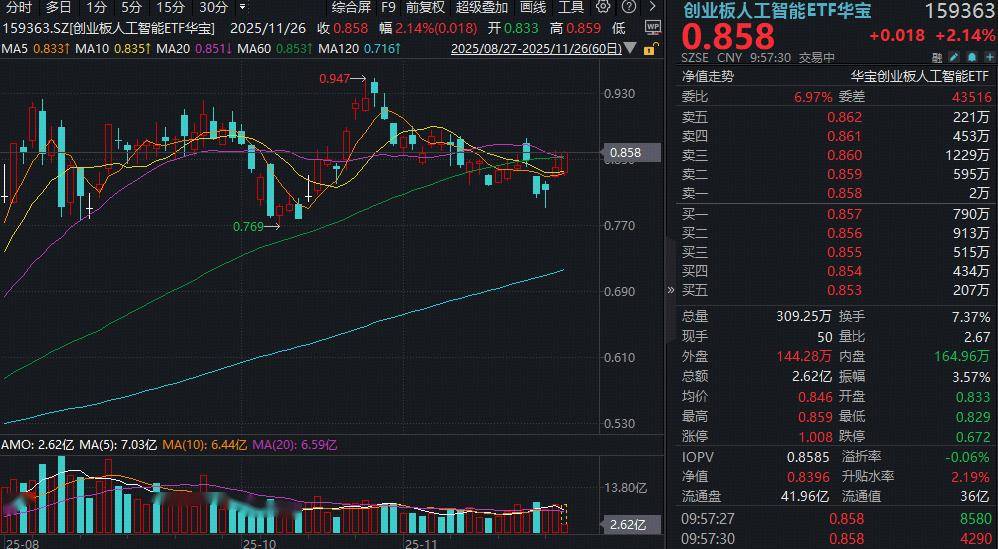
ETF盘中资讯 | 光模块:英伟达GPU与谷歌TPU的算力基石!含“光”量超54%的创业板人工智能ETF(159363)再涨逾2%
Sou Hu Cai Jing· 2025-11-26 02:27
| 分时 多日 1分 5分 15分 30分 7 | 综合屏 F9 前复权 超级叠加 回线 工具 (2) | 159363 | 创业板人工智能印文字 | 159363.SZ[创业板人工智能ETF华宝] 2025/11/26 收 0.858 幅 2.14%(0.018) 开 0.833 高 0.859 低 | 0-8 | OHE | +0.018 +2.14% | | --- | --- | --- | --- | --- | --- | --- | --- | | 10 10 | MA5 0.8331 MA10 0.8351 MA20 0.851 MA60 0.8537 MA120 0.7167 | 2025/08/27-2025/11/26(60日) | SZSE CNY 9:57:30 交易中 | 十八 六 · | | | | | 净值走势 | 华宝创业板人工智能ETF | 0.930 | 製化 | 6.97% === | 43516 | | | | 菜五 | 0.862 | 221万 | 題 要要要要是 | 0.861 | 453万 | | | | 0.858 | 0.860 | 1229万 | 0.85 ...


调整就是布局良机 A股市场迎来放量上涨
Zhong Guo Zheng Quan Bao· 2025-11-25 20:27
Market Overview - On November 25, the A-share market experienced a strong rally with a total trading volume of 1.83 trillion yuan, marking a significant increase in market activity [1][2] - The Shenzhen Component Index and the ChiNext Index both rose over 1%, with more than 4,200 stocks in the A-share market increasing in value, and over 90 stocks hitting the daily limit [1][2] Sector Performance - The communication sector led the gains, with significant contributions from stocks like Zhongji Xuchuang and Sunshine Power, which drove the Shenzhen Component Index and ChiNext Index higher [2][3] - The communication, media, and non-ferrous metal industries saw the highest increases, with respective gains of 3.54%, 2.85%, and 2.42% [3][4] - The Wind communication module index rose by 8.21%, indicating a strong recovery in previously adjusted sectors [3] Fund Flow - On November 25, the net inflow of funds in the Shanghai and Shenzhen markets exceeded 80 billion yuan, ending a streak of seven consecutive days of net outflows [4][5] - The communication sector attracted nearly 40 billion yuan in net inflows, highlighting a shift in investor sentiment [4][5] - The total market capitalization of A-shares reached 114.87 trillion yuan, with the rolling P/E ratio for the entire A-share market at 21.55 times [6] Future Outlook - Analysts suggest that the market may return to an upward cycle as overseas liquidity expectations improve and domestic funding pressures ease [6][7] - The upcoming important meetings in mid-December are expected to provide decisive policy direction, potentially leading to a market recovery [7] - Investment strategies should focus on sectors with safety margins, including communication services, leisure foods, and certain cyclical industries [7]



资产配置日报:乌云乍开-20251125
HUAXI Securities· 2025-11-25 15:20
Core Insights - The report indicates a rebound in the equity market, with the Wande All A index rising by 1.24% and a trading volume of 1.83 trillion yuan, an increase of 858 billion yuan compared to the previous week [1] - The U.S. stock market showed a significant rebound, with the Nasdaq index increasing by 2.69%, attributed to rising expectations of a Federal Reserve interest rate cut [2] - The report highlights a strong performance in the technology sector, particularly with Google’s stock rising by 6.31% due to its AI strategy [2] - Southbound capital inflow into Hong Kong stocks reached 112 billion HKD, indicating confidence in the recovery trend of the Hong Kong market [4] Equity Market Summary - The report notes that the ChiNext index experienced a brief rise before a sustained decline, suggesting ongoing market divergence regarding upward momentum [3] - The light module sector saw a significant increase of 8.21%, driven by released demand following a cautious investment attitude [2][3] - The report suggests that the market is still in a consensus-building phase, with investors cautious about the potential for further declines in the U.S. market and geopolitical tensions [3] Bond Market Summary - The bond market experienced volatility, with long-term interest rates showing limited upward movement initially, followed by a sell-off in long bonds later in the day [4][5] - The report indicates that the sentiment in the bond market is weak, with adjustments in long-duration bonds being influenced by market news [6] - The net redemption strength for bond funds was reported at -0.09, indicating manageable outflows compared to previous significant redemption points [5] Commodity Market Summary - The commodity market showed signs of recovery, particularly in precious metals, with gold and silver prices rising by 1.48% and 2.75% respectively [6] - Lithium carbonate prices rebounded by 4.47%, driven by strong demand and expectations of supply recovery [7] - The report notes a decline in coking coal prices due to increased supply and reduced demand from steel and coke enterprises [8]
ETF龙虎榜 | 科技股爆发 场内千基上涨
Zhong Guo Zheng Quan Bao· 2025-11-25 14:33
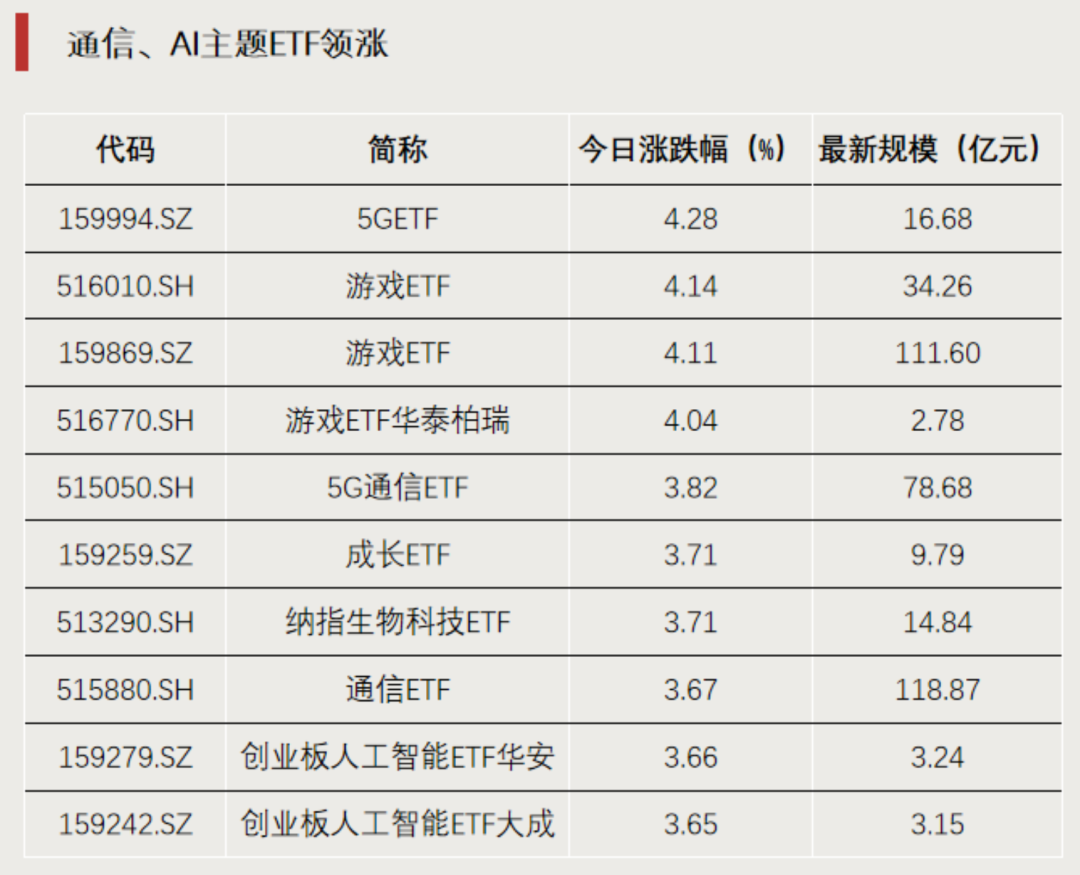
Group 1 - The technology growth sector, represented by optical modules, experienced a significant rally, with some 5G and gaming-themed ETFs rising over 4% and many communication and artificial intelligence-themed ETFs increasing over 3% [1][2] - In the recent wide fluctuations of the A-share market, broad-based ETFs like CSI 300 and CSI 500 have become a "safe haven" for funds, with net inflows exceeding 5.3 billion yuan for CSI 300 ETFs on November 24 [1][5] - Several fund companies reported the first batch of sci-tech entrepreneurship robot ETFs and the first sci-tech entrepreneurship semiconductor ETF during the period from November 24 to November 25 [1][8] Group 2 - The 5G ETF (159994) and multiple gaming-themed ETFs saw increases of over 4%, while many communication, animation, gaming, and artificial intelligence-themed ETFs rose over 3%, indicating a strong overall market performance with over a thousand ETFs closing higher [2][3] - The net inflow for the CSI 300 ETF (510300) exceeded 3.6 billion yuan, ranking first among all ETFs in the market, and it has seen continuous net inflows for two consecutive trading days [6][7] - Recent attention has shifted towards several Hong Kong stock technology-themed ETFs, with the Hang Seng Technology ETF seeing a total net inflow of nearly 10 billion yuan over the past five trading days, ranking first among ETF indices [6][7] Group 3 - The sci-tech entrepreneurship robot index selects 40 companies from the sci-tech board and the entrepreneurial board that provide software and hardware products necessary for robot intelligence, with the latest top ten weighted stocks including Zhongkong Technology and Huichuan Technology [8][9] - The sci-tech entrepreneurship semiconductor index selects 50 larger market capitalization companies in the semiconductor field, with the latest top ten weighted stocks including Cambricon and SMIC [9]
华安基金:创业板50指数追“光”识“新”更掘“金”
Xin Lang Ji Jin· 2025-11-25 09:56
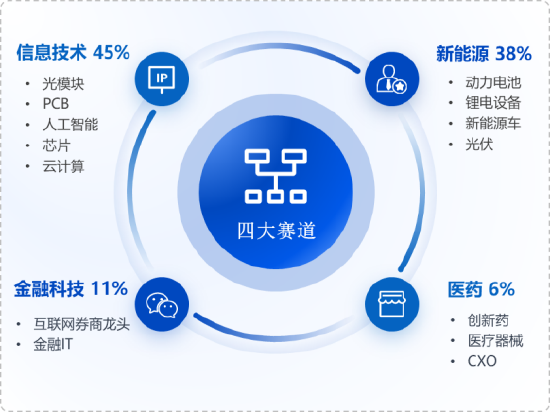
Market Overview - The A-share market experienced a downward trend last week, with major indices showing a general pullback: CSI 300 down 3.77%, CSI 500 down 5.78%, CSI 1000 down 5.80%, ChiNext 50 down 6.04%, and Sci-Tech 50 down 5.54% [1] - The average daily trading volume in the A-share market was around 1.87 trillion yuan, indicating active market participation [1] - Market hotspots showed rapid rotation, initially focusing on lithium batteries, AI applications, Fujian sector, and military industry, followed by semiconductors (photoresists), robotics, and aquaculture, with banks and photoresists gaining strength in the latter part of the week [1] ChiNext 50 Index Insights - The ChiNext 50 Index serves as a direct financing platform for growth-oriented innovative enterprises, focusing on four key sectors: information technology, new energy, financial technology, and pharmaceuticals [1] - The ChiNext 50 Index has a higher concentration of light modules, new energy, and financial technology compared to the ChiNext Index and mainstream broad-based indices [3] - The current valuation of the ChiNext 50 ETF is 37.44 times, placing it in the 32.83% percentile over the past decade [3] Sector Analysis Technology, AI, and Communication - The ChiNext 50 Index includes 45% of the information technology sector, with 19% weight in light modules, which experienced a slight pullback [3] - Google Cloud announced a plan to double computing power every six months, with the retail price of 1.6T light modules rising to $2,000 (up 67% from the listing price) [3] - Despite short-term funding divergence, the demand for 800G/1.6T iterations remains rigid, with LightCounting predicting a 48% growth in the global light module market by 2025 [3] New Energy and Power Equipment - The new energy photovoltaic sector saw a broad decline last week due to price wars and EU anti-dumping investigations, although cost pressures have eased [4] - The industry is experiencing multiple development opportunities, with domestic and international storage demand driving strong sales in lithium batteries and materials, leading to significant price increases for lithium hexafluorophosphate and lithium iron phosphate [4] - Policies in various countries emphasize integrating storage into grid planning, with the first green hydrogen coal chemical demonstration project in China now operational [4] Pharmaceuticals and Biotechnology - The pharmaceutical sector experienced a decline last week, with a focus on the rapid development of innovative drugs and medical devices [5] - The National Medical Products Administration approved several innovative drugs, including the world's first GCG/GLP-1 dual receptor agonist [5] - The first version of the "Commercial Insurance Innovative Drug Catalog" is set to be released, which will help broaden payment channels for innovative drug commercialization [5] ChiNext 50 ETF Performance - The ChiNext 50 ETF (code: 159949) tracks the ChiNext 50 Index and focuses on high-quality leading companies in five key technology sectors: new energy vehicles, biomedicine, electronics, photovoltaics, and internet finance [6] - The ETF has a substantial liquidity, with an average daily trading volume of 1.451 billion yuan over the past year, ranking among the top ETFs on the Shenzhen Stock Exchange [6] - As of November 21, 2025, the ETF's net value was 1.3811, with a total scale of 24.241 billion yuan and a trading volume of 7.909 billion yuan [7]
光模块概念股全面回暖,光库科技20CM涨停
2 1 Shi Ji Jing Ji Bao Dao· 2025-11-25 08:56
(原标题:光模块概念股全面回暖,光库科技20CM涨停) 国盛证券最新研报表示,谷歌通过Gemini3证明了前沿模型技术仍处于快速迭代期,ScalingLaw依然有 效;英伟达则通过创纪录的业绩和指引展现了算力基础设施需求的持续火爆。谷歌与英伟达的强势表 现,共同勾勒出AI产业发展的核心飞轮:模型升级催生算力需求,算力增长为模型创新提供基础。技 术创新、算力基建与产业应用正形成良性循环,算力产业链维持高景气度。综上,我们继续看好算力板 块,坚定推荐算力产业链相关企业如光模块行业龙头。 (声明:文章内容仅供参考,不构成投资建议。投资者据此操作,风险自担。) 11月25日,A股市场震荡拉升,创业板指涨近2%。从板块来看,光模块(CPO)全线回暖,德科立、光 库科技、长光华芯均20CM涨停,长芯博创、炬光科技、凌云光涨超10%,仕佳光子、太辰光、威腾电 气、德福科技等个股跟涨。 消息面上,近期,Alphabet旗下谷歌(Google)发布新一代大型语言模型Gemini3,并从发布当天起将 其部署至谷歌搜索的AI模式、Gemini应用、API接口、VertexAI等核心产品。首席执行官桑达尔·皮查伊 (SundarPi ...