
酒类

Search documents
百润股份:控股股东刘晓东质押3510万股
news flash· 2025-07-28 08:47
Core Viewpoint - The announcement reveals that Liu Xiaodong, the controlling shareholder and actual controller of BaiRun Co., Ltd. (002568), has pledged 35.1 million shares, accounting for 8.25% of his holdings and 3.34% of the company's total share capital [1] Summary by Relevant Sections - **Pledge Details** - Liu Xiaodong pledged 35.1 million shares starting from July 24, 2025, for the purpose of repaying loans [1] - The total number of shares pledged by Liu Xiaodong has reached 72 million, which is 16.92% of his holdings and 6.86% of the company's total share capital [1] - **Unpledged Shares** - Liu Xiaodong has released a pledge on 67.15 million shares, representing 15.78% of his holdings and 6.40% of the company's total share capital [1]

深夜,关税突发!美国:不再延长!
券商中国· 2025-07-27 14:41
Core Viewpoint - The article discusses the impending trade tensions between the United States and the European Union, highlighting the potential for increased tariffs and the urgency for both parties to reach a trade agreement before the August 1 deadline [1][2][4]. Group 1: Tariff Developments - The U.S. Secretary of Commerce, Wilbur Ross, announced that the U.S. will not extend the tariff deadline set for August 1 [2]. - The EU plans to impose tariffs on nearly €100 billion worth of U.S. goods if a satisfactory trade agreement is not reached by the deadline [1][2]. - The EU's initial response includes merging two lists of U.S. goods worth €210 billion and €720 billion for potential tariffs, which could take effect on August 7 [2][3]. Group 2: Trade Negotiations - EU Commission President Ursula von der Leyen is scheduled to meet with U.S. President Trump to discuss a trade agreement, with Trump suggesting a 50% chance of reaching a deal [1][4]. - The proposed agreement may involve a 15% baseline tariff on most EU goods, which is seen as better than the threatened 30% tariff [5]. - Over 70% of EU export goods are currently facing U.S. tariffs, with steel and aluminum at 50%, and automotive products at 25% [4]. Group 3: Economic Implications - The uncertainty surrounding the trade negotiations has led to a pause in interest rate cuts by the European Central Bank, which is concerned about the impact of U.S. tariffs on the Eurozone economy [6]. - The ECB's current economic outlook is described as "exceptionally uncertain," primarily due to the unclear future of U.S.-EU trade talks [6]. - Analysts suggest that the tariffs could trigger further rate cuts or impact the Eurozone's export structure, leading to inflationary pressures [6]. Group 4: Broader Trade Context - Since July 9, the U.S. has only finalized trade agreements with a few countries, including Japan, the Philippines, and Indonesia, while negotiations with the EU and others remain challenging [7][8]. - Trump indicated that most agreements would be finalized by August 1, with potential tariffs ranging from 10% to 50% on various countries [8].


下一阶段轮动到哪些行业?
Soochow Securities· 2025-07-27 14:33
Funding Sources - Incremental funds since late April have been driven by margin financing and insurance contributions, with significant structural inflows observed since late June[1] - Northbound funds have fluctuated around a market value of CNY 2.3 trillion, with trading activity declining to approximately 6% recently, close to levels seen in early April[1] - Margin financing balance has accelerated since late June, reaching CNY 1.94 trillion by July 24, nearing the historical high of CNY 1.95 trillion from March 2025[1] Market Trends - Market style has shifted from a "barbell" structure to a broader sector expansion, with small-cap stocks showing a steeper upward trend compared to mid and large-cap stocks since mid-July[2] - The average repeat rate of leading concepts from April 7 to July 25 has remained around 16%, indicating a lack of sustained momentum in market hotspots, with rapid rotation of themes occurring every 2 to 3 trading days[2] - Overall market sentiment has improved, with increased trading volume and a more optimistic outlook for the third quarter, despite potential limitations in economic growth compared to the second quarter[2] Sector Selection Strategy - Recommended sectors for investment include those likely to benefit from upcoming policies, such as photovoltaic, coal, and chemical industries, as well as technology sectors like robotics that have shown weaker prior performance[2] - Sectors that have not yet experienced significant upward movement, such as alcoholic beverages, service consumption, and real estate development, are also suggested for balanced investment strategies[2] Risk Considerations - Potential risks include delays in policy implementation, crowded funding risks as margin financing approaches previous highs, and discrepancies between estimated and actual fund positions[2]
A股放量突破,短期上行趋势或延续
HTSC· 2025-07-27 10:26
Quantitative Models and Construction Methods 1. Model Name: Genetic Programming Industry Rotation Model - **Model Construction Idea**: This model directly extracts factors from industry indices' price-volume and valuation data, updating the factor library at the end of each quarter. It selects the top five industries with the highest multi-factor composite scores for equal-weight allocation on a weekly basis[3][32] - **Model Construction Process**: - Factor extraction is performed on industry indices based on price-volume and valuation data - The factor library is updated quarterly - Weekly rebalancing is conducted, selecting the top five industries with the highest composite scores for equal-weight allocation[3][32] - **Model Evaluation**: The model achieved strong absolute and relative returns but exhibited rapid industry rotation, leading to slight underperformance against the benchmark in the previous week[3][32] 2. Model Name: Absolute Return ETF Simulated Portfolio - **Model Construction Idea**: Asset allocation weights are determined based on recent trends, with stronger-trending assets assigned higher weights. Equity allocation within the portfolio follows the monthly views of an industry rotation model[4][37] - **Model Construction Process**: - Asset classes are weighted based on recent trend strength - Equity allocation is determined by a monthly industry rotation model - The portfolio includes equity ETFs (e.g., dividend, healthcare, metals) and commodity ETFs (e.g., energy, soybean meal)[4][39] - **Model Evaluation**: The portfolio demonstrated stable performance with a focus on trend-following and diversification[4][37] --- Model Backtesting Results 1. Genetic Programming Industry Rotation Model - **Annualized Return**: 31.87% - **Annualized Volatility**: 18.18% - **Sharpe Ratio**: 1.75 - **Maximum Drawdown**: -19.63% - **Calmar Ratio**: 1.62 - **Year-to-Date (YTD) Return**: 28.68% - **Weekly Performance**: 3.03%[35] 2. Absolute Return ETF Simulated Portfolio - **Annualized Return**: 6.53% - **Annualized Volatility**: 3.82% - **Maximum Drawdown**: -4.65% - **Sharpe Ratio**: 1.71 - **Calmar Ratio**: 1.41 - **Year-to-Date (YTD) Return**: 5.58% - **Weekly Performance**: 0.33%[38] --- Quantitative Factors and Construction Methods 1. Factor Name: Market Intrinsic Momentum Indicators - **Factor Construction Idea**: These indicators measure the internal momentum of the market by analyzing the distribution of individual stock performance[18][19] - **Factor Construction Process**: - **Indicator 1**: Daily turnover difference between rising and falling stocks, normalized by total turnover $ \text{Indicator 1} = \frac{\text{Turnover of rising stocks - Turnover of falling stocks}}{\text{Total turnover}} $ - **Indicator 2**: Monthly high-low turnover difference, normalized by total turnover $ \text{Indicator 2} = \frac{\text{Turnover of stocks hitting monthly highs - Turnover of stocks hitting monthly lows}}{\text{Total turnover}} $ - **Indicator 3**: Six-month high-low turnover difference, normalized by total turnover $ \text{Indicator 3} = \frac{\text{Turnover of stocks hitting six-month highs - Turnover of stocks hitting six-month lows}}{\text{Total turnover}} $ - **Indicator 4**: Annual high-low turnover difference, normalized by total turnover $ \text{Indicator 4} = \frac{\text{Turnover of stocks hitting annual highs - Turnover of stocks hitting annual lows}}{\text{Total turnover}} $[18][19] - **Factor Evaluation**: These indicators effectively capture short-term and long-term market strength and provide strong signals for market trends[19] --- Factor Backtesting Results 1. Market Intrinsic Momentum Indicators - All four indicators showed upward trends in recent periods, aligning with the market's upward trajectory, indicating strong internal momentum supporting the index's rise[19]
轩尼诗人头马在华继续低迷;白酒上半年出口额大涨三成|观酒周报
2 1 Shi Ji Jing Ji Bao Dao· 2025-07-27 02:52
Group 1: LVMH Financial Performance - LVMH reported a total revenue of €39.8 billion for the first half of 2025, reflecting an organic decline of 3% [1] - The operating profit decreased by 22% to €5.7 billion, with the Wine & Spirits segment experiencing a significant operating profit drop of 33% [1] - The Cognac & Spirits business saw an organic revenue decline of 15% due to trade tensions in the US and China, while Champagne & Wines segment showed an organic growth of 2% [1] Group 2: Remy Cointreau Performance - Remy Cointreau's sales for Q1 of the 2025-26 fiscal year reached €221 million, marking an organic growth of 5.7% [2] - The Cognac sales increased by 1.3% year-on-year, with the US market benefiting from a low base effect from the previous year [2] - The liqueurs and spirits segment saw a significant organic growth of 17.3%, particularly strong in the US market [2] Group 3: Chinese Baijiu Export Growth - Chinese baijiu exports surged by 30.9% in the first half of 2025, reaching $530 million, with an export volume of 8.31 million liters [4] - The average export price increased to $63.7 per liter, reflecting a growth of 21.9% [4] - Baijiu imports also rose significantly, with a total import value of $207 million, up 63.4% year-on-year [4] Group 4: Corporate Leadership Changes - Zhang Yong was appointed as the new General Manager of Zhujiang Brewery, with the previous GM Huang Wensheng transitioning to the role of Chairman [5][6] - Gu Yu was elected as the Chairman of Yanghe Co., marking a leadership change within the company [7] Group 5: Strategic Investments and Initiatives - Kweichow Moutai announced a joint investment with its parent company to establish a scientific research institute with a registered capital of 1 billion yuan [9] - Luzhou Laojiao is collaborating with the China Rural Development Foundation to create a rural revitalization public welfare fund, committing a total of 20 million yuan over three years [10] - Wuliangye established a technology innovation company with a registered capital of 100 million yuan, focusing on various technological services [11]
2025济南国际泉水节携手趵突泉酒业共绘新时代“泉城画卷”
Qi Lu Wan Bao· 2025-07-26 10:38
Group 1 - The annual Jinan International Spring Water Festival opened on July 25, showcasing the deep involvement of Baotu Spring Liquor Industry in promoting spring water culture [1][3] - Baotu Spring Liquor Industry's Chairman, Xing Xianqing, participated in the ceremonial torch relay, symbolizing the company's commitment to preserving and passing on the cultural heritage of spring water [3][5] - The festival's opening ceremony highlighted the unity of diverse forces in Jinan, with Xing representing the local liquor industry, emphasizing the role of businesses in cultural promotion and community development [5][8] Group 2 - Baotu Spring Liquor Industry's brand is closely tied to spring water culture, with a history of several hundred years in brewing, reflecting a commitment to gratitude and cultural transmission [7] - The festival represents a convergence of traditional industries and modern events, showcasing the synergy between local brands and city culture in the new era [8]
酒企多举措谋“出海” 上半年白酒出口总额同比增超三成
Zheng Quan Ri Bao· 2025-07-25 16:11
Group 1: Import Market Overview - In the first half of 2023, China's liquor import market showed a "weak import, strong export" trend, with total import value at $1.73 billion, a year-on-year decrease of 13.6% [1] - The total import volume was 360 million liters, down 2.5% year-on-year [1] - Spirits emerged as the largest category of imported liquor, with total import value at $720 million, a decline of 27.9%, while import volume increased by 10.3% to 54.22 million liters [1] - Wine imports saw a significant drop, with total import value at $710 million, a slight decrease of 0.1%, and total volume at 1.1 billion liters, down 12.7% [1] - Beer imports also showed weakness, with total import value at $240 million, down 2.2%, while total volume increased by 2.5% to 1.8 billion liters [1] Group 2: Export Market Overview - In contrast, China's liquor exports continued to grow rapidly, with total export value reaching $1.06 billion, a year-on-year increase of 21.5% [2] - Total export volume was 480 million liters, up 34.0% year-on-year [2] - Notably, baijiu (Chinese liquor) exports totaled $530 million, a 30.9% increase, with volume at 8.31 million liters, up 7.4% [2] - Beer exports amounted to $280 million, a growth of 25.8%, with volume at 400 million liters, up 23.8% [2] - Wine exports surged to $26.35 million, a remarkable increase of 174%, with volume at 2.03 million liters, up 176% [2] Group 3: Industry Trends and Future Strategies - A report indicated that by 2025, 63.9% of baijiu companies are either expanding or planning to enter overseas markets, primarily targeting the Asia-Pacific region, including countries like South Korea, Japan, Australia, Singapore, and Malaysia [2] - The increasing international influence of China is driving the global expansion of Chinese liquor, supported by both external factors and internal industry innovations [2] - Future strategies for Chinese liquor companies include launching lower-alcohol products to cater to local tastes, selecting local ambassadors and distributors for brand promotion, and considering acquisitions or investments in overseas liquor brands and trading companies to enhance their international presence [3]
第二十六届安徽糖酒会上新低度潮饮与精酿啤酒主题展同期举办
Qi Lu Wan Bao· 2025-07-25 08:06
Core Insights - The liquor industry is evolving towards younger, more diverse, and health-conscious consumer preferences, with a significant focus on low-alcohol beverages and craft beer [2][3] - The 2025 Anhui Low-Alcohol Trend Drinks and Craft Beer Exhibition will take place from November 15-17 at the Hefei Binhu International Convention and Exhibition Center, aiming to create a professional platform for industry exchange [2][6] Industry Trends - The low-alcohol beverage market has seen a compound annual growth rate (CAGR) of over 25%, with the market size projected to reach 74.3 billion yuan by 2025, driven by changing consumer attitudes and a focus on healthier drinking options [3][5] - The penetration rate of low-alcohol beverages in China is significantly lower than in the U.S., indicating substantial growth potential, particularly for craft beer, which has a penetration rate of less than 3% in China compared to over 13% in the U.S. [3][5] Market Dynamics - The Anhui province is experiencing economic growth, with a projected GDP of 5,062.5 billion yuan in 2024, marking a year-on-year increase of 5.8%, positioning it as a key market for low-alcohol beverages [6][8] - The integration of Anhui into the Yangtze River Delta economic zone enhances its market potential, providing a broader consumer base for low-alcohol drinks and craft beer [8][9] Exhibition Details - The 2025 Anhui Low-Alcohol Trend Drinks and Craft Beer Exhibition is the only provincial-level professional exhibition in Anhui, aimed at facilitating business cooperation and technical exchanges within the industry [9][11] - The exhibition will coincide with the 26th Anhui International Sugar and Wine Food Trade Fair, leveraging the existing audience and enhancing market outreach for exhibitors [11][13] Marketing and Outreach - The exhibition organizers are committed to attracting a high-quality audience by conducting extensive outreach in Anhui and surrounding provinces, ensuring a robust attendance of professional visitors [13][14] - Additional events, such as seminars on market trends and award ceremonies, will be held during the exhibition to provide further networking opportunities for exhibitors and attendees [13]

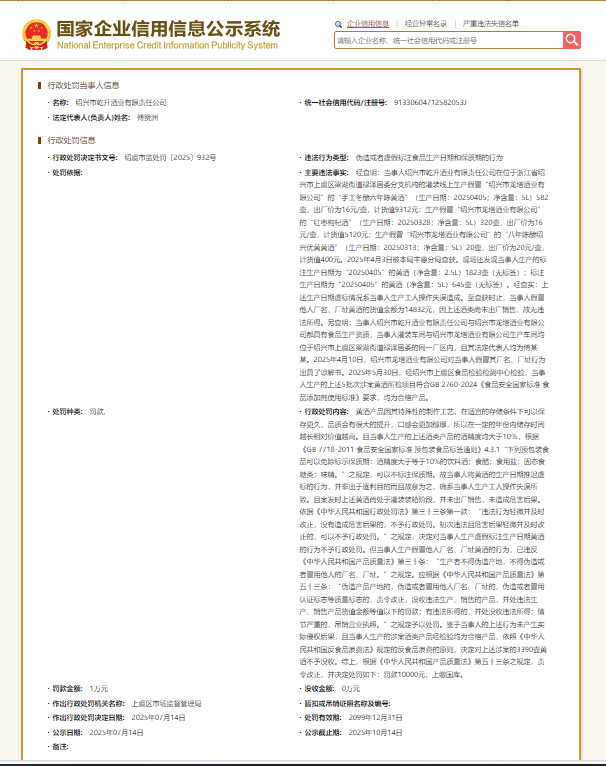
绍兴乾升酒业因假冒厂名被罚1万元,虚标生产日期因“失误”免罚
Qi Lu Wan Bao· 2025-07-25 03:17
Core Viewpoint - Shaoxing Qiansheng Wine Co., Ltd. was fined 10,000 RMB for producing counterfeit yellow wine products under the name and address of Shaoxing Longta Wine Co., Ltd. [1][2] Group 1: Incident Details - On April 3, 2025, the market supervision department discovered multiple batches of counterfeit yellow wine products during an inspection at Shaoxing Qiansheng Wine Co., Ltd. [1] - The counterfeit products included 582 bottles of "Handmade Winter Brew Six-Year Aged Yellow Wine" (5L), 320 bottles of "Red Date Goji Wine" (5L), and 20 bottles of "Eight-Year Aged Shaoxing Superior Yellow Wine" (5L), with a total value of 14,832 RMB [1][2]. - The counterfeit yellow wine was not sold in the market at the time of the inspection, resulting in no illegal profits [1]. Group 2: Regulatory Findings - A large quantity of unlabeled yellow wine with a future production date (April 5, 2025) was found, which was determined to be a result of operational error rather than intentional misconduct [2]. - All involved batches of yellow wine were deemed compliant with quality standards, and due to an alcohol content greater than 10%, they were exempt from labeling a shelf life [2]. - The regulatory authority decided not to impose administrative penalties for the labeling error, as it was corrected promptly and did not cause any harmful consequences [2]. Group 3: Company Background - Shaoxing Qiansheng Wine Co., Ltd. was established on November 29, 1999, with a registered capital of 3.55 million RMB [4]. - The company specializes in the production and sales of yellow wine and white wine, and is located in Shaoxing City, Zhejiang Province [4].
欧盟:如谈判破裂计划对近千亿欧元美国商品加征关税
news flash· 2025-07-23 13:27
Core Points - The European Commission confirmed plans to impose tariffs on nearly €100 billion worth of U.S. goods if trade negotiations fail and the U.S. imposes high tariffs on EU products [1] - The EU aims to merge its previous tariff list targeting €21 billion of U.S. goods with a new list covering €72 billion, creating a unified response plan [1] - The proposed tariffs will affect U.S. products such as Boeing aircraft, automobiles, and bourbon whiskey, with rates matching those threatened by the U.S. against EU goods [1] - EU member states, including Germany, are increasingly supportive of strong countermeasures if negotiations with the U.S. do not succeed [1]