航空

Search documents
消费“升温”场景“上新” 各地节前市场热气升腾迎来“开门红”
Yang Shi Wang· 2026-01-11 02:53
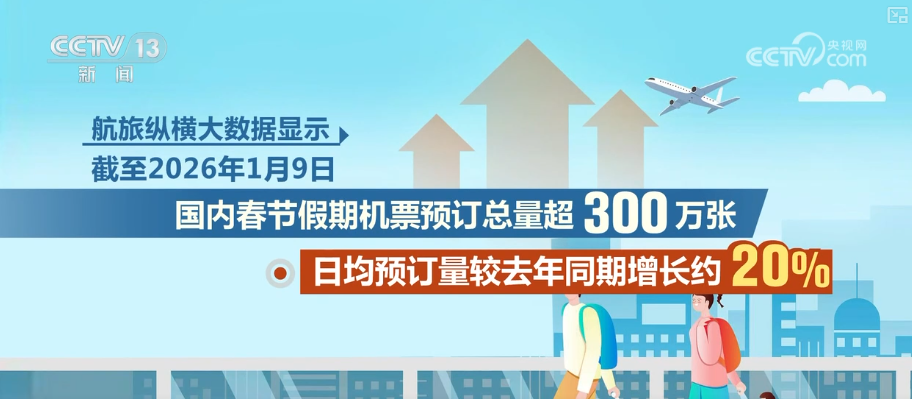
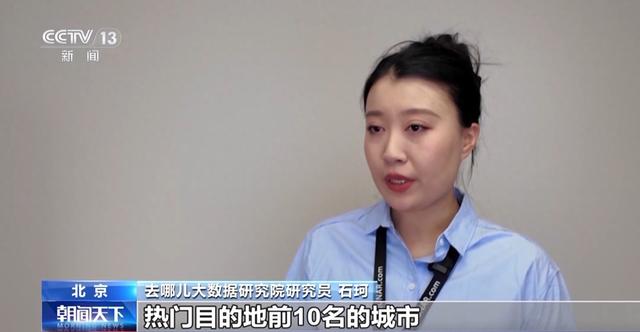
Group 1: Travel and Flight Booking Trends - The domestic flight bookings for the Spring Festival have exceeded 3 million, with a daily booking increase of approximately 20% compared to the same period in 2025 [3] - Major cities and popular provincial capitals have seen a significant increase in flight bookings, with an average growth of about 30% compared to the previous week [3] - Top 10 popular destinations have experienced substantial growth in flight bookings, with Haikou leading at a 120% year-on-year increase, followed by Sanya at 90%, and other cities like Chengdu, Hangzhou, and Chongqing showing increases between 50% and 80% [5] Group 2: Duty-Free Shopping in Hainan - The duty-free shopping market in Hainan has seen a strong start to the new year, with total shopping amounts reaching 1.21 billion yuan, a year-on-year increase of 88% [8] - The number of shoppers and items purchased during the New Year period also saw significant increases of 38.3% and 30.3%, respectively [8] - The expansion of the duty-free product range to 47 categories since November 2025 has effectively boosted consumption in this sector [10] Group 3: Culinary Events in Shanghai - Shanghai has launched the "Global Food Festival" for the entire year, featuring multiple themes and city tasting routes [11] - The Huangpu District is creating a European-style food market to offer diverse culinary experiences, including various international foods [13] - The Shanghai Municipal Commission of Commerce aims to enhance the influence of global cuisine through nine initiatives, promoting high-quality development in the restaurant industry [15][17]

各地消费活动升温,热门目的地机票预订量增长明显
Xin Lang Cai Jing· 2026-01-11 00:39
Group 1: Travel and Flight Bookings - The domestic flight bookings for the upcoming Spring Festival have significantly increased, with over 3 million tickets booked as of January 9, 2026, representing a 20% year-on-year growth in daily bookings [1] - Major cities such as Haikou and Sanya have seen remarkable growth in flight bookings, with Haikou leading the top 10 cities with a 120% increase, and Sanya experiencing a 90% increase [3] - Popular routes are shifting, with new routes to cities rich in traditional New Year activities gaining traction alongside traditional routes like Beijing-Guangzhou and Beijing-Shanghai [3] Group 2: Duty-Free Shopping in Hainan - Hainan's duty-free shopping market has seen a strong start to the year, with total sales reaching 1.21 billion yuan from January 1 to 7, 2026, marking an 88% increase year-on-year [4] - The number of transactions and visitors also increased, with 824,000 items sold and 149,000 visitors, reflecting a 30.3% and 38.3% growth respectively [4] - Sanya's duty-free stores experienced a peak in customer traffic, with sales nearing 800 million yuan in the first week of the year [5] Group 3: Culinary Events in Shanghai - Shanghai launched the "Global Food Festival" on January 9, 2026, featuring various themed culinary events throughout the year [7] - The initiative includes the creation of ten city tasting routes and a European-style market showcasing diverse food products, enhancing the city's culinary culture [7] - The Shanghai Municipal Commission of Commerce aims to encourage more projects and businesses to participate in this initiative to promote high-quality development in the restaurant industry [9]
各地消费活动升温 热门目的地机票预订量增长明显
Yang Shi Xin Wen Ke Hu Duan· 2026-01-11 00:08
Group 1: Travel and Tourism - The domestic flight bookings for the upcoming Spring Festival have significantly increased, with over 3 million tickets booked as of January 9, 2026, representing a 20% year-on-year growth in daily bookings [2] - Popular destinations such as Haikou and Sanya have seen remarkable growth in flight bookings, with Haikou leading at a 120% increase and Sanya at 90% [2] - New travel routes to cities with rich cultural activities, such as Shanghai to Jieyang and Beijing to Foshan, are gaining popularity alongside traditional routes [2] Group 2: Duty-Free Shopping - The duty-free shopping market in Hainan has experienced a strong start to the year, with total sales reaching 1.21 billion yuan from January 1 to 7, 2026, marking an 88% increase year-on-year [3] - Sanya's duty-free stores reported nearly 800 million yuan in sales during the first week of the year, indicating a peak in customer traffic [4] - The expansion of the duty-free product range to 47 categories since November has effectively boosted consumer spending in Hainan [5] Group 3: Culinary Events - Shanghai has launched the "Global Food Festival" initiative, featuring diverse culinary themes throughout the year and introducing ten city tasting routes [6] - The initiative aims to enhance Shanghai's global food influence through various promotional measures and the establishment of food landmarks [6] - The Shanghai Municipal Commission of Commerce emphasizes the goal of high-quality development in the catering industry through increased participation and policy guidance [6]
每周股票复盘:中国东航(600115)东航子公司出售资产获1.38亿元
Sou Hu Cai Jing· 2026-01-10 17:37
Core Viewpoint - China Eastern Airlines' stock price has experienced a slight decline, closing at 5.98 yuan, down 0.33% from the previous week, despite reaching a near one-year high of 6.27 yuan during the week [1]. Group 1: Stock Performance - As of January 9, 2026, China Eastern Airlines' stock closed at 5.98 yuan, a decrease from 6.0 yuan the previous week, representing a 0.33% decline [1]. - The stock reached a weekly high of 6.27 yuan and a low of 5.8 yuan during the week [1]. - The company's current total market capitalization is 132.085 billion yuan, ranking 3rd in the aviation and airport sector and 142nd among 5,182 A-shares [1]. Group 2: Company Announcements - The monthly report for H-shares indicates no changes in the legal/registered capital for both H-shares and A-shares, with total issued shares remaining unchanged at 22.08773667 billion yuan [1]. - A wholly-owned subsidiary, Shanghai Airlines, plans to sell land use rights and buildings at the Hongqiao base to China Cargo Airlines for 137.6018 million yuan, aimed at optimizing the asset-liability structure and supporting core business development [1][3].

中航西飞(000768):关联交易预计仍处于高位,新型号或取得新进展
CMS· 2026-01-10 15:36
Investment Rating - The report maintains a "Strong Buy" rating for the company [2][4]. Core Insights - The company is expected to see high levels of related transactions, with a forecasted related procurement amount of 21.637 billion, reflecting a slight decrease of 3.78% compared to the previous year, but still indicating sustained high demand [8]. - Anticipation for the official debut of the H-20 model in 2026 may provide new growth opportunities for the company [8]. - Revenue and profit are projected to grow steadily, with net profit estimates for 2025, 2026, and 2027 at 1.141 billion, 1.302 billion, and 1.488 billion respectively, corresponding to price-to-earnings ratios of 73, 64, and 56 [2][3]. Financial Data and Valuation - Total revenue is projected to increase from 40.301 billion in 2023 to 59.188 billion in 2027, with year-on-year growth rates of 7%, 7%, 5%, 13%, and 15% respectively [3][16]. - Operating profit is expected to rise from 1.023 billion in 2023 to 1.727 billion in 2027, with significant growth rates of 75%, 16%, 12%, 14%, and 14% [3][16]. - The company's net profit attributable to shareholders is forecasted to grow from 861 million in 2023 to 1.488 billion in 2027, with growth rates of 65%, 19%, 11%, 14%, and 14% [3][16]. - The company’s earnings per share (EPS) is projected to increase from 0.31 in 2023 to 0.54 in 2027 [3][16]. - The report indicates a current price-to-earnings (PE) ratio of 96.8 for 2023, decreasing to 56.0 by 2027 [3][16].

9点1氪丨系统故障致机票低至0.4折,海航:已售机票均有效;最高法:以婚姻为目的给予的购车、购房款应视为彩礼;MiniMax总市值超千亿港元
3 6 Ke· 2026-01-10 01:18
Group 1 - The interest rates for short-term large-denomination certificates of deposit (CDs) have dropped below 1%, entering the "0" range, with many banks offering rates as low as 0.9% for 1-month and 3-month terms [1][2] - Over 30 banks have announced the issuance of the first phase of large-denomination CDs for 2026, indicating a trend in the banking sector towards lower interest rates [1][2] - Major state-owned banks, including ICBC, ABC, BOC, and CCB, are currently offering short-term large-denomination CDs with a minimum deposit requirement of 200,000 yuan [1][2] Group 2 - The Supreme People's Court of China has clarified that funds given for purchasing cars or houses with the intention of marriage can be considered as bride price, which can be adjudicated under the same rules as traditional bride price disputes [2] - A recent case highlighted that a payment of 66,000 yuan and a car purchase of 150,000 yuan were deemed as bride price, leading to a court ruling for the return of over 170,000 yuan after considering shared expenses [2] Group 3 - MiniMax, a large model company, debuted on the Hong Kong Stock Exchange with an initial public offering price of 165 HKD per share, closing at 345 HKD, marking a 109.09% increase and a market capitalization exceeding 100 billion HKD [2] Group 4 - The number of corporate bankruptcies in Germany has reached a 20-year high, with 17,604 bankruptcy applications recorded in 2025, reflecting significant structural pressures on the German economy [2] - In December 2025 alone, there were 1,519 bankruptcy applications, which is 75% higher than the average from 2016 to 2019 [2] Group 5 - Apple is reportedly accelerating the selection process for a new CEO, with John Ternus, the current Senior Vice President of Hardware Engineering, emerging as the leading candidate [3] - Tim Cook, the current CEO, has expressed a desire to reduce his workload and may step down as early as this year, potentially transitioning to the role of Chairman of the Board [3] Group 6 - Xiaomi has announced a price reduction for its Xiaomi 17 smartphone and has eliminated the use of small print in its marketing materials, responding to criticism of "small print marketing" practices [5] - The company aims to enhance transparency and user experience by using larger fonts for product information [5] Group 7 - The Chinese government is implementing a nationwide policy for the cross-province pooling of personal medical insurance accounts, allowing family members to share funds for medical expenses [10] - This policy aims to optimize the use of personal medical insurance accounts and enhance mutual assistance among family members [10]

新华财经早报:1月10日
Xin Hua Cai Jing· 2026-01-10 01:04
Group 1 - The State Council of China is implementing a package policy to promote domestic demand through fiscal and financial collaboration, focusing on enhancing consumer capacity and supporting private investment [1] - The Ministry of Finance and the State Taxation Administration announced the cancellation of the export VAT rebate for photovoltaic products starting April 1, 2026, which is expected to help stabilize foreign market prices and reduce trade friction risks [1] - The State Administration for Market Regulation is conducting an investigation into the competitive status of the food delivery service industry, with major platforms like Meituan and JD Express expressing their willingness to cooperate [1] Group 2 - Baogang Co. announced an adjustment in the related transaction price for rare earth concentrate to 26,834 yuan per ton (excluding tax), reflecting a 2.4% increase from the previous quarter [3] - The company Tongfu Microelectronics plans to raise no more than 4.4 billion yuan through a private placement [3] - Zhongchao Technology expects a net profit increase of 149.61% to 196.88% year-on-year for 2025 [3]


航空股走强 西南航空(LUV.US)涨超3.4%
Zhi Tong Cai Jing· 2026-01-09 15:02
Core Viewpoint - U.S. airline stocks strengthened on Friday, with Southwest Airlines receiving a significant upgrade from Morgan Stanley, which raised its rating from "Underweight" to "Overweight" and increased the target price from $36 to $60 [1] Group 1: Stock Performance - Southwest Airlines (LUV.US) rose over 3.4% [1] - American Airlines (AAL.US) and Alaska Airlines (ALK.US) increased by more than 2% [1] - JetBlue Airways (JBLU.US), United Airlines (UAL.US), and Delta Air Lines (DAL.US) saw gains of over 1% [1] Group 2: Analyst Actions - Morgan Stanley upgraded Southwest Airlines' rating from "Underweight" to "Overweight" [1] - The target price for Southwest Airlines was raised from $36 to $60 [1]

湾财晚报 | 国家将对外卖行业“内卷”竞争启动调查;预计美联储今年将小幅降息;广汽埃安称将给湘超冠军队送车
Nan Fang Du Shi Bao· 2026-01-09 14:02
Group 1 - The National Market Supervision Administration announced an investigation into the competitive conditions of the food delivery platform service industry due to issues like excessive subsidies and price wars, which have intensified "involution" competition and negatively impacted the real economy [3] - Meituan expressed strong support for the investigation and stated it would cooperate fully, aiming to work with other platforms to ensure fair market competition [3] - The investigation will involve on-site verification, interviews, and surveys to gather opinions from various stakeholders, including platform operators, new employment groups, and consumers [3] Group 2 - Qu Guangji has been appointed as the General Manager of China National Aviation Holding Company, replacing Wang Mingyuan [5] - The appointment was announced during an expanded leadership meeting of the company, following the directives from the Central Organization Department [5] Group 3 - Cainiao has launched a new cross-border logistics service from the U.S. to Mexico, establishing a logistics network that covers 99% of Mexico and offers competitive pricing at 60% of the industry average [9][10] - This service aims to break down high-cost barriers for cross-border logistics, providing a cost-effective logistics fulfillment experience for local e-commerce platforms and cross-border sellers [9] Group 4 - The A-share market reached a historic milestone as the Shanghai Composite Index surpassed the 4100-point mark for the first time in ten years, achieving a rare 16 consecutive days of gains, the longest streak since 1993 [15] - The market's trading volume increased significantly, with a total turnover of 3.12 trillion yuan, marking the second-highest trading record in A-share history [15]

美eVTOL制造商计划利用英伟达 IGX Thor开发下一代航空AI技术
Xin Hua Cai Jing· 2026-01-09 09:42
Core Insights - Archer Aviation, an eVTOL manufacturer, plans to develop and deploy next-generation aviation AI technology using NVIDIA's IGX Thor platform [2][3] - The aviation sector is identified as a significant application area for physical AI, particularly in enhancing flight safety, airspace integration, and autonomous readiness systems [2] - Archer aims to showcase its NVIDIA technology integration at the recently acquired Hawthorne Airport, which will serve as a hub for its planned Los Angeles air taxi network and a testing platform for its AI aviation technology [2] Summary by Categories - **Partnership and Technology Development** - Archer has been collaborating with NVIDIA since early 2025 to integrate the IGX Thor platform into its future aircraft projects [2] - The IGX Thor platform is designed for high reliability and real-time onboard computing in safety-critical environments, supporting advanced perception, decision-making, and predictive operations [2] - **Focus Areas for AI Development in Aviation** - Enhancing pilot safety and predictive awareness by utilizing NVIDIA's edge computing to process flight path data and provide actionable insights [3] - Seamless airspace integration through the development of AI systems that modernize existing air traffic control systems, allowing aircraft to safely navigate complex airspace environments [3] - Autonomous flight control by combining NVIDIA's IGX Thor with Archer's proprietary avionics and control software to create a next-generation computing architecture for future autonomous and semi-autonomous flights [3]