软件

Search documents
今夜!科技股下跌 黄金白银跳水
Zhong Guo Ji Jin Bao· 2026-02-04 16:17
Group 1 - The technology sector is experiencing significant pressure, with major stocks like AMD dropping sharply due to disappointing earnings guidance, which has raised concerns about the company's progress in the AI field [2][7] - AMD's stock plummeted by 15%, while other tech stocks also faced declines, including Applovin Corporation down 13.73%, SanDisk down 11.52%, and Micron Technology down 8.88% [3][7] - The iShares Expanded Tech-Software Sector ETF saw a decline of approximately 3%, indicating ongoing investor concerns about the commercial risks associated with software companies as AI tools become more powerful [4][7] Group 2 - Analysts suggest that the market is not abandoning AI but is pricing it more cautiously, with AMD's performance being penalized for not exceeding high expectations set by previous rumors [7] - The storage sector is also facing significant declines, with SanDisk down over 11%, Western Digital nearly 10%, and Micron Technology down over 9%, while Seagate Technology has seen a drastic drop of over 65% [7] - Despite the challenges, there are positive implications for the AI supply chain, as memory and chip manufacturers will be essential for the operation of new AI tools and products [7]



今夜!暴跌了
Zhong Guo Ji Jin Bao· 2026-02-04 16:17
Group 1 - The core point of the news highlights a significant decline in technology stocks, particularly AMD, which dropped 15% due to disappointing earnings guidance, signaling potential issues in the AI sector [3][10] - The Dow Jones Industrial Average saw an increase, while the Nasdaq Composite experienced a substantial drop for the second consecutive trading day [2] - Concerns are rising among investors regarding the commercial risks associated with software companies as AI tools become more powerful, leading to a nearly 3% drop in the iShares Expanded Tech-Software Sector ETF [7] Group 2 - AMD's performance was deemed satisfactory, but the market's expectations were not met, resulting in a punitive reaction from investors [10] - Analysts predict that software stocks will remain under pressure in the short term, but this may not negatively impact the AI supply chain, as memory and chip manufacturers are essential for the operation of new AI tools [11] - The storage sector stocks also faced significant declines, with SanDisk dropping over 11%, Western Digital nearly 10%, and Micron Technology over 9% [12] Group 3 - Precious metals experienced a downturn, with gold prices falling and silver prices significantly narrowing their gains [14]

今夜!暴跌了...
Zhong Guo Ji Jin Bao· 2026-02-04 16:16
【导读】 科技股下跌,黄金白银跳水 中国基金报记者 泰勒 大家好,今晚继续关注海内外市场的消息。科技股,黄金、白银都在跳水。 | 换手:2.78% | | --- | | 振幅:5.56% | | 市净率:5.30 | | 市销率:11.38 | | 总市值:3340.90亿 | | 总股本:16.28亿 | | 货币单位: USD | 2月4日晚间,美股三大指数涨跌不一,道指上涨,纳指大跳水, 连续第二个交易日走弱 。 科技股普遍下跌,超威半导体(AMD)因财报表现不及预期而暴跌15%,进一步加剧了近期科技板块 的压力。这家芯片制造商的销售指引未能令投资者满意。这也被视作一个信号:公司在AI领域的推进 程度,未达到华尔街部分人士此前的预期。 | T 筛选 | 最新价 ÷ | 涨跌幅 + □ | | --- | --- | --- | | 美国超威公司 | 204.62 | -15.49% | | US AMD | | | | Applovin Corporation | 398.41 | -13.73% | | US APP | | | | 闪迪 | 615.70 | -11.52% | | US SNDK ...

城市24小时 | 中部第一城,这次要冲击“一线城市”
Sou Hu Cai Jing· 2026-02-04 15:51
Group 1 - The core viewpoint of the article is that Wuhan is positioning itself as a leading city in the "smart economy" sector by implementing a three-year action plan to significantly boost its artificial intelligence industry and related sectors [2][8] - The "Wuhan Smart Economy Development Action Plan (2026-2028)" aims for an AI industry scale exceeding 200 billion yuan, with a target of over 15,000 P of high-performance computing power and a cumulative data transaction volume of 3 billion yuan [2] - Wuhan plans to cultivate over 1,000 large-scale data enterprises and exceed 1,500 AI-related companies, establishing itself as a super-large-scale AI city [2][8] Group 2 - The concept of "smart economy" is described as a new economic form resulting from the deep integration of artificial intelligence with various industries, representing an advanced stage of digital economy development [3] - Experts liken the digital economy to extracting data "oil," while the smart economy is compared to building "refineries" and "engines" that convert raw data into intelligent decision-making capabilities [4] - Nationally, the "AI+" initiative has become a top-level strategy, with the "14th Five-Year Plan" emphasizing the importance of "smartization" [6] Group 3 - Cities like Beijing, Shanghai, and Shenzhen are leading the smart economy due to their early advantages, making smart economy a new benchmark for regional competitiveness [7] - By 2025, Wuhan's core smart economy industries are projected to reach 1.1 trillion yuan, with the electronic information manufacturing and software industries accounting for over 80% [8] - AI technology is deeply embedded in sectors such as smart connected vehicles, intelligent equipment, and smart healthcare, with a penetration rate exceeding 30% [8] Group 4 - Wuhan has significant infrastructure advantages, including 40 5G base stations per 10,000 people and over 5,000 P of high-performance computing power, along with nearly 3,900 kilometers of open testing roads for smart connected vehicles [8] - The city has established policies to promote AI industry development and aims to create a first-class AI innovation cluster and industrial development hub [8] - The latest action plan emphasizes building three foundational industries: sensors, optical communication, and integrated computing in the electronic information manufacturing sector, along with a software ecosystem and application service providers in the AI field [8][9]

标普500指数早盘基本走平 交易员继续从科技股向外轮动
Xin Lang Cai Jing· 2026-02-04 15:29
华尔街交易员继续将资金从科技股向外轮动,投入能从经济前景改善中获益的更广泛类别的企业。黄金 价格重返5000美元关口。截至发稿,标普500指数基本持平,尽管其大部分成分股走强。纳斯达克100指 数下跌0.5%,道指走高0.4%。软件板块遭遇新一轮抛售,投资者担忧更先进的人工智能工具对它们带 来的商业风险。芯片制造商则因AMD前景未达预期而再度承压。与此同时,一项小盘股指数实现上 涨。 来源:滚动播报 ...
软件股暴跌或成下一轮信贷危机导火索?
Hua Er Jie Jian Wen· 2026-02-04 14:18
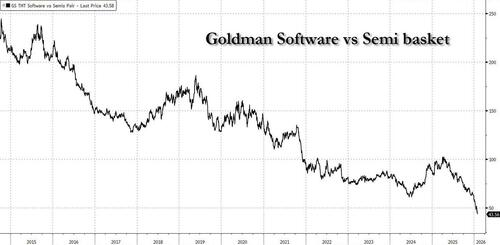
Core Insights - Wall Street analysts warn that the substantial software debt held by Business Development Companies (BDCs) could trigger the next credit crisis, with market concerns already surfacing [1] - BDCs, which primarily fund small to mid-sized private enterprises, have approximately 16% of their portfolios invested in software companies, facing significant asset impairment risks amid an unprecedented sell-off in the software sector [1][3] - The software sector has seen a decline in stock prices, with 9 out of the last 12 trading days experiencing drops, leading to a severe deterioration in market sentiment [1][3] Group 1: Market Conditions and Risks - The collapse in the software sector is largely attributed to the disruptive threat posed by artificial intelligence (AI), causing panic among investors who fear AI could be the end of software companies [3] - BDCs, viewed as major lenders in the Software as a Service (SaaS) space, are experiencing significant market pressure, with any minor fluctuations causing substantial impacts [3] - Morgan Stanley's analysis indicates that the BDC industry may need to undergo a stress test similar to that faced by airline leasing companies during the pandemic, highlighting the need for BDCs to demonstrate their risk resilience [3] Group 2: Financial Exposure and Impact - As of Q3 2025, the total investment portfolio of 30 tracked BDCs is approximately $359 billion, with software exposure amounting to about $70 billion, representing 16% of their portfolios [4] - The broader technology exposure among these BDCs totals around $80 billion, indicating a significant reliance on the tech sector [4] - There is a wide variance in risk exposure among different institutions, with some, like Blue Owl Technology Fund, having software exposure as high as 40% [6] Group 3: Stress Testing and Potential Losses - Morgan Stanley conducted stress tests on BDCs' software portfolios, revealing that under a simplified "33% rule" scenario, these BDCs could face approximately $22 billion in losses, reducing net assets by 11% and increasing leverage from 0.86 to about 1.0 [8] - In a more severe "extreme scenario" where 75% of software companies default and recovery rates are only 10%, the industry could incur cumulative net losses nearing $50 billion, diluting book values by 24% [8] Group 4: Specific Loan Concerns - The report highlights specific software loans under pressure, with several loans trading at significant discounts in the secondary market compared to their book values [10] - Cornerstone OnDemand, a widely held risk asset among six BDCs, has seen its loan price drop by about 10 points since November 2025, currently trading at 83, while the average mark price for BDCs remains at 97 [10] - Other notable loans include Finastra, Medallia, and Auctane, which are also experiencing significant price declines, indicating that the pressure on BDC assets may just be beginning [10]
ZFX山海证券:比特币走低 加密寒冬
Xin Lang Cai Jing· 2026-02-04 14:14
Group 1 - The digital asset market is experiencing significant declines, with Bitcoin recently dropping below key support levels, reflecting a tightening liquidity environment and pushing cryptocurrencies into deeper technical adjustments [1][3] - The recent sell-off in the stock market, particularly in the software and technology sectors, has led to substantial declines in major companies like Adobe and Salesforce, with drops ranging from 7% to 12%, and a 14% decrease in the Technology Software ETF (IGV) over a week [2][5] - The outflow of approximately $3 billion from Bitcoin ETFs over the past two weeks indicates a bearish market trend, further confirming the characteristics of a bear market [2][5] Group 2 - The current asset volatility is attributed to a combination of tightening macro liquidity and a revaluation of technology stocks, with Bitcoin undergoing a severe winter similar to past cycles in 2018 and 2022 [3][6] - ZFX suggests that investors should closely monitor the stabilization signals of the Nasdaq index and the defense performance of the 73,000 key support level to identify opportunities for asset reallocation amid volatility [6]

能走出至暗时刻么?
Xin Lang Cai Jing· 2026-02-04 14:12
来源:市场资讯 (来源:亨特hunter) 到昨天微软还在跌,而且创下了财报后的新低。 美股软件股的崩盘还在加速,这两天OTA也开始暴跌,Booking下跌9%,Expedia下跌15%,Airbnb下跌 7%,担心谷歌的Agent替代掉OTA平台。 这里更严峻的问题在于这个逻辑看起来该受益的AI公司并没有进一步的上涨...市场陷入了负和博弈的循 环当中。 AH股和AI相关的大票近期走势也很弱,A股光模块,港股互联网... 我从来不认为AI的叙事会快速结束,但只要叙事松动,对于高拥挤度资产来说就有巨大风险。 高拥挤度背后从来都是极其敏感的脆弱... 销量崩盘的一个月 近期,各大新能源车企都披露了其一月的销量。 这么差的销量市场是有一定预期的。 这里有三个原因: 第一,去年底有购置税的退坡,这使得很多需求被前置了,消费者选择了提前买而不是跨年到了1月再 买,去年买要省不少钱。 第二,国补的以旧换新政策一月公布,但各个省具体执行还需要点时间,大部分省份都是一月下旬才真 的落地开始执行。 说实话,数据真的很难看。 根据统计,目前已披露的新能源车企销量合计约57.5万辆,同环比分别-14%/-43%。 环比下滑很正常 ...

三大股指期货涨跌不一,市场静待美财政部发债计划和ADP数据,Alphabet(GOOGL.US)盘后公布财报
Zhi Tong Cai Jing· 2026-02-04 14:08
Market Overview - US stock index futures showed mixed performance, with Dow futures up 0.25% and S&P 500 futures up 0.19%, while Nasdaq futures fell 0.11% [1][2] - European indices had varied results, with Germany's DAX down 0.23%, UK's FTSE 100 up 1.21%, France's CAC40 up 0.95%, and Europe's Stoxx 50 up 0.24% [2] Oil Prices - WTI crude oil rose by 0.44% to $63.49 per barrel, while Brent crude oil increased by 0.31% to $67.54 per barrel [3] Debt Market Insights - The steepening of the US Treasury yield curve is nearing a four-year high, driven by uncertainty in bond issuance, with the 10-year yield rising while the 2-year yield remains stable due to Federal Reserve policy expectations [4] - The market is closely watching the US Treasury's quarterly refinancing statement for potential adjustments in long-term bond auction sizes, which could impact government financing costs [4] Software Sector Concerns - A panic over AI replacing software is causing a significant sell-off in global software stocks, with Morgan Stanley noting that investor sentiment has turned extremely negative [4] - Nvidia's CEO Jensen Huang refuted the notion that AI will replace software, arguing that AI will rely on existing software rather than replace it entirely [5] Geopolitical and Economic Outlook - UBS CEO Sergio Ermotti indicated that geopolitical turmoil may persist for the next decade, prompting clients to diversify their investment portfolios away from US assets [6] - The Financial Stability Board (FSB) warned about the risks associated with basis trading, highlighting the potential for a $3 trillion leveraged financing crisis in the bond market [7] Company Earnings and Forecasts - Alphabet (GOOGL.US) is expected to report Q4 revenue of $111.45 billion, a 15.53% year-over-year increase, with a focus on Google Cloud's order backlog [9] - Eli Lilly (LLY.US) forecasts a 27% increase in sales by 2026, reaching $80 billion to $83 billion, driven by strong performance in its weight loss and diabetes medications [10] - Uber (UBER.US) reported a 22% increase in Q4 bookings but issued a weak earnings outlook, leading to a 6% drop in pre-market stock price [11] - AMD (AMD.US) reported a 34% increase in Q4 sales but expressed concerns about its Q1 outlook, which fell short of market expectations [12] - Lumentum (LITE.US) exceeded expectations with Q2 revenue of $665 million, a 65% year-over-year increase, and provided strong guidance for Q3 [13] - Electronic Arts (EA.US) reported mixed Q3 results, with revenue and earnings below expectations, but strong pre-order numbers for its new game helped mitigate losses [14] - Emerson Electric (EMR.US) exceeded Q1 earnings expectations and raised its full-year profit guidance, driven by demand for automation technology [15] - Novartis (NVS.US) warned of declining profits in 2026 due to increased competition from generics [16] - UBS (UBS.US) reported a 56% increase in Q4 net profit, exceeding expectations, and announced a $3 billion stock buyback plan [17] Upcoming Economic Data - Key economic data releases include US ADP employment change, December durable goods orders, and ISM non-manufacturing PMI [21][22][23]

全球SaaS概念股遭抛售,港股5大百亿巨头跌超5%,标普相关指数蒸发近3000亿美元
2 1 Shi Ji Jing Ji Bao Dao· 2026-02-04 14:04
Core Viewpoint - The global capital markets are experiencing significant turbulence due to fears that AI may disrupt the SaaS industry, leading to a sell-off in SaaS stocks following the release of an AI tool by Anthropic aimed at legal services [1][5]. Market Impact - On February 3, the combined market value of two S&P indices tracking software and financial data stocks dropped by approximately $300 billion [1]. - The Hong Kong SaaS index fell by 6.39% on February 4, resulting in a total market value loss of nearly HKD 150 billion [1]. - Major SaaS stocks in Hong Kong, such as Kingdee International and Kingsoft, saw declines of 12.64% and 5.14%, respectively [3][4]. Stock Performance - The performance of major SaaS stocks on February 4 included: - Kingdee International: -12.64% - Kingsoft: -5.14% - Huya Technology: -5.88% - China Software International: -6.72% - Fubo Group: -5.16% [3][4]. - In the U.S., SaaS stocks also faced declines, with the Wind U.S. SaaS index dropping by 4.12% on February 3, including significant losses from Microsoft (-2.87%) and Salesforce (-6.84%) [4][8]. Market Sentiment - The term "SaaSpocalypse" has emerged among traders to describe the current market sentiment regarding SaaS stocks [5]. - Concerns were exacerbated by a question raised at an investor forum about whether "software is dead," further fueling market anxiety [5]. SaaS Business Model Challenges - The SaaS model, which typically involves subscription-based revenue, is facing challenges as AI tools may offer more personalized solutions, potentially undermining the traditional SaaS value proposition [10][11]. - The market is expected to differentiate between traditional SaaS providers and those that integrate AI capabilities, with the latter likely to gain a competitive edge [11][12]. Future Outlook - Deloitte predicts that the SaaS business model may evolve, with a shift towards hybrid pricing models based on usage and outcomes rather than solely on subscriptions [12]. - Gartner forecasts that by 2030, at least 40% of enterprise SaaS spending will transition to usage-based or outcome-based pricing models [12].