低空经济

Search documents
合肥四年跨越三个千亿台阶
Zhong Guo Xin Wen Wang· 2025-11-17 12:03
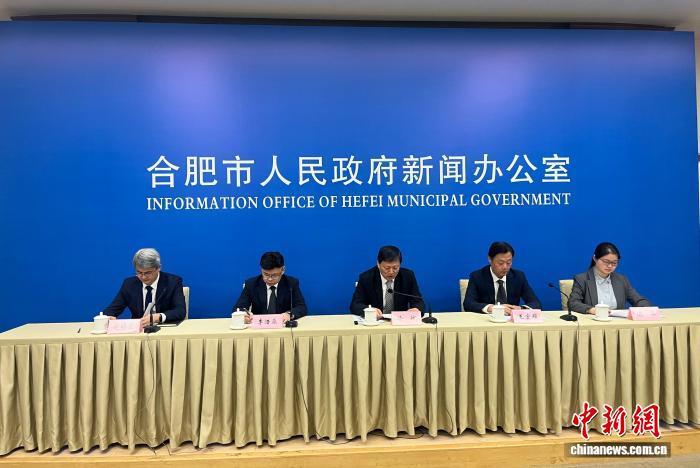
Core Insights - Hefei's GDP has increased from just over 1 trillion yuan at the end of the 13th Five-Year Plan to 1.35 trillion yuan in 2024, achieving an average annual growth rate of 6.2% and ranking 19th among cities nationwide [1][3]. Economic Development - During the 14th Five-Year Plan period, Hefei has established, is constructing, or is researching 13 major scientific facilities, ranking among the top in the country [3]. - The city's total R&D investment intensity has surpassed 4%, placing it second among provincial capital cities and sixth among cities with GDP over 1 trillion yuan [3]. - The number of national high-tech enterprises has exceeded 10,000, more than doubling, while the number of "specialized, refined, distinctive, and innovative" small giant enterprises has reached 312, increasing over fourfold [3]. Industrial Growth - The new strategic industries in Hefei have maintained a leading position in the country, with the city ranking first in the production of new energy vehicles and first globally in photovoltaic inverter production [5]. - The low-altitude economy is also among the top in the country, with the quantum industry leading in the number of enterprises and patents [5]. Integration and Logistics - Hefei is deeply integrated into the Yangtze River Delta regional development, with the construction of the Hongqiao International Open Hub Hefei Link Zone accelerating [5]. - The city has been approved for the Hefei Metropolitan Area Development Plan, and its logistics system has been significantly advanced, being selected as a national logistics hub city [5]. - The number of newly established enterprises from Fortune Global 500 companies has reached 44, totaling over 111, while cross-border e-commerce transactions have doubled to 28.9 billion yuan compared to the end of the 13th Five-Year Plan [5].

【学习贯彻四中全会精神在基层】广东:激活创新动能 构建现代化产业体系 四川:全力推进低空经济快速发展
Yang Shi Wang· 2025-11-17 11:54
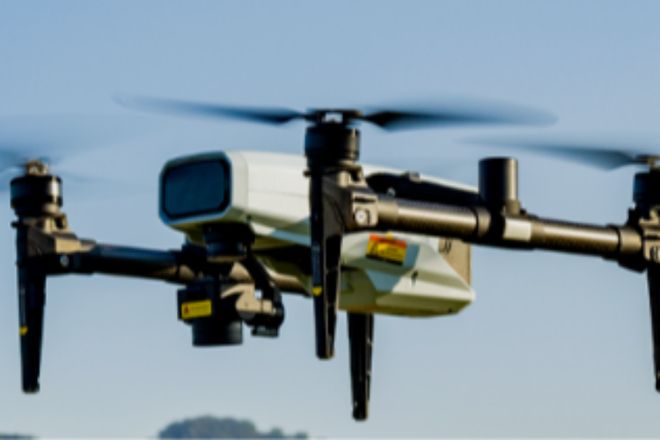
四川:全力推进低空经济快速发展 在四川产竹大县兴文县,秋冬季集中采竹开始了。过去,运竹多靠肩扛人抬,效率低、成本高;今年收 获季,当地引入30多架无人机,运输难题有效解决。全县净增10万吨竹材,经济效益增加5000万元以 上。 四川地域广,高原、丘陵、山区众多,发展低空经济需求迫切。"十四五"以来,四川把低空经济列入全 省17条重点产业链,推动产业集聚成势。目前,已开通无人机物流航线68条,低空观光旅游航线47条。 四中全会提出,建设现代化产业体系,并就培育壮大新兴产业和未来产业作出系统部署,这让四川 在"十五五"时期,发展低空经济等新兴产业的方向更加明确。 央视网消息(新闻联播):党的二十届四中全会高度评价"十四五"时期我国发展取得的重大成就,审议 通过了《中共中央关于制定国民经济和社会发展第十五个五年规划的建议》,为做好"十五五"时期各项 工作、开创中国式现代化建设新局面提供了科学指南。《新闻联播》从今天(11月17日)起推出《学习 贯彻四中全会精神在基层》系列报道,首先来看广东、四川以全会精神为指引,推动科技创新和产业创 新深度融合,加快建设现代化产业体系的生动实践。 广东:激活创新动能 构建现代化产业 ...
单企最高奖励3000万!东莞低空经济资金资助申报启动
Nan Fang Du Shi Bao· 2025-11-17 11:14
Core Viewpoint - The announcement of the special fund application for the low-altitude economy in Dongguan aims to support the high-quality development of the industry through financial incentives, covering a comprehensive range of funding directions for eligible enterprises [2][3]. Funding Directions - The special fund application includes 13 funding directions that cover the entire low-altitude economy industry chain, such as low-altitude take-off and landing infrastructure, low-altitude information infrastructure, and low-altitude equipment manufacturing projects [3][4]. Eligibility Criteria - Enterprises must meet three core conditions to apply: they must be legally established in Dongguan and focus on low-altitude aircraft development and production, possess the necessary project implementation capabilities, and not have received similar municipal financial support previously [4][5]. Application Process - The online application period is from November 18 to November 24, 2025, with a multi-step review process including preliminary and formal audits before funding is disbursed [5][6]. Impact on Industry - The initiation of this special fund application is expected to provide targeted policy support for enterprises in the low-altitude economy sector, enhancing market vitality and promoting systematic and large-scale development of the industry in Dongguan [7].
征地123万平方米!惠州这6个区域拟成片开发
Nan Fang Du Shi Bao· 2025-11-17 10:48
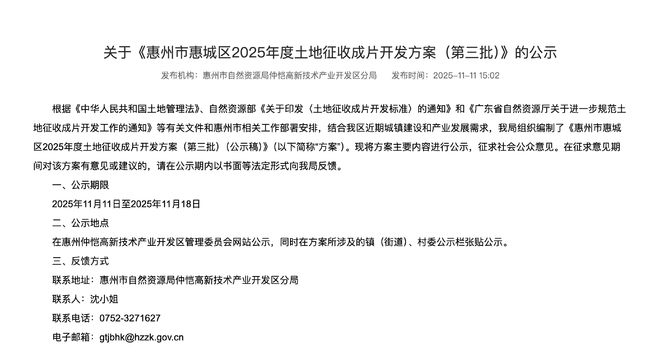
Core Viewpoint - The Huizhou Zhongkai High-tech Zone plans to implement a land acquisition and development scheme for 2025, involving six development areas and a total area of 1.227 million square meters [1][3]. Group 1: Land Acquisition and Development Plan - The land acquisition plan includes six development areas, covering 15 administrative villages, with a total area of 1.227 million square meters [1][3]. - The proposed land acquisition aims to consolidate scattered and inefficient land use, addressing public facility shortcomings and promoting industrial cluster development [3][4]. - The timeline for land development is set for 2026-2027, with 215.622 hectares planned for acquisition in 2026 and 724.238 hectares in 2027 [3]. Group 2: Area and Land Use Distribution - The total area designated for land acquisition is 939.860 hectares, accounting for 76.58% of the overall development plan area [4]. - The development areas include Shuikou, Chenjiang, Huihuan, Lilin, Tonghu, and Tongqiao, with the largest areas in Shuikou and Chenjiang, each approximately 490,000 square meters [7]. - The land use is divided into public and non-public purposes, with public land accounting for 30.75% (377.381 hectares) and non-public land for 69.25% (849.847 hectares) [8]. Group 3: Project Focus and Industry Development - The main focus of the land acquisition is on industrial, residential, and commercial projects, particularly in the fields of smart terminals, ultra-high-definition video display, and energy electronics [8]. - The plan aims to support the development of industries related to new energy precision components, smart equipment, and customized production of materials [8]. - Compensation for agricultural land will follow new standards, with rates set at 83,300 yuan per mu for certain areas and 84,800 yuan per mu for others [9].
赵伟:“十五五”三大主线与超常规科技攻关
申万宏源宏观· 2025-11-17 05:46
Core Viewpoint - The "15th Five-Year Plan" is a critical period for China's modernization, focusing on restructuring economic growth logic, shifting from optimizing traditional industries to "extraordinary" technological breakthroughs, and emphasizing fiscal and financial reforms to alleviate fiscal constraints and promote growth towards the 2035 vision [2][3]. Group 1: Key Tasks and Economic Context - The "15th Five-Year Plan" serves as a transitional phase, linking the "14th Five-Year Plan" and the 2035 modernization goals, requiring both strategic continuity and innovation [4]. - The plan addresses significant changes in the global landscape, domestic economic transformation, and the impact of a new technological revolution, which collectively shape the macro context for the plan [4][5]. Group 2: Economic Growth Baseline and Targets - To double the economic output by 2035 compared to 2020, the nominal GDP growth rate must average around 4% from 2025 to 2035, while per capita GDP must grow at approximately 3.9% [6][7]. - The plan sets ambitious targets for economic growth, reflecting a commitment to high-quality development and the integration of rapid economic growth with long-term stability [7]. Group 3: Industrial Policy and Technological Innovation - The plan prioritizes the transformation of traditional industries, emphasizing quality upgrades in sectors like mining, metallurgy, and chemicals to enhance global competitiveness [7][8]. - It outlines strategic emerging industries and future industries, including new energy, aerospace, and quantum technology, establishing a gradient development framework [7][8]. - Technological modernization is highlighted as a key support for China's modernization, with a focus on breakthroughs in critical core technologies across various sectors [8][9]. Group 4: Service Sector Development - The service sector is identified as having significant growth potential, with a notable gap in consumer spending compared to developed countries, indicating a potential market of nearly 3 trillion yuan [9]. - Systematic solutions for expanding domestic demand include increasing public service spending and enhancing the supply of quality consumer goods and services [9]. Group 5: Fiscal and Financial Reforms - The "15th Five-Year Plan" emphasizes reforms aimed at enhancing macroeconomic governance, with over 300 reform tasks to be completed by 2029 across various sectors [10][11]. - Key reform areas include market-oriented reforms, fostering new productive forces, and achieving green transitions, with a focus on establishing a unified national market [11][12]. - Financial reforms are crucial for improving local fiscal sustainability, addressing challenges in local government financing, and ensuring a clear division of responsibilities between central and local governments [12][13].
中东欧党政代表组团前来,为何看好成都?
Mei Ri Jing Ji Xin Wen· 2025-11-17 03:50
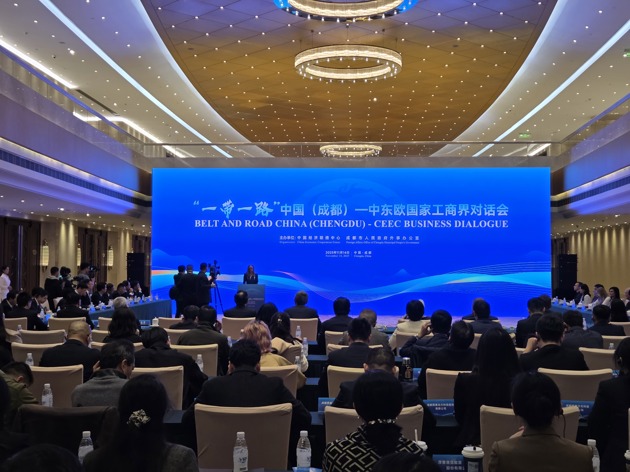
Core Insights - The article highlights the growing cooperation between China and Central and Eastern European (CEE) countries, particularly through the recent "Belt and Road" dialogue held in Chengdu, which aims to explore new business opportunities and strengthen economic ties [1][2][4]. Group 1: Economic Cooperation - Since 2012, trade between China and CEE countries has grown at an average annual rate of 8.8%, with imports from CEE countries increasing by 7.4%, both outpacing China's overall trade growth [2]. - The dialogue event marks a significant step in enhancing the long-term friendship between China and CEE countries into a forward-looking economic cooperation mechanism [4]. Group 2: Strategic Positioning - Chengdu is recognized as a key hub for cooperation due to its central location, similar to Poland's position in Europe, which enhances the significance of their collaborative efforts [5]. - The operation of the China-Europe Railway Express has significantly boosted business for companies like Chengdu Youstong E-commerce, which reported a tenfold increase in European business due to cost-effective and timely logistics [5]. Group 3: Focus on Green Energy and Future Industries - CEE representatives are particularly interested in Chengdu's advancements in new energy and smart manufacturing, with a strong emphasis on the potential for collaboration in these sectors [6]. - The energy investment potential in CEE is highlighted as a critical area for cooperation, especially in light of climate change and regulatory demands [6]. - The dialogue also emphasizes the need for digital transformation in traditional industries, with both regions having complementary strengths in innovation and manufacturing [7].
热词看未来|培育壮大新兴产业和未来产业
Xin Hua Wang· 2025-11-17 02:05
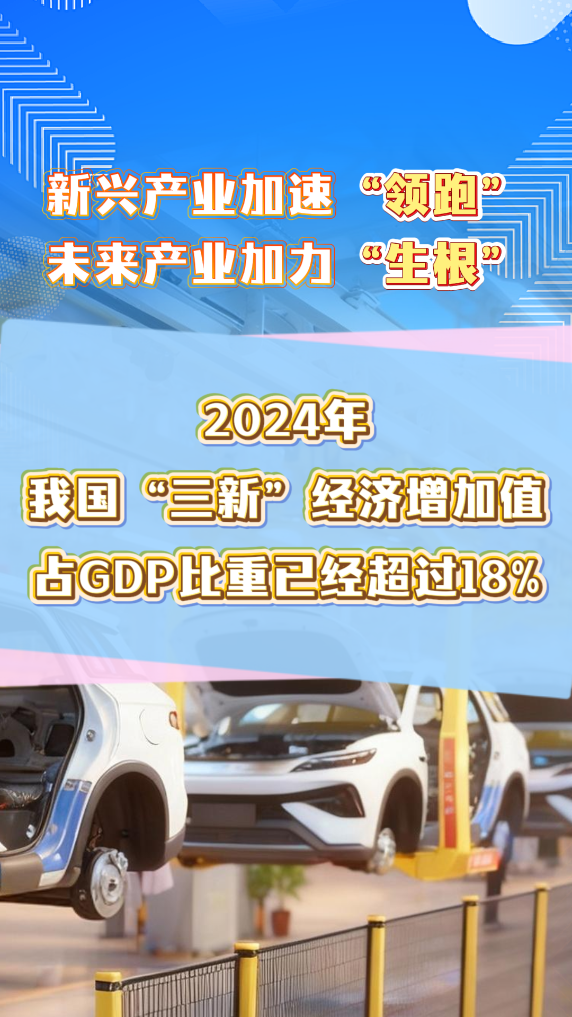
Core Insights - The central viewpoint emphasizes the cultivation and expansion of emerging and future industries in China, with a target for the "three new" economy's contribution to GDP exceeding 18% by 2024 [1] Group 1: Emerging Industries - The proposal highlights the acceleration of strategic emerging industries such as new energy, new materials, aerospace, and low-altitude economy, aiming for large-scale development through innovation and technology [4] - China has maintained its position as the global leader in new energy vehicle production and sales for ten consecutive years, with solar and wind power equipment production ranking among the highest in the world [4] - Over 60 national advanced manufacturing clusters in emerging industries have been cultivated, along with the establishment of 23 national independent innovation demonstration zones [4] Group 2: Future Industries - The proposal advocates for the advancement of future industries including quantum technology, biomanufacturing, hydrogen energy, nuclear fusion energy, brain-computer interfaces, embodied intelligence, and sixth-generation mobile communications as new economic growth points [7] - The biomanufacturing industry in China has reached a scale of nearly 1 trillion yuan, with the embodied intelligence market expected to reach 5.295 billion yuan by 2025, accounting for approximately 27% of the global market [7] Group 3: Economic Impact - The cultivation and expansion of emerging and future industries are projected to generate a new scale equivalent to recreating China's high-tech industry over the next decade, providing continuous new momentum for high-quality economic development [9]
硬核科技实力让龙华区成功C位出圈
Nan Fang Du Shi Bao· 2025-11-16 23:05
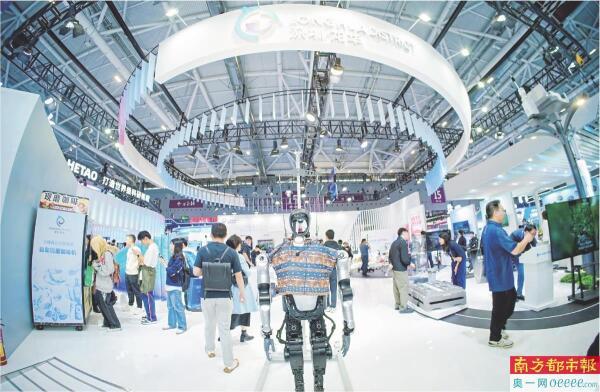
Core Insights - The 27th High-Tech Fair showcased advanced technologies and innovations from Longhua District, including humanoid robots, drones, and health rehabilitation systems, emphasizing the district's commitment to digital and intelligent manufacturing [3][4][6] Group 1: Technological Innovations - Longhua District presented a variety of cutting-edge technologies, such as the Kuavo intelligent robot and the GeneoX smart patrol robot, highlighting advancements in artificial intelligence and robotics [6][7] - The low-altitude economy was represented by innovative drone systems, including the V4 system with near-perfect reliability and Meituan's fourth-generation drone, which has completed over 670,000 orders [6][7] - A mobile real-time motion capture rehabilitation system was introduced, enabling high-precision home rehabilitation training, showcasing the integration of technology in healthcare [7] Group 2: Economic Development - Longhua District's GDP reached 156.7 billion yuan in the first half of 2025, marking a 6.2% year-on-year growth, surpassing national and provincial averages [9][10] - The district has over 4,000 national high-tech enterprises and 138 specialized "little giant" companies, indicating a robust innovation ecosystem [9] - Longhua's focus on digital economy and modern industrial systems is evident in its strategic initiatives, including the establishment of new innovation carriers and the promotion of technology-driven economic growth [8][9][10] Group 3: Exhibition and Collaboration - The High-Tech Fair served as a platform for industry collaboration and project implementation, with dedicated areas for roadshows and investment discussions to facilitate technology transfer [5] - Longhua's exhibition emphasized a blend of technology and culture, utilizing 3D printing to recreate historical architecture and integrating traditional art into modern displays [4][5]
低空经济标准体系建设提速
Zheng Quan Ri Bao· 2025-11-16 17:22
据深圳市低空经济产业协会微信公众号11月15日披露,在第二届低空产业高峰论坛上,《深圳市低空经 济标准体系2.0及标准化路线规划》(以下简称《标准体系2.0》)正式发布。 实际上,截至目前,重庆市、上海市等地均已发布与低空经济相关的标准体系路线规划,旨在为低空经 济产业规范化发展提供有效支撑。 国研新经济研究院创始院长朱克力在接受《证券日报》记者采访时表示,多地主动作为,加快建设低空 经济标准体系,说明我国低空经济产业已进入发展关键期,谁能率先搭建起科学合理的标准体系,谁就 能在以后的产业竞争中占据主动权。 低空经济标准体系主要涉及基础设施、基地平台、网络与设备、应用四大领域。整体来看,国内各地推 动低空经济标准体系建设的思路主要有两种:一种是单点突破,针对某一特定领域出台标准;另一种是 多点突破,同时针对多个领域发布综合性、立体化标准群,比如《标准体系2.0》。 深圳市低空经济产业协会发布的消息显示,《标准体系2.0》立足当地实践,采用"纵向三层+横向两 翼"的立体化设计,构建A—H八大子体系,突出"体系化、协同化、动态化"三个特点,完成从结构设计 到实施路径的整体升级,形成一组可落地、可评估、可复盘的标准 ...
国常会部署“促消费稳投资”,新一轮降准降息有望实施
第一财经· 2025-11-16 15:48
Core Viewpoint - The article discusses the fluctuations in major economic indicators in China due to external demand slowdown, weakened domestic demand, and high base effects from the previous year, emphasizing the need for stronger macroeconomic policies to stabilize growth [3][4]. Economic Indicators - In October, the industrial added value for large-scale enterprises grew by 4.9% year-on-year, slowing down by 1.6 percentage points from September [3]. - The total retail sales of consumer goods increased by 2.9% year-on-year, a slight decline of 0.1 percentage points from September [3]. - From January to October, fixed asset investment (excluding rural households) reached 408,914 billion yuan, a year-on-year decrease of 1.7% [3]. Government Response - The State Council, led by Premier Li Qiang, held a meeting to discuss the implementation of "two major" constructions aimed at enhancing consumption and investment [3][4]. - The government plans to enhance the adaptability of supply and demand in consumer goods to stimulate consumption and achieve a dynamic balance [3][4]. Investment Trends - Despite a decline in overall investment, emerging industries such as digital manufacturing and smart equipment are showing significant growth, with the digital industry manufacturing value-added increasing by 9.5% year-on-year [7][8]. - The investment in fixed assets has seen a historical decline, particularly in infrastructure, manufacturing, and real estate sectors [9]. "Two Major" Construction - The "two major" construction initiative is set to allocate 800 billion yuan to support 1,459 projects, focusing on strategic areas such as ecological restoration and major infrastructure [11][12]. - This initiative aims to optimize project reviews and enhance the quality of investments, promoting new productive forces [11][12]. Consumer Trends - Service consumption is becoming a significant growth point, with retail sales in services growing by 5.3% year-on-year [7]. - Digital and green consumption are expanding, with online retail sales increasing by 9.6% year-on-year, indicating a shift towards a more diversified consumption structure [8][14]. Supply and Demand Adaptability - Enhancing supply and demand adaptability is crucial for releasing consumption potential and ensuring economic circulation [13][15]. - The article highlights the need for a balance between supply and demand, with a focus on quality and personalized consumption [14][15].