制造业

Search documents
国家统计局:国民经济运行总体平稳 经济发展向新向优
Guo Jia Tong Ji Ju· 2026-01-19 07:38
Economic Overview - In 2025, China's GDP is projected to exceed 140 trillion yuan, reaching 1401879 billion yuan, with a year-on-year growth of 5.0% [2] - The contribution rates to economic growth from various sectors are: primary industry at 5.8%, secondary industry at 32.8%, and tertiary industry at 61.4% [2] Sector Performance - Agricultural production is stable, with an increase in the value added of agriculture, forestry, animal husbandry, and fishery by 4.1%, contributing 0.3 percentage points to economic growth [3] - Industrial growth is robust, with a year-on-year increase of 5.8%, contributing 1.7 percentage points to economic growth, while manufacturing increased by 6.1% [3] - The service sector shows strong support, with information transmission, software, and IT services growing by 11.1% and leasing and business services by 10.3%, together contributing 1.0 percentage points to economic growth [3] Domestic Demand and Trade - Final consumption expenditure contributed 52.0% to economic growth in 2025, with a higher contribution of 52.9% in the fourth quarter [5] - Capital formation contributed 15.3% to economic growth in 2025, with 16.0% in the fourth quarter [5] - Net exports showed resilience, contributing 32.7% to economic growth in 2025, with 31.1% in the fourth quarter [5] High-Quality Development - The digital economy is thriving, with a year-on-year revenue growth of 11.9% in the information transmission, software, and IT services sector [7] - The value added of equipment manufacturing and high-tech manufacturing increased by 9.2% and 9.4% respectively, outpacing overall industrial growth [7] - Investment in high-tech services grew by 3.5%, exceeding the overall fixed asset investment growth rate [7]
GDP超140万亿元 比上年增5%
Xin Lang Cai Jing· 2026-01-19 06:51
Economic Overview - In 2025, the national economy achieved high-quality development with a GDP of 14,018.79 billion yuan, growing by 5.0% year-on-year at constant prices [1] - The primary industry added value was 933.47 billion yuan (3.9% growth), the secondary industry was 4,996.53 billion yuan (4.5% growth), and the tertiary industry was 8,088.79 billion yuan (5.4% growth) [1] - Quarterly GDP growth rates were 5.4% in Q1, 5.2% in Q2, 4.8% in Q3, and 4.5% in Q4, with a 1.2% growth in Q4 on a quarter-on-quarter basis [1] Agricultural Performance - National grain production reached 714.88 million tons, an increase of 8.38 million tons (1.2% growth) compared to the previous year [1] - Summer grain production was 149.75 million tons (0.1% decrease), early rice was 28.51 million tons (1.2% increase), and autumn grain was 536.62 million tons (1.5% increase) [1] - Total meat production (pork, beef, lamb, poultry) was 10.072 million tons, marking a 4.2% increase and surpassing 100 million tons for the first time [1] Industrial Growth - The industrial production increased by 5.9% year-on-year, with mining growing by 5.6%, manufacturing by 6.4%, and electricity, heat, gas, and water production and supply by 2.3% [2] - Equipment manufacturing and high-tech manufacturing sectors showed strong growth, with increases of 9.2% and 9.4% respectively, outpacing overall industrial growth by 3.3 and 3.5 percentage points [2] Service Sector Development - The service sector's added value grew by 5.4% year-on-year, with significant contributions from information transmission, software, and IT services (11.1% growth), leasing and business services (10.3% growth), and transportation, warehousing, and postal services (5.2% growth) [2] Income and Consumption Trends - The per capita disposable income for residents was 43,377 yuan, reflecting a nominal growth of 5.0% and a real growth of 5.0% [3] - Urban residents had a per capita disposable income of 56,502 yuan (4.3% nominal growth, 4.2% real growth), while rural residents had 24,456 yuan (5.8% nominal growth, 6.0% real growth) [3] - Per capita consumption expenditure was 29,476 yuan, with a nominal growth of 4.4% and a real growth of 4.4% [3]
从协同到示范,德州委员热议如何深度融入重大战略
Qi Lu Wan Bao· 2026-01-19 06:42
Group 1 - The core theme of the meeting is the deep integration of Dezhou into national and provincial major development strategies, with representatives discussing various proposals to enhance this integration [1] - Dezhou is positioned at the geographical intersection of two national strategies and is seen as a point for policy benefits, prompting suggestions for infrastructure connectivity and collaborative development [2] - The proposal to create a cultural demonstration center along the Grand Canal aims to enhance cultural collaboration among the Beijing-Tianjin-Hebei region and promote the integration of agriculture, culture, and tourism [3] Group 2 - Dezhou has made significant progress in integrating into major development strategies, including the Beijing-Tianjin-Hebei collaborative development, with numerous projects initiated and partnerships established [5] - The city is actively advancing the Yellow River national strategy, with multiple ecological projects underway and a focus on improving environmental quality, evidenced by a 10.2% year-on-year improvement in air quality [6] - Efforts to deepen integration into the Jinan metropolitan area include infrastructure development and educational resource sharing, with several schools and hospitals collaborating across the region [6]
济南去年GDP预计超过1.4万亿元,今年预期目标增长5%以上
Qi Lu Wan Bao· 2026-01-19 06:39
Core Insights - The government report from Jinan City anticipates a GDP exceeding 1.4 trillion yuan by 2025, with public budget revenue projected at 109.34 billion yuan, maintaining a tax revenue share of 74.3%, leading the province for three consecutive years [1] - The year 2026 is designated as the "Project Empowerment Year," focusing on enhancing new productivity, deepening reform and opening up, improving public welfare, and implementing a strong industrial strategy [1] Economic Goals for 2026 - The expected GDP growth for Jinan City is over 5%, with efforts to achieve better results in practice [2] - Public budget revenue is projected to grow by 3% [2] - Industrial added value for large-scale enterprises is expected to increase by 7% [2] - Retail sales of consumer goods are anticipated to grow by over 3% [2] - The city aims to synchronize resident income growth with economic growth [2] - More than 150,000 new urban jobs are targeted [2] - Consumer prices are expected to remain at a reasonable level [2] - The city will meet energy conservation, emission reduction, and environmental quality improvement targets set by the province [2]
2025全国固投成绩单:产业结构优化,“两重两新”政策引领
2 1 Shi Ji Jing Ji Bao Dao· 2026-01-19 06:28
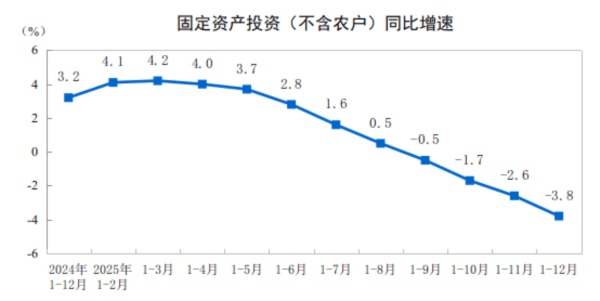
Core Insights - In 2025, China's fixed asset investment (excluding rural households) reached 48.5186 trillion yuan, a decrease of 3.8% from the previous year, with infrastructure investment down by 2.2% and real estate investment down by 17.2% [1][2] - Despite the overall decline in fixed asset investment, manufacturing investment grew by 0.6%, indicating a shift towards high-quality development in the economy [3][4] Investment Breakdown - Infrastructure investment saw a notable decline of 2.2%, while manufacturing investment increased by 0.6%, with specific sectors like railway, shipbuilding, and aerospace manufacturing experiencing a growth of 17.5% [1][2] - Real estate development investment fell by 17.2%, with new commercial housing sales area down by 8.7% and sales value down by 12.6% [1][2] - High-tech industries, particularly information services and aerospace equipment manufacturing, reported significant investment growth of 28.4% and 16.9% respectively [2][3] Policy Impact - The "Two New, Two Heavy" policy framework has played a crucial role in guiding investment trends, with infrastructure investment in key areas showing rapid growth [4][5] - The issuance of long-term special government bonds has facilitated increased investment in infrastructure, with pipeline transportation investment rising by 36.0% [4][5] - Equipment and tool procurement investment grew by 11.8%, contributing significantly to overall investment growth [5]
国家统计局:2025年工业生产稳定发展 产业结构向新向优
Zhong Guo Xin Wen Wang· 2026-01-19 05:56
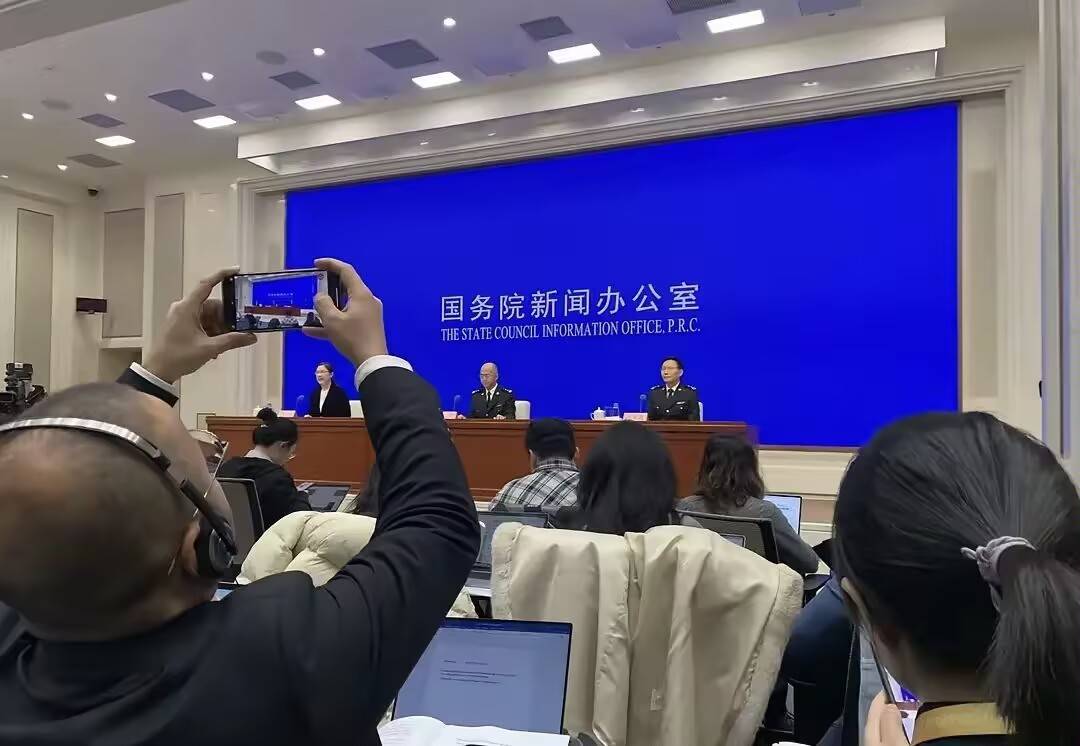
付凌晖表示,总的来看,2025年工业生产稳定发展、产业结构向新向优,完整产业体系优势更加显著。 同时也看到,外部环境变化影响逐步加深,国内转型升级存在阵痛,部分企业生产经营还比较困难。下 阶段,要推动科技创新和产业创新深度融合,持续优化产业结构,加快培育新质生产力,推动工业经济 向好发展。 来源:中国新闻网 编辑:陈俊明 广告等商务合作,请点击这里 中新网1月19日电 国务院新闻办公室1月19日上午举行新闻发布会,介绍2025年国民经济运行情况,并 答记者问。会上,国家统计局新闻发言人、总经济师、国民经济综合统计司司长付凌晖介绍,工业是实 体经济的重要组成部分,也是经济稳定运行的"压舱石"。2025年,工业生产呈现出增长较快、结构向 优、动能向新的特点,为经济稳定运行发挥了重要的支撑作用。 付凌晖指出,从主要的特点看,有以下几个方面: 一是工业实力发展壮大。2025年,我国工业增加值达到41.7万亿元,比上年增长5.8%,增速比上年加快 0.3个百分点,对经济增长的贡献率达到35%,比上年提高1.8个百分点。作为工业经济的主体,制造业 产出规模持续扩大。2025年制造业增加值34.7万亿元,比上年增长6.1% ...
国家统计局:我国制造业规模有望连续16年保持全球第一
Xin Lang Cai Jing· 2026-01-19 04:46
1月19日,国家统计局新闻发言人、总经济师、国民经济综合统计司司长付凌晖在国新办新闻发布会上 表示,2025年工业生产呈现增长较快、结构向优、动能向新的特点。作为工业经济的主体,制造业产出 规模持续扩大。2025年制造业增加值34.7万亿元,比上年增长6.1%,占GDP的比重稳定在25%左右,制 造业规模有望连续16年保持全球第一,门类体系完整的优势更加明显。 ...
产业向新力积聚,2025年规上工业增加值增长5.9%
2 1 Shi Ji Jing Ji Bao Dao· 2026-01-19 04:34
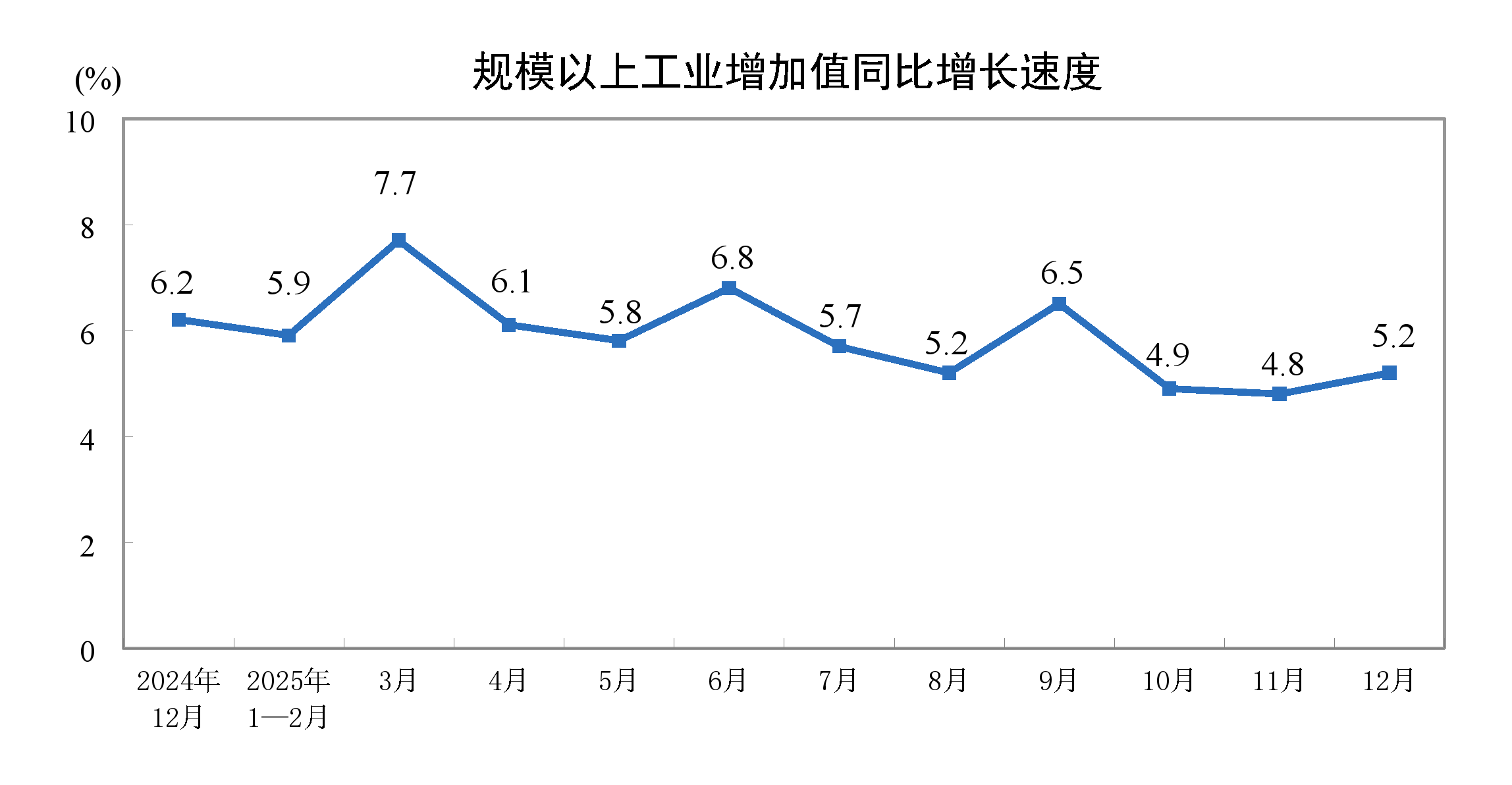
从全年来看,采矿业增加值增长5.6%,制造业增长6.4%,电力、热力、燃气及水生产和供应业增长2.3%。装备制造业增加值增长9.2%,高技术制造业增加 值增长9.4%,增速分别快于规模以上工业3.3、3.5个百分点。 不难看出,装备制造业和高技术制造业增势较好。与之相关的是,2025年,新质生产力给我国经济发展带来诸多新的亮点和变化,从产业来看,产业向新力 积聚成势。 21世纪经济报道记者冉黎黎 北京报道 2026年1月19日,国家统计局发布数据显示,2025年12月份,规模以上工业增加值同比实际增长5.2%(增加值增速均 为扣除价格因素的实际增长率)。从环比看,12月份,规模以上工业增加值比上月增长0.49%。 2025年,全国规模以上工业增加值比上年增长5.9%,保持较快增长态势,增速较上年加快0.1个百分点。 规模以上工业增加值同比增长速度。(国家统计局/图) 分三大门类看,12月份,采矿业增加值同比增长5.4%,制造业增长5.7%,电力、热力、燃气及水生产和供应业增长0.8%。 进一步而言,国家统计局局长康义在当日举行的2025年国民经济运行情况新闻发布会上提到,高端装备、绿色能源、智能制造等新兴领域 ...

不计成本的出口结果:降低了外国人的生活成本、损了绝大多数国人的根本利益!
Sou Hu Cai Jing· 2026-01-19 04:13
Core Viewpoint - The export tax rebate policy in China, initially designed to support export enterprises, has become less relevant over time as the country maintains a trade surplus and sufficient foreign exchange reserves. The policy's continuation may lead to dependency among businesses and distort competition in the market [3][4]. Group 1: Export Tax Rebate Overview - In 2024, China's export tax rebate scale reached 1.93 trillion yuan, a 12.6% increase from the previous year, accounting for 11.02% of the annual tax revenue [3]. - The primary beneficiaries of the export tax rebate are small and micro enterprises, receiving 917.8 billion yuan (39.7% of total rebates), followed by medium-sized enterprises with 510.4 billion yuan (22.1%), and large enterprises with 881.5 billion yuan (38.2%) [3]. Group 2: Issues with Export Tax Rebate - The export tax rebate has led to dependency among some enterprises, where businesses rely on rebates to maintain profitability despite low margins, as illustrated by a lighter factory example [3][4]. - The influx of companies into sectors like new energy vehicles, without the necessary expertise, has intensified competition and price wars, undermining the effectiveness of the export tax rebate [4]. - The reliance on export tax rebates to reduce costs, rather than improving productivity, poses risks and may provide grounds for foreign sanctions against China [4]. Group 3: Future Considerations - Eliminating the export tax rebate policy is deemed necessary, with suggestions to redirect the annual 2 trillion yuan towards improving public welfare and military research, potentially addressing significant societal issues and enhancing national defense capabilities [4].
2025年全国固定资产投资超48万亿,同比下降3.8%
Sou Hu Cai Jing· 2026-01-19 03:48
第三产业中,基础设施投资(不含电力、热力、燃气及水生产和供应业)比上年下降2.2%。其中,管 道运输业投资增长36.0%,多式联运和运输代理业投资增长22.9%,水上运输业投资增长7.7%。 分地区看,东部地区投资比上年下降8.4%,中部地区投资下降2.7%,西部地区投资下降1.3%,东北地 区投资下降15.5%。 分登记注册类型看,内资企业固定资产投资比上年下降3.8%,港澳台企业固定资产投资下降2.2%,外 商企业固定资产投资下降13.8%。 2025年固定资产投资(不含农户)主要数据 注:此表中速度均未扣除价格固意。 据国家统计局网站19日发布数据,2025年,全国固定资产投资(不含农户)485186亿元,比上年下降 3.8%。其中,民间固定资产投资比上年下降6.4%。从环比看,12月份固定资产投资(不含农户)下降 1.13%。 分产业看,第一产业投资9570亿元,比上年增长2.3%;第二产业投资177368亿元,增长2.5%;第三产 业投资298248亿元,下降7.4%。 第二产业中,工业投资比上年增长2.6%。其中,采矿业投资增长2.5%,制造业投资增长0.6%,电力、 热力、燃气及水生产和供应业投 ...