电网设备

Search documents
电网设备板块12月22日涨1.19%,智光电气领涨,主力资金净流入7945.69万元
Zheng Xing Xing Ye Ri Bao· 2025-12-22 09:10
从资金流向上来看,当日电网设备板块主力资金净流入7945.69万元,游资资金净流出3.0亿元,散户资 金净流入2.21亿元。电网设备板块个股资金流向见下表: 以上内容为证券之星据公开信息整理,由AI算法生成(网信算备310104345710301240019号),不构成投资建议。 证券之星消息,12月22日电网设备板块较上一交易日上涨1.19%,智光电气领涨。当日上证指数报收于 3917.36,上涨0.69%。深证成指报收于13332.73,上涨1.47%。电网设备板块个股涨跌见下表: ...


深度解析泉果刚登峰,为何这时更需要关注他?
Xin Lang Cai Jing· 2025-12-22 06:29
Core Viewpoint - The article emphasizes the importance of time in investment, highlighting the growth of a fund manager's credibility and trustworthiness over a longer career span [1][2]. Group 1: Background of the Fund Manager - The fund manager, Gang Dengfeng, has 16 years of experience in the securities industry and 11 years in investment management, evolving from a novice to a seasoned professional [2]. - Gang Dengfeng's early career was shaped by his exposure to value investing principles at Dongfang Securities, which laid a strong foundation for his investment philosophy [4][5]. - The investment philosophy of Gang Dengfeng is influenced by his early experiences and the quality of the team he worked with at Dongfang Securities [4][5]. Group 2: Investment Philosophy and Framework - Gang Dengfeng's investment framework is characterized by a focus on quality growth with a mid-level industry perspective, aiming for sustainable opportunities rather than speculative gains [8][31]. - The investment strategy prioritizes holding high-quality companies with strong financial metrics and competent management, leading to a low turnover rate in his portfolio [13][35]. - The concentration of holdings has increased over time, with the top ten holdings' concentration rising from 36.40% at the end of 2023 to 58.67% by the end of Q3 2025 [35]. Group 3: Performance Metrics - The fund managed by Gang Dengfeng, Quan Guo Si Yuan, has shown a net value growth rate of 32.28% over the past year, significantly outperforming the benchmark [21]. - The fund's turnover rates were recorded at 66.87% for 2023, 96.65% for 2024, and 115.48% for the first half of 2025, indicating a strategy focused on long-term holdings [31][32]. - The fund's maximum drawdown was -13.76% over the past year, compared to -21.04% for the CSI 300 index, demonstrating better risk management [16][37]. Group 4: Market Context and Future Outlook - The current market environment is seen as favorable for active equity funds, with a shift towards shareholder returns and dividends in the A-share market [19]. - The article suggests that the quality investment style may see a resurgence after a prolonged downturn, as high-quality companies are expected to perform better in a recovering economic environment [21]. - The increasing demand for equity investments among residents is noted, as traditional low-risk assets have become less attractive [19].

行业轮动ETF策略周报(20251215-20251219)-20251222
金融街证券· 2025-12-22 05:55
Core Insights - The report emphasizes the construction of a strategy portfolio based on industry and thematic ETFs, leveraging insights from previous strategy reports on industry style continuation and switching perspectives [1] - The strategy update indicates a cumulative net return of approximately 0.53% for the period from December 15 to December 19, 2025, with an excess return of about 0.66% compared to the CSI 300 ETF [2][11] - Since October 14, 2024, the strategy has achieved a cumulative return of approximately 26.72%, outperforming the CSI 300 ETF by about 5.86% [2] ETF Holdings and Performance - The report lists various ETFs with their market values and performance, highlighting the following: - Real Estate ETF (3.51 billion) is newly added with a 100% allocation to real estate development, showing a weekly timing signal of -1 [2] - Battery ETF (145.30 billion) continues to be held with a 62.7% allocation, showing a weekly timing signal of 0 [2] - Innovative Energy ETF (12.02 billion) continues to be held with a 46.04% allocation, showing a weekly timing signal of 0 [2] - Consumer Electronics ETF (11.41 billion) is newly added with a 46.5% allocation to semiconductors, showing a weekly timing signal of 0 [2] - Grid Equipment ETF (31.17 billion) continues to be held with an 80.77% allocation, showing a weekly timing signal of 1 [2] - 5G Communication ETF (79.24 billion) is newly added with a 41.2% allocation, showing a weekly timing signal of 1 [2] Weekly Recommendations - For the week of December 22 to December 26, 2025, the report recommends increasing holdings in sectors such as real estate development, batteries, and photovoltaic equipment, while continuing to hold existing positions in battery, innovative energy, and grid equipment ETFs [11]
金鹰基金:春季躁动布局正当时 聚焦科技+制造主线
Xin Lang Cai Jing· 2025-12-22 02:47
Group 1: Market Overview - The A-share market experienced a fluctuating recovery pattern last week, with a divergence in index performance, characterized by a stronger Shanghai market compared to Shenzhen [7] - Under the expectation of "expanding domestic demand" policies and high dividend defensive attributes, consumption and non-bank financial sectors became the leading gainers, while previously active AI applications and hardware saw a pullback [7] - The average daily trading volume in the A-share market decreased to 1.76 trillion yuan, indicating a decline in market activity [7] Group 2: Economic Indicators - November consumption showed a significant slowdown due to high base effects and policy exhaustion, while fixed asset investment continued to decline, and the real estate market remained sluggish [7] - External demand was noted as a rare bright spot, but there are expectations for monetary stimulus and fiscal pre-positioning to improve domestic economic conditions in early next year [7] Group 3: Global Economic Context - The Bank of Japan's interest rate hike has led to a moderate recovery in market risk appetite, while the U.S. non-farm employment rate is expected to rise, and CPI is projected to be below market expectations [8] - Despite these indicators, the Federal Reserve is unlikely to take further directional actions in the short term, with expectations that it will not lower interest rates in January [8] Group 4: Industry Focus - The focus is shifting towards technology and manufacturing sectors, with a potential bottoming out of the recent global tech pullback [9] - Key factors for the future strength of the tech sector include improvements in large model capabilities and advancements in AI commercialization [9] - The manufacturing sector is expected to benefit from fiscal and monetary easing, with a focus on export-oriented manufacturing and real estate chains related to emerging markets [9]
26年电网工控年度策略:AIDC&机器人共享AI赋能,电力设备出海拥抱全球Supercycle
2025-12-22 01:45
Summary of Conference Call Notes Industry Overview - The conference call discusses the trends and developments in the power systems, humanoid robots, and industrial control sectors, highlighting the significant growth potential in these areas. Key Points on Power Systems - The power systems are transitioning towards high-voltage direct current (HVDC) technology, with rapid iterations in external power supply technology expected to lead to large-scale applications by 2028 [1][2]. - Domestic companies have a technological advantage in HVDC and solid-state transformers (SST), positioning them well in the market [1][2]. - The demand for transformers is strong due to long-cycle upgrades in the power grid, making them a critical component in the supply chain [1][6]. - Alibaba and Tencent have adopted HVDC technology, with the overseas market expected to initiate 800V projects by 2026, marking the arrival of the direct current era [1][7]. - The global investment in power grids is projected to grow at an annual rate of 5%, reaching a total capital expenditure of $650 billion by 2035 [1][18]. Key Points on Humanoid Robots - The humanoid robot market is expected to see production reach 20,000 to 30,000 units by 2025, with domestic demand accounting for about 20,000 units [1][2]. - 2026 is identified as a critical year for technology convergence and supplier confirmation, with Tesla planning to prepare for mass production by the end of 2026 [1][2]. - The supply chain for humanoid robots is rapidly expanding, with companies like Zhejiang Rongtai making significant progress in component integration [1][4][5]. - The market for humanoid robots is projected to exceed 10 billion yuan in orders by 2026, driven by strong policy support and commercial applications [1][27]. Key Points on Industrial Control - The industrial control sector is expected to recover starting in the second half of 2024, with significant contributions from the lithium battery industry and other OEM sectors [1][34]. - Domestic industrial control companies are actively exploring overseas markets, with companies like Inovance competing directly with Siemens [1][35]. - The focus on humanoid robots within the industrial control sector is increasing, with companies leveraging their technological advantages for future production phases [1][35]. Additional Insights - The global power grid construction faces bottlenecks, including supply chain issues, slow equipment expansion, and labor shortages, which may hinder rapid resolution of supply-side problems [1][17]. - The transformer market is experiencing a "super cycle," with demand driven by renewable energy and data centers, leading to a significant backlog of orders [1][19][20]. - The competitive landscape for power equipment companies shows that domestic firms like Siyuan are gaining market share, with room for valuation improvement compared to international counterparts [1][21]. Investment Recommendations - Recommended companies for investment include: - AIDC: Sunshine Sifang, Mai Mi, Zhongheng Hongfa, Liangxin - Humanoid Robots: Sanhua, Inovance, Rongtai, Keda Li, Weichuang, Zhenyu, Leisai, Beite, Sihong, Xinjie - Power Grid: Siyuan, Pinggao, XJ Electric, West Electric, Samsung, Haixing, Nanrui [1][36].

中金公司:逢低布局跨年行情 建议关注三条主线
Zheng Quan Shi Bao Wang· 2025-12-22 00:19
Core Viewpoint - Recent fluctuations in A-shares have led to divergent expectations among investors during the "cross-year" phase, but the short-term impact of internal and external factors on A-shares may be nearing its end, with a relatively loose liquidity environment expected to persist into the first quarter of next year [1] Group 1: Market Environment - The current low-interest-rate environment is likely to continue driving the trend of "deposit migration" among residents, providing a favorable opportunity for investors to position themselves for the "cross-year" market [1] - The recent pullback in indices has created a good entry point for investors looking to capitalize on upcoming market trends [1] Group 2: Investment Strategy - Investors are advised to focus on growth styles during market dips, while dividend styles should emphasize phase-specific and structural opportunities [1] - Three main investment themes are recommended: 1. **Growth in Prosperous Sectors**: The AI technology sector is expected to transition into an application phase next year, with opportunities in computing power, optical modules, and cloud computing infrastructure, particularly in domestic markets. Key application areas include robotics, consumer electronics, intelligent driving, and software applications. Additionally, innovative pharmaceuticals, energy storage, and solid-state batteries are entering a prosperous cycle [1] 2. **External Demand Breakthrough**: The trend of going overseas presents a relatively certain growth opportunity. Sectors to focus on include home appliances, construction machinery, commercial buses, power grid equipment, gaming, and globally priced resources such as non-ferrous metals [1] 3. **Cyclical Reversal**: Attention should be given to sectors nearing improvement points in supply-demand dynamics or benefiting from policy support, such as chemicals, aquaculture, and new energy [1] - Dividend sectors possess defensive attributes but may still be more phase-specific and structural in nature, suggesting a bottom-up stock selection approach based on quality free cash flow [1]

十大券商策略:告别单一叙事!人民币升值指引三条配置线索
Zheng Quan Shi Bao Wang· 2025-12-22 00:12
Group 1 - The core viewpoint is that the market is beginning to focus on the potential for a sustained appreciation of the RMB, which could influence asset allocation strategies [1] - Approximately 19% of industries may see profit margin improvements due to RMB appreciation, leading to increased investor interest in these sectors [1] - Key sectors to watch under a strengthening RMB include aviation, gas, and paper industries driven by short-term muscle memory, as well as upstream resources, consumer goods, and services influenced by profit margin changes [1] Group 2 - The 2026 spring market is anticipated to be active, with a focus on non-mainstream sectors such as policy themes and high-dividend stocks, while the mainline structure (AI industry chain, cyclical stocks) may have limited upward potential [2] - A classic "cross-year-spring" market is forming, with significant institutional investors increasing their holdings in broad-based ETFs, indicating stable incremental capital for the market [3] - The A-share market is expected to resonate upward with global markets, driven by clear mid-term policy and liquidity expectations following the Federal Reserve's interest rate decisions [4] Group 3 - The current market is characterized by a narrow range of fluctuations, influenced by external factors such as U.S. AI bubble concerns and Japan's interest rate hikes, with a potential upward trend as investor sentiment improves [4] - The focus for A-share industry allocation includes dividend value, cyclical recovery, and thematic hotspots, particularly in metals, non-bank financials, and AI sectors [4] - The market is entering a critical window for cross-year layout, with attention on potential signals for a small rally around the New Year [5][6] Group 4 - The market is experiencing a structural trend change, with significant discrepancies in expectations for consumption, non-bank finance, and technology sectors as 2026 approaches [10][11] - Key investment themes include AI applications, commercial aerospace, and nuclear power, with a focus on sectors benefiting from domestic demand recovery and structural policy incentives [12] - The upcoming "15th Five-Year Plan" is expected to drive structural opportunities, particularly in AI, renewable energy, and quantum technology sectors [12]
十大券商一周策略:“春季躁动”行情积极因素累积,拥抱更具备确定性的“实物需求拉动”与“内需政策红利”
Sou Hu Cai Jing· 2025-12-21 23:57
Group 1 - The market is entering a critical window for cross-year layout, with expectations for A-shares to resonate upward with global markets by 2026, focusing on "technology + overseas expansion" as a continuing theme [1][2] - Current market conditions are characterized by narrow fluctuations, influenced by external factors such as concerns over the AI bubble in the US and interest rate hikes by the Bank of Japan [2][3] - Investor sentiment has recently dropped below 70, indicating a pessimistic outlook that may lead to a slight recovery in sentiment and upward market fluctuations [2] Group 2 - Industry allocation strategies include focusing on high dividend stocks, cyclical sectors, and thematic hotspots such as Hainan's duty-free shopping and nuclear power [2][4] - The anticipated "cross-year-spring" market rally is supported by early policy implementation and increased institutional investment in broad-based ETFs [4][5] - The potential for a structural outperformance in sectors like brokerage and technology is expected, driven by upcoming monetary policy changes and market liquidity improvements [7][8] Group 3 - The ongoing appreciation of the RMB is expected to influence asset allocation, with approximately 19% of industries likely to see profit margin improvements due to currency appreciation [3] - Key sectors benefiting from policy support include AI, aerospace, and innovative pharmaceuticals, while cyclical sectors like chemicals and energy metals may also see positive impacts [6][9] - The market is expected to experience a "spring rally" driven by favorable valuation levels, liquidity conditions, and catalysts that enhance risk appetite [6][12] Group 4 - The outlook for 2026 suggests a shift from a single narrative to a broader focus on physical demand and domestic policy benefits, with sectors like AI and consumer services poised for recovery [10][13] - Non-bank financials are highlighted as having significant earnings elasticity, while sectors like electric equipment and machinery are expected to benefit from AI investments and export demand [13][14] - The market is currently in a phase of adjustment before the anticipated cross-year rally, with a focus on structural opportunities aligned with policy directions and industry trends [11][14]
【十大券商一周策略】告别单一叙事!A股跨年行情+春季躁动或将拉开帷幕
Zheng Quan Shi Bao Wang· 2025-12-21 15:11
Group 1 - The core viewpoint is that a classic "cross-year-spring" market trend is brewing, with significant signals indicating its commencement [3] - Factors driving the appreciation of the RMB are increasing, and investors should adapt their asset allocation accordingly, focusing on industries that may benefit from this trend [1] - The market is expected to see a structural shift with a focus on cyclical sectors, particularly industrial metals, non-bank financials, and sectors related to domestic consumption [3][4] Group 2 - The investment strategy should consider three key clues: dividend value, layout of prosperous industries, and thematic hotspots [4] - The anticipated spring market in 2026 is expected to be driven by a combination of fundamental cyclical improvements and new technological trends [2] - The current market is characterized by a narrow range of fluctuations, influenced by external factors such as U.S. monetary policy and investor sentiment [4][6] Group 3 - The focus on AI and advanced manufacturing is expected to dominate the market, with a potential shift towards value and cyclical styles in the first half of 2026 [2] - The market is likely to experience a "value on stage, growth in action" dynamic, particularly as the Lunar New Year approaches [9] - There is a notable expectation for structural opportunities in sectors like AI, new energy, and controlled nuclear fusion, which are aligned with the "14th Five-Year Plan" [6][10]
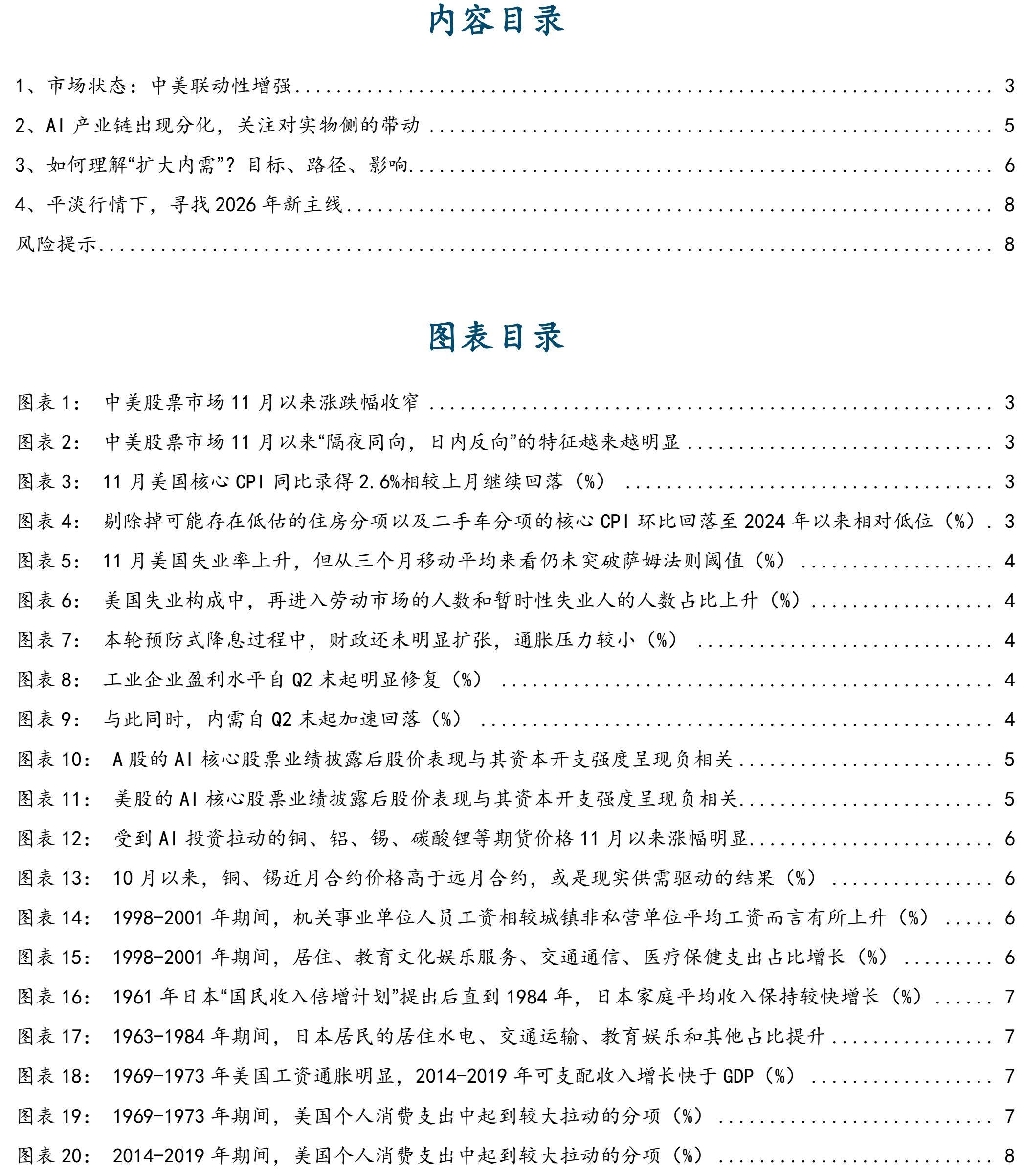
国金策略:单一产业叙事能够带来的收益已经越来越不稳定和难以把握 抓住行情的窄幅波动期布局2026年新主线
Sou Hu Cai Jing· 2025-12-21 12:44
Group 1 - The market status indicates an increased correlation between the US and Chinese markets, with the 20-day rolling correlation of the CSI 300 and S&P 500 rising above the 90th percentile, reflecting a new normal of "overnight alignment and intraday reversal" [2][10][13] - The US core CPI has decreased to 2.6%, the lowest in three and a half years, while the unemployment rate has risen to 4.6%, primarily due to increased labor participation and temporary unemployment, indicating a stable economic environment without significant inflationary pressures [2][10][13] - China's economic fundamentals show a combination of corporate profit bottoming out and a decline in domestic demand, which opens a window for further policy support [2][10][13] Group 2 - The AI industry chain is experiencing a divergence, with broader AI-related assets (copper, lithium, aluminum, energy storage, and electrical equipment) performing better than core AI assets (computing chips, optical modules, PCB) [3][24][25] - Investors are becoming less tolerant of the contradiction between aggressive capital expenditures and the lack of revenue growth in companies within the AI industry chain, leading to a negative correlation between stock performance and capital expenditure as a percentage of revenue [3][24][25] - Commodity prices for copper, aluminum, tin, and lithium carbonate have been rising since late October, driven by demand from AI investments, with near-term contracts for copper and tin outperforming longer-term contracts [3][24][25] Group 3 - The concept of "expanding domestic demand" is emphasized as a strategic move, with a focus on increasing consumer demand supported by income growth and effective investment [4][31][32] - The government plans to enhance the second distribution of income by increasing minimum pension standards and implementing childcare subsidies, while future efforts may focus on optimizing the first distribution through wage reforms [4][31][32] - Historical examples from Japan and the US illustrate that income growth leads to increased service and new-type consumption, suggesting that China's current income growth initiatives could similarly boost consumer spending [4][31][32] Group 4 - The current market environment, characterized by limited macro elasticity and increased industry differentiation, suggests a shift in investment strategy towards tangible demand and domestic policy benefits as the new focus for 2026 [5][42][43] - Recommendations include investing in industrial resource products (copper, aluminum, tin, lithium, crude oil) that benefit from AI investment and global manufacturing recovery, as well as sectors poised for recovery in consumer spending (airlines, hotels, duty-free, food and beverages) [5][42][43] - Non-bank financial institutions (insurance, brokerage) are expected to benefit from capital market expansion and a rebound in long-term asset returns, alongside opportunities in China's equipment export chain and manufacturing sectors [5][42][43]