军工制造

Search documents
特朗普搬石头砸脚,稀土价格暴涨6000%,美国全球抢购,八万零件遭断供
Sou Hu Cai Jing· 2026-01-02 02:07
Group 1 - The "Pax Silica Declaration" alliance aims to end China's dominance in the global rare earth supply chain, particularly in heavy rare earths like yttrium, samarium, and dysprosium [1][2] - The U.S. is attempting to bypass market dependencies through a political alliance, creating a "de-China" rare earth pathway with partners like Australia, Japan, and South Korea [2][3] - Despite these efforts, the U.S. Geological Survey reported that the U.S. still relies on China for 93% of its yttrium supply, highlighting the structural issues in the industry [4][6] Group 2 - The U.S. lacks industrial-scale rare earth separation and refining capabilities, with two-thirds of its raw ore still needing to be processed in China [10][12] - The construction of a new rare earth refinery in the U.S. could take 7 to 10 years, with costs significantly higher than those in China [12][38] - The U.S. Department of Defense's investment in MP Materials does not address the fundamental issue of lacking refining capabilities [12][48] Group 3 - China's export controls on heavy rare earths, including yttrium and samarium, are a strategic response to U.S. actions, impacting critical industries like defense and automotive [14][41] - The price of yttrium skyrocketed from $6 to $320 per kilogram, a 53-fold increase, due to supply shortages, affecting global manufacturing [21][32] - Major automotive companies and defense contractors are facing production disruptions due to reliance on Chinese rare earths, with significant implications for supply chains [24][27] Group 4 - The crisis reveals the limitations of political solutions in addressing complex supply chain issues, as the U.S. attempts to restructure its rare earth supply without the necessary industrial foundation [33][55] - The rare earth industry is characterized by high technical barriers and geopolitical significance, with China controlling a significant portion of the global supply chain [23][34] - The U.S. is now exploring legislative measures to prioritize non-Chinese rare earths for defense projects, but the market lacks sufficient alternatives [50][52] Group 5 - The ongoing crisis emphasizes the need for a multi-faceted approach to resource management, as countries reassess their resource potentials and supply chain dependencies [53][55] - The rare earth market is being redefined as a strategic asset rather than a mere commodity, with geopolitical implications influencing supply and pricing [55][55] - The long-term solution may lie in accepting a diversified supply chain rather than attempting to politically sever ties with China [55][55]

益智:“央企尽责概念股”有望在价值重估中脱颖而出
Zhong Guo Jin Rong Xin Xi Wang· 2025-12-29 10:22
Core Viewpoint - The implementation of the "Measures for Accountability of Central Enterprises for Violating Investment Operations" in 2026 marks a significant reform in the governance of central enterprises, aiming to reshape the investment logic and governance of listed companies in which they hold stakes [1][2]. Group 1: Accountability and Governance - The new measures extend accountability to the entire chain of equity investment by central enterprises, addressing issues such as cross-industry investments and loss of control over invested companies [2]. - The measures aim to eliminate the governance vacuum where central enterprises act as major shareholders without fulfilling their supervisory responsibilities, thus promoting a shift from "scale" to "quality" in investments [2]. - The establishment of a "full-chain accountability and lifelong accountability" mechanism compels central enterprise shareholders to actively fulfill their supervisory duties, enhancing the protection of minority investors [2][3]. Group 2: Market Implications - The introduction of the measures is expected to create a structural market trend for "responsible central enterprise concept stocks," particularly benefiting companies with low valuations, compliant governance, and asset integration expectations [3]. - Specific companies such as Electric Power Investment Corporation and Four Creation Electronics are highlighted as potential beneficiaries due to their strategic positions and expected asset injections [3]. - The anticipated buyback of shares by central enterprises could inject nearly 100 billion yuan into the market, making companies with sound internal controls and a focus on core business attractive investment targets [3]. Group 3: Investment Strategies - Investors are advised to focus on three key strategies: specialized integration platforms under central enterprises, low PE and PB stocks at industry bottoms, and companies with stable cash flows and robust dividend buyback mechanisms [4]. - Companies that actively focus on business layout and responsibility are likely to achieve a win-win situation for both minority shareholders and central enterprises [4]. - The implementation of the measures signifies a move towards standardized and refined governance of central enterprises, with those demonstrating diligence and investor care expected to stand out in value reassessment [4].




川崎重工丑闻缠身,为何军工订单却“接到手软”?
Xin Lang Cai Jing· 2025-12-28 13:11
Core Viewpoint - The credibility of "Made in Japan" is declining, particularly affecting the defense industry, as evidenced by the recent suspension of Kawasaki Heavy Industries from bidding for two and a half months due to data manipulation in submarine engine tests [1][3]. Group 1: Company Misconduct - Kawasaki Heavy Industries admitted to falsifying fuel efficiency data for submarine engines supplied to the Japan Maritime Self-Defense Force (JMSDF), with the fraudulent activity occurring from 1988 to 2021, affecting 66 engines used in 33 submarines [8]. - The Japanese Ministry of Defense described the incident as a "long-term, systematic fraud," although it stated that there was no impact on operational actions or safety [8]. - The company’s president, Yasuhiko Hashimoto, expressed a serious commitment to addressing the issue and restoring trust, indicating that disciplinary actions against involved employees are being considered [8]. Group 2: Financial and Contractual Implications - Kawasaki Heavy Industries holds significant contracts with the Japanese Ministry of Defense, with a reported contract amount of 638.3 billion yen (approximately 4.1 billion USD) for the fiscal year 2024, marking a 60% increase from the previous year [14]. - The company is projected to see its defense business sales rise to between 500 billion and 700 billion yen by fiscal year 2030, with optimistic forecasts suggesting sales could exceed 700 billion yen [17]. Group 3: Broader Industry Context - The recent scandals involving Kawasaki Heavy Industries are not isolated, as similar fraudulent activities have been reported involving other companies like Mitsubishi Heavy Industries and Japan Marine United Corporation, indicating a systemic issue within the defense procurement process [14][21]. - The Japanese defense sector is experiencing increased scrutiny and calls for regulatory reforms, yet Kawasaki Heavy Industries continues to thrive despite its scandals, raising questions about the effectiveness of the penalties imposed [19][21].
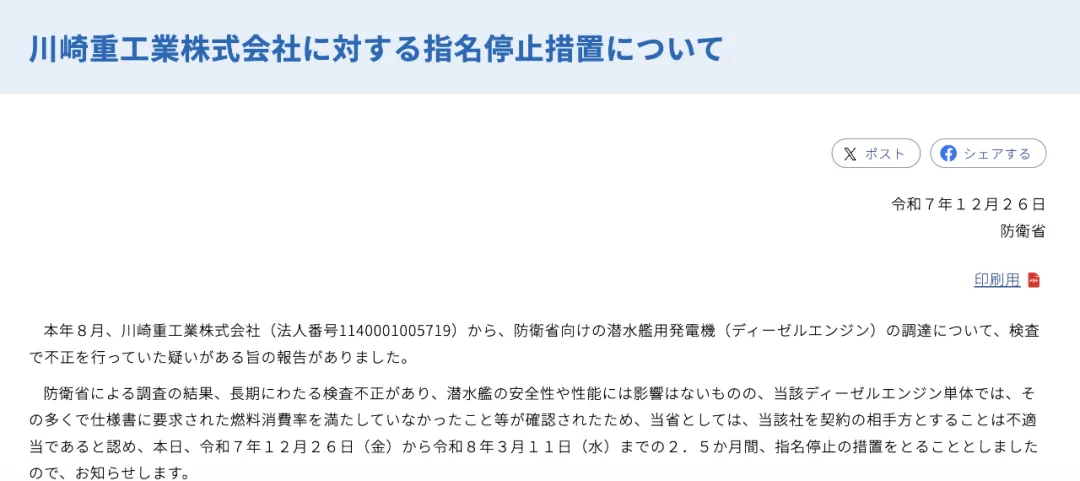
日本军工巨头造假
Xin Lang Cai Jing· 2025-12-28 09:12
Core Points - Kawasaki Heavy Industries has been found to have falsified fuel efficiency data for submarine engines used by the Japan Maritime Self-Defense Force (JMSDF) for over 30 years, leading to a suspension from bidding on contracts for two and a half months [1] - The fraudulent activities, which involved 66 engines for 33 submarines, occurred from 1988 to 2021 and were described as a "long-term, systematic fraud" by the Ministry of Defense [1] - The company has a significant contract amount of 638.3 billion yen (approximately 4.1 billion USD) for the fiscal year 2024, ranking second in defense procurement [1] Company Summary - Kawasaki Heavy Industries has been implicated in falsifying data related to submarine engine fuel efficiency, which has raised serious concerns about its integrity in the defense sector [1] - The company has also been accused of inflating budgets and has been under scrutiny for potentially illegal financial practices for about 40 years [1] - The president of Kawasaki Heavy Industries publicly apologized for the violations and expressed a commitment to restoring public trust through preventive measures [1] Industry Summary - The Japan Maritime Self-Defense Force operates 25 submarines, all equipped with engines produced by Kawasaki Heavy Industries, highlighting the company's central role in Japan's military capabilities [1] - The Ministry of Defense has taken disciplinary actions against 11 JMSDF personnel for accepting gifts from Kawasaki Heavy Industries, indicating a broader issue of ethical conduct within the defense procurement process [1] - The Ministry of Defense is considering requiring Kawasaki Heavy Industries to return funds equivalent to the breach of contract amounts, which could have significant financial implications for the company [1]
美方介入!喊话中国停止对日本制裁,同时宣布对中国半导体加税
Sou Hu Cai Jing· 2025-12-28 08:12
Group 1 - The U.S. Trade Representative's office announced new tariffs on Chinese semiconductor products, set to take effect in June 2027, with an initial tax rate of 0% starting December 2025 [1][3] - The tariffs target older semiconductor technologies, including silicon wafers and discrete semiconductor devices, and will be added on top of existing 50% tariffs imposed since 2018 [3][5] - The delay in implementation is seen as a strategy to maintain tariff leverage while easing tensions with China, indicating a desire to stabilize U.S.-China relations [3][5] Group 2 - China's rapid advancements in semiconductor self-research and development are being stimulated by U.S. sanctions, leading to the establishment of a $47.5 billion national semiconductor fund in 2024 [7][15] - The U.S. manufacturing sector has faced nine consecutive months of contraction, with rising raw material costs and declining orders, prompting a reevaluation of tariff policies [5][19] - The U.S. trade policy is causing a global trade slowdown, with growth rates dropping significantly and increasing costs for global supply chain restructuring [19] Group 3 - China's response to U.S. tariffs includes export controls on critical materials essential for semiconductors and other industries, which could impact U.S. supply chains [12][15] - The U.S. political support for Japan in the context of tensions with China has been largely symbolic, with limited practical support, leading to confusion and disappointment in Japan [9][21] - The ongoing U.S.-China trade tensions reflect a contradictory approach, where the U.S. aims to pressure China while simultaneously avoiding severe damage to bilateral trade relations [19][21]
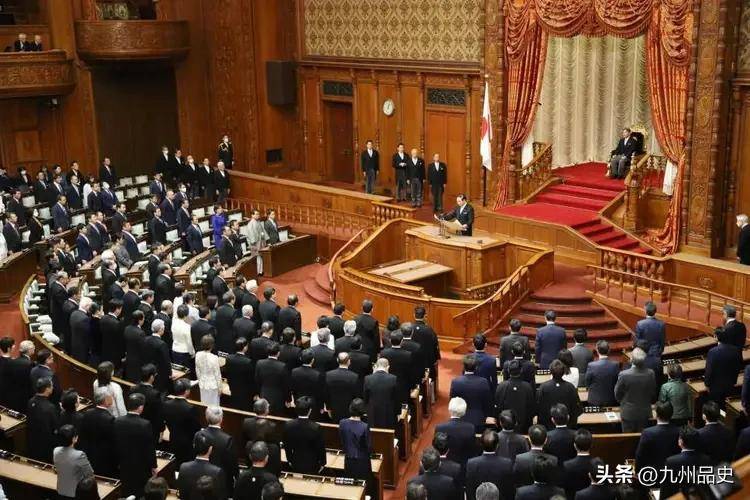
新刊 | 海南封关
Sou Hu Cai Jing· 2025-12-27 09:45
风起海之南 1988 年,改革开放第一个十年的潮声中,海南建省办经济特区,成为中国最年轻的省份 和最大约经济特区。那是一段闯海人奔赴热土的燃情岁月,也是海南岛与国家命运深度绑定 的起点。 中国民营军工力量崛起 p46 无人继承遗产如何处置 pss 安利中国30年价值重格 日本有核世界7 年易王回尊亦群8 ANNIN WEEKLY INFE "乒乓球饭圈"调查 2025 年第 48 期 / 总 了影响 記 977 : 1948 : 859-1 : 昌分倒过 日本月1日 9202- 日 62 海南封关 三十余载乘风破浪,改革基因深植血脉。自 2018年建设自由贸易港的号角吹响,七年来, 这片土地以"首"为铭:首个跨境服务贸易负面清单、首张最短外商投资准入清单、首单飞机租 费,首票"零关税"货物……·无数突破性的"首"字,如同破浪的航标,标记出制度型开放的艰深 航道,让海南从地理边陲跃升为中国对外开放的"新前沿"。 2025年 12月 18日,全岛封关运作正式启动。这不仅是海南自贸港建 关键一跃,更是中国在更高水平上推动制度型开放、构建新发展格局的星程碑 "一线放开、二线管住、岛内自由"的监管模式全面落地,海南将在 ...
中方反制美20家军工企业
Xin Lang Cai Jing· 2025-12-27 02:13
Group 1 - The Chinese government has announced countermeasures against 20 U.S. military-related companies and 10 senior executives in response to the U.S. selling weapons to Taiwan, emphasizing that Taiwan is a core interest of China and any provocation will be met with strong retaliation [1][2] - The U.S. recently announced a significant arms sale to Taiwan valued at $11.1 billion, which includes $4 billion for 82 units of the HIMARS rocket systems and $4 billion for 60 self-propelled howitzers, marking the largest arms sale to Taiwan by the U.S. [2] - Companies affected by the sanctions include Northrop Grumman, known for developing stealth bombers and advanced missile systems, and Boeing's St. Louis division, which produces F-15 fighter jets and other military equipment [2][3] Group 2 - L3 Harris Maritime Services, another company under sanctions, provides technical services and logistics support to the U.S. Navy, including underwater combat systems and maritime engineering [3] - The sanctions involve freezing assets within China and prohibiting transactions with the listed companies and individuals, as well as denying visas and entry to the affected executives [1][2]


用实际行动捍卫国家核心利益
Huan Qiu Wang· 2025-12-27 01:48
Group 1 - The Taiwan issue is a core interest of China, and any external interference is considered a red line that cannot be crossed [1] - The Chinese government and people are committed to safeguarding national sovereignty and territorial integrity, viewing Taiwan as an inseparable part of China [1] - Any actions aimed at splitting the country will face strong opposition from the Chinese populace and will be judged by history [1] Group 2 - The recent announcement by the U.S. to sell offensive weapons, including the "HIMARS" rocket system to Taiwan, is seen as a blatant provocation and a betrayal of commitments [2] - This arms sale is characterized as the largest and most severe, undermining the U.S.'s own "Taiwan Relations Act" and using Taiwan as a pawn against China [2] - China has responded by placing 20 military companies and 10 executives on a sanctions list, freezing assets and banning cooperation, indicating a strong legal and military response to external interference [2] Group 3 - China's capability and determination to protect its core interests are demonstrated through military displays and its status as the world's second-largest economy [3] - The country possesses advanced military capabilities, including a strong shipbuilding industry and a large missile force, which are essential for national defense [3] - The desire for reunification is supported by the shared heritage of the people across the Taiwan Strait, with a focus on peace, stability, and prosperity [3] Group 4 - Understanding China requires looking at its actions rather than words, with its rise viewed as a return of peace rather than a threat [4] - The U.S. is urged to cease its military support for Taiwan and to adhere to the One China principle to maintain peace in the Taiwan Strait [4] - China is prepared to use all necessary means to defend its sovereignty and interests, indicating a readiness for strong countermeasures against provocations [4]
中方对20家美国军工企业 及10名高管采取反制措施
Xin Lang Cai Jing· 2025-12-27 00:10
转自:邯郸日报 (来源:邯郸日报) 美国近日宣布向中国台湾地区大规模出售武器,严重违反一个中国原则和中美三个联合公报,严重干涉 中国内政,严重损害中国主权和领土完整。依据《中华人民共和国反外国制裁法》第三条、第四条、第 五条、第六条、第九条、第十五条规定,中方决定对以下美国军工相关企业及高级管理人员采取反制措 施: 一、对诺斯罗普·格鲁曼系统公司、L3哈里斯海事服务公司、波音密苏里州圣路易斯市分公司、吉布斯 与考克斯公司、先进声学概念有限责任公司、VSE公司、塞拉技术服务公司、红猫控股公司、蒂尔无人 机公司、侦察艇有限责任公司、高点航空技术公司、伊庇鲁斯公司、迪德罗恩公司、I领域公司、蓝力 技术公司、潜航技术公司、万拓公司、英特磊公司、菱形力量公司、拉撒路人工智能公司等20家后附 《反制清单》列明的企业,冻结在我国境内的动产、不动产和其他各类财产;禁止我国境内的组织、个 人与其进行有关交易、合作等活动。 二、对帕尔默·卢基(安杜里尔公司创始人)、约翰·坎蒂伦(L3哈里斯技术公司副总裁、L3哈里斯海事 服务公司副总裁兼首席会计官)、迈克尔·卡诺维尔(先进声学概念有限责任公司总裁兼首席执行 官)、约翰·库默(VS ...
外交部公布关于对美国军工相关企业及高级管理人员采取反制措施的决定
Ren Min Ri Bao· 2025-12-26 23:23
Core Viewpoint - The Chinese government has announced countermeasures against U.S. military-related companies and senior executives in response to the U.S. decision to sell weapons to Taiwan, which China views as a violation of its sovereignty and territorial integrity [1][2]. Group 1: Countermeasures Against Companies - The Chinese government will freeze assets and prohibit transactions with 20 U.S. military-related companies, including Northrop Grumman Systems Corporation, L3Harris Maritime Services, and Boeing in St. Louis [1][4]. - The list of companies also includes Gibbs & Cox, Advanced Acoustic Concepts, VSE Corporation, and several others, all of which are specified in the countermeasure list [4][5]. Group 2: Countermeasures Against Executives - The countermeasures extend to 10 senior executives from the listed companies, including Palmer Luckey (founder of Anduril), John Cantillon (L3Harris), and Michael Carnovale (Advanced Acoustic Concepts) [2][5]. - These executives will have their assets frozen and will be prohibited from entering China, including Hong Kong and Macau [2][5]. Group 3: Implementation Date - The countermeasures will take effect on December 26, 2025 [3].