动画电影

Search documents
大麦娱乐动画厂牌总部落地园区
Su Zhou Ri Bao· 2025-08-02 23:11
Core Insights - The establishment of the "Little Universe Future Affairs Office" under Damai Entertainment marks the completion of a production base in Suzhou Industrial Park, focusing on the full-chain operation of animated films [1] - The office, founded in 2022, has been involved in popular films such as "Chang'an 30,000 Miles," "New Gods: Yang Jian," and "Pleasant Goat and Big Big Wolf: The Future of the Basket" [1] - The collaboration with eight A-level animation suppliers, seven of which are based in Suzhou, forms a competitive "Suzhou Animation Corps" [1] Company Developments - Damai Entertainment has registered a wholly-owned subsidiary, Suzhou Little Universe Film and Television Media Co., Ltd., to leverage the advantages of talent, policies, and industrial support in the park [1] - The partnership with Suzhou Dihai Cultural Media Co., Ltd., known for producing "The King's Avatar: The King's Return" and "Deep Sea," will focus on developing the "Young Song Walk" animated film IP [1] Industry Trends - The Suzhou Industrial Park is optimizing its business environment by attracting leading enterprises and projects in digital culture, creative design, content publishing, and cultural equipment [1] - The establishment of the Little Universe Future Affairs Office is expected to inject new creative energy, cutting-edge artistic concepts, and top-notch technological momentum into the park, contributing to the development of a globally influential digital cultural industry cluster [1]
《罗小黑战记2》首周票房破亿元 中文在线“决胜IP”战略价值凸显
Zheng Quan Shi Bao Wang· 2025-07-21 10:02
Core Viewpoint - The animated film "The King's Avatar: For the Glory" has achieved significant box office success, indicating the strong market appeal and fan loyalty of the IP "The King's Avatar" [1][2] Group 1: Company Performance - The film "The King's Avatar: For the Glory" grossed over 100 million yuan within three days of its release, becoming a box office hit for the summer season [1] - The film received a high rating of 8.6 on Douban, with nearly 50,000 ratings, showcasing its popularity among audiences [1] - The company, Chinese Online, has successfully integrated the IP development chain for "The King's Avatar," enhancing its value and influence in the market [1] Group 2: IP Development Strategy - The "The King's Avatar" series has developed a unique world where humans and spirits coexist, creating a sustainable content and commercial ecosystem [1] - The company plans to leverage its business and talent advantages to deepen the integration of the IP, aiming for a diversified revenue structure [1] - Collaborations with various brands such as Pizza Hut, Pop Mart, and Tmall Genie have been announced to launch merchandise and e-commerce initiatives related to the IP [1] Group 3: Market Trends - The success of "The King's Avatar: For the Glory" reflects the ongoing improvement in the quality of Chinese animation content and its market presence [2] - The film is set to be released in Japan on November 7, with expectations for strong overseas performance based on the success of the first film [2] - The company is committed to an "international first" strategy, aiming to elevate the value of Chinese original IPs in the global market [2]

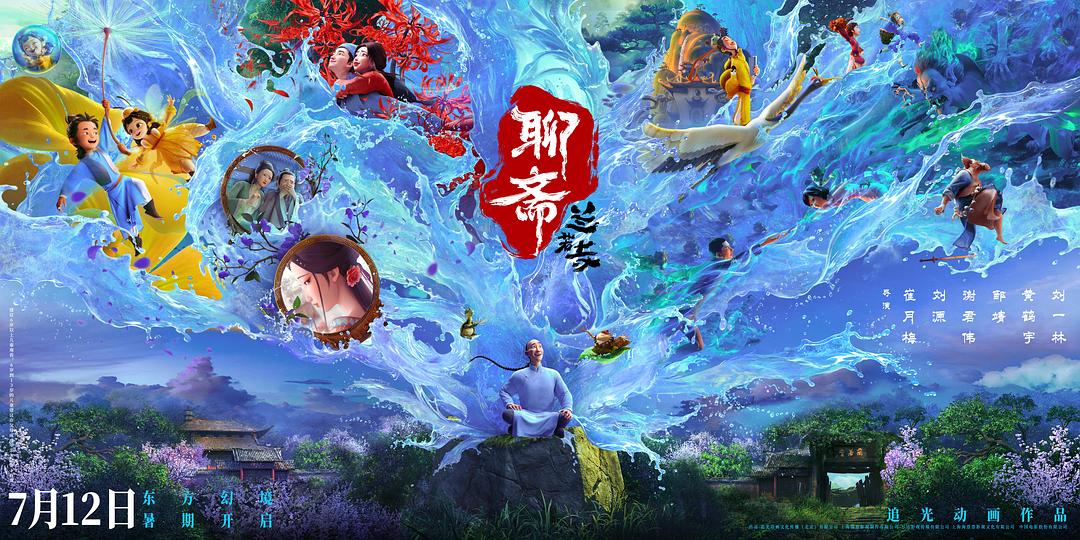
专访|制片人谈《聊斋:兰若寺》:6种方式打开东方志怪世界
Xin Lang Cai Jing· 2025-07-19 11:06
Core Viewpoint - The animated film "Liao Zhai: Lan Ruo Si" has been released on July 12 and has achieved significant box office success, showcasing the potential of Chinese animation in storytelling and cultural representation [1][35]. Group 1: Film Overview - "Liao Zhai: Lan Ruo Si" is described as the largest, most complex, and highest investment animated film by the production company, featuring multiple stories from Pu Songling's "Strange Stories from a Chinese Studio" [1][3]. - The film consists of five chapters, blending various styles such as humor, nostalgia, and romance, while exploring human emotions through the lens of traditional Chinese folklore [1][6]. Group 2: Production Insights - The production team, led by producer Song Yiyi, emphasizes the importance of adapting traditional stories for contemporary audiences, aiming to create a dialogue between ancient narratives and modern societal values [16][27]. - The film's creative process involved selecting five stories from a total of 491, balancing well-known tales with lesser-known ones to create a fresh yet familiar narrative experience [6][20]. Group 3: Cultural Significance - The film aims to resonate with audiences of all ages, providing a mix of fantasy for children, romantic adventures for young adults, and philosophical reflections for older viewers [11][14]. - The adaptation of classic stories like "Nie Xiaoqian" and "Hua Pi" incorporates modern perspectives, focusing on themes of identity and emotional depth, particularly through female characters [20][25]. Group 4: Industry Impact - The film's release has sparked discussions about the evolution of Chinese animation, moving away from stereotypes of being solely for children to a medium that can convey complex narratives and emotions [35]. - The success of "Liao Zhai: Lan Ruo Si" is seen as a potential catalyst for higher industry standards, as audiences now expect more sophisticated and engaging animated content [35][36]. Group 5: Future Prospects - The production company is planning for the film's overseas distribution, emphasizing the importance of accurately translating cultural nuances to appeal to international audiences [35].

百度萝卜快跑牵手Uber出海;MiniMax入港上市;霸王茶姬重返越南;《哪吒2》阿联酋上映|一周大公司出海动态
Tai Mei Ti A P P· 2025-07-18 22:29
Group 1: Strategic Partnerships and Expansions - Baidu's autonomous driving service platform "Luobo Kuaipao" has formed a global strategic partnership with Uber to expand driverless services beyond the US and mainland China, with thousands of sixth-generation driverless cars expected to join Uber's global network by the end of this year [1] - DingTalk, a subsidiary of Alibaba, has launched its first independent AI application "7Ding" overseas, integrating AI, office collaboration, and e-commerce procurement functions to enhance business efficiency [2] - WeRide has commenced pure driverless operations of its autonomous shuttle "Robobus" in Singapore, marking a milestone for smart mobility in Southeast Asia [3] Group 2: Market Entries and Product Launches - CHAGEE (霸王茶姬) has officially re-entered the Vietnamese market with its first store opening in Ho Chi Minh City, focusing on fresh leaf milk tea and original tea series products [4] - Midea Group has signed a sponsorship deal for the 2025 Africa Cup of Nations, aiming to accelerate its investment in the African market, with plans to invest at least $50 million in local production of home appliances by early 2026 [5][6] - Chery Automobile plans to launch two new SUV models in the UK, optimizing them for the local market, following a successful sales increase in the previous year [7] Group 3: Entertainment and Cultural Exports - The Chinese animated film "Nezha 2" premiered in the UAE and is set to release in North America starting August 22, having already broken numerous box office records [8] Group 4: Overseas Manufacturing Initiatives - Changan Automobile is in the planning stage for establishing a factory in Europe, with a focus on selling electric vehicles across ten European countries by 2027 [9] - Shoujia Technology is exploring the feasibility of establishing a manufacturing base in Romania as part of its overseas growth strategy, with a significant portion of its business now coming from exports [10] Group 5: Financing and IPO Activities - XPeng Huitian has completed a $250 million Series B financing round to support the development and commercialization of its flying car [11][12] - MiniMax, backed by Alibaba, has submitted an IPO application in Hong Kong, with a valuation of approximately $4 billion [13] - Zhipu AI is considering relocating its IPO to Hong Kong, seeking to raise around $300 million [14] - Yushu Technology has initiated its IPO counseling process with CITIC Securities as the advisory firm [15]
“希望给国产动画带来新鲜血液”
Huan Qiu Shi Bao· 2025-07-14 02:35
Core Viewpoint - The animated film "Liao Zhai: Lan Ruo Si," produced by Light Chaser Animation, aims to showcase the rich world of "Liao Zhai" and convey fundamental values and philosophical thoughts of Chinese culture, achieving a box office of over 260 million RMB shortly after its release [2][3][8] Group 1: Film Overview - "Liao Zhai: Lan Ruo Si" is adapted from Pu Songling's collection of short stories "Liao Zhai Zhi Yi," featuring classic tales such as "Cangshan Dao Shi," "Lian Hua Gong Zhu," "Nie Xiao Qian," "Hua Pi," and "Lu Gong Nu" [2][3] - The film employs a narrative structure of "1+5," starting with the protagonist Pu Songling's night at Lan Ruo Si, leading to various stories that he judges [3][4] Group 2: Creative Process - The creative team selected stories from nearly 500 in the original work, aiming for a balance of authenticity and innovation while exploring themes of greed, true love, and the complexities of life [4][7] - The film integrates six distinct visual styles within a unified national aesthetic, customizing each chapter's style to enhance emotional progression [5][6] Group 3: Cultural Significance - The project is part of Light Chaser Animation's "New Culture" series, focusing on transforming the essence of Chinese civilization into tangible expressions through modern animation techniques [7][8] - The film is positioned as a significant cultural export, with plans for overseas distribution to present the intricacies and charm of traditional Chinese culture to a broader audience [8]

中国动画电影这十年
Hu Xiu· 2025-07-08 04:35
Core Insights - The past decade marks a significant industrialization phase for animated films in China, evolving from niche artistic endeavors to a major genre that consistently contributes to the film market [1] - The expansion of the Chinese film market has provided ample space for diverse themes and artistic experimentation in animation, moving beyond the traditional children's entertainment label [1] Group 1: Mythological Adaptations - The most impactful animated films have involved the reinterpretation of Chinese mythology, driven by the need for creative innovation and the modernization of outdated values [2] - Films like "The King's Return" and "Nezha" series have shifted the narrative focus to personal stories, emphasizing themes of love and familial bonds over traditional heroic narratives [4][6] - "The King's Return" uniquely redefines the relationship between Tang Seng and Sun Wukong, reflecting modern existential struggles [3] Group 2: Original Works and Unique Narratives - Original animated films like "Big Fish & Begonia" attempt to create entirely new mythological worlds, though they often struggle with coherence and depth [12] - "The Guardian" stands out for its unique dystopian narrative and artistic style, blending childlike innocence with serious themes [13] Group 3: Historical and Realistic Themes - Films such as "Chang'an 30,000 Miles" and "Lion Boy" explore historical and social themes, highlighting the emotional struggles of characters against the backdrop of significant historical events [14][16] - "Lion Boy" incorporates a strong sense of realism, addressing the socio-economic challenges faced by families during China's economic rise [16] Group 4: Common Themes and Future Outlook - The best animated films of the past decade share a strong humanistic value orientation, balancing emotional depth with entertainment [19] - Despite the influence of foreign methodologies, there is a strong desire among creators to establish a unique Chinese animation identity, indicating a hopeful future for the industry [19]
2025年中国动画电影产业现状简析:内容产能不足与创新周期延长仍是问题核心[图]
Chan Ye Xin Xi Wang· 2025-06-20 01:44
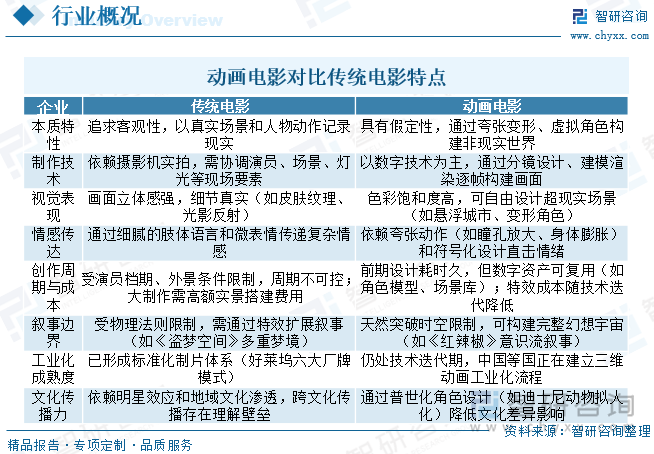
Core Insights - The Chinese animation film industry has experienced fluctuating box office performance in recent years, with domestic films achieving breakthroughs in genre diversification and brand operation, successfully activating family viewing demand and enhancing market pricing power [1][8] - From 2022 to 2024, the box office share of domestic animation films has remained in the 60% range, indicating a reliance on blockbuster hits while exposing issues such as insufficient production capacity for mid-tier films and lagging derivative product development [1][10] - In 2024, the total box office for Chinese animation films reached 6.863 billion yuan, with domestic animation accounting for 41.89% of this total [1][10] Animation Film Industry Overview - Animation films are defined as films produced using animation techniques, including theatrical releases and OVA (Original Video Animation) [2] - The industry is characterized by a shift from traditional filmmaking, which relies on real scenes and actors, to digital technology-driven animation that allows for creative freedom and a broader audience reach [2][3] Industry Policy Background - The Chinese government supports the animation film industry through tax incentives, funding support, and awards to encourage content creation that explores traditional culture and modern expression [4] - Policies aim to enhance the industry chain, nurture leading companies, support small teams, and promote cross-media IP development to strengthen international communication [4] Industry Chain Structure - The animation film industry chain includes upstream traditional production hardware and digital technology, midstream content creation and industrial production, and downstream distribution and marketing [6] - The integration of various technical paths, including 2D hand-drawn, 3D digital, and stop-motion animation, is essential for a comprehensive content production system [6] Current Industry Status - The box office share of domestic animation films declined from 2015 to 2017 due to content innovation and industrialization challenges, but saw a rapid recovery from 2018 onwards, with a significant increase in market share [8][10] - The number of domestic films breaking the 100 million yuan mark has fluctuated, with a notable increase in 2019 due to the success of films like "Ne Zha" [10] Competitive Landscape - Leading companies in the animation film industry, such as Light Chaser Animation and Bilibili, leverage technology and IP development to maintain market dominance [12][13] - Emerging players are exploring adult-oriented markets and cross-media development, indicating a competitive landscape focused on enhancing original content and global IP operations [12][14] Future Development Trends - The industry is moving towards deeper integration of technology and industrialization, utilizing AI and virtual production to enhance efficiency and visual expression [14] - Content creation is expected to draw from traditional cultural resources while innovating modern expressions, aiming to resonate emotionally with audiences and adapt to fragmented viewing habits [14]

皮克斯高管:不会像前老板乔布斯那样在凌晨3点给员工打电话
财富FORTUNE· 2025-06-16 12:33
Core Viewpoint - The article discusses the leadership styles of prominent figures like Steve Jobs, Elon Musk, and Jeff Bezos, highlighting their demanding work cultures and expectations for employee availability. Group 1: Leadership Styles - Steve Jobs was known for his intense work ethic, often contacting employees at all hours, including 3 AM, demonstrating a lack of respect for personal time but a strong respect for their work [1][2][6] - Jobs empowered creative personnel by allowing them autonomy over their projects, stating he would not interfere with their creative processes [2][3] - Elon Musk is noted for sending emails as late as 2:30 AM, expecting employees to keep pace with his high-intensity work culture [6][7] Group 2: Company Cultures - Pixar, co-founded by Jobs, became a major player in the film industry, producing beloved films like "Toy Story" and "Finding Nemo," which contributed to its success [3][4] - The competitive environment led Disney to acquire Pixar for $7.4 billion in 2006, indicating the studio's significant market value [4] - Amazon, under Jeff Bezos, is characterized by a demanding work culture where employees are expected to respond to communications at all hours, reflecting a focus on "harmony" between work and life rather than balance [7]

从《时间之子》开始,中国动画电影走上“云端”
Mei Ri Jing Ji Xin Wen· 2025-06-13 10:10
Core Viewpoint - The article discusses the challenges and advancements in the Chinese animation industry, particularly focusing on the transition to cloud-based production methods, exemplified by the film "The Time of Son" which is the first fully cloud-produced animated film in China [1][2][4]. Group 1: Animation Production Challenges - The production of "Ne Zha" involved over a hundred production companies and thousands of artists, leading to complex management and unstable production cycles due to traditional subcontracting methods [1]. - The animation industry in China has historically faced issues such as workflow fragmentation and management complexity, which cloud-based solutions aim to address [1][3]. Group 2: Cloud-Based Production Advantages - "The Time of Son" utilized the "Maoyan Cloud Production Platform," achieving over 70% of production tasks and 100% of rendering and data storage in the cloud, significantly reducing production time [2]. - The film's production process allowed for parallel task execution, extending the time available for refining visual effects from five to over twelve months [2]. Group 3: Industry Transformation - The shift to cloud production represents a move from heavy asset reliance to a lighter service subscription model, which is particularly beneficial for small production teams [4]. - Chinese cloud service providers like Tencent Cloud are gaining advantages in local film production due to their deep service capabilities and rapid implementation compared to foreign giants like AWS and Google Cloud [4]. Group 4: Future Potential and Expansion - The capabilities demonstrated by the "Maoyan Cloud Production Platform" could be replicated across more animation and film projects, potentially leading to standardized production services in the industry [6]. - Other cloud providers are also enhancing various aspects of the content industry, such as script creation and dubbing efficiency, indicating a broader trend towards intelligent production solutions [5].



抛弃大铁笼“锁电脑”,《时间之子》国产动画电影的“全云制作”实践
Tai Mei Ti A P P· 2025-06-12 02:49
Core Viewpoint - The article discusses the innovative approach of "fully cloud-based production" in the animation film industry, exemplified by the original animated film "The Time Traveler," which achieved over 100 million in box office revenue during the Dragon Boat Festival despite lacking a major IP or renowned director. This method addresses significant challenges in traditional animation production, such as environmental fragmentation, inefficient data transmission, and computational bottlenecks [2][3][4]. Group 1: Challenges in Traditional Animation Production - Traditional animation production faces three main challenges: environmental fragmentation, inefficient data transmission, and computational bottlenecks. The current mainstream model involves multiple teams working across various locations, leading to significant discrepancies in local environments [3][4]. - Data transmission issues are prevalent, with large files often being compressed or delayed, which can impact project timelines. For instance, a 50GB model file can be reduced to 10GB for email transmission, risking errors upon decompression [4]. - The computational demands for rendering are substantial, with complex scenes potentially requiring days of rendering time on local machines. The film "The Time Traveler" consists of 2,336 shots and 97,234 production tasks, highlighting the need for efficient computational resources [4]. Group 2: Advantages of Fully Cloud-Based Production - Fully cloud-based production resolves these issues by providing a unified environment where all teams use standardized software and tools, significantly reducing setup time. For example, a supplier was able to start working on the cloud the same day as the kickoff meeting, submitting their first shot just three days later [5]. - The centralized computational power allows for rapid processing of tasks that previously took hours on local machines. For instance, complex effects that once required hours of local rendering can now be processed in just half an hour on the cloud [5][6]. - The iterative capabilities of cloud production enable real-time data sharing, allowing teams to work concurrently rather than sequentially, thus enhancing the creative process and allowing for more extensive revisions [6]. Group 3: Future Implications and Industry Impact - The success of "The Time Traveler" demonstrates the replicability of cloud production, with plans to promote this model in future projects, particularly those requiring extensive collaboration among multiple teams [7]. - The cloud production model is expected to become a foundational infrastructure for the animation industry, reducing costs and increasing efficiency for smaller teams that previously had to invest heavily in equipment and software [7][8]. - The Chinese animation market is projected to reach 742.54 billion by 2024, accounting for 28% of the global market, with the potential for further growth to 3,595.42 billion by 2030. The widespread adoption of cloud production could help Chinese animation align technologically with international standards [8].