
汽车行业

Search documents
【环球财经】德国9月工业新订单环比增长1.1%
Xin Hua She· 2025-11-05 15:40
Core Insights - Germany's industrial new orders increased by 1.1% month-on-month in September, ending a four-month decline trend [1] - In Q3, industrial new orders decreased by 3% year-on-year [1] - Domestic new orders fell by 2.5% month-on-month, while foreign new orders rose by 3.5% [1] Domestic and Foreign Orders - Domestic new orders decreased by 2.5% month-on-month in September [1] - Foreign new orders increased by 3.5% month-on-month, with orders from the Eurozone and outside the Eurozone rising by 2.1% and 4.3% respectively [1] Sector Performance - The growth in new orders was primarily driven by the automotive industry and electrical equipment manufacturing, which saw month-on-month increases of 3.2% and 9.5% respectively [1] - In contrast, demand in energy-intensive sectors weakened, with new orders in the metal products manufacturing sector declining by 19% month-on-month [1] Year-on-Year Trends - Adjusted for working days, industrial new orders in September decreased by 4.3% year-on-year [1] Economic Outlook - The German Federal Ministry for Economic Affairs and Energy noted that the recent volatility in domestic and foreign orders makes it difficult to determine a clear trend in industrial demand [1] - The ministry highlighted that ongoing geopolitical uncertainties contribute to the fragility of industrial demand in Germany [1]
德国9月工业新订单环比增长1.1%
Xin Hua Wang· 2025-11-05 14:01
Core Viewpoint - Germany's industrial new orders showed a month-on-month increase of 1.1% in September, ending a four-month decline, although the third quarter saw a year-on-year decrease of 3% [1] Group 1: New Orders Data - In September, domestic new orders in Germany decreased by 2.5% month-on-month, while foreign new orders increased by 3.5%, with orders from the Eurozone and outside the Eurozone rising by 2.1% and 4.3% respectively [1] - The growth in new orders for September was primarily driven by the automotive industry and electrical equipment manufacturing, which saw month-on-month increases of 3.2% and 9.5% respectively [1] - In contrast, demand in energy-intensive sectors weakened, with new orders in the metal products manufacturing sector declining by 19% month-on-month [1] Group 2: Year-on-Year Comparison - Adjusted for working days, industrial new orders in September experienced a year-on-year decline of 4.3% [1] Group 3: Economic Outlook - The German Federal Ministry for Economic Affairs and Energy noted that due to significant fluctuations in domestic and foreign orders in recent months, it is currently difficult to determine a clear trend in industrial demand [1] - The ministry also highlighted that ongoing geopolitical uncertainties contribute to the fragility of industrial demand in Germany [1]
山东政商要情(10.27—11.2)
Sou Hu Cai Jing· 2025-11-03 09:30
Economic Performance - In the first three quarters of 2023, Shandong's GDP reached 77,115 billion yuan, growing by 5.6% year-on-year at constant prices [2] - The primary industry added value was 4,825 billion yuan (3.9% growth), the secondary industry 30,150 billion yuan (5.3% growth), and the tertiary industry 42,140 billion yuan (6.1% growth) [2] - Industrial value added for large-scale enterprises grew by 7.8%, with significant contributions from equipment manufacturing (12.0% growth) and specific sectors like automotive (17.0%), railway and shipbuilding (14.9%), and electronics (16.6%) [2] Policy and Development Initiatives - A major project planning and implementation meeting was held to ensure the achievement of economic and social development goals for the year and to support a strong start for the 14th Five-Year Plan [4] - Five key areas for project planning were identified: industrial upgrading, infrastructure, energy transition, urban-rural integration, and improving people's livelihoods [5] Trade and Investment - Jinan's foreign trade import and export reached 2,056.4 billion yuan in the first three quarters, a 28% increase year-on-year, significantly outperforming the provincial average [7] - The city achieved a balanced growth in exports (1,382.6 billion yuan, 24.2% growth) and imports (673.8 billion yuan, 36.5% growth), marking a historical high for the total trade volume [7][8] Conferences and Events - The 4th Confucian Business Conference was held in Jinan, attracting 468 guests from 36 countries, with 45 key projects signed, including 9 foreign investment projects totaling 1.01 billion USD [6] - The 25th Blue Economy International Talent and Industry-Academia-Research Cooperation Conference took place in Qingdao, showcasing innovations in various fields and signing key projects in biotechnology and semiconductors [9]


薛鹤翔:“十五五”锚定发展新航向
Sou Hu Cai Jing· 2025-11-02 11:32
Group 1 - Manufacturing PMI fell to 49.0% in October, indicating a contraction due to short-term disturbances from pre-holiday demand release and complex international environment [9][11] - The decline in PMI is not a signal of overall weakness, as large enterprises and advantageous industries continue to show resilience, while small and medium enterprises face pressure [11][12] - High-tech manufacturing, equipment manufacturing, and consumer goods industries maintain expansion in PMI, serving as core support for stabilizing manufacturing [12][31] Group 2 - The non-manufacturing business activity index slightly rose to 50.1%, driven by structural recovery in the service sector, although recovery remains uneven across industries [13][31] - The economic outlook indicates a need for more precise policy alignment with the pain points in specific sectors to support demand recovery [11][12] - The overall economic performance shows signs of stabilization, with a focus on high-quality development and structural optimization [28][31] Group 3 - The U.S. Federal Reserve lowered the benchmark interest rate by 25 basis points to 3.75%-4.00% in October, marking the second consecutive rate cut [22][24] - Despite a cooling of December rate cut expectations, there remains potential for further rate reductions based on economic and inflation conditions [22][25] - The U.S. economy is exhibiting signs of "stagflation," with nominal growth under pressure and rising unemployment, yet the likelihood of significant inflation remains low [23][25]

“十五五”规划建议的18个新提法,释放了哪些重要信号?
Mei Ri Jing Ji Xin Wen· 2025-10-29 15:24
Group 1 - The "15th Five-Year Plan" emphasizes the importance of technological innovation, mentioning "technology" 46 times and "innovation" 61 times, aiming to create a favorable environment for original and disruptive innovations [2] - The plan proposes to gradually increase the basic pension for urban and rural residents, highlighting the focus on improving people's livelihoods and promoting common prosperity [2][29] - New strategic technologies such as quantum technology, biomanufacturing, hydrogen energy, and artificial intelligence are identified as future economic growth points, with a focus on their commercialization during the "15th Five-Year Plan" period [3][4] Group 2 - The plan suggests establishing a risk-sharing mechanism for future industry investments, recognizing the uncertainties in technology and market conditions [5][6] - It proposes a new national system to tackle key technologies in areas like integrated circuits and advanced materials, emphasizing the need for collective efforts from various market entities [7] - The plan includes measures to enhance public service spending to boost consumer capacity, indicating a shift towards improving the consumption environment [9][10] Group 3 - The plan aims to peak coal and oil consumption, aligning with the broader goal of achieving carbon peak by 2030, necessitating a transition to a new energy system [12][13] - It emphasizes the need for proactive macroeconomic policies to stabilize growth, employment, and expectations, particularly in light of the challenges posed by traditional economic drivers [14][15] Group 4 - The plan highlights the importance of expanding service trade and optimizing market access, particularly in the service sector, to enhance international competitiveness [18][21] - It focuses on promoting green trade and intermediate goods trade, which are seen as vital for stabilizing foreign trade and aligning with global environmental goals [19][20] Group 5 - The plan includes initiatives to enhance food security through a new round of grain production capacity improvement actions, aiming for a significant increase in grain output [23][24] - It emphasizes the need for efficient land use in rural areas, addressing the mismatch between idle land and the demand for construction land to support rural development [25][26] Group 6 - The plan proposes to expand free education and explore extending compulsory education, which is expected to alleviate educational burdens and improve human capital development [27][28] - It aims to optimize the supply of affordable housing to meet the basic housing needs of urban wage earners and disadvantaged families, marking a shift towards a more inclusive housing policy [30][31]

独家洞察 | 贸易回暖?中美马这波谈判释放重磅信号!
慧甚FactSet· 2025-10-29 02:14
Core Viewpoint - The article highlights the significant easing of global trade tensions following U.S. President Trump's trade agreements during his Asia trip, leading to a positive market sentiment and record highs in U.S. stock indices [2][4]. Group 1: Trade Agreements - Trump signed formal trade agreements with Malaysia and Cambodia, and reached a framework agreement with Thailand and Vietnam, which includes tariff reductions on U.S. automobiles and agricultural products [4]. - Malaysia committed to investing approximately $70 billion in the U.S. over the next decade, while the U.S. will exempt some tariffs, maintaining an overall tax rate between 19% and 20% [4]. Group 2: U.S.-China Trade Talks - A new round of U.S.-China trade negotiations took place in Kuala Lumpur, resulting in a "framework agreement" for further cooperation, with plans for a meeting between the two countries' leaders at the APEC summit [4][5]. - Key discussion topics included bilateral trade, export controls, and the potential for a resolution regarding tariffs on soybeans and rare earth exports [5]. Group 3: Market Reactions - Following the trade agreements, U.S. stock indices reached new closing highs, with the S&P 500 rising by 1.23% to 6875.16 points, the Dow Jones increasing by 0.71% to 47544.59 points, and the Nasdaq soaring by 1.86% to 23637.46 points [2][4]. Group 4: Future Trade Relations - Analysts suggest that the recent talks signal a stable framework for U.S.-China relations, reducing the likelihood of sudden risks in the short term, despite unresolved issues regarding tariffs and trade [6]. - The establishment of a "framework agreement" is seen as a constructive outcome, potentially paving the way for future negotiations and trade agreements [6][7].

77115亿元!山东前三季度GDP增长5.6%
Qi Lu Wan Bao· 2025-10-28 07:36
Economic Overview - Shandong's GDP for the first three quarters reached 77,115 billion yuan, growing by 5.6% year-on-year, surpassing the national average, indicating strong economic resilience [1] - The primary industry added value was 4,825 billion yuan, growing by 3.9%; the secondary industry added value was 30,150 billion yuan, growing by 5.3%; and the tertiary industry added value was 42,140 billion yuan, growing by 6.1%, becoming the main driver of economic growth [1] Agriculture Sector - The total output value of agriculture, forestry, animal husbandry, and fishery grew by 4.3%, maintaining the same growth rate as the first half of the year [2] - Vegetable production increased by 3.1%, and fruit production grew by 2.6% [2] - Livestock production showed positive trends, with major livestock and poultry products increasing by 4.0%, and pig slaughtering up by 4.4% [2] Industrial Sector - The added value of large-scale industries in Shandong grew by 7.8%, indicating a sustained positive trend in industrial economy [3] - Equipment manufacturing saw a remarkable increase of 12.0%, significantly higher than the overall industrial growth [3] - The automotive industry grew by 17.0%, while the electronics sector increased by 16.6%, showcasing the rapid development of high-end manufacturing [3] Service Sector - The revenue of large-scale service industries grew by 5.4%, with 87.5% of industries experiencing revenue growth [4] - Consumer upgrade sectors performed well, with entertainment growing by 19.4% and business services by 16.9% [4] - Retail sales of consumer goods totaled 30,386.1 billion yuan, growing by 5.6%, with online retail sales increasing by 17.1% [4] Investment Trends - Despite a 3.7% decline in overall fixed asset investment, industrial investment grew by 7.7%, highlighting a shift towards high-quality development [6] - High-end manufacturing investment surged, with general equipment manufacturing up by 29.5% [6] Foreign Trade - Shandong's total import and export value reached 2.62 trillion yuan, growing by 5.5%, with exports at 1.60 trillion yuan and imports at 1.02 trillion yuan [7] - Private enterprises played a crucial role, with their import and export growth at 6.8%, accounting for 75.7% of total trade [7] Social Welfare - The employment situation remained stable, with 1.059 million new urban jobs created, reflecting resilience amid economic pressures [8] - Per capita disposable income reached 33,826 yuan, with urban and rural incomes growing by 4.4% and 5.1% respectively [8]
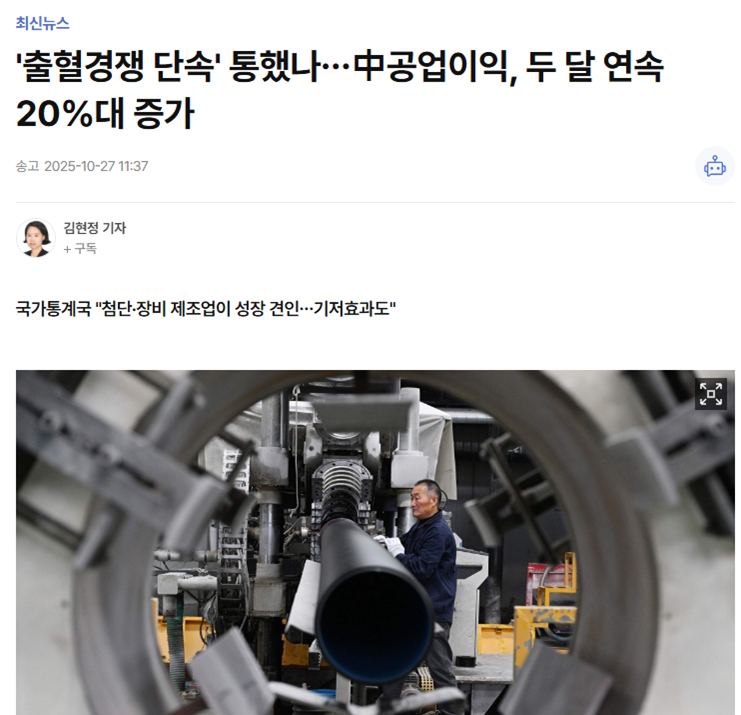
规上工业企业利润连续两个月增速超过20%,新质生产力实现较快增长
Huan Qiu Wang· 2025-10-28 01:02
Group 1 - The core viewpoint of the articles indicates that China's industrial profits have shown a significant year-on-year growth of 21.6% in September, marking a 1.2 percentage point acceleration from August, with growth rates exceeding 20% for two consecutive months [1][5] - High-tech manufacturing and equipment manufacturing sectors are experiencing rapid growth, contributing to the overall increase in industrial profits [1] - The profit growth is particularly notable in private and foreign enterprises, reflecting a broader recovery in the industrial sector [1] Group 2 - The Chinese government has implemented price control policies since May to curb excessive price competition, which has been effective in preventing disruptions in certain industries [5] - Despite ongoing trade tensions with the United States, these price control measures have alleviated downward pressure on manufacturers, particularly in sectors like automotive, solar energy, and petrochemicals [5]
前三季度全社会用电量同比增长4.6%
Zheng Quan Ri Bao· 2025-10-23 19:05
Core Insights - In September, China's total electricity consumption reached 888.6 billion kWh, marking a year-on-year increase of 4.5%. For the first three quarters, total electricity consumption accumulated to 7,767.5 billion kWh, with a growth of 4.6% year-on-year [1] - The third quarter saw a significant electricity consumption of 2.9 trillion kWh, driven by high temperatures in July and a recovering macroeconomic environment, leading to increased industrial capacity [1] - The second industry contributed 51% to the total electricity consumption growth in the third quarter, with a year-on-year increase of 5.1% [1] Industry Performance - The industrial electricity consumption in the third quarter grew by 5.4%, an increase of 2.3 percentage points compared to the second quarter. Manufacturing electricity consumption also rose by 5.2%, up by 3.2 percentage points from the previous quarter [2] - The third industry experienced a robust growth in electricity consumption, with an 8.3% year-on-year increase in the third quarter, driven by policies promoting consumption and the rapid development of new infrastructure [2] - Notable growth was observed in sectors such as information transmission, software, and IT services, with electricity consumption increasing by 33.8% year-on-year, and the electric vehicle charging services sector saw a remarkable growth of 49.6% [2] Quarterly Trends - Year-on-year growth rates for total electricity consumption were 2.5% in Q1, 4.9% in Q2, and 6.1% in Q3, indicating a consistent upward trend throughout the year [3]
9月社会用电量同比增长4.5%
Shang Hai Zheng Quan Bao· 2025-10-23 09:07
Core Insights - In September, China's total electricity consumption reached 888.6 billion kWh, a year-on-year increase of 4.5% [1] - From January to September, total electricity consumption accumulated to 7,767.5 billion kWh, with a year-on-year growth of 4.6% [1] - The third quarter saw significant growth in electricity consumption, with a total of 2.9 trillion kWh, marking a new phase in energy consumption scale for China's economic development [1] Group 1: Electricity Consumption by Sector - In September, the first industry consumed 12.9 billion kWh, up 7.3% year-on-year; the second industry consumed 5,705 billion kWh, up 5.7%; the third industry consumed 1,765 billion kWh, up 6.3%; while urban and rural residential electricity consumption fell by 2.6% to 128.7 billion kWh [1] - The second industry's electricity consumption for the first three quarters was 4.91 trillion kWh, a year-on-year increase of 3.4%, with a notable recovery in the third quarter, growing by 5.1% [2] - The manufacturing sector's electricity consumption in the third quarter increased by 5.2%, with 17 provinces reporting growth rates exceeding 5% [2] Group 2: Growth Drivers - The growth in the second industry's electricity consumption was driven by a series of government policies aimed at stabilizing growth, particularly in sectors like electronics, automotive, and steel [2] - High-tech and equipment manufacturing sectors saw a significant increase in electricity consumption, with a 9.5% year-on-year growth in the third quarter, surpassing the average growth rate of the manufacturing sector [3] - The third industry's electricity consumption grew by 8.3% in the third quarter, supported by rapid development in new energy vehicles and infrastructure [4] Group 3: Residential Electricity Consumption - The average temperature in the third quarter was historically high, leading to a record residential electricity consumption exceeding 500 billion kWh [5] - Residential electricity consumption for the first three quarters increased by 5.6%, with a 6.4% increase in the third quarter [5] - Several provinces, including Tibet and Ningxia, reported residential electricity consumption growth exceeding 10% due to higher average temperatures [5]