量子计算

Search documents
为全球经济增长带来更多动力
Ren Min Ri Bao· 2026-01-27 02:52
Core Insights - The 2025 China Economic Report highlights the resilience and growth of the Chinese economy amidst complex domestic and international environments, maintaining its position as the world's second-largest economy and contributing significantly to global economic growth [1][2][3] Economic Performance - The industrial added value for large-scale industries increased by 5.9% year-on-year, while total goods import and export rose by 3.8% [2] - The contribution rate of final consumption expenditure to economic growth exceeded 50%, with real disposable income per capita growing by 5.0%, aligning with economic growth [2] - China's GDP surpassed 140 trillion RMB for the first time, achieving a year-on-year growth of 5.0% [2][3] Government Initiatives - The Chinese government implemented various economic stimulus measures, including a trade-in policy for consumer goods, which boosted retail sales of consumer goods [2] - The government’s actions have effectively stimulated domestic demand and enhanced national economic confidence [3] Innovation and Technology - R&D expenditure intensity reached 2.8%, surpassing the OECD average for the first time, indicating a strong focus on innovation [4] - China’s innovation index entered the global top ten, with significant advancements in AI, quantum technology, and green energy [4] - Production in advanced technology sectors, such as civilian drones (up 37.3%), 3D printing equipment (up 52.5%), industrial robots (up 28.0%), and new energy vehicles (up 25.1%), has seen notable growth [4] Global Economic Impact - China is projected to contribute approximately 30% to global economic growth, reinforcing its role as a stable and reliable driver of the world economy [7] - The country’s advancements in technology and innovation are transforming it from a "world factory" to a technology and innovation powerhouse [7][8]
【中国新闻网】两院院士评出2025中国十大科技进展:“人造太阳”创世界纪录等入选
Zhong Guo Xin Wen Wang· 2026-01-27 02:36
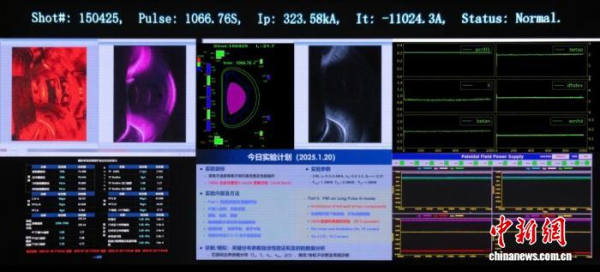
中国科学院院士和中国工程院院士投票评选的2025年中国十大科技进展新闻、世界十大科技进展新 闻,1月26日下午在北京揭晓。其中,中国"人造太阳"(EAST)创造"亿度千秒"世界纪录等入选2025年中 国十大科技进展。 2025年中国十大科技进展新闻分别是: ——中国"人造太阳"(EAST)创造"亿度千秒"世界纪录。中国有"人造太阳"之称的全超导托卡马克核 聚变实验装置(EAST)在安徽合肥创造新世界纪录,其首次完成1亿摄氏度1066秒"高质量燃烧",标志着 中国聚变能源研究实现从基础科学向工程实践的重大跨越,对人类加快实现聚变发电具有重要意义。 EAST形如"巨罐",集"超高温""超低温""超高真空""超强磁场""超大电流"等尖端技术于一体,近百 万个零部件协同工作,拥有专利近2000项。10余年来,EAST历经15万多次实验,最终实现"亿度千 秒"的长脉冲高约束模等离子体运行,攀上新的科学高峰。 ——深度求索(DeepSeek)公司另辟蹊径推出中国AI。成立仅一年多的深度求索公司,推出新一代大 模型R1,在性能比肩OpenAI o1正式版的同时,实现超低训练成本,并且全面开源,给全球人工智能 (AI)界带来 ...

上海交大教授创业光量子计算,再获数亿融资,公司估值已近70亿|36氪独家
3 6 Ke· 2026-01-27 01:27
Financing Information - TuringQ has completed a new round of financing amounting to several hundred million yuan in its Series B round [1] - The financing was led by major state-owned capital and includes strategic investors such as Sichuan Provincial Industrial Revitalization Group, Shenzhen Investment Holdings, Fosun, and SenseTime [1] - The funds will be primarily used for the research and development of domestically controllable quantum computers, core technology breakthroughs, and the establishment of a high-end R&D talent team [1] Company Overview - TuringQ was established in 2021 and is headquartered in Shanghai [2] - The company focuses on "photon chip + quantum computing" technology and aims to promote the industrialization of photonic quantum computing [2] - Its core products include the TuringQ Gen2 large-scale programmable photonic quantum computing system and a fully controllable quantum-classical hybrid computing solution [2] Technical Highlights - TuringQ has achieved a complete closed-loop from design to system integration, establishing full autonomy in chip to system capabilities [4] - The company leads in materials and processes, utilizing thin-film lithium niobate for photonic chips and has built the first domestic pilot line for photonic chips [4] - TuringQ has launched the TuringQ Gen2 quantum computer, the DeepQuantum AI programming framework, and the "Quantum Engine" cloud platform [4] Market Potential - The quantum computing market is projected to reach $811.7 billion by 2035, with photonic quantum computing being a mainstream path due to its compatibility with existing semiconductor processes [5] - TuringQ has overcome key technical bottlenecks in photonic quantum chip manufacturing, enabling scalable and programmable production [5] Business Growth - TuringQ has shown strong commercial growth, with orders exceeding 100 million yuan by 2025 and a compound annual growth rate of over 200% in revenue [8] - The company is involved in multiple national-level major projects and participates in the formulation of industry and national standards [8] Team Background - The founder, Jin Xianmin, is a distinguished professor with over 20 years of experience in photonic quantum chips and has published over 150 papers [9] - The core team includes talents from prestigious institutions, with over 70% holding master's or doctoral degrees [9] Strategic Direction - The company aims to scale the application of photonic quantum computers and deploy "quantum-super fusion" computing centers nationwide [12] - TuringQ is transitioning from being a product and solution provider to a builder of computing infrastructure and "quantum+" ecosystems [11]


量子计算重大整合!IonQ(IONQ.US)18亿美元收购SkyWater(SKYT.US),打造“量子英伟达”模式
Zhi Tong Cai Jing· 2026-01-27 00:00
Core Viewpoint - IonQ Inc has agreed to acquire SkyWater Technology for approximately $1.8 billion, marking a significant step towards building a fully integrated quantum platform [1][2] Group 1: Acquisition Details - The acquisition will be executed through a cash and stock transaction, with IonQ offering $35 per share, comprising $15 in cash and $20 in stock, representing a 38% premium over SkyWater's average stock price over the past 30 days [1] - The deal has received unanimous approval from both companies' boards and is expected to close in the second or third quarter of 2026, pending regulatory approvals and shareholder votes [1] Group 2: Strategic Implications - This acquisition is the largest in a series of recent purchases by IonQ, which includes a $1.08 billion acquisition of UK-based Oxford Ionics [1] - The integration of SkyWater's semiconductor manufacturing capabilities with IonQ's quantum architecture aims to create a closed-loop process from quantum chip design to end production [1][3] Group 3: Technological Advancements - IonQ's CEO stated that the acquisition will allow the company to utilize a large domestic chip foundry, accelerating technology development and enhancing appeal to U.S. clients in sensitive sectors like defense [2] - The collaboration is expected to significantly reduce the development time for a 256-qubit chip from 9 months to 2 months, and advance IonQ's roadmap for testing 200,000 physical qubit units by 2028 [2] Group 4: Market Position and Future Outlook - SkyWater, identified as the largest domestic chip foundry in the U.S., will operate as a wholly-owned subsidiary of IonQ while maintaining its brand and existing production facilities [3] - The acquisition is seen as a strategic move to enhance IonQ's competitiveness in the federal and defense sectors, aiming to replicate Nvidia's model by controlling core hardware manufacturing [3] - The quantum computing industry is transitioning from experimental phases to large-scale industrial applications, indicating a significant shift in market dynamics [3]



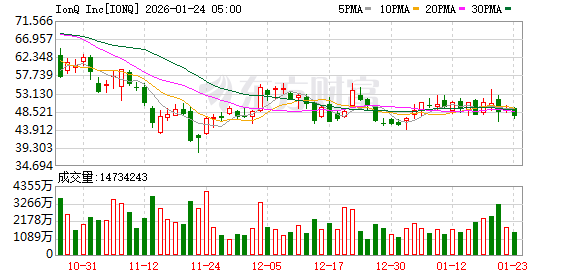
伊翁量子计算公司(IONQ)盘前股价上涨2.7%
Mei Ri Jing Ji Xin Wen· 2026-01-26 13:25
(文章来源:每日经济新闻) 每经AI快讯,1月26日,伊翁量子计算公司(IONQ)盘前股价上涨2.7%。 ...
美股前瞻 | 三大股指期货齐跌 黄金逼近5100美元 稀土公司USA Rare Earth(USAR.US)盘前暴涨
智通财经网· 2026-01-26 12:36
盘前市场动向 市场消息 多家科技巨头财报本周亮剑:AI万亿豪赌迎生死大考。微软、Meta Platforms和特斯拉将于周三公布财报,苹果紧随其后于周 四公布。随着大型科技公司准备在未来几周陆续公布季度财报,AI交易正走向一个关键节点。"美股七巨头"此前被视为市场中 毫无争议的赢家,但这一叙事在今年以来已明显动摇,投资者开始追逐周期股、小盘股以及国际市场的动量。本轮财报季将考 验这些超大市值科技股的韧性,尤其是在市场从少数赢家向更广泛标的扩散的背景下。此外,在存储芯片行业已进入"超级周 期"之际,韩国两大存储芯片巨头——SK海力士和三星电子——本周将公布财报。华尔街分析师们对存储芯片/存储产品相关核 心公司的基本面与股价前景正在变得愈发积极。 鲍威尔能否"硬刚"到底?市场已经押注美联储"不屈服"。今年以来,关于美联储独立性的博弈已升级多个层级,但这家全球最 重要的央行几乎没有妥协的迹象——如今它还获得了最高法院与资深政客的支持。这种支持是否让美联储有底气强硬抵制"加 速降息"的压力,将成为本周的核心考验。本周的联邦公开市场委员会(FOMC)会议几乎肯定不会开启加速宽松周期。但鲍威尔 如何规划未来的政策路径、如 ...

多所高校成果,入选中国十大科技进展
Xin Lang Cai Jing· 2026-01-26 11:15
Core Insights - The 2025 China and World Top Ten Scientific Advances were announced, highlighting significant achievements in various fields of science and technology [2][13]. Group 1: China's Top Ten Scientific Advances - The "artificial sun" EAST achieved a world record of 1 billion degrees Celsius for 1066 seconds, marking a major leap in fusion energy research [14]. - DeepSeek launched a new AI model R1, which matches the performance of OpenAI's models while significantly reducing training costs and being fully open-source [15]. - A thorium-based molten salt reactor was built, achieving thorium-uranium fuel conversion and demonstrating the feasibility of using thorium resources in nuclear energy [15]. - A high-precision AI diagnostic tool for predicting liver cancer recurrence was developed, achieving an accuracy rate of 82.2% and featured on the cover of Nature [16]. - The "North Brain No. 1" wireless brain-computer interface was successfully implanted, enabling patients with speech impairments to communicate effectively [17]. - A novel target for Parkinson's disease was discovered, providing new hope for treatment and drug development [18]. - The "Zu Chongzhi No. 3" superconducting quantum computer was built, outperforming the fastest supercomputers by a factor of 10 trillion [19]. - New hydrogen production technology was developed, eliminating CO2 emissions and achieving high hydrogen yield [20]. - Significant breakthroughs in black soil protection technology were reported, supporting sustainable agricultural practices [21]. - A new ultra-wideband optoelectronic integrated system for 6G communication was developed, enabling high-speed wireless communication across a wide frequency range [22]. Group 2: World Top Ten Scientific Advances - Brain-computer interfaces allow patients to express emotions through speech and song, translating thoughts into language in real-time [23]. - An integrated chip system combining electronics, photonics, and quantum technology was created [23]. - The largest black hole merger event was detected, challenging existing black hole formation models [23]. - The highest energy neutrino ever detected was found, being 20 times more energetic than previous detections [23]. - The first visible "time crystal" was created [23]. - Transgenic pig organ transplants set a new record for survival time [23]. - Ground-based telescopes detected signals from 13 billion years ago [23]. - The largest cosmic map to date was produced [23]. - The most detailed brain map was created, describing numerous neurons and their activities [23]. - "Deep Thinking" announced AI test scores equivalent to gold medal levels in international mathematics competitions [23].

瞭望 | 量子计算突围路线图
Xin Hua She· 2026-01-26 09:44
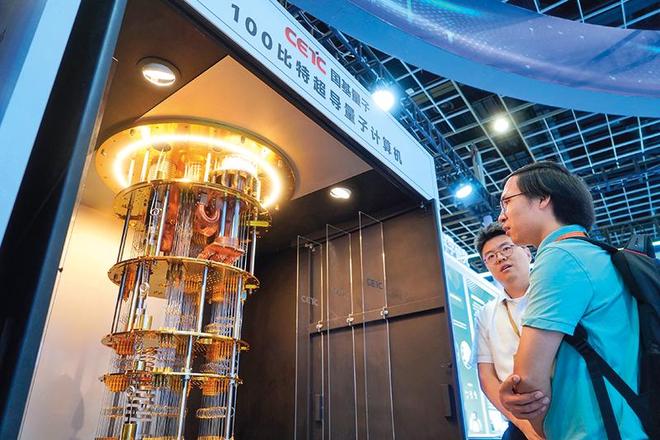
Core Insights - The global quantum computing competition is intensifying, with countries like the US, EU, and Japan elevating quantum computing to a national strategy, focusing on legislation, substantial investments, and international collaboration [3][4] - China has made significant strides in quantum computing, establishing itself in the first tier of the industry, but faces challenges in technology breakthroughs, supply chain security, and standardization [1][4] - The success of quantum computing depends on building a sustainable, full-stack ecosystem rather than just the parameters of individual machines [1][7] Investment and Strategic Initiatives - The US has invested approximately $6.078 billion over seven years through the National Quantum Initiative Act, while the EU plans to invest around $1.1 billion from 2018 to 2027 under its Quantum Technology Flagship program [3] - Japan has earmarked 1.05 trillion yen for quantum technology, designating 2025 as the "year of quantum industrialization" [3] - South Korea has allocated 198 billion won for quantum technology in 2025, indicating a global trend towards comprehensive breakthroughs in quantum computing [3] Technological Development - The focus is on six core capabilities: quantum chip systems, quantum computing measurement and control systems, quantum computing environmental support systems, quantum operating systems and software, quantum computing cloud platforms, and quantum application software [3][4] - China is advancing its quantum computing capabilities with a focus on "self-controllable" technology, achieving several independent results in the six core capability areas [4][5] Ecosystem and Collaboration - The US and EU are building ecosystems centered around operating systems, with companies like IBM and Google leading the way in standardization and collaboration [4][5] - China's quantum computing cloud platform is rapidly developing, providing low-cost access to quantum computing for various industries, thus promoting application exploration [5][6] Challenges and Barriers - The core technology barriers in quantum computing stem from its high specialization, requiring significant R&D investment and long-term technical accumulation [8][9] - The ecological barriers arise from the interdependence of hardware and software, with leading global companies creating user stickiness and technological moats [9][10] - Standard barriers are critical for industry dominance, with the US and EU actively working on international standards that could dictate future developments [9][10] Future Directions - Experts suggest that China should focus on three essential capabilities: quantum chips, measurement and control systems, and operating systems, to achieve breakthroughs [11][12] - A coordinated national strategy is recommended to foster innovation and industry cultivation, ensuring that China can compete effectively in the global quantum landscape [11][12] - The development of a shared ecosystem between research and industry is crucial for advancing quantum applications in key sectors like biomedicine and finance [12]

3.9万亿元研发经费投入厚蓄硬核实力
Jing Ji Ri Bao· 2026-01-26 02:43
Group 1 - The core point of the article highlights China's significant investment in R&D, reaching 39,262 billion yuan, with an R&D intensity of 2.8%, marking a new milestone in the country's technological development and surpassing the OECD average for the first time [1] - Continuous increase in R&D investment is attributed to the synergy of policy guidance, market drive, and active participation from enterprises [1] - The top-level design has established a solid institutional foundation for technological innovation, with systematic measures empowering high-level technological self-reliance and strength as a strategic support for modernization [1] Group 2 - China's innovation indicators are improving, with the country ranking in the top ten globally for innovation index and surpassing 5 million effective invention patents, while leading the world in PCT international patent applications for six consecutive years [2] - The speed of industrial upgrading is accelerating, with the added value of equipment manufacturing and high-tech manufacturing industries expected to reach 36.8% and 17.1% of the total industrial added value by 2025 [2] - Key breakthroughs have been achieved in fields such as artificial intelligence, quantum computing, and new energy, with the number of AI companies exceeding 6,000 and the core industry scale projected to surpass 1.2 trillion yuan by 2025 [2] Group 3 - Despite notable achievements, there is still room for improvement in the structure and efficiency of R&D funding, particularly in increasing the proportion of basic research [3] - There is a need to promote balanced regional development, as R&D resources are currently concentrated in the eastern regions, requiring policy guidance and collaboration to bridge the gap with central and western regions [3] - Enhancing the mechanism for converting research results into market applications is essential to prevent technological achievements from remaining unused [3]
一家AI陪伴公司,阿里启明五源都来投了丨投融周报
投中网· 2026-01-26 02:12
将投中网设为"星标⭐",第一时间收获最新推送 硬科技赛道,新能源与储能成热门。 上周,海尔新能源在青岛举行B轮融资签约仪式暨发展战略研讨会,与农银投资、招商银行、鲁信创投、山能资本 等资方达成合作,本轮融资超10亿元。此外,至华新能源科技(浙江)有限公司完成新一轮战略融资。本轮融资由浙江省产业基金、财通资本、浙江产 投、浙创投联合投资。 大健康赛道,生物医药成重点。 上周,浙江德进生物医药完成数千万元A轮融资,本轮融资由弘晖基金领投,凯乘资本担任首席财务顾问并继续负责后 续融资。此外,深圳市新樾生物近日完成数千万元A+轮战略融资,本轮融资由老股东晶泰科技追加投资。 互联网赛道,量子计算受重视。 上 周,量子计算企业量旋科技宣布完成数亿元C轮融资,本轮由隆利科技、晶凯资本、恒泰华盛、毅达资本、青岛瀚 瑞、海南风凯翔联合投资,邝中、夏佐全持续跟投。此外,国内量子计算应用的创新先行者微观纪元宣布完成近亿元A轮融资。本轮获容亿投资领投, 尖晶资本等参与投资。 据投中网不完全统计,投融资详情如下(统计周期1月17日—1月23日): 新消费 速览投资风口,掌握资本律动。 作者丨 长风 来源丨 东四十条资本 大家好,我是长 ...