
可再生能源

Search documents
(经济观察)2035年新目标彰显中国能源转型雄心
Zhong Guo Xin Wen Wang· 2025-09-25 12:50
中国"十四五"时期非化石能源消费比重目标是20%。中国国家能源局局长王宏志此前透露,去年该比重 已经达到了19.8%,今年预计可以超额完成目标。 中新社北京9月25日电 (记者 王梦瑶)《巴黎协定》达成10周年之际,中国宣布新一轮国家自主贡献目 标。此间专家认为,这意味着中国能源转型将持续发力,彰显应对气候变化的责任担当。 上述目标中明确:到2035年,中国非化石能源消费占能源消费总量的比重达到30%以上,风电和太阳能 发电总装机容量达到2020年的6倍以上、力争达到36亿千瓦。 作为世界上最大的能源消费国,中国在保障能源安全的前提下完成这一目标需要艰苦努力,但有底气兑 现承诺。 李昇认为,中国具备实现新目标的产业基础、技术优势与市场规模。完整的产业链、领先的技术和持续 创新能力为未来发展提供坚实保障。 当前,单边主义、保护主义倾向不断显现,国际政治博弈加剧,使得气候变化领域的政治色彩一再强 化,各国应对气候变化的互信和努力遇到冲击。中国提出2035年国家自主贡献目标,也进一步彰显大国 担当。 电力规划设计总院党委书记胡明指出,中国仍处于发展阶段,人均能源消费尚未达到经济合作与发展组 织(OECD)国家平均水 ...
北京能源国际获惠誉常青确认评级结果 主体评分提升至“80”
Zhi Tong Cai Jing· 2025-09-25 12:02
Core Insights - Beijing Energy International (00686) announced that Fitch Ratings has confirmed its ESG issuer rating of "2" and upgraded its score from "78" to "80" [1] Group 1 - The upgrade in the ESG score reflects the company's significant efforts in promoting renewable energy development and climate action [1]
北京能源国际(00686)获惠誉常青确认评级结果 主体评分提升至“80”
智通财经网· 2025-09-25 11:57
Core Viewpoint - Beijing Energy International (00686) has received an upgraded ESG rating from Fitch Ratings, reflecting the company's commitment to renewable energy and climate action [1] Group 1 - The company maintained an ESG issuer rating of "2" as of September 24, 2025 [1] - The ESG score increased from "78" to "80", indicating improved performance in sustainability efforts [1] - The upgrade signifies high recognition of the company's initiatives in promoting renewable energy development [1]
月度用电量再破万亿,是中国经济活力最直观证明 | 新京报快评
Xin Jing Bao· 2025-09-25 10:06
Core Insights - China's monthly electricity consumption has exceeded 1 trillion kilowatt-hours for two consecutive months, indicating a stable economic performance with a year-on-year growth of 5.0% in August [2][3] Electricity Consumption Breakdown - The primary industry consumed 101.2 billion kilowatt-hours, growing by 10.6% year-on-year, while the secondary industry accounted for 4,338.6 billion kilowatt-hours with a growth of 3.1% [2] - The tertiary industry saw a significant increase in electricity consumption, reaching 1,329.7 billion kilowatt-hours, which represents a 7.7% year-on-year growth, highlighting a shift towards a service-oriented economy [3][4] - Urban and rural residential electricity consumption was 1,109.4 billion kilowatt-hours, growing by 6.6%, reflecting stable consumer spending and improved living standards [2][3] Economic Resilience and Structural Changes - The stable growth in the secondary industry indicates a solid industrial base, essential for overall economic stability amidst external challenges [3] - The rapid increase in electricity consumption in the tertiary sector signals profound changes in economic structure, with a focus on consumption potential and the development of modern services [3][4] Impact of Digital Economy and AI - The rise in electricity demand is closely linked to the booming digital economy and the rapid expansion of the artificial intelligence sector, marking a transition from traditional to innovation-driven economic growth [4][5] - The demand for electricity from AI and digital technologies necessitates higher quality and sustainable energy supply, aligning with China's ongoing energy revolution [4][5] Future Outlook - The trend of exceeding 1 trillion kilowatt-hours in electricity consumption not only reflects economic stability but also highlights the dual driving forces of traditional industrial strength and the emerging digital economy [4][5] - Balancing technological innovation with energy sustainability will be crucial for the future quality of economic development [5]

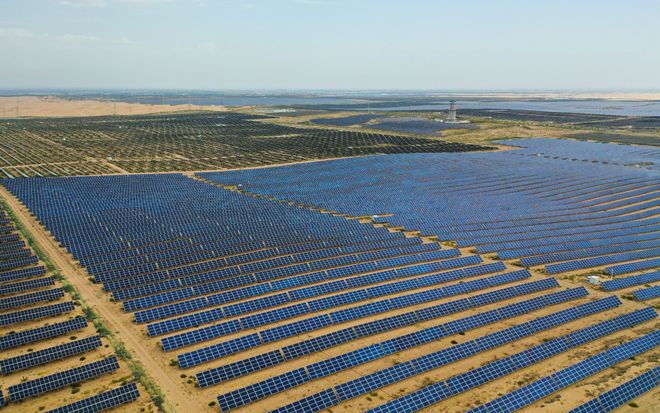
6倍以上、36亿千瓦,我国更新风光装机目标!相关板块股价上涨
Di Yi Cai Jing· 2025-09-25 09:00
Group 1 - China has achieved its 2020 wind and solar installation target six years ahead of schedule, with a new goal set to reach 3.6 billion kilowatts by 2035, which is six times the 2020 target [1][2] - The renewable energy sector has seen significant market performance, with solar equipment and energy storage indices showing positive growth, indicating investor confidence in the sector [1] - The total installed capacity of renewable energy in China reached 2.68 million kilowatts in the first half of this year, accounting for 91.5% of new installations, and the total capacity reached 2.159 billion kilowatts, representing a year-on-year growth of 30.6% [3] Group 2 - The new installation targets for wind and solar energy are seen as a strategic arrangement for optimizing China's energy structure and contributing positively to global climate governance [2] - The demand for energy in various sectors such as industry, construction, and transportation is expected to continue growing, driven by the electrification trend and the rapid adoption of digital technologies [2] - Renewable energy is projected to maintain its dominant position in new installations, constituting nearly 60% of the total installed capacity in the country [3]





供应链降碳,既要“绿电集采”也要推动供应商“用绿电”
Xin Lang Cai Jing· 2025-09-25 05:56
Core Insights - The ultimate goal for companies purchasing green electricity is to achieve specific carbon reduction targets and attain "carbon neutrality" [3][10] - Many small and medium-sized enterprises in the supply chain face challenges in technology, funding, and channels when entering the green electricity market [3] - Leading companies typically adopt two strategies: facilitating "green electricity collective procurement" for suppliers and prioritizing partnerships with low-carbon suppliers based on ESG performance [3][4] Green Electricity Collective Procurement - The motivation for companies to procure green electricity and engage suppliers in collective procurement largely stems from the carbon reduction requirements imposed by leading enterprises, especially those with significant scope 3 emissions [4][5] - The "green electricity collective procurement" model allows leading companies to aggregate the green electricity needs of multiple suppliers and sign long-term contracts with large renewable energy developers, resulting in price advantages [4][5] - For instance, in 2023, Decathlon assisted 14 suppliers in Fujian to sign long-term green electricity procurement agreements with China General Nuclear Power Group [4] Regional Focus and Efficiency - Collective procurement is more effective when conducted within the same province, as it facilitates stable green electricity consumption and supports local renewable energy projects [5] - Lenovo plans to pilot green electricity collective procurement in Guangdong in 2024, with an expected reduction of 30,000 tons of CO2 emissions from the procurement of 46 million kWh of green electricity [5] Integrated Sales Model - Companies requiring large-scale green electricity procurement often find it more efficient to choose integrated sales companies that possess both generation and sales capabilities [6] - Integrated sales companies can better meet the needs of large users due to their stable self-generated resources, while pure sales companies may face challenges in matching user demand and securing stable green electricity sources [6] Supply Chain Collaboration - Collaboration between upstream and downstream enterprises can enhance the use of green electricity among suppliers, driven by ESG performance evaluations [7][8] - ESG compliance has become a critical factor for companies, influencing their creditworthiness and market competitiveness, particularly in the solar industry [7][8] Case Studies and Industry Standards - JinkoSolar conducts annual ESG audits of its primary suppliers, covering over 60 suppliers by 2025, which accounts for approximately 70% of its procurement [8] - Baosteel is responding to green and low-carbon demands from automotive clients by calculating carbon footprints and gradually introducing low-carbon steel products [9][10] Conclusion - Companies need to adopt a goal-oriented approach to green electricity procurement, considering the entire supply chain to facilitate collective procurement and promote ESG performance [10]
专家解读丨2035年国家自主贡献目标:我国能源转型持续发力 彰显应对气候变化责任担当
国家能源局· 2025-09-25 04:43
Core Viewpoint - The article emphasizes the significance of green and low-carbon energy transition in achieving China's carbon peak and carbon neutrality goals, highlighting the country's commitment to sustainable development and international cooperation in addressing climate change [2][6][8]. Group 1: Achievements in Energy Transition - China's energy consumption reached 5.96 billion tons of standard coal in 2024, maintaining its position as the world's largest energy consumer. The country has made remarkable progress in energy green and low-carbon transition under strong leadership [3]. - Energy efficiency and cleanliness have improved, with energy consumption per unit of GDP decreasing by 11.6% compared to the end of the 13th Five-Year Plan. The share of non-fossil energy consumption reached 19.8%, an increase of 7.8 percentage points since 2015, with expectations to exceed the 20% target by 2025 [3]. - The electrification rate of end-use energy has reached around 30%, with over one-third of electricity being green energy, reflecting a significant shift in energy consumption structure [3]. Group 2: Strengthening Non-Fossil Energy Supply - China has the world's largest and fastest-growing renewable energy system, with installed capacities for hydropower, wind, solar, and biomass power leading globally. By July 2025, the total installed capacity for wind and solar power reached 1.68 billion kilowatts, accounting for nearly half of the global total [4]. - The country has consistently approved over 10 nuclear power units annually, leading the world in operational and under-construction nuclear power capacity. The average power supply reliability reached 99.924% in 2024 [4]. Group 3: Growth of Clean Energy Industry - Since 2015, China's share of global clean energy investment has increased from 26% to around 34%, making it the largest investor in energy transition. The country leads in the production of photovoltaic products, lithium batteries, and new energy vehicles, contributing over 80% of global photovoltaic modules and 70% of lithium batteries [5]. - China's exports of wind and solar products have significantly supported global climate change efforts, reducing carbon emissions by approximately 4.1 billion tons since 2020 [5]. Group 4: National Contribution Goals for 2035 - China's 2035 national contribution goals reflect its commitment to addressing climate change and establishing a fair global energy governance system. The country aims to achieve a non-fossil energy consumption share of over 30% by 2035, demonstrating its responsibility as a major power [6][7]. - The country acknowledges the challenges of achieving significant reductions in carbon intensity while facing rising energy demand, emphasizing its commitment to the principle of "common but differentiated responsibilities" in global climate governance [6][8]. Group 5: Strategies for Achieving Goals - The strategy for achieving carbon peak and carbon neutrality includes constructing a green and resilient energy consumption system, promoting structural changes in energy consumption, and implementing dual control over total carbon emissions and intensity [9]. - The focus on non-fossil energy development will be intensified, with plans to expand the multi-source supply system for non-fossil energy and develop a new power system that integrates various energy forms [9][10]. - Emphasis will be placed on technological innovation in energy, market reforms, and international cooperation to enhance the effectiveness of energy transition efforts [10].

美国民主党公布能源计划,推动2026年中期选举
Xin Lang Cai Jing· 2025-09-24 18:16
Core Viewpoint - The proposed legislation by House Democrats aims to reduce rising energy costs for Americans by increasing investments in renewable energy and enhancing the energy assistance program for low-income households [1] Group 1: Renewable Energy Initiatives - The bill includes the restoration of tax credits for renewable energy projects [1] - It proposes investment tax incentives for new transmission lines to strengthen the power grid [1] - The focus is on shifting support away from fossil fuel projects, which were favored during the Trump administration, towards renewable energy sources [1] Group 2: Energy Assistance for Low-Income Households - The legislation aims to expand the low-income energy assistance program [1] - It seeks to provide reliable heating and cooling services year-round for impoverished families [1]
摩根大通私行全球市场策略师:中国已处于或接近价值链尖端位置
Di Yi Cai Jing· 2025-09-24 06:57
Group 1: Supply Chain Dynamics - The Asian supply chain is diversifying and becoming more refined, with China increasing its share of high-end manufactured goods in the value chain [1][2] - The ASEAN countries exhibit significant differences in industrial specialization and development levels, impacting their positions in the value chain [1] Group 2: Trade Relations - ASEAN has effectively replaced the U.S. as China's largest regional export market, with approximately 16% of China's exports directed to ASEAN in 2024, slightly above the 14% share to the U.S. [2] - China has shifted from a trade deficit to a growing surplus with ASEAN in the electronics sector, indicating an enhancement in China's production dominance [2] Group 3: Foreign Direct Investment (FDI) - ASEAN welcomed a record FDI of $230 billion in 2023, with China becoming a major source of investment, particularly in Indonesia, where Chinese FDI reached $8.2 billion in the first half of 2025 [6] - The influx of FDI is expected to boost manufacturing capacity, create jobs, and optimize labor structures in the region [6] Group 4: Economic Resilience and Strategies - The economic ties between China and ASEAN have strengthened since the U.S.-China trade tensions, showcasing resilience despite potential risks from external pressures [3][4] - Companies can enhance regional supply chain resilience by diversifying partnerships and aligning investments with long-term national development goals, particularly in clean energy and digital economy sectors [7]
摩洛哥启用非洲首座浮动光伏电站
Shang Wu Bu Wang Zhan· 2025-09-24 03:32
Core Insights - The first floating solar power station in Africa has been officially launched near the Oued Rmel dam adjacent to the Tangier-Mediterranean port [1] - The project is led by Morocco's Ministry of Equipment and Water, in collaboration with the Oued Loukkos Water Authority and various public and private entities [1] - The solar station consists of approximately 22,000 photovoltaic panels covering an area of 10 hectares of water [1] - The power station not only provides clean electricity to the Tangier port but also effectively reduces water evaporation from the reservoir, offering both economic and ecological benefits [1] - This project marks a significant breakthrough in Morocco's renewable energy utilization, reinforcing its leading position in solar energy use in Africa [1]