
有色金属

Search documents
港股收评:恒指涨0.66%、科指跌0.19%,钢铁、有色概念股走高,大型科技股走势分化,AI应用板块回调
Jin Rong Jie· 2026-02-25 08:20
Market Performance - The Hong Kong stock market showed mixed performance with the Hang Seng Index rising by 0.66% to 26,765.72 points, while the Hang Seng Tech Index fell by 0.19% to 5,260.5 points [1] - Major technology stocks had varied movements, with Alibaba up 0.2%, Tencent up 0.48%, and Meituan up 1.6%, while Xiaomi and NetEase saw declines of 0.39% and 0.61% respectively [1] Sector Highlights - The steel, non-ferrous metals, and rare earth sectors led the gains, with Chongqing Steel rising nearly 8% and China Aluminum up 5% [1] - The semiconductor sector weakened, with Lattice Semiconductor down over 7% [1] - The AI application sector experienced a pullback, with Zhiyun down 10.75% [1] Company-Specific Movements - Sinochem Fertilizer saw a rise of over 3% due to international phosphate prices exceeding $700 per ton [2] - Dongyue Group increased by nearly 7% supported by low refrigerant inventory and bullish price expectations [3] - Dazhu CNC rose over 5% after its laser drilling machine received certification from NVIDIA [4] - Huizhu Technology surged over 10%, reaching a historical high after raising HKD 1.635 billion [5] - Hongteng Precision increased over 6% as it transitions towards high-margin AI server interconnect and electric vehicle businesses [6] - Mingming Henan saw a rise of nearly 9% as its leading position in the industry was reaffirmed [8] Analyst Insights - Analysts from China Galaxy Securities highlighted three main themes for the Hong Kong market: rising geopolitical risks boosting precious metals, consumer policy driving low-valuation consumer stock recovery, and the release of valuation pressure in the tech sector [12] - Haitong International expressed optimism about the pharmaceutical sector, particularly Stone Pharmaceutical Group, expecting it to return to an upward cycle by 2026 [12]
【环球财经】日经股指收盘登上58000点关口
Xin Hua Cai Jing· 2026-02-25 07:59
Core Viewpoint - The Tokyo stock market indices continued to rise on February 25, with the Nikkei 225 index closing up 2.20%, surpassing the 58,000-point mark for the first time [1] Market Performance - The Nikkei 225 index closed at 58,583.12 points, up 1,262.03 points, while the Tokyo Stock Exchange index rose 27.18 points to close at 3,843.16 points [1] - The market was buoyed by a rebound in the three major U.S. stock indices the previous night, leading to a strong opening in Tokyo [1] Sector Performance - Most of the 33 industry sectors on the Tokyo Stock Exchange saw gains, with notable increases in sectors such as non-ferrous metals, electrical products, and real estate [1] - Conversely, nine sectors, including steel, banking, and mining, experienced declines [1] Influencing Factors - Market expectations for a quick interest rate hike by the Bank of Japan diminished due to comments from Prime Minister Fumio Kishida regarding the central bank's hesitance to raise rates soon [1] - The appointment of pro-inflation figures to the Bank of Japan's advisory committee also influenced market sentiment positively [1]
A股25日收评:超3700只个股飘红,三大指数集体收涨
Sou Hu Cai Jing· 2026-02-25 07:50
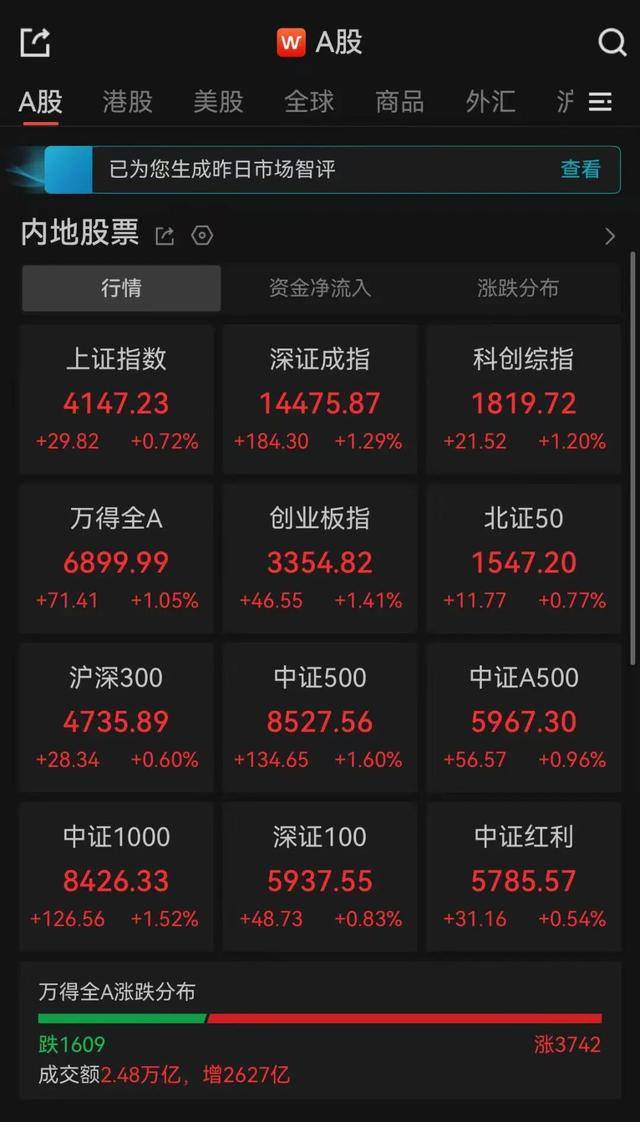
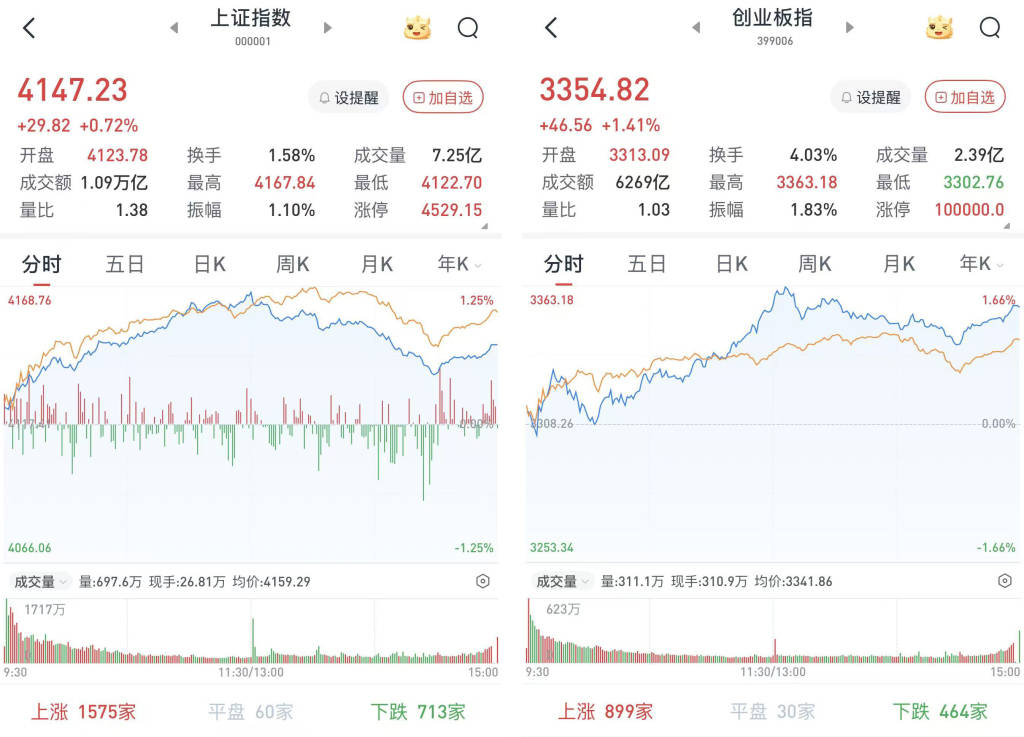
Market Performance - The A-share market experienced a positive trend with the Shanghai Composite Index rising by 0.72% to close at 4147.23, while the Shenzhen Component Index increased by 1.29% to 14475.87, and the ChiNext Index rose by 1.41% to 3354.82 [1][2]. Trading Volume and Stock Movement - The total trading volume in the market reached 2.48 trillion, with over 3700 stocks showing an increase in value [3]. - Sectors such as chemicals, non-ferrous metals, steel, and building materials saw significant gains, while real estate, environmental protection, and semiconductor sectors also performed well [3]. Sector Activity - Active sectors included lithium batteries, commercial aerospace, and financial technology concepts, whereas AI applications and CPO themes weakened, with banking and oil & gas sectors experiencing a pullback after initial gains [3].

粤开市场日报-20260225
Yuekai Securities· 2026-02-25 07:45
Market Overview - The A-share market showed a general upward trend today, with the Shanghai Composite Index rising by 0.72% to close at 4147.23 points, the Shenzhen Component Index increasing by 1.29% to 14475.87 points, the ChiNext Index up by 1.41% to 3354.82 points, and the STAR 50 Index gaining 0.54% to 1473.28 points. Overall, 3742 stocks rose while 1609 fell, with a total trading volume of 24625 billion yuan, an increase of 2605 billion yuan compared to the previous trading day [1]. Industry Performance - Among the Shenwan first-level industries, sectors such as steel, non-ferrous metals, building materials, real estate, and basic chemicals led the gains, with increases of 4.69%, 3.48%, 2.75%, 2.53%, and 2.16% respectively. In contrast, the media and banking sectors experienced declines of 1.15% and 0.46% respectively [1]. Concept Sector Performance - The concept sectors that saw the highest gains today included rare earths, selected rare metals, phosphate chemicals, minor metals, rare earth permanent magnets, cobalt mines, semiconductor materials, lithium mines, copper-clad laminates, lithium battery electrolytes, semiconductor silicon wafers, fiberglass, lithium battery cathodes, semiconductor equipment, and the copper industry. Conversely, sectors such as optical communication, DeepSeek, cultivated diamonds, short drama games, and AI computing power experienced pullbacks [2].
铜日报:供需局面维持稳定,春节期间全球市场窄幅波动-20260225
Tong Hui Qi Huo· 2026-02-25 07:41
供需局面维持稳定,春节期间全球市场窄幅波动 主力合约与基差 :SHFE主力合约价格在2026年2月24日为101920元/吨,较 春节前小幅上扬1230元/吨,涨幅1.22%。基差方面,现货升贴水走强:升 水铜从2月13日的25元/吨大幅走高至2月24日的320元/吨;平水铜从-25元/ 吨升至170元/吨;湿法铜从-70元/吨升至130元/吨。LME(0-3)贴水在2月23 日为-83.6美元/吨,较前期贴水收窄。 持仓与成交 :LME持仓在2月23日增加327手至317849手,持仓量略有扩 大。SHFE仓单在2月24日增加80409吨至277089吨,交割量达134600吨。 产业链供需及库存变化分析 供给端 :供应压力显著增加,主要因进口与国产货源集中到货,以及持货 商受交割驱动积极入库。SMM报告显示,2月24日境内电解铜库存累库15.49 万吨至50.85万吨,创五年新高。全球铜库存升至约102万吨,为近23年最 高水平,自2025年9月起几乎翻倍,部分受关税不确定性和中国季节性需求 放缓影响。长期看,Vale计划2026-2030年投资35亿美元于铜项目,但短期 供给宽松。 需求端 :需求持续疲 ...
盘中必读|今日共101股涨停,创指放量收涨1.41%,化工板块持续活跃
Xin Lang Cai Jing· 2026-02-25 07:33
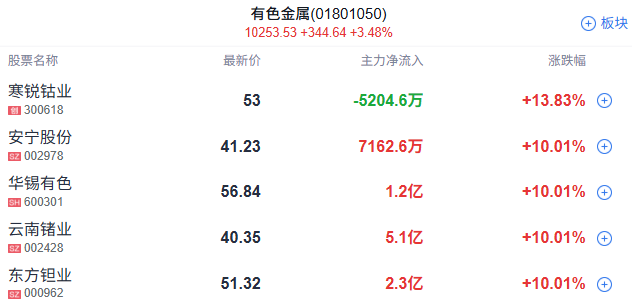
Market Performance - The A-share market saw all three major indices close higher, with the Shanghai Composite Index at 4147.23 points, up 0.72% [1] - The Shenzhen Component Index closed at 14475.86 points, increasing by 1.29% [1] - The ChiNext Index ended at 3354.82 points, rising by 1.41% [1] - Overall, more than 3700 stocks rose, indicating a bullish market sentiment [1] - The total trading volume in the Shanghai and Shenzhen markets reached 2.46 trillion yuan, an increase of 260 billion yuan compared to the previous trading day [1] Sector Performance - The chemical sector experienced significant gains, with companies like Six Nations Chemical, Chitianhua, Yuntianhua, Chuanjin Nuo, Jinzhengda, and Chengxing Co. hitting the daily limit [1] - The rare earth and minor metals sectors also saw a collective surge, with stocks such as Yunnan Zhenye, Huaxi Nonferrous, Northern Rare Earth, Dongfang Tantalum, Zhongtung High-tech, Zhongse Co., Luoping Zinc Electric, and Zhangyuan Tungsten all reaching the daily limit [1] - The real estate sector rallied in the afternoon, with stocks like I Love My Family, Huangting International, City Investment Holdings, Hualian Holdings, and Zhongtian Decoration hitting the daily limit [1] - The optical communication concept remained active, with stocks such as Farsen, Yueling Co., Lingwei Technology, and Meike Home also reaching the daily limit [1] - In contrast, the film and television sector continued to adjust downwards [1]
A股收评 | 指数放量上涨 深成指、创指涨超1% 涨价题材全线爆发
智通财经网· 2026-02-25 07:33
Market Overview - The A-share market opened high and closed with gains, with the Shanghai Composite Index rising by 0.72%, the Shenzhen Component Index by 1.29%, and the ChiNext Index by 1.41%. The total trading volume reached 2.46 trillion yuan, an increase of 260.5 billion yuan compared to the previous trading day [1]. Key Sectors 1. Non-ferrous Metals - The non-ferrous metals sector saw significant gains, with small and precious metals stocks surging. Companies like Dongfang Tantalum Industry, Huaxi Nonferrous Metals, and China Tungsten High-Tech hit the daily limit [2][3]. 2. Steel Stocks - Steel stocks experienced fluctuations but generally trended upwards, with Baogang Steel and Linggang Steel reaching the daily limit [4][5]. 3. Oil and Gas - The oil and gas sector remained strong, with Intercontinental Oil and Tongyuan Petroleum hitting the daily limit and rising over 14% respectively [6][7]. 4. Rare Earth Permanent Magnet - The rare earth permanent magnet sector saw a resurgence, with companies like Shenghe Resources and Northern Rare Earth hitting the daily limit, and prices for rare earth products increasing significantly [8][9]. 5. Semiconductor Industry - The semiconductor sector continued to strengthen, with stocks like Yuyuan Silicon and Linweina reaching the daily limit, and several others rising over 10% [10][11]. 6. Commercial Aerospace - The commercial aerospace sector showed continued growth, with Aerospace Development hitting the daily limit and other companies like XH Technology and Shenkong Technology rising significantly [12][13]. Institutional Insights - Dongguan Securities noted that the A-share market often experiences a high win-rate window after the Spring Festival, with a significant probability of index increases. The Shanghai Composite Index successfully surpassed the 4100-point mark, indicating potential stabilization [14]. - China Galaxy Securities highlighted three main investment themes post-Spring Festival, focusing on sectors benefiting from policy support and industry trends, including non-ferrous metals and AI-related fields [15]. - Zhongyuan Securities emphasized that the influx of incremental capital will provide a solid foundation for market upward movement, while the overall market is expected to experience wide fluctuations and structural differentiation [16].


有色金属价格全线上涨!有色金属ETF天弘(159157)标的指数盘中跳涨超5%,成交额突破3亿元
Mei Ri Jing Ji Xin Wen· 2026-02-25 07:25
Group 1 - The core viewpoint of the news highlights a significant rise in the industrial metals sector, particularly with the Tianhong ETF (159157) showing a 4.69% increase and a trading volume of 300 million yuan, indicating strong market interest [1] - The Tianhong ETF has seen a net inflow of 1.067 billion yuan over the last ten trading days, reaching a total fund size of 2.159 billion yuan, marking a new high since its listing and making it the largest in its category in the Shenzhen market [1] - The ETF's core advantage lies in its focus on industrial metals, with copper (34.7%), aluminum (20.2%), and rare earths (12.5%) making up over 70% of its holdings, which are directly linked to the demand from emerging industries such as renewable energy and AI [1] Group 2 - The industrial metals index has a PE-TTM of 27.57, currently positioned at the 44.67% historical percentile, suggesting it is more cost-effective than 55% of the time in the past, indicating potential investment value [2] - Recent news indicates that the U.S. plans to set reference prices for critical minerals like germanium and gallium using AI, which has heightened market attention on strategic resources [2] - The London Metal Exchange reported a significant increase in tin prices by 5.41% and copper prices by 2.54%, with external price movements providing support to the sector [2]
A股高开高走:周期股延续强势,银行股午后回落
Sou Hu Cai Jing· 2026-02-25 07:25
Market Overview - The A-share market opened higher on February 25, with the Shanghai Composite Index rising by 0.72% to 4147.23 points, the ChiNext Index increasing by 1.41% to 3354.82 points, and the Shenzhen Component Index up by 1.29% to 14475.87 points [2][4] - Total trading volume in the Shanghai and Shenzhen markets reached 24,626 billion yuan, an increase of 2,605 billion yuan compared to the previous trading day [2] Sector Performance - Cyclical stocks continued to show strength, with significant gains in the chemical, non-ferrous metals, steel, and building materials sectors [4] - The real estate sector also saw substantial increases, with several stocks hitting the daily limit [4] - The banking sector experienced a decline in the afternoon, with major banks dropping over 1% [4] - Media stocks faced downward pressure, with several companies hitting the daily limit down [4][5] Investment Sentiment - Financial analysts suggest that the A-share market is likely to remain volatile in the short term, with a focus on sectors with strong performance [6][7] - There is an indication of increased inflow from overseas mutual funds, which could provide a solid foundation for market recovery [7] - Technical indicators suggest a potential stabilization for the Shanghai Composite Index, with a recent upward movement above 4100 points [6][7]
A股收评:沪指涨0.72%、创业板指涨1.41%,涨价题材股集体爆发,全市场超3700股走高,连续两日超百股涨停
Jin Rong Jie· 2026-02-25 07:11
Core Viewpoint - The A-share market experienced a strong upward trend, with significant gains across major indices, driven by resource stocks and specific sectors like semiconductors and rare earths [1][2][3]. Market Performance - The Shanghai Composite Index rose by 29.82 points, or 0.72%, closing at 4147.23 points; the Shenzhen Component increased by 184.3 points, or 1.29%, to 14475.87 points; the CSI 300 Index gained 28.34 points, or 0.6%, ending at 4735.89 points; the ChiNext Index climbed 46.55 points, or 1.41%, to 3354.82 points; and the STAR 50 Index rose by 7.91 points, or 0.54%, to 1473.28 points [1]. Sector Highlights - Resource stocks, particularly in rare earths and precious metals, saw significant gains, with companies like Shenghe Resources hitting the daily limit up and achieving historical highs [2]. - The price of praseodymium and neodymium oxide increased to an average of 882,000 yuan/ton, up by 41,600 yuan/ton compared to before the holiday [2]. - The semiconductor sector showed strength, with stocks like Yiyuan Silicon and Fuchuang Precision rising over 10% [3]. Weakness in Certain Sectors - The film and media sector faced continuous declines, with companies like Hengdian Film experiencing consecutive limit downs [4]. - AI application stocks weakened, with some individual stocks in storage chips and optical modules undergoing corrections [4]. Institutional Insights - Dongguan Securities noted a high probability of market gains post-holiday, with historical data indicating a significant increase in A-share prices after the Spring Festival [5]. - China Galaxy Securities highlighted that the market will be driven by policy catalysts around the Two Sessions, with a focus on "hotspot rotation and style switching" [5]. - Zhongyuan Securities observed that the volatility in funds before the Spring Festival is nearing its end, with a rebound in equity fund issuance and significant inflows into overseas mutual funds [5]. Short-term Market Outlook - Caixin Securities suggested that there is still room for improvement in short-term risk appetite, with the market likely to remain volatile [6]. - Huatai Securities emphasized the mid-term value of sectors like robotics and intelligent driving, driven by recent high-profile events [6].



