保险业

Search documents
因给予投保人保险费回扣 中邮人寿旗下分公司被罚
Shang Hai Zheng Quan Bao· 2025-11-21 09:37
来源:上海证券报·中国证券网 上证报中国证券网讯(记者 何奎)11月21日,辽宁金融监管局发布行政处罚信息公示列表显示,中邮 人寿保险股份有限公司辽宁分公司因给予投保人保险合同约定以外的保险费回扣或者其他利益,被罚款 25万元。 ...
好书推荐·赠书|《战略决定一切》详解泰康新寿险战略
清华金融评论· 2025-11-21 09:33
Core Viewpoint - The article emphasizes the importance of strategic decision-making in business, highlighting the insights and experiences of Chen Dongsheng, founder of Taikang Insurance Group, as presented in his book "Strategy Determines Everything" [5][6]. Summary by Sections Book Overview - "Strategy Determines Everything" is a culmination of over 30 years of Chen Dongsheng's experience in the business world, documenting his entrepreneurial journey and the innovative life insurance model developed by Taikang, which serves as a reference for the transformation of China's life insurance industry [3][5]. Author Background - Chen Dongsheng, born in 1957, is a prominent Chinese entrepreneur and the founder of Taikang Insurance Group, as well as the founder of China Guardian Auctions [4]. Strategic Insights - The book outlines the strategic evolution of Taikang Insurance, focusing on seven key areas: positioning, strategy, governance structure, risk, innovation, and values, showcasing the company's growth from inception to becoming a global player [5][6]. - Chen emphasizes that the essence of competition among enterprises is strategic competition, asserting that "strategy is continuous focus" and "values are the foundation of strategy" [6]. Long-term Vision - Chen advocates for a broad perspective in strategic planning, suggesting that understanding historical and future trends is crucial for effective decision-making [7]. - He identifies the rise of the middle class and the aging population as pivotal trends that have shaped Taikang's business strategy [7][8]. Strategic Adjustments - Since its establishment in 1996, Taikang has undergone three major strategic shifts, each propelling the company to new heights while maintaining a focus on the life insurance industry [9]. New Life Insurance Model - The traditional life insurance model is facing significant challenges, necessitating a transformation towards a new growth trajectory. Chen predicts that the future demand will center around health and elderly care [10]. - Taikang's new model integrates "payment + service + investment," creating a three-dimensional structure that enhances the traditional life insurance framework [10][11]. - The new model shifts the focus from sales-driven to service-driven, centering on customer needs to drive traditional insurance sales [11]. Innovation and Social Impact - The new life insurance model fosters innovation in resource allocation, enhancing service quality and expanding income opportunities for agents, thus contributing to the long-term stability and high-quality transformation of the industry [12]. - It aims to meet the essential needs of the population, positioning life insurance as a core component of the broader health and wellness ecosystem [12][13]. Industry Transformation - The article discusses the broader context of the life insurance industry in China, which is undergoing profound transformation due to economic slowdowns, aging populations, and changing customer demands [14]. - Taikang's model is presented as a paradigm shift for the industry, illustrating how to create a sustainable business model that integrates technology, finance, and industry [14].


黄志伟招商仁和人寿董事长任职资格获批
2 1 Shi Ji Jing Ji Bao Dao· 2025-11-21 09:31
黄志伟招商仁和人寿董事长任职资格获批 相关文章 南方财经11月21日电,今日,国家金融监督管理总局深圳监管局发布《关于黄志伟招商局仁和人寿保险 股份有限公司董事长任职资格的批复》,核准黄志伟招商局仁和人寿保险股份有限公司董事长的任职资 格。 公开资料显示,黄志伟,1975年9月出生,中国人民大学经济学学士,北京大学、清华大学高级管理人 员工商管理硕士,高级经济师。曾任中国人寿保险股份有限公司机关团委书记(副处级),浙江省湖州分 公司副总经理,股改上市改革办公室重组法律组副组长,企业文化部机关党委办公室副主任,人力资源 部绩效管理处经理,市场拓展部总经理助理,人力资源部总经理助理、党委组织部部长助理,人力资源 部副总经理、党委组织部副部长,业务管理部副总经理(主持工作),深圳分公司党委书记、总经理; 横琴人寿保险有限公司联席总裁、总经理;招商局仁和人寿保险股份有限公司临时负责人(代行总经理 职权);招商局仁和养老投资有限公司董事长。 南方财经11月21日电,今日,国家金融监督管理总局深圳监管局发布《关于黄志伟招商局仁和人寿保险 股份有限公司董事长任职资格的批复》,核准黄志伟招商局仁和人寿保险股份有限公司董事长的 ...
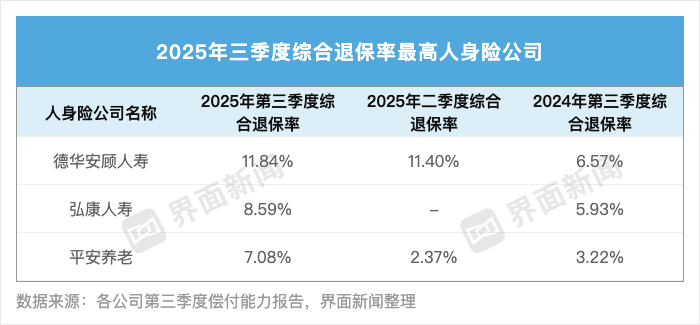
70家人身险企三季度退保率盘点:近八成同比下降,德华安顾人寿退保率居首
Xin Lang Cai Jing· 2025-11-21 05:33
Core Insights - The overall trend in the third quarter shows a decline in the comprehensive surrender rate among life insurance companies, with nearly 80% of the 70 companies reporting a decrease compared to the first three quarters of 2024, while 15 companies experienced an increase [1][4]. Group 1: Surrender Rate Trends - The highest comprehensive surrender rate in Q3 2025 was reported by Deutsche Bank Life at 11.84%, followed by Hongkang Life at 8.59% and Ping An Pension at 7.08%. The lowest rates were reported by National Pension, Xinhua Pension, and Aixin Life, all below 0.5% [2][3]. - Among the 70 life insurance companies, 55 reported a decrease in surrender rates year-on-year, with Dajia Pension showing the largest decline from 6.5% in Q3 2024 to 1.16% in Q3 2025 [4][9]. Group 2: Product and Channel Analysis - Surrender rates are primarily concentrated in investment-linked and universal life insurance products, with significant rates exceeding 60% or even 100% for some products [11][12]. - The silver insurance channel remains a major source of high surrender rates, attributed to the nature of products sold, which are often short-term savings products that lead to concentrated surrenders once they reach their maturity [17][18]. Group 3: Factors Influencing Surrender Rates - The decline in surrender rates reflects improvements in product structure, enhanced customer management capabilities, and stabilized market interest rate expectations [1][10]. - The shift towards more flexible, short-term products has reduced early surrender pressures compared to traditional long-term savings products [10][16]. - The impact of market interest rates on surrender behavior is significant, with lower rates leading to higher surrender rates in products with strong financial attributes, such as universal and investment-linked insurance [16][17].

中国中车获中国平安增持858万股
Ge Long Hui· 2025-11-20 23:33
Group 1 - The core point of the article is that China Ping An Insurance (Group) Co., Ltd. has increased its stake in CRRC Corporation Limited by purchasing 8.58 million shares at an average price of HKD 6.3429 per share, raising its ownership percentage from 5.88% to 6.08% [1][2]. Group 2 - The total investment made by China Ping An for this acquisition amounts to approximately HKD 54.42 million [1]. - Following the purchase, China Ping An's total shareholding in CRRC Corporation is now 265,816,000 shares [1][2].



央行报表及债券托管量观察:债市主线暂缺下的机构行为特征
Huachuang Securities· 2025-11-20 13:25
1. Report Industry Investment Rating The report does not mention the industry investment rating. 2. Core Viewpoints of the Report - The year - end bond market rally can still be expected, but the magnitude should be rationally viewed. Bank, insurance, and wealth - management funds still have bond - allocation needs, protecting the market. However, the rate - cut expectation is weaker than in the past two years, so the rally may be limited [5][7][109]. - Currently, the three factors affecting bond - market fluctuations are risk preference, fund sales regulations, and year - end rally. As the negative impacts of risk preference and fee regulations are weakening, the risk of yield rising above the previous high is controllable. Before the implementation of the fee regulations, the bond market may fluctuate narrowly around 1.8%, and a potential decline in yield may occur later [5][7][109]. - Structurally, there is room to explore the spread of 3 - 5y policy - financial bonds. Attention can be paid to 7y CDB bonds in the medium - term, and the 30 - 10y treasury bond term spread may continue to compress. The 30y treasury bond swap strategy can be considered, and 15 - 30y local bonds can be participated in after the November supply peak [5][7][109]. 3. Summary According to the Directory 3.1 10 - month Central Bank Balance Sheet and Custody Volume Interpretation - **2025 October Central Bank Balance Sheet Changes**: The central bank's balance - sheet size decreased from 47.14 trillion yuan to 47.06 trillion yuan. The main reduction item on the asset side was "claims on the government", and the main increase item on the liability side was "government deposits". The "other depository corporation deposits" decreased seasonally [12][13][22]. - **Impact of Central Bank Operations on Custody Volume in October 2025**: The net investment scale of innovative tools was close to the change in the custody - account balance. The main incremental bond type was local bonds, and treasury bonds shifted from reduction to increase [27]. 3.2 Leverage Ratio Driven by the carry - trade space, institutions' willingness to increase leverage marginally recovered. In October, the average monthly trading volume of repurchase increased, and the average leverage ratio of bond funds rose. It reached the highest level in early November and then declined due to tightened liquidity [30]. 3.3 By Institution - **Banks**: Big banks' bond - allocation speed slowed down, with both primary - and secondary - market bond - buying efforts decreasing. Rural commercial banks may still have bond - allocation needs as their deposit growth rate exceeds the loan growth rate [42][48][54]. - **Insurance**: In the context of a bullish equity market, the incremental bond investment of insurance companies declined. In Q3 2025, there was an inversion between the incremental bond investment and secondary - market bond - buying scale. However, in the future, there may still be bond - allocation demand for incremental funds [62][70]. - **General Funds**: The bond - allocation sentiment improved. At the end of the year, there may still be a tendency to front - run, but the intensity may weaken. The scale of bond funds increased, and wealth - management products had strong bond - allocation demand, which is beneficial for the year - end rally [72][80][83]. - **Foreign Capital**: The comprehensive return on investing in certificates of deposit decreased, and foreign capital maintained a net outflow, mainly reducing holdings of certificates of deposit and policy - financial bonds while increasing holdings of treasury bonds [84][91]. 3.4 By Bond Type In October, the incremental custody volume of the bond market rebounded, and certificates of deposit and government bonds were the main supporting items. The net financing scale of government bonds decreased, the supply of policy - financial bonds slightly increased, and the net financing of certificates of deposit increased significantly [92][99][102].
"十五五"资本市场走向何方?周延礼、吴晓求、王忠民等大咖发声
Di Yi Cai Jing· 2025-11-20 12:08
Group 1 - The focus of economic theory and policy is shifting from "expanding supply" to "effectively managing excess economy and expanding domestic demand" [1][2] - The transition from an industrial economy to a digital and AI-driven economy presents new risks for heavy assets, with depreciation rates potentially leading to negative cash flow risks due to rapid technological obsolescence [4][6] - The insurance industry needs to upgrade from traditional risk compensation to comprehensive risk management, focusing on new product development for emerging industries like renewable energy and AI [6] Group 2 - The capital market's primary function is to incentivize innovators, and there is a need to reconstruct the ecosystem from the asset, demand, and institutional platform perspectives [7] - Insurance funds have seen a significant increase in investment in the capital market, with a balance exceeding 37 trillion yuan by Q3 2025, indicating a shift towards long-term and value investments [7] - Companies are encouraged to adopt a "light asset" strategy, utilizing financing models like leasing to meet operational needs while outsourcing heavy asset components [8] Group 3 - Large listed companies should allocate 10% to 20% of their resources to invest in innovation within small and medium enterprises, fostering a "win-win" ecosystem along the supply chain [9] - The integration of diverse capital modalities is essential for startups, with a focus on risk-sharing mechanisms to support innovation despite high failure rates [8]
富德生命人寿保险股份有限公司减持中煤能源282.3万股 每股作价11.67港元
Zhi Tong Cai Jing· 2025-11-19 10:57
Group 1 - The core point of the article is that Fude Life Insurance Co., Ltd. has reduced its stake in China Coal Energy Co., Ltd. by selling 2.823 million shares at a price of HKD 11.67 per share, totaling approximately HKD 32.9444 million [1] - After the reduction, Fude Life Insurance's remaining shareholding is approximately 1.6424 billion shares, representing a holding percentage of 39.99% [1]

富德生命人寿保险股份有限公司减持中煤能源(01898)282.3万股 每股作价11.67港元
智通财经网· 2025-11-19 10:50
Group 1 - The core point of the article is that Fude Life Insurance Co., Ltd. has reduced its stake in China Coal Energy Co., Ltd. by selling 2.823 million shares at a price of HKD 11.67 per share, totaling approximately HKD 32.9444 million [1] - After the reduction, Fude Life Insurance's remaining shareholding is approximately 1.6424 billion shares, representing a holding percentage of 39.99% [1]
一根鸡肋 | 谈股论金
水皮More· 2025-11-19 10:36
Market Overview - The A-share market showed mixed performance today, with the Shanghai Composite Index rising by 0.18% to close at 3946.74 points, while the Shenzhen Component Index slightly declined, closing at 13080.09 points, and the ChiNext Index increased by 0.25% to 3076.85 points [2][4]. - The total trading volume in the Shanghai and Shenzhen markets was 1.7259 trillion yuan, a decrease of 200.2 billion yuan compared to the previous day, marking the lowest level this month and the third lowest in the past three months [5]. Individual Stock Performance - Despite the index performance appearing stable, the majority of individual stocks experienced significant declines, with approximately 3984 stocks down and only 1176 stocks up at market close. The median decline across all A-shares was about 1.50% [4][6]. - The main contributors to the rise in the Shanghai Composite Index were major state-owned enterprises in the oil and banking sectors, with PetroChina, CNOOC, and Sinopec contributing 8.04 points to the index's rise [6]. Sector Analysis - The oil sector showed strength, influenced by rumors of increased oil reserves, while the lithium mining sector also performed well due to rising lithium carbonate futures prices. However, the lithium mining companies are still in the process of turning profitable, and the rising lithium prices have pressured the battery sector, which fell by approximately 1.4% today [6]. - Notably, CATL, a leading company in the battery sector, rose by about 1.50%, closing at 391.1 yuan per share, indicating profitability for funds that acquired shares during a recent price reduction [6]. Market Sentiment - The market sentiment appears to be cautious, with a significant outflow of capital, totaling 513 billion yuan today, following a previous outflow of nearly 1000 billion yuan [6]. - The number of stocks hitting the daily limit down was 24, primarily from speculative stocks that had previously been driven by "mystical" trading strategies. The Hainan sector, once a hot topic, saw the largest decline today, around 4% [7]. Conclusion - The overall market sentiment is described as "disheartened," with concerns about liquidity as institutions face year-end accounting pressures, leading to potential further declines in trading volume [7].