稀土

Search documents
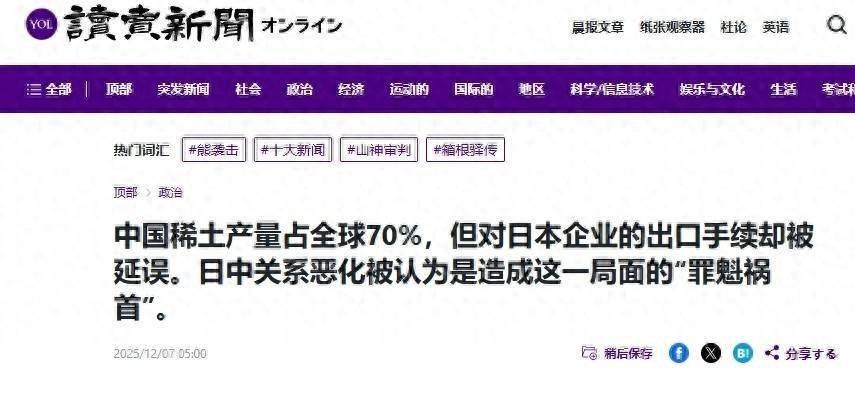
稀土牌打出来了?中国出口审批放缓,触动日本产业敏感神经
Sou Hu Cai Jing· 2025-12-10 06:10
Group 1 - Recent reports indicate that China has slowed down the approval process for rare earth exports, particularly affecting Japanese companies, which has raised concerns in Japan's political and business circles [1][5][10] - The slowdown in approvals is perceived as a potential signal from China amidst heightened tensions in Sino-Japanese relations, particularly following controversial statements by Japanese politicians regarding Taiwan [3][7][19] - Japan's dependency on Chinese rare earths is highlighted, as the country struggles to diversify its supply sources despite efforts to develop alternative resources [10][11][17] Group 2 - The sensitivity of the rare earth approval issue is compounded by China's recent criticism of Japanese political statements, suggesting that the approval delays may be a form of response from China [7][19][21] - Japan's plans to develop rare earth resources around Minami-Torishima (South Bird Island) have faced delays, with the timeline for trial mining pushed from 2024 to 2026, reflecting the challenges in securing alternative supplies [13][15][17] - The approval process changes serve as a reminder of the delicate balance between economic cooperation and political tensions, emphasizing the need for Japan to navigate its relationship with China carefully to maintain supply chain stability [22][23]

有色龙头ETF(159876)逆市突围逼近历史高点,资金跑步入场抢筹
Sou Hu Cai Jing· 2025-12-10 02:52
Group 1 - The A-share major indices declined, while the Nonferrous Metal Leaders ETF (159876) rose by 0.33%, indicating strong market interest with a net subscription of 51 million units [1] - The Nonferrous Metal Leaders ETF (159876) has seen a total net inflow of 54.3 million yuan over the past two days, with a current fund size of 748 million yuan, making it the largest ETF tracking the same index in the market [1] - The Federal Reserve's monetary policy meeting on December 9-10 is expected to announce a 25 basis point rate cut with a probability of 89.4%, which is anticipated to support the price increase of nonferrous metals [1] Group 2 - During the Fed's rate-cutting cycle, tight supply and demand for physical assets are expected to create significant price elasticity, particularly for industrial metals like copper and aluminum [2] - The demand for copper is projected to increase due to power investments by 2026, while storage and alternative demands are expected to drive aluminum demand [2] - The Nonferrous Metal Leaders ETF (159876) and its linked fund (017140) cover a broad range of sectors including copper, aluminum, gold, rare earths, and lithium, providing a diversified investment option [2]
中信证券徐广鸿:估值修复与结构重塑共振 2026年港股锚定四大核心赛道
Zhong Guo Zheng Quan Bao· 2025-12-09 22:44
Core Viewpoint - The Hong Kong stock market is entering a phase of valuation repair and structural reshaping, characterized by undervaluation, capital misalignment, and performance differentiation, with significant net inflows from southbound funds and a shift in foreign capital [1][2]. Valuation and Market Trends - The Hang Seng Index has experienced a cumulative decline of over 50% from early 2021 to January 2024, leading to a significant valuation gap [2]. - As of December 9, 2023, the Hang Seng Index, Hang Seng China Enterprises Index, and Hang Seng Technology Index have recorded cumulative gains of 49.20%, 22.59%, and 24.32%, respectively [2]. - By the end of 2025, the expected EPS growth for the Hang Seng Index in 2026 is projected to be 8%, with a dynamic P/E ratio of only 12 times, indicating a notable valuation gap compared to major global markets [2]. Capital Flow Dynamics - Southbound funds have seen a record net inflow of nearly 1.4 trillion HKD by the end of November 2023, marking a new high since the launch of the mutual market access mechanism [3]. - The inflow of ETFs surged to 51.3% from June to October, with August reaching 88%, indicating strong enthusiasm among domestic individual investors [3]. - Institutional investors favor sectors like non-bank themes and precious metals, while individual investors focus on growth sectors such as automotive, pharmaceuticals, and consumer goods [3]. Sector Performance and Investment Opportunities - The technology sector is expected to see significant profit growth in 2025, contrasting with traditional sectors like finance and real estate [4]. - The AI industry chain in Hong Kong is strengthening, with a positive correlation between the Hang Seng Technology Index and the USD/JPY exchange rate [4]. - For 2026, investment opportunities should focus on sectors with performance certainty and valuation elasticity, particularly technology, pharmaceuticals, resource products, and essential consumer goods [8]. Long-term Market Outlook - The market is anticipated to experience a second round of valuation repair driven by internal and external factors, including the implementation of the "14th Five-Year Plan" and easing monetary policies globally [6][5]. - The potential for external capital inflow is expected to increase as the risk premium decreases due to improved Sino-U.S. relations [6]. Specific Sector Insights - The technology sector, especially the AI industry, is expected to benefit from a virtuous cycle of investment and revenue growth, with a focus on leading companies and quality players in the computing power supply chain [8]. - The pharmaceutical sector is entering a growth phase supported by policy and industry developments, with a focus on innovative companies and those benefiting from domestic market reforms [8]. - The resource sector is supported by supply-demand mismatches and liquidity drivers, with companies in precious metals and rare earths likely to benefit from rising commodity prices [9]. - The essential consumer goods sector is poised for valuation recovery as domestic policies stimulate consumption and improve income expectations [9].

中信证券徐广鸿: 估值修复与结构重塑共振 2026年港股锚定四大核心赛道
Zhong Guo Zheng Quan Bao· 2025-12-09 20:46
Core Viewpoint - The Hong Kong stock market is entering a phase of valuation repair and structural reshaping, characterized by undervaluation, capital misalignment, and performance differentiation, with a significant influx of southbound capital and a shift in foreign investment reshaping the funding landscape [1][2]. Valuation and Market Dynamics - The Hang Seng Index has experienced a cumulative decline of over 50% from the post-Lunar New Year of 2021 to January 2024, leading to a significant valuation gap [2]. - As of December 9, 2023, the Hang Seng Index, Hang Seng China Enterprises Index, and Hang Seng Technology Index have recorded cumulative gains of 49.20%, 22.59%, and 24.32%, respectively [2]. - By the end of 2025, the expected EPS growth rate for the Hang Seng Index in 2026 is projected to be 8%, with a dynamic P/E ratio of only 12 times, indicating a notable valuation gap compared to major global markets [2]. Capital Flow and Investment Preferences - Southbound capital has seen a record net inflow of nearly 1.4 trillion HKD by the end of November, marking a new high since the launch of the mutual market access mechanism [3]. - The capital structure shows a clear differentiation, with institutional investors favoring themes like non-bank ETFs and personal investors focusing on growth sectors such as automotive, pharmaceuticals, and consumer goods [3]. - Foreign capital, while still experiencing outflows, has shown signs of recovery since August, with long-term foreign capital seeing its first phase of inflow since September 2022, particularly favoring the information technology sector [3]. Sector Performance and Outlook - The technology sector is expected to see significant profit growth in 2025, contrasting sharply with traditional sectors like finance and real estate [4]. - The Hang Seng Technology Index has shown volatility but continues to strengthen its core competitiveness, with the sector benefiting from advancements in AI and related technologies [4]. - The long-term trend of recovery in the Hong Kong stock market is expected to continue, driven by policy dividends and external risk dynamics [5][6]. Investment Directions - Key investment opportunities for 2026 are identified in four main sectors: technology, pharmaceuticals, resource products, and essential consumer goods, focusing on "earnings certainty + valuation elasticity" [8][9]. - The technology sector, particularly the AI industry chain, is anticipated to benefit from a virtuous cycle of investment and revenue growth, with a focus on leading companies and quality players in the computing power supply chain [8]. - The pharmaceuticals sector is entering a phase of certain growth, supported by policy and industry developments, with a focus on innovative companies and those benefiting from domestic market reforms [8]. - The resource products sector is supported by supply-demand mismatches and liquidity drivers, with expectations of rising commodity prices benefiting related stocks [9]. - The essential consumer goods sector is poised for valuation recovery, supported by domestic policies aimed at boosting consumption and improving income expectations [9].
估值修复与结构重塑共振 2026年港股锚定四大核心赛道
Zhong Guo Zheng Quan Bao· 2025-12-09 20:22
● 本报记者 谭丁豪 2025年港股步入估值修复与结构重塑并行阶段,估值低估、资金错位与业绩分化成为核心特征。历经此 前三年调整,恒生指数形成显著的估值洼地,南向资金创纪录净流入与外资转向共同重塑资金格局。 日前,中信证券海外策略首席分析师徐广鸿在接受中国证券报记者专访时表示,2026年港股将在政策红 利与外部风险博弈中开启第二轮估值修复,内外因素共振有望进一步打开上行空间。在此背景下,投资 需紧扣"业绩确定性+估值弹性"主线,科技、医药、资源品与必选消费四大赛道,凭借政策支撑、产业 景气或供需优势,成为把握港股修复行情的核心方向。 估值洼地凸显 今年以来,港股三大指数震荡上行。Wind数据显示,截至12月9日,恒生指数、恒生中国企业指数、恒 生科技指数分别累计涨幅为49.20%、22.59%、24.32%。 "今年港股市场整体呈现估值修复的态势,有业绩支撑的行业估值扩张更为显著,例如原材料板块。在 此背景下,具有进一步基本面支撑的行业有望获得更大的估值上行空间。"徐广鸿说。 "当前港股正处于估值修复与结构重塑的关键阶段,估值低估、资金错位与业绩分化构成市场核心特 征。"徐广鸿表示,从估值维度看,2021年春 ...
韩重整关键矿产供应链
Shang Wu Bu Wang Zhan· 2025-12-09 18:19
近期韩政府召开资源安全协商会,审议了运营规程、资源安全强化方案、核心供需机构指定、稀土 供应链对策以及第5次石油储备计划等五大议题。政府将通过建立国家级综合数据库与预警体系,将危 机应对模式从事后处理转为事前预防与常态监测。 韩国《亚洲经济》12月5日报道,韩国政府依据《国家资源安全特别法》,全面推进能源与矿物资 源供应链政策重构,以应对长期化的全球地缘政治风险与关键资源供需不稳定。 稀土供应链被列为本次政策的最重要议题。韩国将17类稀土全部纳入关键矿物,推出短、中、长期 路线图:短期着重稳定从中国的供应与提升储备;中期推动美国、澳大利亚、日本、东南亚等多元化供 应链合作与联合投资;长期聚焦国内精炼能力培育、回收体系建设及相关研发投入。 政府同时强化政企联合危机响应架构,将炼油、天然气和矿物企业指定为核心供应机构,将半导 体、汽车等行业龙头指定为核心需求机构,并在供应风险或价格异常时实现快速汇报与多渠道协同处 置。海外资源开发政策将全面转向项目基准模式,国家将以定制化政策包支持企业分担风险,提高贷款 支持比例,并将关键矿物储备从100天提升至180天,同时推动天然气储备体系双轨化。 (原标题:韩重整关键矿产供 ...
欧媒:欧盟现在很焦虑,不光怕中国一个,更怕美国变成下一个中国
Sou Hu Cai Jing· 2025-12-09 10:44
Core Viewpoint - The European Union (EU) is attempting to reduce its reliance on Eastern countries for critical raw materials, particularly rare earth elements, to ensure supply chain security [1][4]. Group 1: EU's Strategic Initiatives - The EU has launched the "ResourceEU" plan, committing €3 billion (approximately 24.7 billion RMB) to key raw materials needed for electric vehicles, wind turbines, and semiconductors over the next year [2]. - The intention behind this investment is to diversify Europe's supply chain through recycling, joint procurement, and strategic reserves, aiming to regain some control over rare earth materials [4]. Group 2: Challenges and Risks - The acquisition of Less Common Metals (LCM) by USA Rare Earth signifies a critical blow to Europe's rare earth industry, as LCM is one of the few companies in Europe capable of converting rare earth oxides into metals and alloys [5][8]. - The loss of LCM means that Europe may not be able to produce the magnets required for electric vehicles, despite having access to raw materials [7][11]. - The current situation indicates that while Europe seeks to establish its own supply chain, it is losing existing capabilities to American companies, which could lead to a dependency shift from China to the U.S. [11][12]. Group 3: Geopolitical Implications - The U.S. is leveraging its capital strength and the Inflation Reduction Act (IRA) to acquire critical mineral assets globally, which poses a threat to Europe's industrial base [13][15]. - There is a growing realization that the EU's efforts to secure raw materials may inadvertently lead to a form of dependency on the U.S., rather than achieving true autonomy [12][20]. - The EU's current predicament reflects a struggle between wanting to reduce reliance on China while simultaneously facing the risk of becoming subordinate to U.S. interests in the critical materials sector [20][22].

中国稀土反制有多狠?继美后日本成下一目标,对华挑衅代价已显现
Sou Hu Cai Jing· 2025-12-09 09:22
Core Viewpoint - China's rare earth control is a strategic move that directly impacts the military-industrial sectors of both the United States and Japan, leveraging advanced traceability technology to enforce supply chain integrity and exert pressure on these nations [1][10][17]. Group 1: China's Rare Earth Control - China's innovative traceability technology assigns a unique digital identity to each batch of exported rare earths, allowing for real-time tracking from mining to final processing [1][3]. - The traceability system can identify the source of rare earths even if they are processed in other countries, making it difficult for the U.S. to circumvent supply chain issues [3][17]. - China's dominance in rare earth purification technology, developed over decades, creates a significant barrier for other countries attempting to replicate this capability [5][6][17]. Group 2: U.S. Military Implications - The U.S. military's reliance on rare earth materials for advanced weaponry, such as the F-35 fighter jet, is critical, with current stockpiles only sufficient for 14 months [9][10]. - The Pentagon has struggled to rebuild its rare earth supply chain, facing technological barriers that could take a decade to overcome [7][9]. - The urgency of the situation is underscored by the fact that delays in rare earth supply could halt production lines and disrupt national defense strategies [9][10]. Group 3: Japan's Dependency - Japan remains heavily reliant on China for rare earth imports, with 60% of its supply coming from China, particularly in high-tech sectors [12]. - Despite efforts since 2010 to diversify its rare earth sources, Japan's initiatives have not yielded significant results, leaving it vulnerable to supply disruptions [10][12]. - Potential economic losses for Japan due to a three-month restriction on rare earth exports from China could exceed 650 billion yen, escalating to 2.5 trillion yen if prolonged for a year [12]. Group 4: Strategic Implications - China's rare earth strategy combines resource control, advanced technology, and precise regulatory measures to exert targeted pressure on nations that challenge its interests [17][18]. - The approach maintains a surgical precision, affecting only key industries of provocateurs while not disrupting the global supply chain [18]. - China's actions serve as a warning to those undermining its core interests, emphasizing its capability to defend its rights and the consequences of provocation [18].


向日本出口稀土出现延误?中方回应
财联社· 2025-12-09 08:09
据澎湃新闻,12月9日,外交部发言人郭嘉昆主持例行记者会。 路透社记者提问,近日多位欧洲领导人访问中国,表达了对中国向欧洲供应稀土的担忧。这些访问是否旨在寻求中方就确保欧洲稀土供应作 出承诺,或者承诺发放稀土通用许可证?第二个问题,日本媒体报道称,由于北京和东京之间的外交争端,中国向日本出口稀土出现延误。 中方对此有何评论? 郭嘉昆表示, 中方主管部门已经多次介绍了稀土相关物项出口管制的工作情况,中方正在依法依规处理有关问题。 ...

中国向日本出口稀土出现延误?中方回应
第一财经· 2025-12-09 07:51
编辑 |瑜见 路透社记者提问,近日多位欧洲领导人访问中国,表达了对中国向欧洲供应稀土的担忧。这些访问是否 旨在寻求中方就确保欧洲稀土供应作出承诺,或者承诺发放稀土通用许可证?第二个问题,日本媒体报 道称,由于北京和东京之间的外交争端,中国向日本出口稀土出现延误。中方对此有何评论? 郭嘉昆表示,中方主管部门已经多次介绍了稀土相关物项出口管制的工作情况,中方正在依法依规处理 有关问题。 来源|澎湃新闻 12月9日,外交部发言人郭嘉昆主持例行记者会。 ...