
外卖

Search documents
新疆乌苏市市场监管局开展“双节”前夕专项检查筑牢安全防线
Zhong Guo Shi Pin Wang· 2025-09-28 06:26
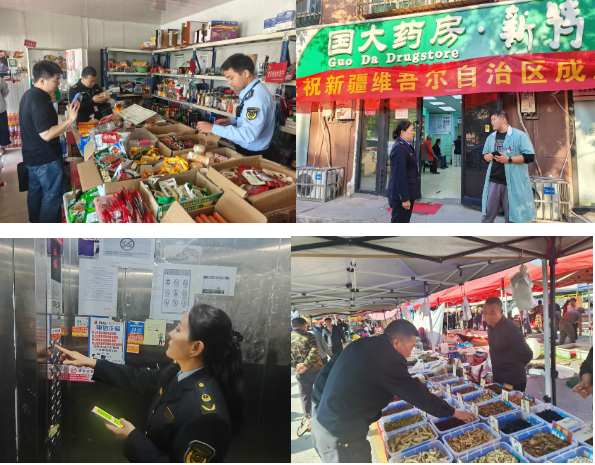
Core Viewpoint - The article emphasizes the proactive measures taken by the Urumqi Market Supervision Administration in Xinjiang to ensure public safety and quality during the upcoming National Day holiday through comprehensive inspections and safety awareness campaigns [1] Group 1: Safety Inspections - The administration has formed inspection teams comprising regulatory, technical, and law enforcement personnel to conduct thorough safety checks across multiple sectors [1] - Five key areas of focus for inspections include industrial product quality, food safety in restaurants, safety in the delivery industry, pharmaceutical safety, and the safety of special equipment [1] Group 2: Industrial Product Quality Safety - Inspections target various consumer products such as building insulation materials, hazardous chemicals, special labor protection products, fire safety products, electric bicycles, children's toys, and charging devices to ensure compliance with safety standards [1] - The administration also checks food packaging for mooncakes and tea to prevent illegal production and ensure adherence to national standards [1] Group 3: Restaurant and Delivery Safety - In restaurants, the focus is on the compliance of gas appliances and food safety management in accordance with the Food Safety Law of the People's Republic of China [1] - For the delivery industry, safety regulations regarding traffic, electric bicycle modifications, and food safety are being promoted to enhance the awareness of delivery personnel [1] Group 4: Pharmaceutical and Special Equipment Safety - The administration conducts random checks on pharmacies, medical institutions, and cosmetic businesses, ensuring any issues found are rectified promptly [1] - Special equipment safety is emphasized, with inspections on pressure vessels, boilers, elevators, and forklifts to ensure adherence to safety management protocols [1] Group 5: Future Actions - The administration plans to intensify safety regulation efforts during the holiday period, streamline complaint channels, and strictly investigate any violations to protect consumer and operator rights [1]

24小时环球政经要闻全览 | 9月28日
Sou Hu Cai Jing· 2025-09-28 03:00
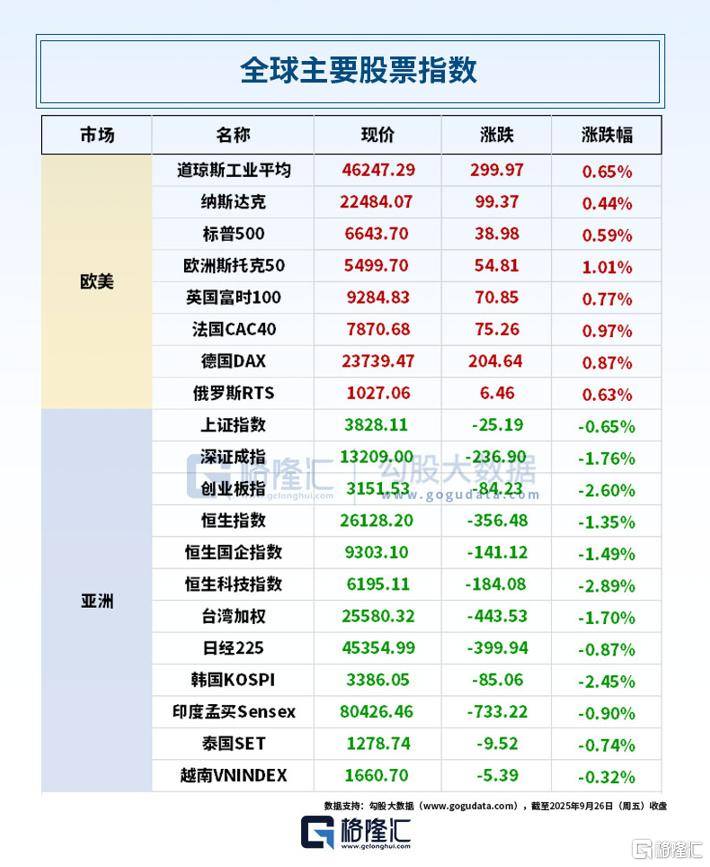
Market Summary - Major US indices showed positive performance with the Dow Jones Industrial Average up by 299.97 points (0.65%) to 46247.29, Nasdaq increased by 99.37 points (0.44%) to 22484.07, and S&P 500 rose by 38.98 points (0.59%) to 6643.70 [2] - European markets also experienced gains, with the Euro Stoxx 50 up by 54.81 points (1.01%) to 5499.70, and Germany's DAX rising by 204.64 points (0.87%) to 23739.47 [2] - In contrast, Asian markets faced declines, with Taiwan Weighted down by 443.53 points (1.70%) to 25580.32, and South Korea's KOSPI falling by 85.06 points (2.45%) to 3386.05 [2] Company Developments - Tesla announced the delivery of its first Model Y vehicles in India, with prices set at approximately 600,000 INR (around $70,000) for the standard model and 680,000 INR (around $79,000) for the long-range version [8] - Jaguar Land Rover will receive a £1.5 billion (approximately $2 billion) loan guarantee from the UK government to support its supply chain following a cyberattack that halted production [11] - Starbucks' Chief Technology Officer, Deb Hall Lefevre, has resigned, and the company has appointed Ningyu Chen as the interim CTO [12] - Meituan's international food delivery brand, Keeta, has launched operations in the UAE [13] Geopolitical Events - The US government is considering tariffs on foreign electronics based on the number of chips contained in each device, which could exacerbate inflation [4] - Ukraine conducted a drone strike on a Russian oil pipeline pump station, halting oil transport through the facility [5][6] - Tensions escalated between Thailand and Cambodia, with reports of gunfire exchanged, suggesting a potential provocation [7]
餐饮房租,可以降了
21世纪经济报道· 2025-09-28 02:13
Core Insights - The article discusses the significant impact of the ongoing food delivery competition on the restaurant industry, highlighting the challenges faced by community dining establishments due to consumer shifts towards online platforms [1][2]. Group 1: Restaurant Market Overview - The restaurant market is currently facing a bleak outlook, with intensified price wars leading to a decline in average spending. According to Meituan Research Institute, 47.8% of continuously operating restaurants reduced their average price in 2024, with over 80% of restaurants with an average price above 100 yuan experiencing a drop in customer spending [1]. - The number of restaurant closures in China has surged to 4.09 million in 2024, with a closure rate of 61.2%, surpassing the figures from 2023. Many national restaurant brand founders have expressed concerns about declining revenues and profits, prompting cost-cutting measures such as reducing staff and downgrading renovations [1]. Group 2: Rental Costs and Trends - The decline in restaurant rental costs has become increasingly important, with some restaurant brand founders noting a downward trend in rental prices, particularly outside of first-tier cities, although the decrease is not yet significant [2]. - In first-tier cities, the restaurant market is contracting, with Beijing's restaurant revenue dropping by 3.6% to 79.2 billion yuan and Shanghai's by 2.9% to 114.195 billion yuan from January to July [2]. - The ongoing shift of consumer traffic from offline to online platforms has led to a decrease in the tolerance for high rental prices among restaurants, particularly in community dining [2]. Group 3: Future Outlook - The current situation presents a critical negotiation phase between property owners and restaurant operators, with the potential for faster rental declines due to the survival challenges faced by restaurants amid the food delivery competition [2]. - There is hope that rental reductions could help alleviate some of the financial pressures on restaurant owners, although concerns remain about potential increases in service fees from delivery platforms like Meituan [3].

柳州警方通报醉酒男子殴打外卖骑手,行拘十日并罚款500元
Guan Cha Zhe Wang· 2025-09-28 00:51
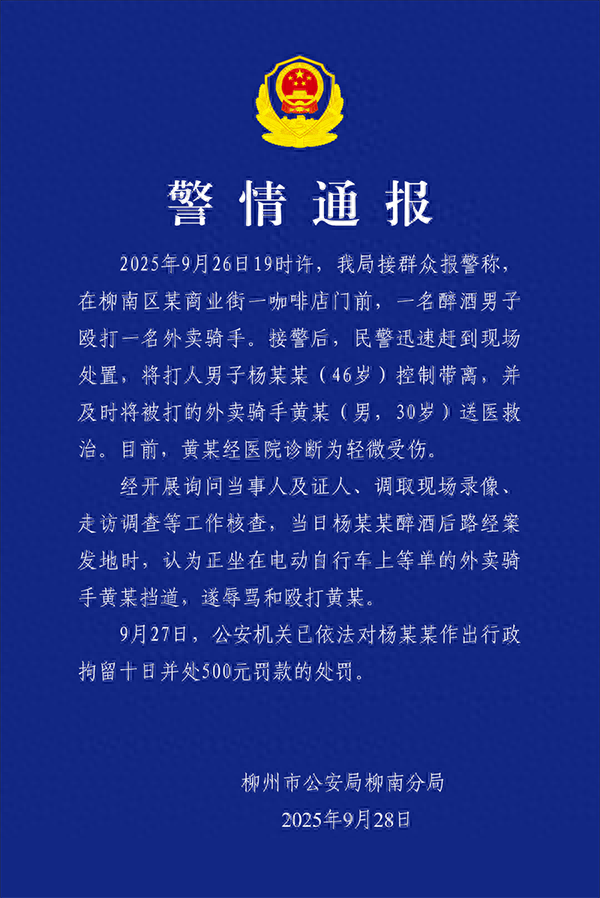
Core Viewpoint - A violent incident involving a delivery rider in Liuzhou, Guangxi, highlights the need for respect and protection of riders' rights in the gig economy [3][4]. Group 1: Incident Details - On September 26, a drunk man assaulted a delivery rider waiting outside a coffee shop in Liuzhou, leading to the rider sustaining minor injuries [1]. - The assailant, identified as Yang, was subsequently detained for ten days and fined 500 yuan for his actions [1]. - The rider, Huang, remained calm during the incident and did not retaliate, instead opting to call the police [4]. Group 2: Company Response - SF Express issued a statement expressing concern over the incident and emphasized the importance of protecting riders' legal rights [3]. - The company provided 5,000 yuan as a consolation payment to the affected rider and offered legal assistance and psychological support [4]. - SF Express acknowledged the bravery of other riders and citizens who intervened during the incident, highlighting the spirit of mutual assistance within the industry [4].
宝马召回超过33万辆汽车;零跑汽车官方回应成失信被执行人;娃小宗商标进入异议程序;河北一省属高校破产重整丨邦早报
创业邦· 2025-09-28 00:08
Group 1 - Zong Fuli's application for the "Wawa Xiaozong" trademark has entered the opposition procedure, as the trademark is currently under review by the National Intellectual Property Administration [3] - Leap Motor has responded to reports of being listed as a dishonest executor due to a contract dispute, confirming that it has paid the full amount of 3,618,085.25 yuan [4] - Neta Auto's restructuring process has seen only one potential investor meet the requirements to submit a complete application, following an increase in the application threshold [5] Group 2 - BMW is recalling over 330,000 vehicles due to potential short circuit risks in starter motors, with more than 130,000 affected in Germany alone [6][7] - Xiaomi's 17 series achieved record sales within five minutes of launch, setting a new record for domestic smartphone sales [7] - Hebei province's Shijiazhuang Institute of Technology is undergoing bankruptcy restructuring, with the government taking over to ensure normal operations [10] Group 3 - Apple is reportedly developing an internal testing application similar to ChatGPT for a major upgrade of Siri, currently named Veritas [12] - GAC Fiat Chrysler is preparing for its sixth asset auction, with core assets divided into two packages, one for land and buildings starting at 600 million yuan and another for production equipment starting at 200 million yuan [12][13] - Li Kaifu emphasized that DeepSeek's contribution to China's AI development lies in fostering an open-source ecosystem [12] Group 4 - SAIC Group predicts that by 2030, the penetration rate of new energy vehicles in China will reach 70%, with a significant market share still held by fuel vehicles [12] - The demand for camera and drone rentals has surged ahead of the National Day and Mid-Autumn Festival holidays, particularly in Guangdong and Zhejiang provinces [12] - Tesla has begun delivering its first vehicles in India, all sourced from its Shanghai Gigafactory [12] Group 5 - Meta is focusing on humanoid robots as its next major investment, with software development being the current bottleneck [16] - Anthropic plans to double its international workforce and expand its AI team fivefold by 2025 due to increased demand for its Claude AI model [16] - Lucid Motors anticipates needing additional funding by 2026, as it transitions to a fleet management model [16] Group 6 - Lotus Group's CEO stated that achieving breakeven requires annual sales of 30,000 units, with plans to launch a D-class SUV by 2026-2027 [17] - Meituan's international food delivery brand Keeta has launched operations in the UAE, marking its third entry into the Middle East within 40 days [17] - The collectible card market in China is expected to see significant monetization, with the top five companies holding 82.4% of the market share [17] Group 7 - Samsung's Galaxy S26 Ultra is set to feature a rounded design, with adjustments made to the S Pen to match this aesthetic [21] - Ideal Auto has launched its new generation five-seat pure electric SUV, the Ideal i6, priced at 249,800 yuan, featuring advanced driving assistance and a long range [23] - The UK automotive industry reported its lowest production levels in nearly 70 years, with August output down 18.2% year-on-year [25]






美团助力中小商户赢下长期价值,外卖行业驶入生态共建新赛道
Bei Jing Ri Bao Ke Hu Duan· 2025-09-27 23:49
Core Viewpoint - The market regulator's recent guidance aims to address subsidy disputes among food delivery platforms, promoting a healthy ecosystem in the food delivery industry, with Meituan leading initiatives to support small and medium-sized businesses and shift competition from price wars to quality and service [1] Industry Overview - The food delivery market has seen significant growth, with daily orders increasing from approximately 100 million in early 2025 to nearly 300 million by August 2025 [1] - The competition has led to concerns about the sustainability of small and medium-sized businesses, which are crucial for community engagement and cultural preservation [6][8] Meituan's Support Initiatives - Meituan launched a support plan for small merchants in August 2025, aiming to cover over 100,000 small restaurants by the end of the year, with individual support amounts reaching up to 50,000 yuan [7] - The support funds have been utilized by merchants to enhance service quality, improve operational efficiency, and develop new products, thus fostering a more resilient business model [8][10] Consumer Engagement Strategies - Meituan's "Dine-in Boost" plan encourages consumers to visit physical stores by offering consumption vouchers, which has been shown to increase overall sales for participating merchants [9] - The "Worry-Free Opening" service assists new merchants in entering the online market efficiently, providing tools for digital transformation and store upgrades [9][10] Rider Support and Safety Measures - Meituan emphasizes the importance of rider welfare, implementing safety incentives and providing smart helmets to enhance delivery safety and efficiency [11] - The company plans to establish 1,000 "Rider Homes" to offer various support services, including training and emergency assistance, while also introducing a pension insurance subsidy for riders [12] Ecosystem Development - The combination of merchant support, consumer engagement, and rider welfare creates a virtuous cycle that enhances the overall quality of the food delivery ecosystem [13] - Meituan aims to continue investing resources to expand support for all participants in the industry, fostering a collaborative environment for sustainable growth [13]

【钛晨报】央行例会最新定调:抓好政策执行,加力支持小微、外贸等;开源鸿蒙新进展:未来可支持全尺寸类人型机器人;零跑汽车回应成失信被执行人
Tai Mei Ti A P P· 2025-09-27 23:29
Monetary Policy Insights - The People's Bank of China indicated that the economy is stabilizing with improvements, but still faces challenges such as insufficient domestic demand and low price levels [2][3] - The third quarter meeting emphasized the need for effective implementation of monetary policy measures to maximize their impact [2][3] - Structural monetary policy tools will be prioritized, with increased financial support for small and micro enterprises and stabilization of foreign trade [2][3] Banking Sector Developments - The meeting highlighted the importance of maintaining liquidity and guiding financial institutions to increase credit supply, aligning social financing growth with economic growth and price expectations [3] - Large banks are encouraged to play a leading role in supporting the real economy, while smaller banks should focus on their core responsibilities [3] Market Stability Measures - The meeting reiterated the need to stabilize the foreign exchange market and prevent excessive fluctuations in the RMB exchange rate [3] - For the bond market, attention will be paid to long-term yield changes to prevent capital turnover issues [3] - The capital market will continue to focus on stability, utilizing mechanisms like stock repurchase and loan support for market maintenance [3] Automotive Industry Updates - Leap Motor addressed its status as a dishonest executor due to a contract dispute, confirming that all payments have been made and operations are normal [5] - Nezha Auto's restructuring process has seen only one potential investor meet the requirements, indicating challenges in attracting investment [5] Technology Sector Developments - OpenAI's CEO stated that general artificial intelligence will arrive by 2030, potentially taking over 30-40% of jobs [4] - The development of humanoid robots is becoming a competitive focus for companies, with significant advancements expected in the next 2-3 years [4] Credit Card Market Changes - Several banks have adjusted credit card overdraft rates, with some offering rates as low as 0%, aiming to attract high-quality customers [8][9] Stock Market Trends - Nine ST companies have seen stock price increases exceeding 100% this year, with significant movements linked to acquisitions and emerging business areas [21] - The Hong Kong stock market is viewed as having substantial upside potential, particularly in the technology sector [22] Regulatory Developments - The Chinese government is implementing export license management for pure electric passenger vehicles starting January 1, 2026, to regulate the market [17] - The National Development and Reform Commission is promoting the construction of a national integrated computing network to support digital economy innovation [18]


告别“乱收费”、禁止“零元购”,外卖新规直击餐饮四大痛点
Hu Xiu· 2025-09-27 23:10
Core Viewpoint - The new regulatory draft aims to address the pain points of restaurant owners regarding the opaque fee structures and unfair practices of food delivery platforms, promoting transparency and fairness in the industry [1][3][49]. Group 1: Fee Transparency - The draft mandates that platforms must clearly disclose all fee structures, eliminating hidden costs and ensuring that restaurant owners can understand their financials [4][5][10]. - Platforms are restricted to charging only three types of fees: technology service fees, delivery service fees, and promotional service fees, preventing arbitrary charges [7][9]. - Detailed billing requirements are established, ensuring that all charges are itemized and transparent, allowing restaurant owners to track their expenses accurately [11][13]. Group 2: Promotion Autonomy - The draft stipulates that platforms must bear the costs of their promotional activities, relieving restaurant owners from the burden of subsidizing these costs [20][23]. - Restaurant owners are granted the autonomy to decide on their promotional strategies without being coerced into participating in platform-led promotions [26][28]. - The draft prohibits platforms from using misleading promotional tactics, ensuring that promotional information is presented fairly and transparently [30][31]. Group 3: Stricter Entry Requirements - The draft introduces stringent entry requirements for food delivery platforms, including the necessity for restaurants to provide real business licenses and undergo video verification to prevent "ghost kitchens" from operating [33][39]. - Platforms are required to conduct regular checks on restaurant compliance, ensuring that only legitimate businesses are allowed to operate [41][43]. - The draft emphasizes the responsibility of platforms in managing food safety and compliance, ensuring that they cannot shift liability onto restaurant owners [36][38]. Group 4: Operational Improvements - The introduction of a "peak order warning" system aims to help restaurants manage high order volumes effectively, reducing conflicts with customers and delivery personnel [45]. - A mechanism for restaurants to appeal against platform penalties is established, promoting fairness in the operational ecosystem [46]. - The draft also addresses the rights of delivery personnel, ensuring fair compensation and working conditions, contributing to a more sustainable delivery workforce [47][48]. Group 5: Industry Transformation - The food delivery industry is at a pivotal moment, with new regulations fostering a more transparent, fair, and competitive environment for compliant restaurant operators [49][50]. - The new rules are expected to create a protective barrier for honest businesses, emphasizing the importance of trust and efficiency in the evolving market landscape [51].
40天连拓三国!美团Keeta再开新城 “枢纽支点”迪拜能撬动多少市场?
Mei Ri Jing Ji Xin Wen· 2025-09-27 12:09
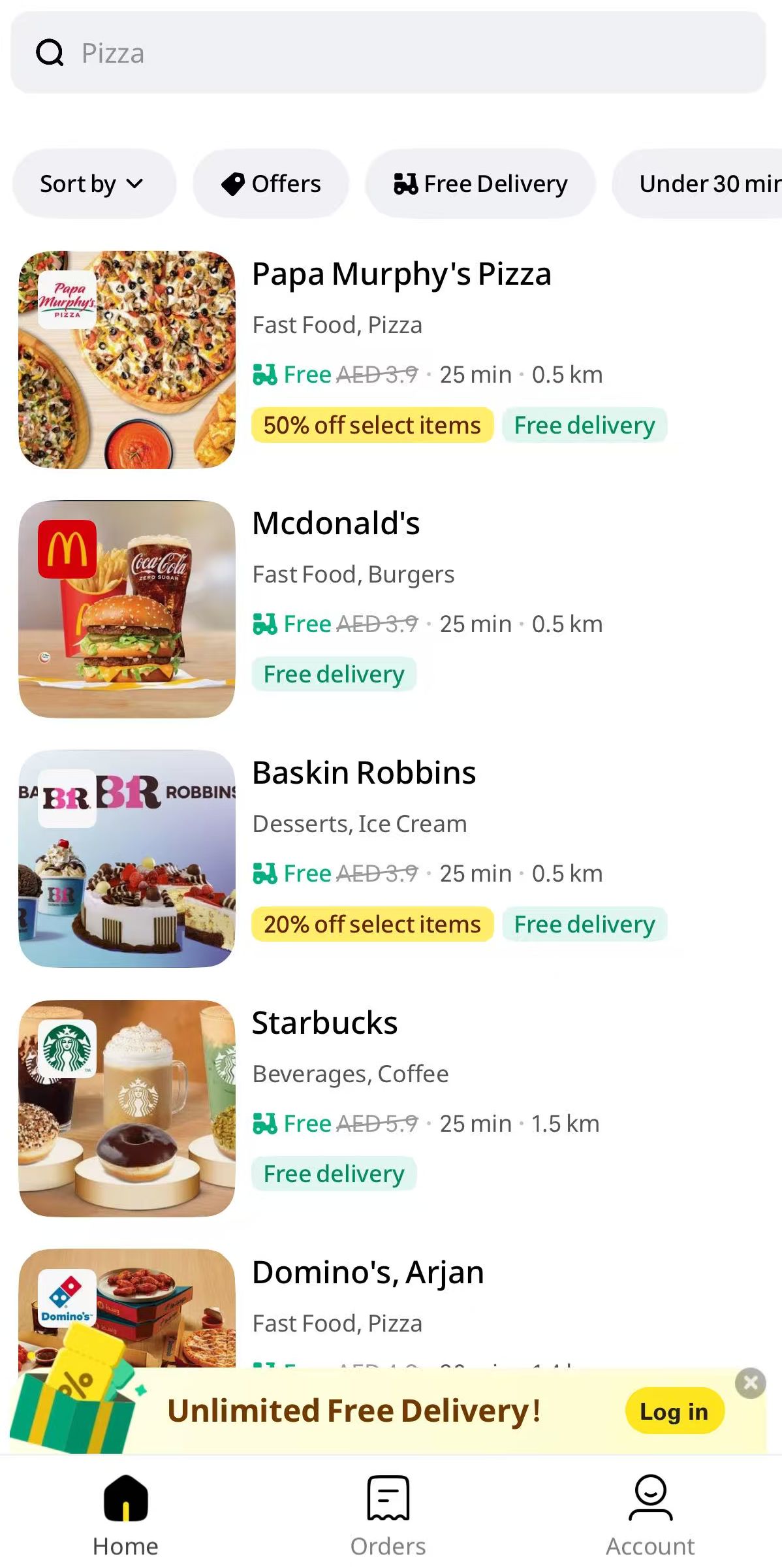
Core Insights - Meituan's international delivery brand Keeta has officially launched operations in Dubai, marking the fourth strategic location in the Middle East within 40 days after entering Qatar and Kuwait [1] - The company aims to cover six Gulf countries within three years, indicating a strong commitment to international expansion amid fierce domestic competition [1] - The launch in Dubai is part of Meituan's accelerated international strategy, leveraging local market experience gained from Saudi Arabia [1] Market Expansion - Keeta's initial offering in Dubai includes free delivery for all orders, with standard delivery fees around 3.9 AED (approximately 7.57 RMB) per kilometer [2] - New users can benefit from significant discounts, with promotions offering up to 150 AED (approximately 291.34 RMB) [8] - Dubai is characterized by high demand for quality delivery services, making it a valuable market due to its high consumer spending power and well-developed infrastructure [12] Operational Strategy - Meituan plans to integrate Keeta with its drone delivery service, Keeta Drone, to create a dual fulfillment network combining ground and aerial delivery [12] - The company has received commercial operation certification for drone delivery in Dubai, allowing it to offer a variety of products through aerial logistics [12] - The strategic location of Dubai serves as a hub for further expansion into surrounding regions, enhancing Meituan's operational footprint [13] Long-term Goals - Meituan's CEO expressed confidence in Keeta's long-term growth potential, targeting a GMV (Gross Merchandise Volume) of 100 billion USD within ten years, starting from May 2023 [14] - The company emphasizes the importance of adapting its business model to local markets rather than merely replicating its domestic strategy [14] - Challenges remain due to geopolitical changes in the Middle East, necessitating careful timing and alignment with local conditions for further expansion [14]
美团旗下国际外卖品牌Keeta上线阿联酋
Di Yi Cai Jing· 2025-09-27 07:48
Group 1 - Meituan's international food delivery brand Keeta officially launched operations in Dubai, UAE on September 27 [1] - This marks the third Middle Eastern market expansion for Keeta within 40 days, following launches in Qatar in August and Kuwait in September [1] - The UAE becomes the fourth strategic location for Meituan's international business in the Gulf region [1]