
医药生物

Search documents
20cm速递|创业板50ETF国泰(159375)涨超2.2%,科技成长主线或成中期焦点
Mei Ri Jing Ji Xin Wen· 2025-11-26 22:55
Core Viewpoint - The ChiNext 50 Index is expected to benefit from the technology growth theme in 2026, despite a short-term market style shift towards dividend stocks. The index's performance is anticipated to return to a focus on technology growth in the medium term due to the relative earnings growth of "technology and value" not having reversed, and the TMT sector's trading density remaining low [1]. Group 1: Market Trends - The current market style is temporarily rebalancing towards dividend stocks, but the growth potential in technology sectors remains strong [1]. - The ChiNext 50 Index, which has a high proportion of emerging industries, is projected to see a net profit growth rate for 2026-2027 that exceeds the average level of the Wind All A Index [1]. Group 2: Sector Performance - The index's constituent stocks are primarily concentrated in high-growth sectors such as power equipment and biomedicine, indicating a combination of high growth potential and good liquidity [1]. - There are signs of overheating in specific areas such as AI hardware and semiconductor equipment, suggesting a potential shift in market focus towards AI applications and consumer electronics [1]. Group 3: Future Outlook - The performance turning point for technology companies is expected to emerge around 2025-2026, supported by policies aimed at improving corporate profitability in the context of "anti-involution" [1]. - The ChiNext 50 ETF (159375) tracks the ChiNext 50 Index (399673) and has shown a daily fluctuation of up to 20%, reflecting the overall performance of well-known, large-cap, and liquid companies in the ChiNext market [1].

创业板指26日涨超2% 算力、医药领涨
Shang Hai Zheng Quan Bao· 2025-11-26 18:35
Market Performance - The A-share market showed mixed results with the Shanghai Composite Index down by 0.15%, while the Shenzhen Component and ChiNext Index rose by 1.02% and 2.14% respectively [1] - The total trading volume in the Shanghai and Shenzhen markets was 1.7972 trillion yuan, a decrease of 29 billion yuan compared to the previous trading day [1] CPO and AI Sector - The CPO sector continued to perform strongly, with Changguang Huaxin hitting a 20% limit up and Zhongji Xuchuang rising over 13% [2] - Alibaba Group reported a revenue of 247.795 billion yuan for Q2 of FY2026, exceeding market expectations, with a year-on-year growth of 15% after excluding sold businesses [2] - Alibaba Cloud's revenue reached 39.824 billion yuan, marking a 34% year-on-year increase, driven by strong AI demand and public cloud revenue growth [2] - The CEO of Alibaba stated that the demand for GPUs is currently at full capacity, indicating a supply-demand imbalance in AI resources for the next three years [2] - CITIC Securities reported that Alibaba's capital expenditure for the quarter was 31.5 billion yuan, with a total of approximately 120 billion yuan spent on AI and cloud infrastructure over the past four quarters [2] Pharmaceutical Sector - The pharmaceutical sector showed strong performance, driven by the flu season, with companies like Yuyuan Health and Huaren Health hitting a 20% limit up [3] - The Chinese CDC reported that flu activity is currently at a rising stage, with the H3N2 subtype accounting for over 95% of cases [3] - Companies like Zhenbaodao have responded to investor inquiries regarding their flu treatment drugs and vaccines, indicating ongoing production and sales [3] - Everbright Securities noted that the global interest rate cut cycle benefits innovative assets, and the aging population is driving increased healthcare spending, expanding global demand for pharmaceuticals [3] Foreign Investment Sentiment - Foreign investment sentiment remains positive towards Chinese assets, with Morgan Asset Management forecasting a 7.7% annualized return for A-shares over the next 10 to 15 years [4] - The report cites three main drivers: long-term economic resilience, stronger shareholder return policies, and potential valuation upside due to improved corporate governance and increased international investment [4] - Morgan Stanley's chief equity strategist expressed cautious optimism, highlighting investor focus on positive signals for the Chinese market while being wary of rising market volatility [5]
4000点临门一脚:A股年末行情能否突破?
Sou Hu Cai Jing· 2025-11-26 16:21
Market Overview - The A-share market is currently experiencing fluctuations and is hovering around the 4000-point mark, with the Shanghai Composite Index closing at 3873.52 points, just under 130 points away from the target [1][3] - The market has shown a mixed performance in November, with a notable decrease in trading volume by 3.19% compared to the previous trading day, indicating a gradual recovery in market sentiment [3] Sector Performance - The telecommunications sector led the market with a 4.36% increase, followed by electronics, comprehensive, and pharmaceutical sectors with gains of 2.45%, 1.69%, and 1.28% respectively [3] - Conversely, the defense, banking, and oil sectors experienced the largest declines, with decreases of 1.93%, 1.24%, and 0.90% respectively, highlighting a clear divergence in sector performance [3] Institutional Perspectives - Institutions predict a narrow upward trend for the market in December, driven by the need to recover from previous adjustments while remaining in a "slow bull" trend [5] - The focus is shifting towards sectors with high visibility in economic recovery, particularly technology stocks like AI, which are expected to attract significant attention [5] - Some institutions remain cautious, advising to control positions in the short term while maintaining confidence in the long-term market outlook [5] Policy Expectations - The upcoming Central Economic Work Conference in December is anticipated to be a key factor influencing market direction [7] - Analysts expect the market to experience fluctuations until the conference, after which a new bullish phase may emerge as institutional funds reposition for the following year [7] Capital Flows - The RMB is maintaining a strong position, supported by a consistent surplus in bank foreign exchange settlements [9] - Expectations of a potential interest rate cut by the Federal Reserve in December could facilitate inflows of foreign capital into the A-share market [9] - Despite some short-term profit-taking by long-term funds, there has been a net inflow of various capital types into the A-share market [10] Investment Strategies - Institutions recommend focusing on dividend-paying blue-chip stocks and sectors benefiting from long-term capital inflows, such as traditional industries and consumer sectors [14] - There is a consensus on the technology growth sector, particularly AI, as a key area for future investment, with expectations of a market recovery led by this sector [16] - The market is seen as preparing for a potential spring rally, with optimism about future growth despite current volatility [16]


11月26日沪深两市强势个股与概念板块
2 1 Shi Ji Jing Ji Bao Dao· 2025-11-26 10:49
Strong Stocks - As of November 26, the Shanghai Composite Index fell by 0.15% to 3864.18 points, while the Shenzhen Component Index rose by 1.02% to 12907.83 points, and the ChiNext Index increased by 2.14% to 3044.69 points [1] - A total of 76 stocks in the A-share market hit the daily limit up, with the top three strong stocks being: TeFa Information (000070), Huanrui Century (000892), and Leike Defense (002413) [1] - The top 10 strong stocks showed significant trading activity, with TeFa Information achieving a 4-day limit up and a turnover rate of 25.84%, while Huanrui Century also had a 4-day limit up with a turnover rate of 37.38% [1] Strong Concept Sectors - The top three concept sectors based on A-share performance were: Horse Racing Concept, Duty-Free Shops, and Guangdong Free Trade Zone, with respective increases of 1.95%, 1.72%, and 1.5% [2] - The Horse Racing Concept had 50% of its constituent stocks rising, while the Duty-Free Shops sector saw 68.97% of its stocks increase [2] - The top 10 concept sectors displayed a mix of performance, with sectors like Medical E-commerce and CPO (Co-Packaged Optics) also showing positive growth [2]


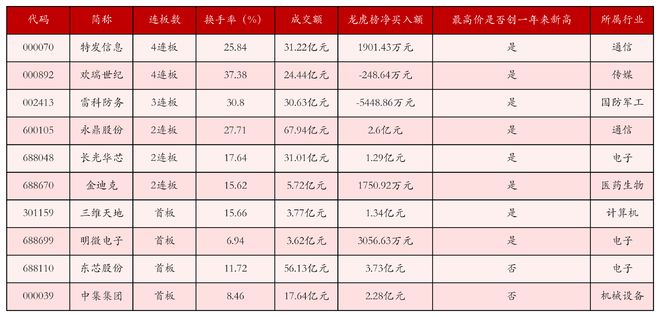
数据复盘丨CPO、创新药等概念走强 63股获主力资金净流入超1亿元
Zheng Quan Shi Bao Wang· 2025-11-26 10:40
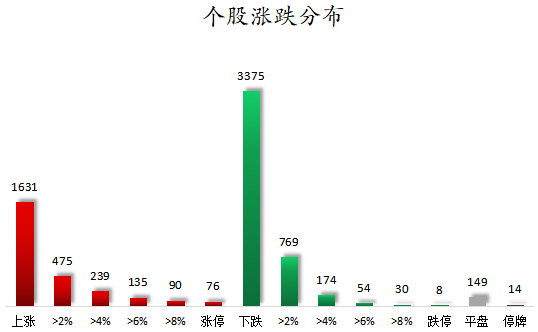
Market Overview - The Shanghai Composite Index closed at 3864.18 points, down 0.15%, with a trading volume of 701 billion [1] - The Shenzhen Component Index closed at 12907.83 points, up 1.02%, with a trading volume of 1082.3 billion [1] - The ChiNext Index closed at 3044.69 points, up 2.14%, with a trading volume of 529 billion [1] - The STAR Market 50 Index closed at 1315.04 points, up 0.99%, with a trading volume of 57.6 billion [1] - Total trading volume for both markets was 1783.3 billion, a decrease of 28.8 billion from the previous trading day [1] Sector Performance - Strong sectors included telecommunications, electronics, home appliances, pharmaceutical biology, retail, and automotive [3] - Active concepts included CPO, innovative drugs, cultivated diamonds, optical communication modules, synchronous reluctance motors, and duty-free [3] - Weak sectors included defense, media, beauty care, oil and petrochemicals, banking, environmental protection, agriculture, forestry, animal husbandry, and coal [3] - The number of stocks that rose was 1631, while 3375 stocks fell, with 149 stocks remaining flat and 14 stocks suspended [3] Capital Flow - The net outflow of main funds in the Shanghai and Shenzhen markets was 11.01 billion [6] - The ChiNext saw a net outflow of 5.64 billion, while the CSI 300 experienced a net inflow of 5.23 billion [6] - The electronic sector had the highest net inflow of 3.16 billion, followed by telecommunications, home appliances, retail, banking, and automotive [6] - The media sector had the largest net outflow of 4.44 billion, followed by computer, defense, non-ferrous metals, and electrical equipment [6] Individual Stock Performance - 2386 stocks saw net inflows from main funds, with 63 stocks receiving over 1 billion in net inflow [7][8] - The stock with the highest net inflow was Xinyi Technology, with 1.646 billion, followed by Zhongji Xuchuang, Yangguang Electric, and others [9] - 2765 stocks experienced net outflows, with 108 stocks seeing over 1 billion in net outflow [11] - The stock with the highest net outflow was Aerospace Development, with 1.312 billion, followed by Guangku Technology, Kunlun Wanwei, and others [12][13] Institutional Activity - Institutional net buying totaled approximately 1.9 billion, with 13 stocks seeing net buying and 13 stocks seeing net selling [15][16] - The stock with the highest institutional net buying was Changguang Huaxin, with approximately 232 million, followed by China International Marine Containers and others [17]






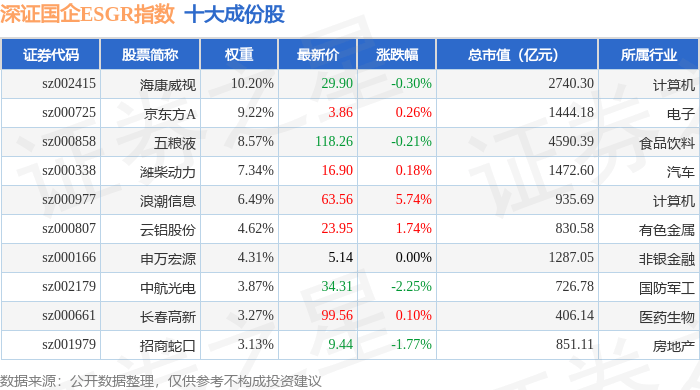
11月26日深证国企ESGR(470055)指数涨0.31%,成份股泰达股份(000652)领涨
Sou Hu Cai Jing· 2025-11-26 10:35
Core Viewpoint - The Shenzhen State-Owned Enterprise ESGR Index (470055) closed at 1552.92 points, up 0.31%, with a trading volume of 27.52 billion yuan and a turnover rate of 0.83% on November 26 [1] Group 1: Index Performance - The ESGR Index had 16 constituent stocks rising, with Taida Co., Ltd. leading at a 10.07% increase, while 31 stocks declined, with Zhonglai Co., Ltd. leading the decline at 4.21% [1] - The top ten constituent stocks of the ESGR Index include Hikvision, BOE Technology Group, Wuliangye, Weichai Power, Inspur Information, Yun Aluminum, Shenwan Hongyuan, AVIC Optoelectronics, Changchun High-tech, and China Merchants Shekou, with varying weights and market capitalizations [1] Group 2: Capital Flow - The net inflow of main funds into the ESGR Index constituent stocks totaled 845 million yuan, while retail investors experienced a net outflow of 370 million yuan [1] - Specific stocks such as Inspur Information saw a significant net inflow of 113.7 million yuan from main funds, while retail investors had a net outflow of 64 million yuan [2] - Other notable stocks include Taida Co., Ltd. with a main fund net inflow of 113 million yuan and a retail net outflow of 52.45 million yuan, and Weichai Power with a main fund net inflow of 15.46 million yuan [2]

指数基金产品研究系列报告之二百五十九:景顺长城中证沪港深红利成长低波动指数型基金投资价值分析
Shenwan Hongyuan Securities· 2025-11-26 09:43
Report Industry Investment Rating - Not provided in the content Core Viewpoints of the Report - The market maintains a low - interest - rate environment, enhancing the allocation value of stable assets. The dividend growth low - volatility strategy combines high dividends, profit growth, and price stability, achieving good long - term performance [3][8]. - The dividend growth low - volatility index outperforms other Smart Beta strategies. Since 2020, the three - factor Smart Beta strategy composed of dividend, growth, and low - volatility has significantly better returns than the two - factor strategies [14]. - The dividend yield is at a historical high, and against the low - interest - rate backdrop, the value of dividend allocation is further increased. The Hong Kong stock market has low valuations, and dual - market diversified allocation is advisable [21][24]. - The CSI SH - HK - SZ Dividend Growth Low Volatility Index selects high - quality low - volatility target enterprises in both the A - share and H - share markets, with stable long - term performance and high investment value [26][42]. - The Invesco Great Wall CSI SH - HK - SZ Dividend Growth Low Volatility Index Fund closely tracks the index, aiming to minimize tracking deviation and error and obtain returns similar to the target index [58][59]. Summary by Directory 1. Market Maintains Low - Interest - Rate Environment, and the Allocation Value of Stable Assets Increases 1.1 Dividend Growth Low - Volatility Strategy: Emphasizing High Dividends, Profit Growth, and Low Volatility, a Stable Investment Strategy under Policy Promotion - The dividend growth low - volatility strategy combines high dividend yields, profit - growth capabilities, and price stability, enabling stable medium - to - long - term returns while controlling risks [8]. - Since the end of 2022, regulatory policies on listed - company cash dividends have intensified, enhancing the attractiveness of high - dividend assets and the effectiveness of the high - dividend strategy [11][12]. 1.2 Long - Term Returns Lead Similar Smart Beta Strategies - The dividend growth low - volatility index outperforms other Smart Beta strategies. Since 2020, the annualized returns of the dividend growth low - volatility and SHS dividend growth low - volatility indices have been 11.83% and 11.18% respectively, significantly better than the two - factor indices [14]. - The three - factor strategy performs well in various market conditions. It has better defense in volatile and downward markets and can achieve high growth in upward markets [17]. 1.3 Dividend Yield at a Historical High, and the Value of Dividend Allocation Further Increases under Low - Interest - Rate Conditions - As of November 21, 2025, the difference between the dividend yield of the SH - HK - SZ Dividend Growth Low Volatility Index (in the past 12 months) and the 10 - year Treasury bond yield is at a historical high, with the index's dividend yield at 4.6075% and the 10 - year Treasury bond yield at 1.8207%, and the spread at 2.7868% [21]. - In the context of falling long - term interest rates, dividend - type assets have the property of bonds, helping to hedge against interest - rate risks and having increased allocation value [21]. 1.4 Hong Kong Stocks Have Low Valuations, Are Attractive, and Allow for Dual - Market Diversified Allocation - The Hong Kong stock market has been under pressure in recent years, with valuations in a low range globally. Against the backdrop of improving macro - environment, policy support, and the restoration of Chinese enterprises' profitability, the long - term allocation value of Hong Kong stocks is emerging [24]. 2. CSI SH - HK - SZ Dividend Growth Low Volatility Index: A Multi - Layered Selection of High - Quality Enterprises Combining Dividends and Growth in the A - share and H - share Markets 2.1 Considering Both Markets and Selecting High - Quality Low - Volatility Target Enterprises with Dividends and Profit Growth - Issued by CSI Index Co., Ltd., the index selects 100 securities with continuous cash dividends, stable profit growth, and low - volatility characteristics from the mainland and Hong Kong markets to reflect the overall performance of such listed - company securities [26]. - The index conducts six - layer screening on the sample space from multiple perspectives such as liquidity, dividends, profit growth, and low - volatility, and uses expected dividend - yield weighting, with sample adjustments made semi - annually [28]. 2.2 Concentrated Industry and Market - Value Distribution, Demonstrating Professionalism and Focus Value of Industry Selection - The index's A - share holdings are mainly concentrated in the banking sector, and other sectors with relatively high holdings include pharmaceutical biology, machinery and equipment, and transportation. The H - share holdings also have a high proportion of banks. The total weight of bank stocks in the current holdings is as high as 40.66% [35]. - The index's performance is not dependent on specific industries or periods. It can adjust in a timely manner according to market data, making it a long - term effective and stable investment method [37]. 2.3 Stable Long - Term Performance and Outperforming Similar Dividend Indices This Year - From the base period on November 14, 2019, to November 21, 2025, the cumulative return of the SH - HK - SZ Dividend Growth Low Volatility Index was 289.42%, with an annualized return of 13.12%. Since 2019, the index has shown a long - term stable upward trend [42]. - In the past three years, the index has outperformed similar dividend - themed indices, especially since the "924" market. As of 2022, the average annual return of 15.66% ranks among the top of similar indices, with an annualized volatility of 14.43% and a maximum drawdown of only 14.17%, and a Sharpe ratio as high as 0.96, indicating high investment value [47][50]. 2.4 Low Valuation + High Dividend, with Dividend Yield Significantly Exceeding Mainstream Dividend Indices - As of July 28, 2025, the index's PE (TTM) is 8.31 times, and PB is 0.87 times, which are around the historical average since the base date of 2019. The current valuation is relatively reasonable, and there is room for the index to rise [52]. - As of September 30, 2025, the dividend yield of the SHS Dividend Growth Low Volatility Index is 4.86%, leading the dividend yields of the Shanghai Dividend Index, CSI Dividend Index, Dividend Low - Volatility Index, and Hang Seng Index, showing investment value in the field of dividend investment [55]. 3. Invesco Great Wall SH - HK - SZ Dividend Growth Low Volatility Index (007751) - The Invesco Great Wall CSI SH - HK - SZ Dividend Growth Low Volatility Index Fund, established on September 6, 2019, is currently managed by Mr. Zeng Li. The management fee is 0.50%, and the custody fee is 0.15% [58][59]. - The fund closely tracks the CSI SH - HK - SZ Dividend Growth Low Volatility Index, aiming to minimize tracking deviation and error. It is the only ETF product in the market that tracks this index [59]. - Since its establishment, the fund has maintained positive returns except in 2020. The tracking error has been continuously decreasing, with the tracking error in 2025 relative to the benchmark date being only 0.0893%, indicating the strengthening of the product's tracking ability for the benchmark index [61]. 4. Fund Manager Information - Invesco Great Wall Fund Management Co., Ltd. was established on June 12, 2003, and is the first Sino - US joint - venture fund management company in China approved by the China Securities Regulatory Commission. As of November 24, 2025, it manages 22 passive index - type ETFs, with a total scale of approximately 7.1068 billion yuan [63].
2026年上半年期A股投资策略报告:方兴未艾,逐光而行-20251126
Dongguan Securities· 2025-11-26 09:14
Group 1 - The A-share market experienced a strong upward trend in 2025, with the Shanghai Composite Index reaching 4000 points, driven by domestic policies and a rebound in the technology sector [6][15]. - The market is expected to continue its recovery in the first half of 2026, supported by improved economic fundamentals and favorable policies, despite potential short-term volatility [6][22]. - The report emphasizes the importance of strategic optimism and suggests investors focus on structural opportunities aligned with policy guidance and performance trends [6][6]. Group 2 - The report outlines three main investment themes for 2026: 1) High dividend assets with low valuations and stable earnings, particularly in sectors like finance, non-ferrous metals, public utilities, and transportation [6]. 2) Technology-driven sectors that align with the "14th Five-Year Plan," focusing on domestic substitution and innovation in areas such as semiconductors and AI [6]. 3) Domestic demand expansion, highlighting sectors like food and beverage, automotive, home appliances, and pharmaceuticals that benefit from strong domestic market strategies [6][6]. Group 3 - The report recommends overweighting sectors such as non-ferrous metals, TMT (Technology, Media, and Telecommunications), finance, power equipment, food and beverage, and machinery [6][6]. - It suggests a benchmark allocation for sectors like agriculture, automotive, transportation, public utilities, and defense [6][6].
科创板平均股价38.87元,6股股价超300元
Zheng Quan Shi Bao Wang· 2025-11-26 09:07
Core Insights - The average stock price on the STAR Market is 38.87 yuan, with 65 stocks priced over 100 yuan, and the highest priced stock is Cambrian-U at 1314.66 yuan, which increased by 4.34% today [1][2] - Among the stocks priced over 100 yuan, 203 stocks rose while 379 stocks fell, with an average increase of 1.31% for the rising stocks [1] - The average premium of the stocks priced over 100 yuan relative to their issue price is 511.43%, with the highest premiums seen in companies like Shunwei New Materials and Cambrian-U [1] Stock Performance - Cambrian-U closed at 1314.66 yuan, up 4.34%, followed by SourceJ Technology at 587.08 yuan, up 7.42%, and GuoDun Quantum at 455.88 yuan, down 0.90% [2][3] - The stocks with the highest net inflow of funds today include Cambrian-U, Dongxin Technology, and SourceJ Technology, with net inflows of 6 billion yuan, while the largest net outflows were from DeKeLi, Tengjing Technology, and Zhongxin International [2] - The total margin balance for stocks priced over 100 yuan is 896.97 billion yuan, with Cambrian-U, Zhongxin International, and Haiguang Information having the highest margin balances [2] Industry Distribution - The stocks priced over 100 yuan are concentrated in the electronics, pharmaceutical, and computer industries, with 33, 9, and 9 stocks respectively [1] - The top-performing sectors today include electronics and pharmaceuticals, with significant movements in stocks like Changguang Huaxin and Haoubo [1][3]



中证A500ETF(159338)收涨超0.6%,科技成长主线或成中期焦点
Mei Ri Jing Ji Xin Wen· 2025-11-26 08:45
Core Viewpoint - The A-share market is expected to return to a "technology growth" theme by 2026, with a continued trend of high performance growth in the technology sector [1] Group 1: Technology Sector - The performance growth trend in the technology sector has not reversed, and the valuation differentiation between growth and value is not at an extreme [1] - The TMT (Technology, Media, and Telecommunications) sector remains relatively under-traded overall, despite some overheating in AI hardware areas like electronics and communications [1] - There are potential rebound opportunities in media and computer sectors as AI application sectors lag behind [1] Group 2: Traditional Industries - The "anti-involution" policy is expected to improve the fundamentals of certain industries, with traditional sectors like coal and steel likely to see a recovery in profitability driven by policy support [1] - Emerging industries such as photovoltaics and lithium batteries may stabilize in supply-demand dynamics after capacity clearing [1] Group 3: Consumer Sector - The consumer sector is anticipated to experience a mild recovery, with structural opportunities in service consumption and travel industries supported by demand recovery and policy backing [1] Group 4: Index Overview - The CSI A500 ETF (159338) tracks the CSI A500 Index (000510), which selects 500 stocks with large market capitalization and good liquidity from the Shanghai and Shenzhen stock exchanges [1] - The index emphasizes balanced industry allocation, focusing on both growth and cyclical sectors, and highlights leading companies in niche industries and representative firms in the new economy [1]