创新药

Search documents
亚太股市集体反弹,沪指收复4100点,算力硬件爆发,港股腾讯、智谱涨超6%
21世纪经济报道· 2026-03-10 04:16AI Processing
涨 4345 具体来看,A股 科技股回暖,算力硬件方向领涨。CPO概念持续走强,汇绿生态、瑞斯康达封涨停。PCB概念震荡反弹,金安国纪、广合科 技、迅捷兴涨停。 商业航天概念表现活跃,航天电器、中衡设计涨停。超硬材料概念快速走高,黄河旋风涨停。消息面上,由中国运载火箭技术研究院研制的长 征八号甲遥八运载火箭,在海南商业航天发射场成功实施转运,火箭箭体被顺利运至发射区一号发射工位,计划近期择期发射。 近期 OpenClaw爆火, 网络安全概念股异动拉升,国安股份涨停,天融信、绿盟科技、浩瀚深度等大涨。创新药概念震荡反弹,信立泰涨停, 海特生物、维康药业涨超10%。 记者丨张嘉钰 编辑丨曾静娇 3月10日早盘,亚太股市全线上涨。其中日经225涨超3%,韩国综合指数涨超4%,盘中一度涨5%触发熔断,SK海力士涨超10%;A股主要指数 飘红,全 市场逾4300股上涨, 沪指收复4100点;港股走强,恒生指数、恒生科技指数均涨约1.8%。 内地股票 [4 | 上证指数 | 深证成指 | 科创综指 | | --- | --- | --- | | 4112.62 | 14288.32 | 1772.85 | | +16.0 ...



超4300只个股上涨
第一财经· 2026-03-10 03:47
Core Viewpoint - The A-share market shows a positive trend with significant gains in the ChiNext index, driven by a rebound in technology stocks and specific sectors like computing hardware and innovative pharmaceuticals [2][3]. Market Performance - As of midday, the Shanghai Composite Index rose by 0.39%, the Shenzhen Component Index increased by 1.57%, and the ChiNext Index surged by 2.47% [2]. - The total market capitalization reached 90,876 billion, with a trading volume of 1.6 trillion, down by 190 billion from the previous trading day [4]. Sector Highlights - Technology stocks experienced a broad rebound, particularly in the computing hardware industry, with notable gains in CPO and circuit board sectors [3]. - The human-robot concept saw active trading, with stocks like Shoukai Co. and Fenglong Co. hitting the daily limit [5]. - The cultivated diamond sector showed strength, with stocks like Huanghe Xuanfeng and Sifangda rising over 10% following price increase announcements from manufacturers [6]. - The commercial aerospace sector also saw initial gains, with stocks like Xinjin Gang and Guanglian Aviation rising significantly [6]. Stock Movements - The ChiNext Index opened at 3,281.94, with a high of 3,298.01 and a low of 3,272.99, reflecting a market PE ratio of 40.8 and a PB ratio of 5.615 [3]. - The oil and gas sector faced significant declines, with multiple stocks hitting the daily limit down, influenced by a drop in crude oil prices [7][9]. Opening Trends - The A-share market opened positively, with all three major indices showing gains, particularly the ChiNext Index which opened up by 2.29% [8]. - The Hong Kong market also opened strong, with the Hang Seng Index rising by 1.31% and technology stocks performing well [11].

伊朗局势的关键推演:环球市场动态2026年3月10日
citic securities· 2026-03-10 02:59
Market Overview - Oil prices experienced extreme volatility, with WTI crude oil futures soaring to nearly $120 per barrel before plummeting to around $85 following comments from Trump about the end of military actions in Iran[4][26]. - The U.S. stock market rebounded after a significant drop, with the Dow Jones increasing by 239 points (0.5%) to close at 47,740.8, and the S&P 500 rising by 0.8%[8][9]. Asian Market Dynamics - The A-share market showed resilience, with the Shanghai Composite Index closing down 0.67% at 4,096.60 points, while the Hong Kong Hang Seng Index fell by 1.35% to 25,408.46 points[15][11]. - The Asian markets overall were under pressure, with Vietnam's index dropping 6.5% and South Korea's KOSPI down 6.0%[20][21]. Sector Performance - Energy stocks surged due to rising oil prices, with the energy sector in Hong Kong gaining 3.0%[11][16]. - The technology sector in the U.S. led the market rebound, with the information technology index rising by 1.8%[9]. Economic Implications - The ongoing conflict in Iran is expected to lead to increased input inflation, with potential short-term negative impacts on exports but long-term benefits for certain sectors[6]. - The gas industry faces narrowing margins, with domestic import costs projected to rise by 7% to 25% in 2026 due to geopolitical tensions[13]. Investment Recommendations - For the A-share market, it is advised to focus on sectors such as chemicals, non-ferrous metals, power equipment, and new energy, while increasing exposure to insurance and brokerage firms[6]. - In the U.S. market, defense and energy infrastructure stocks are expected to benefit from the current geopolitical climate[6].
具身智能“吸金”近百亿丨投融周报
投中网· 2026-03-09 14:31
Focus Review - The hard technology sector continues to favor embodied intelligence and robotics, with Galaxy General Robotics completing a new round of financing of 2.5 billion yuan, backed by multiple investors including the National Artificial Intelligence Industry Investment Fund and China Petroleum [4][7] - In the health sector, innovative drugs and cell therapies remain significant capital attractors, with Zhitai Bio completing over 500 million yuan in Series C financing led by OrbiMed [4][23] - The internet sector sees major companies increasing investments in AI, with Deep Principle announcing A2 round financing led by Jinma Investment [5][36] Hard Technology - Galaxy General Robotics completed a new round of financing of 2.5 billion yuan, with multiple investors participating [4][7] - Songyan Power announced the completion of B round financing, accumulating nearly 1 billion yuan [4][9] - Yuliqi Robotics completed nearly 300 million yuan in new equity financing, with participation from various investors [4][12] Health Sector - Zhitai Bio completed over 500 million yuan in Series C financing, with continued support from existing shareholders [4][23] - Yimufeng Bio completed nearly 200 million yuan in Pre-IPO financing, led by Gao Rong Venture Capital [4][26] - Huamei Haolian announced the completion of several hundred million yuan in Series D financing [22] Internet Sector - Deep Principle completed A2 round financing, led by Jinma Investment [5][36] - VAST announced the completion of 50 million USD in A round financing, with participation from Alibaba and Hengxu Capital [5][35] - Light Year Touch completed a million-dollar angel round financing [30] Other Notable Financing - Kaal Power completed over 100 million USD in B round financing [8] - Sainade completed over 200 million yuan in strategic financing [13][18] - Proton Automotive completed several hundred million yuan in B round financing [17]

资讯日报:中东持久战担忧下油价飙升-20260309
Guoxin Securities Hongkong· 2026-03-09 12:28
Market Overview - The Hang Seng Index closed at 25,757, up 1.72% for the day but down 3.28% year-to-date[3] - The Hang Seng Tech Index rose 3.15%, while the Hang Seng China Enterprises Index increased by 2.09%[9] - The S&P 500 and Nasdaq fell by 1.33% and 1.59% respectively, with year-to-date declines of 1.54% and 3.68%[3] Oil Price Surge - WTI crude oil prices surged approximately 36% and Brent crude by about 27% due to escalating conflicts in the Middle East, disrupting oil transport in the Strait of Hormuz[9] - The VIX index rose by 22%, reaching its highest level since April of the previous year, indicating increased market volatility[9] Employment Data - The U.S. non-farm payroll report for February showed a loss of 92,000 jobs, with the unemployment rate rising to 4.4%[9] - This data has heightened concerns regarding inflation and economic outlook[9] Sector Performance - JD.com reported a revenue of over 1.3 trillion yuan for 2025, a 13% year-on-year increase, with a core retail operating margin of 4.6%[9] - Biopharmaceutical stocks surged, with companies like 3SBio and CanSino rising over 9% following government support for the sector[9] Commodity Trends - Gold stocks faced pressure, with China Gold International and Tongguan Gold dropping by 5.20% and 1.93% respectively, amid rising inflation expectations due to oil price hikes[9] - The copper inventory on the LME increased by over 20,000 tons, marking the largest weekly rise since August 2024, contributing to a 43.69% increase in domestic copper stock[9]

医药生物行业报告(2026.3.2-2026.3.6):聚焦两会:打造生物医药等新兴支柱产业,健全医疗保障体系,推动商保和创新发展
China Post Securities· 2026-03-09 07:13
Industry Investment Rating - The investment rating for the pharmaceutical and biotechnology industry is "Outperform the Market" [1] Core Insights - The report highlights the government's focus on strengthening basic medical services and promoting the biopharmaceutical industry as a key emerging sector during the 2026 National People's Congress [4][16] - It is anticipated that policy guidance will lead to increased capital support for pharmaceutical supply-side innovations, enhancing the global competitiveness of domestic innovative drug companies [5][20] Summary by Sections Industry Overview - The closing index for the pharmaceutical and biotechnology sector is 8092.32, with a 52-week high of 9323.49 and a low of 6876.88 [1] Market Performance - The A-share pharmaceutical and biotechnology sector fell by 2.78% from March 2 to March 6, 2026, underperforming the CSI 300 index by 1.71 percentage points [6][21] - The sector's performance ranked 17th among 31 sub-industries during the week [6] Investment Recommendations 1. **Innovative Drugs and Industry Chain**: - The report suggests a stable funding environment for innovative drugs, with a focus on companies like Innovent Biologics, 3SBio, and others [7][24] - The report emphasizes the increasing global participation of domestic innovative drugs, predicting a harvest period for new drugs in the medium term [24] 2. **CXO and Life Science Services**: - Investment opportunities are seen in CXO and life science service companies due to a stable recovery in overseas R&D and production outsourcing demand [8][25] 3. **Medical Devices**: - The medical device sector is expected to see a turnaround as the pressure from centralized procurement diminishes, with leading companies showing improved performance [28] 4. **Traditional Chinese Medicine**: - The report highlights opportunities in traditional Chinese medicine, particularly those benefiting from basic drug policies and innovation [31][32] 5. **AI in Healthcare**: - AI technology is expected to enhance drug development efficiency and diagnostic accuracy, with several companies identified as potential beneficiaries [36] Sector Valuation - As of March 6, 2026, the overall valuation of the pharmaceutical sector is 30.45, with a valuation premium of 125.07% over the CSI 300 index [43]
翰森制药核心产品新适应症获批,中国生物制药罗伐昔替尼出海落地!港股通创新药ETF(159570)回调近2%,超2亿元资金狂涌!
Xin Lang Cai Jing· 2026-03-09 06:45
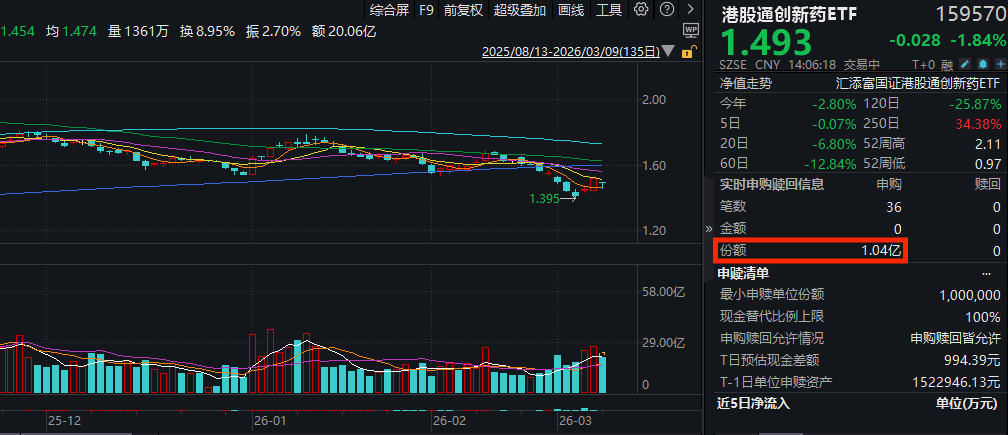
Group 1 - The core viewpoint of the news highlights the recent downturn in the Asia-Pacific market, particularly in the Hong Kong pharmaceutical sector, with the Hong Kong Stock Connect Innovation Drug ETF (159570) experiencing a nearly 2% decline, despite a significant net subscription of 210 million yuan and a total scale exceeding 23.1 billion yuan [1][3] - The high-level meeting has officially categorized innovative drugs as an "emerging pillar industry," emphasizing the acceleration of commercial health insurance development and the promotion of high-quality development in innovative drugs [3] - The approval of Hansoh Pharmaceutical's application for the listing of Amivantamab tablets marks a significant milestone, as it is the first domestically developed third-generation EGFR-TKI in China, with five approved indications since its initial approval in March 2020 [3] Group 2 - In business development news, China Biologic Products announced an exclusive licensing agreement with Sanofi for Rovafatinib, a novel oral small molecule JAK/ROCK inhibitor, with potential payments totaling up to 1.53 billion USD, including an upfront payment of 135 million USD [4] - The Hong Kong Stock Connect Innovation Drug ETF (159570) saw most of its index's popular stocks decline, with notable drops including 5% for 3SBio and over 4% for CanSino Biologics, while Hansoh Pharmaceutical saw a slight increase due to new drug news [4] - The innovative drug sector is experiencing short-term volatility, but the long-term growth potential remains intact, with a focus on the globalization of Chinese pharmaceutical companies and the advancement of innovative technologies [6][9] Group 3 - The focus of the market has shifted from the ability to enter overseas markets to the progress of products in overseas clinical deployments, with key data readouts and milestone achievements becoming critical for future evaluations [7] - Chinese companies are making breakthroughs in frontier technologies such as small nucleic acids and cell therapies, positioning themselves as core assets in global transactions [8] - Leading innovative drug companies are entering a positive cycle of product commercialization and reinvestment in research and development, with expectations for significant performance improvements in the upcoming earnings period [9]


两会消费行业政策专题解读
2026-03-09 05:18
Summary of Conference Call Records Industry or Company Involved - **Consumer Sector**: Focus on various segments including apparel, home appliances, education, agriculture, food and beverage, and pharmaceuticals. Key Points and Arguments Consumer Sector Overview - **2026 Domestic Consumption**: Expected to stabilize, supported by special government bonds and a 100 billion yuan fund for trade-in programs, with a focus on companies like Li Ning and Anta for growth opportunities [1][2]. - **Real Estate Policy Shift**: The real estate sector is positioned as a stabilizing force, benefiting home furnishing companies like Kuka Home and Oppein as demand improves [1][3]. - **Education Sector Growth**: The "14th Five-Year Plan" anticipates an increase of over 2 million high school seats, benefiting companies like China Oriental Education [1][4]. Agriculture and Livestock - **Pig Farming Sector**: Currently in a deep loss phase with an average loss of over 250 yuan per head, suggesting a need for strategic investments in leading companies like Muyuan Foods and WH Group [1][8]. - **Grain Security Policy**: The focus on grain security aims for a production target of 145 million tons, indicating systemic investment opportunities in breeding and smart agriculture [5][6]. Food and Beverage Sector - **CPI Recovery**: Policies aimed at stabilizing the CPI are expected to positively impact pricing in the food and beverage sector, with recommendations for leading brands like Kweichow Moutai and Wuliangye [1][11]. - **Market Sentiment**: The food and beverage sector is currently experiencing a downturn, but there are signs of recovery, particularly in the liquor segment, with Moutai's pricing stabilizing [1][13][14]. Home Appliances - **Policy Impact**: The government has introduced a 250 billion yuan bond issuance to support the home appliance sector, focusing on high-efficiency products [1][22]. - **Market Dynamics**: The home appliance sector is expected to face pressure in 2026, with potential declines in white goods sales unless supported by subsidies [1][23]. Pharmaceutical Sector - **Emerging Industry Status**: The pharmaceutical industry has been elevated to a new pillar industry status, with a focus on innovative drugs and biotechnology [1][20]. - **Investment Opportunities**: Companies like BeiGene and Innovent Biologics are highlighted as key investment targets in the innovative drug space [1][21]. Service Sector - **Consumer Services**: The government emphasizes boosting consumer services, with a focus on increasing residents' income and expanding personal consumption loans [1][16]. - **Tourism and Hospitality**: Companies like Ctrip and Songcheng Performance are recommended due to expected improvements in tourism and entertainment sectors [1][18]. Other Important but Possibly Overlooked Content - **Investment Strategies**: The overall investment strategy suggests a cautious approach, focusing on companies with strong fundamentals and potential for recovery in various sectors [1][30]. - **Market Sentiment**: The current market sentiment is relatively calm, which may provide a favorable environment for long-term investments in consumer sectors [1][29]. This summary encapsulates the key insights from the conference call records, highlighting the strategic focus areas and potential investment opportunities across various sectors.
创新药-继续看好国际化-政策支持和技术突破
2026-03-09 05:18
Summary of Key Points from Conference Call Records Industry Overview - The focus for pharmaceutical investments in 2026 is on ADC (Antibody-Drug Conjugates), second-generation IO (Immuno-Oncology), small nucleic acids, and weight loss sectors, with the CRO (Contract Research Organization) industry expected to see a demand turning point as global investment and financing recover [1][2]. Core Insights and Arguments Company-Specific Developments - **Kanglongda (科伦博泰)**: SKB264 is being advanced overseas by Merck with 17 Phase III clinical trials, with key data expected in 2026 for lung cancer and breast cancer indications [1][4]. - **Shiyao Group (石药集团)**: Achieved significant business development (BD) progress with AstraZeneca on the GLP-1 platform, exceeding market expectations. The EGFR ADC has received three FDA fast track designations, and multiple small nucleic acid pipelines are expected to enter IND in 2026 [1][4]. - **Kangfang Biotech (康方生物)**: Has 14 Phase III clinical trials globally for AK112, with key data readouts expected in H2 2026 for lung cancer and cholangiocarcinoma [1][4]. - **Hengrui Medicine (恒瑞医药)**: Entering a positive performance cycle with expectations of 10 innovative drug approvals in 2026 and over 20 Phase III clinical data readouts [1][8]. - **Innovent Biologics (信达生物)**: Anticipates significant revenue growth in 2026, primarily from the high-volume launch of Ma Shidu peptide and ongoing commercialization of new molecules [1][9]. - **Rongchang Biotech (荣昌生物)**: Expects to achieve breakeven in 2026, with significant overseas clinical progress for RC118 in collaboration with AbbVie [1][10]. Investment Themes - **Innovation Line**: Optimism for innovative drug investments in 2026, driven by improved global liquidity and supportive domestic policies. Key areas include ADC, second-generation IO, small nucleic acids, and weight loss therapies [2]. - **Global Expansion**: Increased market attention on companies going global, with the Chinese pharmaceutical industry gradually gaining global competitiveness. However, challenges remain in the long-term process of internationalization [2]. - **Marginal Changes**: Policy support and improvements are expected to be significant trading logic in 2026, with a focus on CRO industry recovery and opportunities arising from supply-demand improvements [2]. Clinical and Regulatory Milestones - **Clinical Trials**: Multiple companies are expected to report critical clinical data in 2026, including early data from various ADC and IO projects, with significant implications for their market positions [5][6][11]. - **Regulatory Approvals**: Companies like Hengrui and Shiyao are on track for numerous drug approvals and submissions, indicating a robust pipeline and regulatory strategy [8][4]. Other Important Insights - **Market Dynamics**: The CRO sector is highlighted as a key area for recovery, with companies like WuXi AppTec and Tigermed expected to benefit from renewed global demand [2]. - **Emerging Technologies**: The focus on innovative drug development, particularly in the context of ADC and IO, reflects a broader trend towards precision medicine and targeted therapies [1][2]. This summary encapsulates the critical developments and insights from the conference call records, providing a comprehensive overview of the pharmaceutical industry's landscape and specific company trajectories for 2026.
两会定调新航向!看好这些板块,基金经理挖掘“2026投资地图”!
券商中国· 2026-03-09 00:38
Core Viewpoint - The article emphasizes that the government work report during the 2026 Two Sessions outlines a clear blueprint for economic development and policy direction, signaling numerous investment opportunities, particularly in emerging industries like biomedicine, new infrastructure represented by computing and electricity synergy, and the domestic consumer market [1]. Group 1: Biomedicine as an Emerging Pillar Industry - The government work report has prioritized the cultivation of new driving forces, specifically highlighting biomedicine as a newly added emerging pillar industry, alongside future industries like brain-computer interfaces [2][3]. - Following the announcement, the biomedicine sector saw significant gains, with the China Hong Kong Innovation Drug Index rebounding by 4.24% in a single day, and individual stocks like Jiuzhou Pharmaceutical and Rongchang Bio rising by 43.53% and 10.92%, respectively [2]. - Analysts suggest that the inclusion of biomedicine in the government report, combined with the approval of several new drugs, may lead to a recovery in the sector, supported by improved market sentiment and reduced selling pressure [3]. Group 2: Computing and Electricity Synergy as New Infrastructure - The government work report has placed significant emphasis on creating a new form of intelligent economy, particularly through the implementation of computing and electricity synergy projects as part of new infrastructure [4][5]. - The term "computing and electricity synergy" was introduced in the report, indicating a focus on integrating AI with energy resources to address structural energy supply issues, which has led to increased activity in the power and grid equipment sectors [5][6]. - The demand for high-density energy consumption driven by AI computing is expected to create substantial opportunities for equipment manufacturers, with the potential for a trillion-level market expansion in this area [6]. Group 3: Domestic Consumption Recovery - The government work report has prioritized building a strong domestic market, emphasizing the need to stimulate consumption and expand investment, which is expected to enhance domestic demand [7][8]. - Specific policies aimed at boosting consumption include a plan for urban and rural residents' income growth and the promotion of paid leave for workers, which are designed to create new consumption scenarios [8]. - Analysts predict that the combination of supply and demand-side policies will lead to a robust recovery in domestic consumption, with a focus on service consumption and effective investment potential [8][9]. Group 4: Market Outlook - Fund companies generally believe that the positive policy expectations from the Two Sessions will help boost market confidence and risk appetite, potentially leading to a new market rally driven by domestic demand and technological innovation [9][10]. - The report indicates a commitment to maintaining growth targets and policy support, which, combined with the resumption of work and production, is expected to create favorable conditions for the market [10]. - Investment strategies are suggested to focus on sectors benefiting from supply-demand improvements and economic recovery, particularly in midstream manufacturing and cyclical sectors, as well as technology-driven investment opportunities [10][11].