太阳能电池

Search documents
镍日报-20250724
Jian Xin Qi Huo· 2025-07-24 01:52
Report Summary 1. Industry Investment Rating No relevant information provided. 2. Core View - On July 23, the nickel price shifted to narrow - range fluctuations as the continuously surging varieties adjusted, indicating emerging market divergence. The nickel surplus pattern remains unchanged, and price pressure persists. With the approval of additional RKAB quotas in Indonesia, nickel ore supply will be abundant, and there is room for a decline in premiums and ore prices. Although the ferronickel price has slightly rebounded, most smelters in Indonesia are still at a loss, and the production reduction after the conversion to high - grade nickel matte is limited, providing limited price support. Stainless steel is in the traditional off - season with high inventories, and it is difficult to support the raw material end. The sulfuric acid nickel price remained flat. Overall, the nickel fundamentals have not changed significantly, and the subsequent support from the ore end may weaken. Currently, the macro - sentiment dominates the market, and the nickel price is temporarily strong, but the rebound space should be viewed with caution [7]. 3. Summary by Section 3.1行情回顾与操作建议 (Market Review and Operation Suggestions) - On July 23, the SHFE nickel 2509 closed at 123,370, down 0.06% from the previous day, and the total index positions decreased by 2,860 to 173,672 lots. The nickel market's excess situation remains, and price pressure exists. The supply of nickel ore will be loose, and there is room for a decline in premiums and ore prices. The ferronickel price has a slight rebound, but most Indonesian smelters are still at a loss, and the support for prices is limited. Stainless steel is in the off - season with high inventories, and it is difficult to support the raw material end. The sulfuric acid nickel price remained at 27,250, and it is expected to stop falling temporarily. The overall performance of each industrial link is weakening, and the support from the ore end may loosen. The macro - sentiment currently dominates the market, and the nickel price is temporarily strong, but the rebound space should be treated with caution [7]. 3.2行业要闻 (Industry News) - The Indonesian Nickel Miners Association (APNI) revealed that Indonesia's actual nickel ore production in 2025 was only 120 million tons, far lower than the approved RKAB quota of 364.1 million tons in the first half of the year. The low utilization rate of the quota was due to the rainy season in major mining areas. In the first half of the year, Indonesia imported 4.6 million tons of nickel ore from the Philippines. Since January 2025, the cost pressure on Indonesia's nickel industry has been increasing due to policies and taxes. APNI is formulating ESG regulations to enhance its international reputation [8][10]. - Bulgaria launched a 124 - megawatt/496.2 - megawatt - hour battery energy storage system, marking a step towards its goal of deploying 10,000 megawatt - hours of battery energy storage capacity within a year [10]. - A Turkish research team developed a TOPCon solar cell using nickel contact with almost no silver, which significantly reduces silver consumption while maintaining high efficiency, potentially reducing production costs [10]. - Renewable energy storage company Apatura obtained planning permission for a 100 - megawatt battery energy storage system project in Scotland, which will help the region achieve its energy and emission - reduction goals [10].
9.5% 创新动能加快积聚
Jing Ji Ri Bao· 2025-07-21 22:04
Group 1: Economic Growth and Innovation - The added value of high-tech manufacturing in China increased by 9.5% year-on-year in the first half of the year, contributing 23.3% to the overall industrial growth [1] - R&D expenditure as a percentage of GDP in China has approached 2.7%, surpassing the EU average and nearing the OECD average [2] - The number of effective invention patent applications in China reached nearly 5 million in the first five months, growing by 12.8% [2] Group 2: Technological Advancements - Significant technological achievements include the launch of DeepSeek model, amphibious firefighting aircraft AG600 receiving certification, and advancements in quantum computing and nuclear fusion [2][3] - The number of national-level manufacturing innovation centers has reached 33, supporting the industrialization of technological achievements [2] Group 3: Industry Transformation - The structure of the economy is steadily adjusting, with high-tech manufacturing and high-tech service investments growing by 9.5% and 8.6% respectively [4] - The production of industrial robots increased by 32% year-on-year, and the added value of smart vehicle equipment manufacturing grew by 26.8% [4] Group 4: Green Development - The production of new energy vehicles, lithium-ion batteries for vehicles, and solar batteries increased by 36.2%, 53.3%, and 18.2% respectively in the first half of the year [4] Group 5: Financial Support for Innovation - The total amount of loans for technological innovation and technological transformation reached 1.7 trillion yuan, 1.9 times that of the end of last year [7] - A new "technology board" in the bond market has been established to promote the construction of a technology finance system [6][7]
逐新向高,创新场活力充沛(年中经济观察)
Ren Min Ri Bao· 2025-07-20 00:40
Group 1 - China's economy shows strong growth in high-tech manufacturing, with an increase of 9.5% in value added for large-scale high-tech manufacturing in the first half of the year [2] - Strategic emerging service industries also saw significant growth, with revenues increasing by nearly 10% from January to May [2] - The innovation-driven development strategy is gaining momentum, enhancing the vitality of innovation and driving economic growth [2] Group 2 - Traditional industries are undergoing upgrades, with companies like Xiangtan Steel focusing on high-end and specialty steel products to capture market demand [3][4] - The integration of advanced technologies such as AI and 5G in industries like coal mining is improving safety, efficiency, and environmental sustainability [5] - Companies are increasingly adopting innovative technologies to enhance productivity and reduce training times, as seen in Suzhou Huazhan Aerospace Electric Co. [5] Group 3 - The development of compound semiconductor industries is crucial, with companies like Huagong Technology achieving breakthroughs in laser wafer cutting equipment [6][7] - Innovation is essential for industries to withstand risks and enhance resilience, with a focus on addressing critical technological challenges [8] Group 4 - The transformation of scientific achievements into productive forces is accelerating, with companies like Xihai Biotechnology rapidly moving from research to industrial production [9] - Over 77% of R&D investment in China comes from enterprises, highlighting the importance of market-driven innovation [9] Group 5 - New industries are gradually emerging, with a focus on sectors such as marine technology and hydrogen energy, as demonstrated by the launch of China's first offshore CCUS project [12] - The development of new materials, such as high magnesium lightweight aluminum, is key to enhancing competitiveness in various fields [15] Group 6 - Private enterprises are becoming increasingly active in innovation, with sectors like integrated circuits and artificial intelligence seeing significant growth [16][17] - Foreign investment is shifting towards innovation-driven projects, as evidenced by new R&D facilities established by companies like Siemens in China [18] Group 7 - Continuous innovation efforts are supported by a robust talent pool, with China leading globally in the number of R&D personnel and STEM graduates [22] - The integration of education, technology, and talent development is crucial for fostering innovation and high-quality growth [21]
中国经济展现强大韧性活力(锐财经·年中经济观察 ①)
Ren Min Ri Bao Hai Wai Ban· 2025-07-15 21:32
Core Viewpoint - The 2025 mid-year economic report indicates that China's economy is showing resilience and vitality, with a GDP growth of 5.3% in the first half of the year, reflecting the effectiveness of proactive macroeconomic policies [2][3]. Economic Performance - The GDP for the first half of 2025 reached 66,053.6 billion yuan, with a year-on-year growth of 5.3%, showing a steady increase compared to the previous year [2][3]. - The unemployment rate has remained stable, fluctuating between 5.0% and 5.4%, while prices have been stable and international payments are balanced [3][5]. Key Indicators - Major economic indicators have exceeded expectations, with GDP growth rates of 5.4% in Q1 and 5.2% in Q2, marking an increase of 0.3 percentage points compared to the same period last year [3]. - Domestic demand contributed 68.8% to GDP growth, with final consumption expenditure accounting for 52% [5]. Innovation and New Industries - High-tech industries saw a value-added growth of 9.5% year-on-year, and the "three new" industries are projected to account for about 18% of GDP by 2024 [3][6]. - R&D expenditure as a percentage of GDP is close to 2.7%, surpassing the EU average and nearing the OECD average, with nearly 5 million effective invention patent applications filed in the first five months of 2025, a growth of 12.8% [6]. Digital and Green Economy - The digital economy's core industries contributed approximately 10% to GDP, with significant growth in sectors like new energy vehicles, which saw production increase by over 30% [6]. - The green industry, particularly in new energy vehicles and lithium batteries, continues to grow rapidly, with lithium-ion battery production increasing by 53.3% [6]. Future Outlook - Despite external uncertainties, the economic outlook for the second half of 2025 remains stable, supported by strong domestic demand and proactive policies [8][9]. - The service sector's contribution to GDP has risen to 59.1%, with a contribution rate exceeding 60% to GDP growth, indicating a positive trend in service industry performance [9].

上海财经大学校长刘元春:治理“内卷化”竞争,宏观调控与微观治理协同发力
Zhong Guo Jing Ying Bao· 2025-07-08 03:05
Group 1 - The core viewpoint presented by Liu Yuanchun emphasizes the need for macroeconomic governance to incorporate a new dimension of "coordinating macro regulation with micro governance" to address the issue of "involution" in competition, thereby solidifying the micro foundation for high-quality development [1][2] - The primary concern of the current macroeconomic environment is the persistently low price levels, which are influenced by both structural issues on the demand side, such as the decline in real estate investment, and complex supply-side shocks [1] - A significant supply shock driven by technological advancements and economies of scale has been observed, with labor productivity in China increasing by nearly 90% over the past decade, and costs for new energy vehicles, lithium batteries, and solar cells significantly decreasing [1] Group 2 - The phenomenon of "involution" in pricing has led to a decline in corporate profit margins, with many industries experiencing worsening financial indicators despite technological upgrades, resulting in a situation where costs decrease but profits decline even faster [1][2] - To address the challenges of low prices and "involution," a comprehensive initiation of micro governance is necessary, shifting from a reliance on industry self-discipline to a new model of "government-led, industry-coordinated, and enterprise-implemented" policies [2] - The "2025 China Macroeconomic Situation Analysis and Forecast Mid-Year Report" highlights that the main short-term contradiction in China's macroeconomic operation is the imbalance between supply and demand, which has spread from the production side to the demand side, impacting key areas such as the labor market and real estate market [2]
中国绿色创新释放更多红利(国际论道)
Ren Min Ri Bao· 2025-07-06 22:44
Core Insights - This year marks the 10th anniversary of the Paris Agreement and the 5th anniversary of China's "dual carbon" goals, highlighting China's commitment to green innovation and sustainable development [1] Group 1: Green Innovation and Technology - Nearly 50% of Chinese enterprises have initiated or plan to initiate green innovation, with 30.9% in strategic emerging industries already engaged in such efforts [2] - China has developed a fast-charging system for electric vehicles that can charge in 5 minutes, showcasing its technological advancements in clean energy [2] - China leads globally in the number of patents in clean energy technologies, with installed wind turbines and solar panels exceeding the total of other countries combined in 2024 [2][6] Group 2: Economic Impact of Clean Energy - The clean energy sector is projected to contribute 10% to China's economic growth in 2024, with a value of approximately 13.6 trillion RMB, comparable to the annual GDP of countries like Saudi Arabia [4] - The clean energy industry is becoming a significant driver of economic growth, demonstrating the potential of green innovation to address climate change [4] Group 3: Global Influence and Collaboration - China's green technology is aiding the low-carbon transition in developing countries, with increasing interest from emerging economies in adopting Chinese green technologies [8] - The "Belt and Road" initiative is facilitating financing for global green energy projects, positioning China as a key player in the clean energy supply chain [9] - Chinese companies are actively promoting electrification in Africa, enhancing the continent's electricity coverage with cost-effective solutions [9]
刘元春:应将治理“内卷化”竞争作为政策重点
news flash· 2025-07-06 10:52
Group 1 - The primary concern of the current macroeconomic environment is the persistently low price levels [1] - The low price levels are attributed to structural issues on the demand side, such as the decline in real estate investment, and more significantly, complex supply-side shocks [1] - China is experiencing a "good" supply shock driven by technological advancements and economies of scale, leading to a nearly 90% increase in overall labor productivity over the past decade [1] Group 2 - The costs of new production modes, represented by new energy vehicles, lithium batteries, and solar cells, have significantly decreased [1] - This decrease in costs reflects the potential for new production models in the industry [1]
登上《科学》 我国科学家在新型半导体光伏研发实现新突破
Xin Hua She· 2025-06-27 09:15
Core Insights - The research team at the Changchun Institute of Applied Chemistry has developed a new type of free radical self-assembled molecular material that addresses the performance issues of hole transport layers in perovskite solar cells, achieving efficiency certification from the U.S. National Renewable Energy Laboratory [1][2] - Perovskite solar cells are gaining attention due to their low cost, high efficiency, and ease of processing, with applications in photovoltaic power generation, vehicle-mounted photovoltaics, and photovoltaic buildings [1] - The new material significantly improves carrier transport efficiency and stability, with carrier transport rates more than doubled compared to traditional materials [2] Industry Implications - The development of this new material could potentially overcome key challenges in the commercialization of perovskite solar cells, which have been hindered by issues such as poor carrier transport capability and chemical stability [1][2] - The perovskite material has become a key choice for many companies in the production of new energy batteries, with 2025 anticipated as a pivotal year for rapid technological advancements in this field [2] - Numerous domestic companies, including Longi Green Energy, are accelerating their investments and strategies in perovskite technology [2]
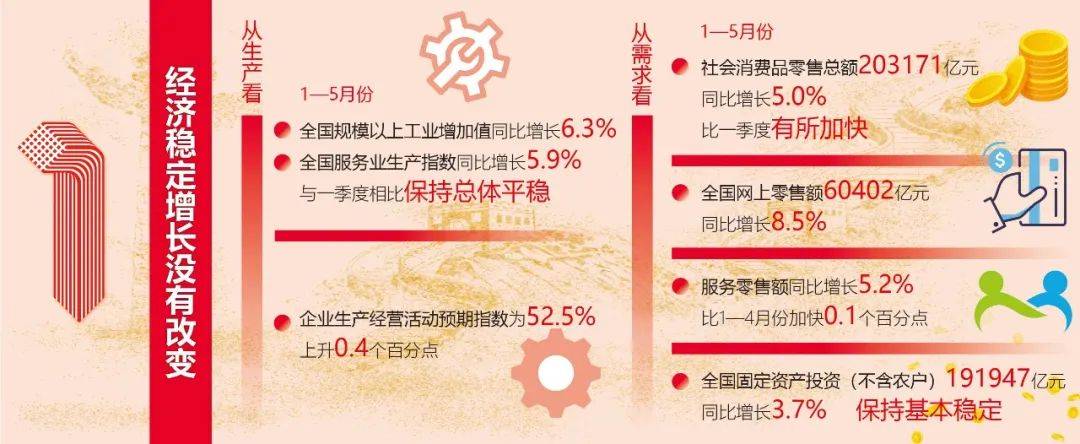
智库·数据丨五个“没有改变”有力支撑经济平稳运行
Sou Hu Cai Jing· 2025-06-19 02:19
Core Viewpoint - China's economy has shown resilience and stable growth in the first five months of the year despite external challenges, with a strong foundation and positive development trends remaining intact [1][4]. Economic Performance - In the first five months, the industrial added value above designated size increased by 6.3% year-on-year, and the service production index rose by 5.9% [4]. - The expected business activity index for enterprises increased by 0.4 percentage points in May, indicating sustained market confidence [4]. Demand Side Performance - The total retail sales of consumer goods grew by 5.0% year-on-year, with online retail sales leading the market at an 8.5% growth rate [5]. - Fixed asset investment increased by 3.7% year-on-year, providing solid support for stable economic operation [5]. Innovation and Technology - High-tech manufacturing and digital product manufacturing achieved growth rates of 9.5% and 9.9%, respectively, significantly outpacing overall industrial growth [5]. - The production of industrial robots surged by 32%, and the value added of smart vehicle equipment manufacturing grew by 26.8% [5]. Green Transition - The production of new energy vehicles increased by 40.8%, and solar cell production rose by 18.3% in the first five months [5]. - Clean energy generation experienced double-digit growth, reflecting a positive trend in the green industry [5]. Foreign Trade and Investment - Private enterprises' imports and exports grew by 7%, with export growth reaching 8% [6]. - Exports of electromechanical products increased by 9.3%, and integrated circuit exports rose by 18.9% [6]. Employment and Social Welfare - The urban surveyed unemployment rate dropped to 5.0% in May, with social security and education expenditures growing faster than overall fiscal spending [6]. - These improvements in social welfare are expected to enhance domestic demand and support innovation-driven development [6]. Overall Economic Characteristics - China's economy is characterized by stable growth, innovation and green transformation, upgraded openness, and improved livelihoods, all contributing to high-quality development [6].
5月宏观数据喜忧参半:消费等数据持续改善,仍需警惕出口扰动、透支效应等问题
Hua Xia Shi Bao· 2025-06-17 13:48
Economic Overview - In May, the overall economic operation showed a stable and progressive development trend, with key indicators such as industrial added value, service production index, and retail sales of consumer goods maintaining stable growth [2][3] - The urban surveyed unemployment rate in May was 5%, a decrease of 0.1 percentage points from the previous month [2] - The Consumer Price Index (CPI) saw a slight year-on-year decline, influenced by international factors and a drop in some food prices, while the core CPI excluding food and energy showed an expanded increase [2] Industrial Performance - The industrial added value for enterprises above designated size grew by 5.8% year-on-year in May, despite a 0.3 percentage point decrease from the previous value, indicating robust growth [3] - The equipment manufacturing sector's added value increased by 9%, contributing 54.3% to industrial production, while high-tech manufacturing added value rose by 8.6% [3] - The production of new energy vehicles and solar batteries grew by 31.7% and 27.8%, respectively, indicating sustained high growth in these sectors [3] Trade Dynamics - In May, China's total goods import and export value increased by 2.7% year-on-year, with exports growing by 6.3% [5] - Exports to the US declined, while trade with ASEAN and Belt and Road countries continued to grow, highlighting the resilience of China's economic scale and industrial system [5] - The export of electromechanical products increased by 9.3%, accounting for 60% of total exports, while labor-intensive product exports slowed down [5] Consumer Market - Retail sales of consumer goods in May grew by 6.4% year-on-year, accelerating by 1.3 percentage points from the previous month, driven by policies promoting consumption [6] - The investment in equipment and tools saw a growth of 17.3% in the first five months, contributing 63.6% to overall investment growth [6] - The "old-for-new" consumption policy significantly boosted sales in related sectors, although some regions showed signs of consumption overextension [6] Investment Trends - Real estate investment continued to drag down the economy, with a year-on-year decline of 10.7% in the first five months [7] - Fixed asset investment (excluding rural households) grew by 3.7%, below market expectations, with infrastructure investment remaining strong due to accelerated issuance of special bonds [7][8] - Manufacturing investment maintained a high growth rate of 8.5%, supported by favorable policies and better-than-expected export conditions [7][8] Government Policy and Support - By the end of May, the issuance of new local government special bonds exceeded 1.6 trillion yuan, significantly higher than the same period last year, reaching 37% of the government work report target [8] - The macroeconomic operation is in a gradual recovery phase, with investment acting as a counter-cyclical variable to support the economy, particularly in broad infrastructure investment [8]