
工业母机

Search documents
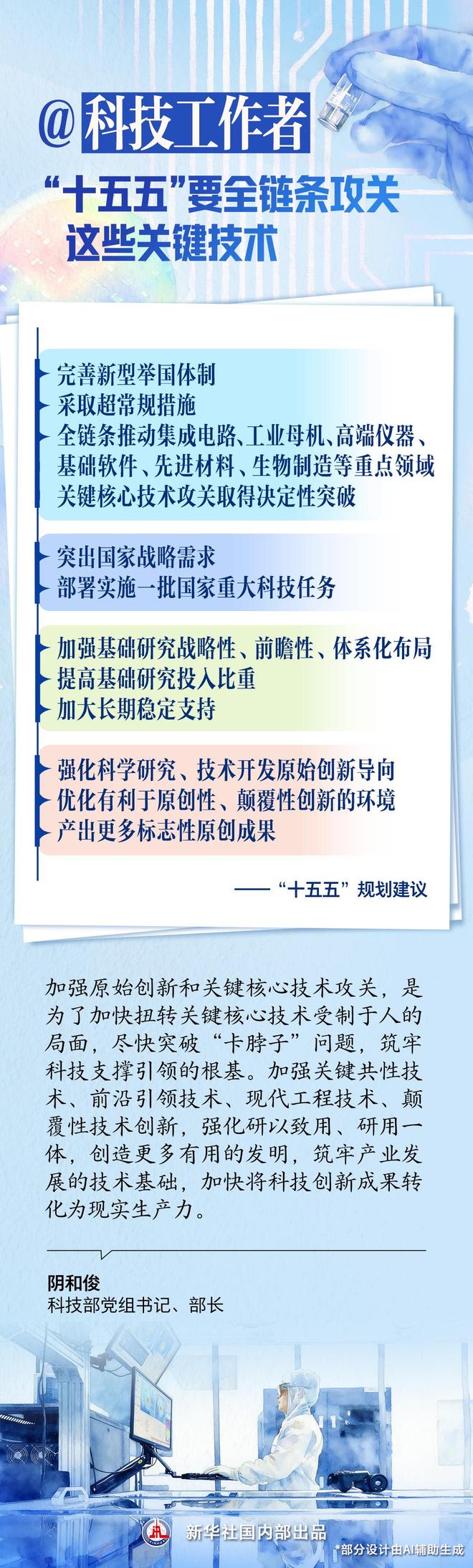
@科技工作者,“十五五”要全链条攻关这些关键技术
Xin Hua She· 2025-12-24 09:48
Group 1 - The article emphasizes the importance of strengthening original innovation and key core technology breakthroughs to address the issue of dependency on external technologies and to overcome critical bottlenecks in various sectors [2][1] - It highlights the need for a comprehensive approach to promote integrated circuits, industrial mother machines, high-end instruments, foundational software, advanced materials, and biomanufacturing as key focus areas for technological advancement [1] - The article outlines the strategic deployment of national major scientific tasks to enhance foundational research and increase investment in this area, aiming for a more systematic and forward-looking layout [1][2] Group 2 - The "14th Five-Year Plan" suggests optimizing the environment for original and disruptive innovation to produce more landmark original achievements [2] - It stresses the importance of transforming scientific and technological innovations into practical productivity, thereby solidifying the technological foundation for industrial development [2] - The article calls for a long-term and stable support system for foundational research to ensure sustained progress in key technological areas [1][2]

加计抵减 VS 加计扣除
蓝色柳林财税室· 2025-12-24 08:43
Summary of Key Points Core Viewpoint The article discusses the tax reduction policies related to value-added tax (VAT) and corporate income tax in China, specifically focusing on the preferential treatment for advanced manufacturing, industrial mother machines, and integrated circuit industries. Group 1: VAT Deduction Policies - Advanced manufacturing enterprises are allowed to deduct 5% of the current deductible input tax from their VAT payable [3] - Industrial mother machine enterprises can deduct 15% of the current deductible input tax from their VAT payable [4] - Integrated circuit design, production, packaging, testing, equipment, and materials enterprises can also deduct 15% of the current deductible input tax from their VAT payable [4] Group 2: Corporate Income Tax Deduction Policies - From January 1, 2023, R&D expenses that do not form intangible assets can be deducted at 100% in addition to the actual expenses incurred [5] - For R&D expenses that form intangible assets, the cost can be amortized at 200% for tax purposes [5] - The deduction rate for R&D expenses for integrated circuit and industrial mother machine enterprises has been increased to 120% [5][6] - Basic research expenditures can be deducted at 100% for tax purposes [6] - Wages paid to disabled employees can be deducted at 100% in addition to the actual wages paid [8]

启新程 勇争先
Xin Lang Cai Jing· 2025-12-23 23:14
Group 1 - The article highlights the significant advancements in various industries in Liaoning, including the successful delivery of world-class high-end industrial mother machines in Shenyang, which marks a major technological breakthrough and addresses the issue of "disconnection between research and application" [3] - In Dalian, the synthesis efficiency of high-value compounds, specifically香紫苏醇, has been enhanced through precision modifications by the Dalian Institute of Chemical Physics, promoting large-scale and green production [3] - The Huajin Amoco project in Panjin, covering an area of 13,500 acres, is nearing completion with over 91% progress, contributing to Liaoning's goal of establishing a trillion-level petrochemical and fine chemical industry base [3] Group 2 - The article discusses the ongoing efforts and determination across Liaoning to achieve comprehensive revitalization, as depicted in various scenes of progress and development throughout the province [4] - The provincial economic work meeting held on December 22 outlined a series of practical arrangements for the upcoming "14th Five-Year Plan," emphasizing the need for a grounded approach to harness the province's potential and resilience [4] - The article stresses the importance of maintaining a proactive and determined mindset to overcome challenges in high-quality development, with local governments actively seeking projects and accelerating economic progress [5]
太仓加速推进工业母机探索实践
Su Zhou Ri Bao· 2025-12-23 22:19
Core Insights - The 2025 Industrial Mother Machine Technology Investment Conference was held in Taicang, establishing a bridge between technological innovation and market application, and creating an efficient platform for policymakers, innovators, capital holders, and application pioneers [1] - The Taicang industrial mother machine industry cluster is rapidly growing, with significant contributions from local enterprises and technological breakthroughs [1][5] Group 1: Industry Development - Taicang is home to 65 key enterprises in the industrial mother machine sector, with a projected output value of 13.96 billion yuan in 2024, reflecting a year-on-year growth of 5.1% [5] - The region has a comprehensive ecosystem with 43 upstream component enterprises and 22 midstream machine enterprises, covering various critical areas such as core materials and metal processing [5] - The industrial mother machine industry is considered the "heart of industry," essential for the manufacturing of key components in smartphones, automobiles, and aircraft [4] Group 2: Local Enterprise Success - Taicang Ruiding Precision Machinery Technology Co., Ltd. has experienced a growth rate of 40% to 50% annually since its establishment in 2012, recently completing a Series B financing round [2] - The company is recognized as a high-tech enterprise and has received multiple honors, contributing to the overall growth of the Taicang industrial mother machine cluster [2][3] Group 3: International Collaboration - Taicang has attracted over 560 German enterprises, accounting for more than 10% of the national manufacturing sector, providing a unique advantage for the local industrial mother machine industry [7] - Leading German companies like Trumpf and DMG Mori have established deep R&D collaborations in Taicang, enhancing local innovation capabilities [8][9] Group 4: Future Prospects - The Taicang Advanced Manufacturing Fund and the CICC Schaeffler (Suzhou) Industrial Investment Fund were launched to support local enterprise incubation and growth, ensuring continuous financial support for the industrial mother machine sector [10] - Taicang is developing a dual-system vocational education model in collaboration with German enterprises to cultivate skilled talent for the industry [11] - The region aims to become a key player in the high-end equipment manufacturing industry, with a focus on integrating advanced materials and aerospace sectors [6][13]
登高稳行:成长乘势聚力,价值重构红利
Sou Hu Cai Jing· 2025-12-23 04:17
Group 1 - The core focus of China's economic policy in 2026 will shift towards technological self-reliance and new productivity paradigms, moving away from the traditional real estate and investment-driven growth model [1] - The report emphasizes the importance of integrating resources through a new type of national system, focusing on key technologies such as integrated circuits, industrial mother machines, and high-end instruments, while also planning for future industries like quantum technology and sixth-generation mobile communications [1] - The structural transformation aims to enhance the security of the industrial chain and create a high-quality supply system, fostering a virtuous cycle among technology, industry, and finance to inject long-term growth momentum into the capital market [1] Group 2 - The logic of stimulating domestic demand is undergoing a profound shift, transitioning from physical consumption driven by subsidies for appliances and automobiles to service consumption as the new engine [1] - China's service consumption currently accounts for less than 50%, significantly lower than the nearly 70% in the United States, indicating substantial room for improvement [1] - The aging population is driving the "silver economy," while younger generations prefer experiences and spiritual satisfaction, further reinforcing the structural upward trend in service consumption, supported by intensive policy initiatives [1] Group 3 - The global liquidity environment is expected to improve significantly in 2026, with the Federal Reserve potentially initiating an unexpected rate-cutting cycle due to increasing fiscal pressures and political cycles [2] - The weakening of the US dollar will create favorable conditions for global risk assets, particularly emerging market equities, benefiting both A-shares and Hong Kong stocks [2] - Domestic policies focusing on technology and consumption will provide valuation support, potentially leading to a market value reconstruction trend, with quality growth and high-dividend leaders showing investment value [2]

科技成长攻守兼备,看好机械中盘蓝筹投资机会
2025-12-22 15:47
Summary of Conference Call Records Industry Overview - The mechanical industry is expected to see stable growth in 2026, driven by technology empowerment and policy support, particularly in the mid-cap blue-chip and robotics sectors [2][3] - The implementation of anti-involution policies is improving cash flow and profitability across the industry, especially in general equipment and engineering machinery [1][2] Key Points on Specific Sectors Mid-Cap Blue-Chip - Mid-cap blue-chip companies are anticipated to perform well due to improved growth and profitability in the mechanical sector, alongside reduced market risks from recovering downstream demand [3][4] - The forklift market is expected to benefit from urbanization and an aging population, leading to increased demand for machinery to replace human labor [3][10] Lithium Battery Equipment - Revenue growth for lithium battery equipment is improving quarterly, with new orders increasing significantly, showing a 70%-80% growth in backlog orders compared to last year [6] - The push for solid-state battery production by 2027 indicates strong future demand for equipment [6] Industrial Mother Machines - Industrial mother machines are expected to see stable production and revenue growth, with potential improvements in margins due to increased sales of large machines [7][8] - The domestic market shows significant potential for replacing imported high-end machines, indicating a shift towards higher-end development [8] Oil and Gas Equipment - Demand for oil and gas equipment is projected to improve in 2026, driven by increased capital expenditure in China and the U.S. government's push for oil and gas development [9] - The demand for natural gas from data centers is expected to expand the business opportunities for oil and gas equipment companies [9] Forklift Equipment - The forklift market has shown resilience, with strong growth in both domestic sales and exports, expected to continue into 2026 [10] - The introduction of new products like unmanned forklifts is anticipated to provide additional growth points [10][11] Engineering Machinery - The engineering machinery sector is showing signs of growth, particularly in the domestic market, with expectations for sustained demand starting in 2026 [13][14] - The trend towards electrification and automation is expected to increase average selling prices and profit margins [14] Coal Machinery - The coal machinery sector is expected to see a narrowing of declines in 2026, supported by policy initiatives and a peak in equipment replacement cycles [15] - The development of smart coal machinery and unmanned mining technologies is anticipated to accelerate growth in this sector [15] Light Industry Equipment - The light industry equipment sector, including textiles and accommodation, is expected to experience a slight slowdown in growth due to weakening consumer demand in Europe and the U.S. [16] - AI integration in equipment, such as sewing machines and injection molding machines, is identified as a key growth area [16] Robotics - The robotics sector is characterized by certainty in production opportunities, with significant developments expected from companies like Tesla and others with high barriers to entry [17] - Companies with clear business models and cash flow are seen as having substantial investment potential in the robotics field [17] Conclusion - The mechanical industry is poised for growth in 2026, with various sectors showing potential for investment opportunities driven by technological advancements and supportive policies. The focus on mid-cap blue-chip companies, lithium battery equipment, and robotics highlights the evolving landscape of the industry.
顶压前行 向新向优——2025年辽宁经济发展回眸
Liao Ning Ri Bao· 2025-12-22 14:12
北国冬日,霜雪压枝。辽山辽水间,仍激荡着破冰突围的新气象、积厚成势的新希望。 黑土地上,辽宁农业生产再显担当。今年辽宁省粮食总产量达515.56亿斤,为历史第一高产年,产量位 居全国第十二位,同比增长3.1%,增幅居粮食主产省第一位。 生产线上,辽宁开启全新探索。不久前,世界级高端工业母机在通用技术沈阳机床下线交付。此次合作 不仅取得重大技术突破,还探索开创了"场景牵引、联合研发、风险共担、利益共享"的国产工业母机协 同创新范式。 碧海潮头,辽宁敢于顶风搏浪。眼下,大连金州湾国际机场的填海工程主体已完工,总计形成陆域面积 约20平方公里。这一工程努力攻克"海上筑岛"的多项建设难题,填补了我国离岸式人工岛机场建设的技 术空白。 在全省各地,无数个拼搏的"我"集合成实干的"我们",披荆斩棘、奋楫争先。这一年,面对纷繁复杂的 形势、交织叠加的挑战,全省上下顶住压力、迎难而上,统筹推进稳增长、促改革、惠民生、防风险, 全省经济运行基本平稳,发展韧性持续提升,改革开放深化拓展,民生福祉不断改善,社会大局保持稳 定,各项工作取得新进展新成效。 辽宁即将步入"十五五",回望间,山水千万程,风雨未停歇。再出发,胸怀凌云志,步 ...

顶压前行 向新向优
Liao Ning Ri Bao· 2025-12-22 01:07
Core Insights - Liaoning Province has achieved a record grain production of 51.556 billion jin, ranking 12th nationally, with a year-on-year increase of 3.1%, the highest growth among major grain-producing provinces [1] - The province is exploring new industrial paradigms, exemplified by the delivery of a world-class high-end industrial mother machine, marking a significant technological breakthrough [1] - Dalian Jinzhou Bay International Airport's reclamation project has been completed, addressing multiple construction challenges and filling a technical gap in offshore artificial island airport construction [1] Economic Resilience - The province's economic operation remains stable, with a focus on steady growth, reform promotion, and risk prevention, leading to improved development resilience and social stability [1][4] - The retail sales of consumer goods reached 956.5 billion yuan, with a year-on-year growth of 2.3%, indicating consumption as a stabilizing force for the economy [3] - High-tech manufacturing value added increased by 3.3%, contributing to the overall industrial value added growth of 1.1% [6] Industrial Transformation - Liaoning's industrial transformation is evident in the establishment of a fully automated digital glass production line, reducing labor costs by 80% while doubling production efficiency [6] - The province is actively promoting intelligent, green, and integrated development in various industrial sectors, enhancing production efficiency and supply chain collaboration [6][7] Major Projects - The Huajin Amoco fine chemical and raw material project in Panjin is nearing completion, with over 91% progress, aimed at establishing a world-class green intelligent petrochemical industry base [7] - High-quality projects across strategic emerging industries, livelihood security, and ecological protection are being actively developed, with high-tech manufacturing investment increasing by 14.1% [7] Innovation and Technology - Liaoning is focusing on developing new quality productivity, with significant advancements in robotics, aerospace equipment, and green petrochemicals, positioning itself for high-quality development [8] - The launch of the NeuViz P10 photon counting CT by Neusoft Medical marks a significant innovation, reducing radiation exposure and enhancing imaging clarity [9] - The establishment of a comprehensive low-altitude economy industry chain in Shenyang is fostering the development of cargo drones, showcasing the province's competitive edge in this emerging sector [11] Reform and Open Economy - The province is enhancing its business environment through initiatives like the "Little Tang Team," which provides comprehensive support for enterprises, streamlining processes and improving service efficiency [15][16] - Liaoning is deepening its integration into the Belt and Road Initiative, with significant progress in its free trade zone and international logistics networks, enhancing its global trade connectivity [18]
顶压前行 向新向优——二〇二五年辽宁经济发展回眸
Xin Lang Cai Jing· 2025-12-21 22:47
Core Insights - Liaoning Province has achieved a record grain production of 51.556 billion jin, marking a 3.1% year-on-year increase, ranking 12th nationally and leading the main grain-producing provinces in growth rate [1] - The province is exploring new industrial paradigms, including a collaborative innovation model for domestic industrial mother machines, which emphasizes joint research and shared risks and benefits [1] - Major infrastructure projects, such as the completion of the main fill for Dalian Jinzhou Bay International Airport, are addressing technical challenges in offshore artificial island airport construction [1] Economic Performance - The overall economic operation in Liaoning remains stable, with a focus on growth, reform, and improving people's livelihoods, despite facing complex challenges [1] - Social retail sales in the province reached 956.5 billion yuan, a 2.3% increase year-on-year, with significant growth in sales of wearable smart devices (up 16.3 times) and energy-efficient home appliances (up 1.1 times) [3][6] - Industrial value added in the province increased by 1.1% year-on-year, with high-tech manufacturing growing by 3.3% [6] Industrial Transformation - Liaoning is advancing industrial transformation through digitalization, exemplified by the establishment of a fully automated digital glass production line that reduced labor costs by 80% while doubling production efficiency [5][6] - The province is focusing on smart, green, and integrated development, with significant investments in high-tech manufacturing, which saw a 14.1% increase in investment year-on-year [7] Innovation and Technology - Liaoning is fostering innovation through the establishment of high-energy scientific and technological platforms, such as the new materials pilot base, which has successfully developed high-performance alloy steel [12] - The province is also nurturing a growing number of technology-based small and medium-sized enterprises, with over 7,100 "unicorn" and "gazelle" companies established [12] Reform and Open Economy - The province is enhancing its business environment through reforms that streamline processes and improve service delivery for enterprises, exemplified by the establishment of dedicated support teams [15][16] - Liaoning is actively integrating into the global trade network, with significant developments in its free trade zone and international logistics, enhancing its role as a key gateway for Northeast Asia [17]
制造业创新迈向系统性跃迁
Xin Lang Cai Jing· 2025-12-21 22:46
Core Insights - The sales revenue of China's high-tech manufacturing industry increased by 11.1% from January to November this year, with integrated circuits and industrial mother machines growing by 19.3% and 11% respectively [1][2] - Traditional industry key tax source enterprises increased R&D investment by 12.3% year-on-year, indicating a surge in innovation vitality within the manufacturing sector [1] Group 1: Manufacturing Innovation Trends - China's manufacturing innovation is transitioning from fragmented breakthroughs to systematic leaps, focusing on deep restructuring across the entire production chain, innovation elements, and development cycles [1] - The competition in manufacturing must be systemic, with a focus on technology integration, resource allocation, and scenario innovation to gain an advantage in the new technological revolution and industrial transformation [1] Group 2: Technological and Scenario Integration - The integration of technology is deepening, with digital technology becoming a core element embedded in manufacturing processes, driving transformation and upgrades [2] - Manufacturing innovation is extending beyond workshops to encompass R&D design, supply chain management, and after-market services, enhancing industry resilience and giving rise to new business models like shared manufacturing and customized services [2] Group 3: Policy and Ecosystem Support - To foster a better innovation ecosystem, there is a need to strengthen digital support and address challenges such as data silos and inconsistent standards [2] - Policies should be enhanced to encourage participation in deep innovation areas like core algorithms and high-end equipment, while also promoting collaboration between academia and industry to expedite the transition of laboratory results to production lines [2]