AI科技浪潮

Search documents
1-2月贸易数据点评:出口保持强韧性,进口同比增速上行
Tai Ping Yang Zheng Quan· 2026-03-13 14:40
Export Performance - In January-February 2026, China's export value reached $656.58 billion, a year-on-year increase of 21.8%[3] - In February 2026, exports amounted to $299.88 billion, showing a significant year-on-year growth of 39.6%[4] - The export growth was supported by a low base effect from the previous year and a recovery in global manufacturing PMI, which remained above the threshold at 50.9% and 51.9%[4] Regional Export Trends - Exports to the EU increased by 27.8%, up 19.4 percentage points from the previous month, driven by the recovery in EU manufacturing[4] - Exports to Africa saw a remarkable growth of 49.9%, while exports to ASEAN and Japan grew by 29.4% and 8.9%, respectively[4] - Exports to the US decreased by 11.0%, although the decline was less severe compared to a 20.0% drop in December 2025[4] Import Performance - In January-February 2026, China's import value totaled $442.96 billion, with a year-on-year growth of 19.8%[5] - February imports were $208.90 billion, reflecting a 13.8% increase compared to the same month last year[5] - The increase in imports was primarily due to recovering domestic demand and higher imports of intermediate goods related to rising exports[5] Regional Import Trends - Imports from the EU rose by 11.7%, while imports from South Korea surged by 35.8%[5] - Imports from Japan increased by 26.5%, whereas imports from the US fell by 26.7%, marking a significant widening of the decline compared to December 2025[5] Product-Specific Insights - Imports of electromechanical products and high-tech products grew by 24.0% and 27.7%, respectively, contributing significantly to overall import growth[5] - Agricultural products saw a year-on-year growth of 9.7%, with edible vegetable oil surging by 52.4%[5] - Integrated circuit imports increased by 39.8%, reflecting the impact of the AI technology wave on demand[5] Risk Factors - Potential risks include policy uncertainties, unexpected changes in macroeconomic fundamentals, and geopolitical risks overseas[6]
重拾大笔买入!南向资金净买额超108亿,机构:港股科技作为共识性品种,或可“调整再上车”
Ge Long Hui· 2026-02-06 06:48
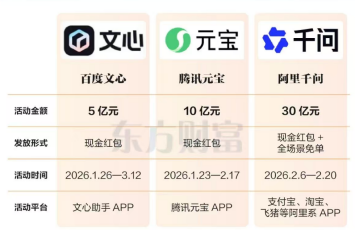
Market Overview - The Hong Kong stock market experienced fluctuations on February 6, with the Hang Seng Tech Index initially dropping about 2% before recovering slightly [1] - Southbound capital saw a significant increase, with net purchases exceeding 10.8 billion HKD, compared to a previous average of less than 1 billion HKD over the past ten days [1] Company Performance - Major tech companies like Li Auto, SMIC, and Xiaomi saw gains, while Alibaba and Tencent experienced declines of 2.4% and 1.16% respectively [1] - North American tech giants, including Google, Microsoft, and Amazon, reported strong Q4 2025 earnings, but increased capital expenditures for AI in 2026 raised concerns among investors [2] AI Investment and Competition - Chinese internet giants are heavily investing in AI applications, with Tencent, Alibaba, and Baidu announcing substantial cash giveaways to enhance user engagement and compete for market share [2][3] - The competition for AI traffic entry points is viewed as a strategic battle among major players, focusing on user habits and ecosystem integration [2] Valuation and Market Sentiment - The Hang Seng Tech Index has a current P/E ratio of 23.93, which is below the five-year average of 33.79%, indicating potential value for investors [4] - Analysts suggest that the current market environment may present good investment opportunities, particularly in sectors like materials, overseas computing power, and semiconductors [4] Macro and Micro Economic Factors - The appreciation of the RMB and strong trends in the tech industry are seen as key drivers for market growth, supported by favorable external and internal conditions [5] - The Hang Seng Tech Index includes a diverse range of companies, with a focus on both large-cap and small-cap tech firms, providing a broader investment scope [5][6]

中金深度:“沃什冲击”如何改变全球市场?
Xin Lang Cai Jing· 2026-02-05 23:45
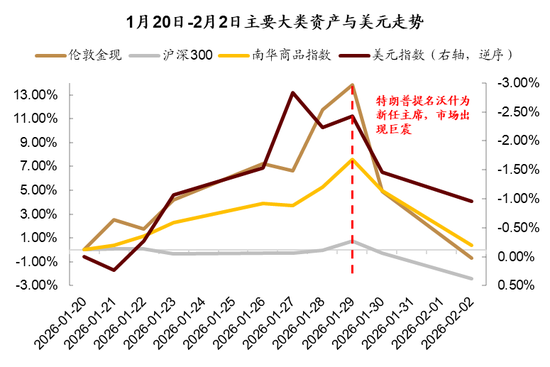
Group 1 - The Federal Reserve is unlikely to initiate "balance sheet reduction" in the short term, but the threshold for continued "balance sheet expansion" and QE has significantly increased [1][5][63] - If the Federal Reserve is unwilling to support fiscal easing through "balance sheet expansion," a new temporary monetary-fiscal coordination method may involve increasing the rate of interest cuts and the issuance of short-term bonds by the Treasury [1][10][69] - The potential for the Federal Reserve to cut interest rates may exceed market expectations, leading to a return of dollar easing trades in the short term [1][59][88] Group 2 - The nomination of Waller as the next Federal Reserve Chair has caused significant global asset volatility, with gold and silver prices dropping by 20% and 40% respectively, and a broad sell-off in stocks and commodities [2][60] - The past year has seen AI technology and dollar liquidity as the two main themes in global markets, with a restructuring of monetary order leading to a depreciation of the dollar [4][62] - If Waller successfully reduces the Federal Reserve's balance sheet, it could partially restore the dollar's credibility and delay the "de-dollarization" process, impacting global market trends [4][62] Group 3 - The "rate cut + balance sheet reduction" policy combination proposed by Waller is seen as contradictory, as balance sheet reduction is a tightening measure that conflicts with the current administration's goals of economic growth and reduced debt costs [5][63] - Market constraints indicate that balance sheet reduction would withdraw liquidity from the financial system, potentially leading to financial risks due to insufficient bank reserves [6][66] - Historical precedents show that previous balance sheet reductions have led to liquidity crises in the money market, suggesting that current financial conditions do not support Waller's proposed balance sheet reduction [8][66] Group 4 - The Federal Reserve's short-term policy focus may lean towards interest rate cuts rather than balance sheet reduction, with a dovish stance expected rather than a hawkish one [11][71] - Waller's potential policy priorities may include relaxing financial regulations to facilitate future balance sheet reductions, which could also help restore liquidity in the Treasury market [12][72] - The current financial regulatory framework constrains banks' balance sheet usage, and relaxing these regulations could improve efficiency and lower market-making costs [12][72] Group 5 - The U.S. banking sector may benefit from the "Waller shock," as continued interest rate cuts without QE or balance sheet expansion could steepen the yield curve, improving bank profitability [25][84] - The potential for a temporary economic overheating in the U.S. could support the banking sector, as traditional cyclical stocks may gain traction [28][87] - The dollar may experience a temporary strengthening, but the long-term trend of "de-dollarization" remains uncertain, influenced by the broader economic policies under Waller's leadership [29][39]
智能汽车ETF(159889)回调超3%显布局机会,把握汽车产业升级机遇
Mei Ri Jing Ji Xin Wen· 2026-02-02 08:17
Core Viewpoint - The smart automotive ETF (159889) has experienced a pullback of over 3%, presenting an opportunity to capitalize on the automotive industry's upgrade driven by AI technology [1] Group 1: Industry Outlook - The automotive industry is expected to undergo significant upgrades due to the current wave of technological advancements represented by AI [1] - By 2026, advancements in high-level assisted driving and robotics are anticipated to open new valuation anchors for the automotive sector, leading to a potential valuation reconstruction [1] - The robotics sector is moving towards large-scale production, indicating a shift in investment opportunities from a dispersed to a concentrated approach [1] Group 2: Sector Analysis - The components sector is accelerating its global capacity layout and expanding its second growth curve [1] - The two-wheeler sector continues to trend towards international markets, with substantial growth potential overseas [1] Group 3: ETF and Index Information - The smart automotive ETF (159889) tracks the CS Smart Automotive Index (930721), which selects listed companies involved in smart automotive hardware and software, as well as vehicle manufacturers [1] - The index emphasizes the comprehensiveness and growth potential of the smart automotive industry chain, covering terminal perception and platform application sectors [1]
滨江集团20260119
2026-01-20 01:50
Summary of the Conference Call for Binjiang Group Industry Overview - The real estate market in 2026 is expected to transition from an incremental market to a stock market, with significant differences in the pace of fundamental recovery across cities. Key influencing factors include supply-demand relationships and income levels. Simple comparisons of rental yields and mortgage rates are insufficient to accurately assess housing price recovery, as actual mortgage rates and buyer income inflation must also be considered [2][4][5]. Key Insights on Binjiang Group - Binjiang Group has a strong presence in Hangzhou, leading in land auctions in 2025. The company has a clean inventory, and the net profit margin of sold but unsettled value has improved. It is expected that the settlement profit margin will gradually increase from 2025 to 2026, benefiting from the recovery of Hangzhou's fundamentals, which may enhance the company's profitability [2][7]. - The technology sector is driving wealth growth, which is reflected in asset prices. Hangzhou, due to the AI technology wave, is attracting talent and supporting housing prices in the Binjiang area. High-tech industrial clusters are more likely to show signs of housing price stabilization, making it essential to monitor the development dynamics in these regions [2][8]. - Binjiang Group demonstrates strong resilience during the current real estate cycle's bottoming and recovery phase. The company has relatively clean land reserves and low impairment pressure, indicating a high likelihood of benefiting from industry recovery with minimal downside risk in profit settlements. The current valuation of approximately 1x PB is deemed reasonable, reflecting its land reserve situation and impairment pressure [2][9][10]. Financial Metrics and Valuation - Binjiang Group's land reserve quality is high, with low impairment risk and fast sales turnover. The internal rate of return (IRR) on projects is expected to exceed the cost of capital, resulting in a good return on capital. Therefore, a 1x PB valuation is justified, with historical valuations reaching 1.2-1.3x PB in the past two years [4][10]. - The company is projected to have an absolute return potential of 20%-30% in 2025, corresponding to a 1.2-1.3x PB valuation. The high sales absorption rate, particularly for non-price-restricted projects, is expected to reach 80%-90%, with project IRR anticipated at 10%-12%. If housing prices in Hangzhou stabilize, the valuation could exceed 1.2x PB [4][11]. Future Outlook - Market awareness of Binjiang Group is currently low, but as Hangzhou's fundamentals gradually recover, the company's stock price is expected to reflect this in the latter half of the year. Particularly towards the end of the year, with improved sales performance, the path for valuation recovery will become clearer. Therefore, Binjiang Group is considered a significant investment target and is recommended as a key stock for 2026 [2][12].

汇添富基金邵佳民:2026年固定收益投资,心动还是幡动
Sou Hu Cai Jing· 2026-01-13 09:18
Group 1 - The year 2025 is marked by significant geopolitical changes and economic developments, with China demonstrating strong national power amidst tariff frictions, the Shanghai Composite Index surpassing 4000 points, and the renminbi appreciating significantly [1] - Wealth disparity is evident globally, with high housing prices becoming a common feature in major cities, and the AI and semiconductor industries thriving compared to traditional sectors [1] - The ongoing geopolitical tensions, such as the Russia-Ukraine conflict, have led to increased military spending in the EU and a focus on manufacturing revival in the US [2] Group 2 - The renminbi is showing resilience and is positively evaluated based on government stability, policy continuity, fiscal sustainability, and trade surplus, which enhances its attractiveness for internationalization [2] - Global liquidity is on the rise despite wealth and cognitive disparities, with traditional credit demand declining due to varying industry performances [2] - The adjustment of long-term bonds in 2025 reflects concerns over potential mild inflation and the need for sufficient liquidity compensation in a secure investment environment [3] Group 3 - The public fund industry in 2025 is undergoing profound changes, emphasizing investor returns and a return to performance benchmarks [3] - Fixed income investments are expected to remain attractive in a stable renminbi environment, despite the changing risk preferences of investors [3] - The bond market in 2026 is anticipated to experience wide fluctuations influenced more by expectations and investor behavior than by fundamental conditions [3]
成交额超1.8亿元!科创100ETF华夏(588800)冲击6连涨
Xin Lang Cai Jing· 2025-12-26 03:15
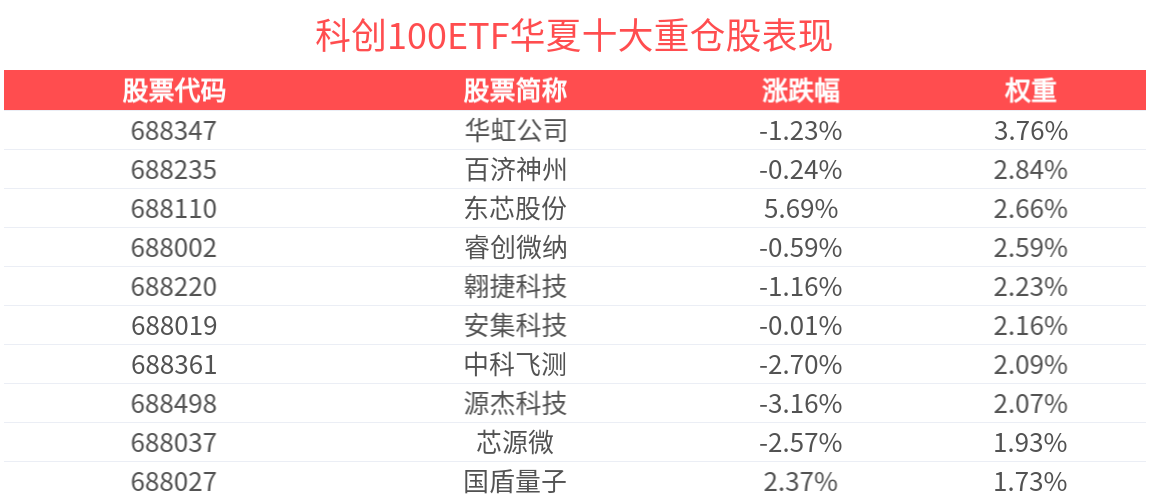
Core Viewpoint - The Shanghai Stock Exchange Sci-Tech Innovation Board 100 Index has shown positive performance, with significant gains in several constituent stocks, indicating a favorable market environment for technology-focused investments [1][2]. Group 1: Index Performance - As of December 26, 2025, the Sci-Tech Innovation Board 100 Index increased by 0.65%, with notable gains from stocks such as Fushen Eagle (up 12.34%) and Rongbai Technology (up 8.32%) [1]. - The Huaxia Sci-Tech 100 ETF (588800) rose by 0.59%, marking its sixth consecutive increase, with a latest price of 1.36 yuan [1]. - Over the past week, the Huaxia Sci-Tech 100 ETF has accumulated a rise of 5.65% [1]. Group 2: Liquidity and Fund Flow - The Huaxia Sci-Tech 100 ETF recorded a turnover rate of 6.87% during the trading session, with a transaction volume of 181 million yuan, leading its peers [1]. - The average daily trading volume for the Huaxia Sci-Tech 100 ETF over the past month was 291 million yuan [1]. - The latest scale of the Huaxia Sci-Tech 100 ETF reached 2.623 billion yuan, with a financing buy-in amount of 8.6512 million yuan and a financing balance of 41.5552 million yuan [2]. Group 3: Market Outlook - According to a report from China International Capital Corporation (CICC), Chinese stocks continue to benefit from the AI technology wave and ample liquidity, with reasonable valuations and no signs of a market peak [2]. - The report maintains a positive outlook on the revaluation of Chinese assets, recommending an overweight position in Chinese stocks [2]. - The market style is expected to remain growth-oriented in the short term due to moderate growth policies, with a potential shift to cyclical and value styles awaiting clearer economic or policy signals [2]. Group 4: Top Constituents - As of November 28, 2025, the top ten weighted stocks in the Sci-Tech Innovation Board 100 Index accounted for 26.72% of the index, including Huahong Semiconductor and East China Semiconductor [3]. - The performance of the top ten stocks varied, with some experiencing declines, such as Huahong Company (down 1.23%) and Baijie Shenzhou (down 0.24%) [4].
中金:坚定看好中国资产重估,维持超配中国股票
Xin Lang Cai Jing· 2025-12-26 00:55
Core Viewpoint - The report from CICC suggests that Chinese stocks continue to benefit from the AI technology wave and ample liquidity, with current valuations being reasonable and no signals indicating a market peak, thus maintaining an overweight position on Chinese stocks [1] Group 1: Market Outlook - The Chinese market is expected to see asset revaluation, supported by favorable conditions [1] - The current market style is likely to remain focused on technology growth in the short term due to moderate growth policies [1] Group 2: Investment Strategy - A shift towards cyclical and value styles is anticipated but will require clearer economic or policy signals [1]
中金:美国政策与经济尚未出现拐点 黄金牛市或持续 维持超配黄金
智通财经网· 2025-12-26 00:09
Group 1: Gold Price Surge - Recent gold prices have surpassed $4500 per ounce, reaching a historical high due to three main factors: the Federal Reserve's resumption of a loose monetary policy, declining confidence in the US dollar, and escalating global geopolitical risks [1][2] - The Federal Reserve has restarted interest rate cuts after maintaining rates for nine months, with three consecutive cuts of 25 basis points each, and plans to purchase short-term government bonds starting in December [2] - The US fiscal deficit has risen to around 6% post-pandemic, significantly higher than pre-pandemic levels, leading to increased debt risks and a decline in the dollar's value, which has dropped approximately 10% this year [2] Group 2: Geopolitical Risks and Silver Market - Global geopolitical tensions have increased, benefiting gold as a safe-haven asset, while silver has seen even larger price increases due to industrial demand factors [3] - The demand for silver is expected to rise in sectors such as photovoltaics, electric vehicles, and electronics, while supply expansion remains limited, tightening the supply-demand balance [3] Group 3: Future of Gold Market - The current gold bull market has lasted for three years, with a 2.7 times increase in price, but the company warns against relying solely on macro narratives for investment decisions [4] - Historical analysis indicates that the most effective signals for the end of a gold bull market are a clear tightening of monetary policy by the Federal Reserve and fundamental improvements in the US economy [4] - The company maintains an overweight position in gold, anticipating that the bull market may continue until a clear economic or policy turning point is observed [4] Group 4: Gold Price Forecast - The company has introduced a four-factor model to explain and predict gold prices, suggesting a price center of $2400 per ounce, with an upgraded long-term forecast of $3300 to $5000 per ounce [5][6] - Current gold prices are above the model's short-term valuation center, indicating potential market volatility, and the company advises focusing on asset trend changes rather than specific price predictions [7] Group 5: Asset Allocation Recommendations - The company recommends maintaining an overweight position in gold and adjusting commodity allocations to standard levels, while continuing to favor Chinese stocks due to their reasonable valuations and lack of signals indicating a market peak [8] - The company suggests a low allocation to Chinese bonds due to low yields and high valuations, while maintaining a standard allocation to US stocks and bonds, with caution regarding potential risks from rising inflation and economic growth in the US [8][9]
登高稳行:成长乘势聚力,价值重构红利
Sou Hu Cai Jing· 2025-12-23 04:17
Group 1 - The core focus of China's economic policy in 2026 will shift towards technological self-reliance and new productivity paradigms, moving away from the traditional real estate and investment-driven growth model [1] - The report emphasizes the importance of integrating resources through a new type of national system, focusing on key technologies such as integrated circuits, industrial mother machines, and high-end instruments, while also planning for future industries like quantum technology and sixth-generation mobile communications [1] - The structural transformation aims to enhance the security of the industrial chain and create a high-quality supply system, fostering a virtuous cycle among technology, industry, and finance to inject long-term growth momentum into the capital market [1] Group 2 - The logic of stimulating domestic demand is undergoing a profound shift, transitioning from physical consumption driven by subsidies for appliances and automobiles to service consumption as the new engine [1] - China's service consumption currently accounts for less than 50%, significantly lower than the nearly 70% in the United States, indicating substantial room for improvement [1] - The aging population is driving the "silver economy," while younger generations prefer experiences and spiritual satisfaction, further reinforcing the structural upward trend in service consumption, supported by intensive policy initiatives [1] Group 3 - The global liquidity environment is expected to improve significantly in 2026, with the Federal Reserve potentially initiating an unexpected rate-cutting cycle due to increasing fiscal pressures and political cycles [2] - The weakening of the US dollar will create favorable conditions for global risk assets, particularly emerging market equities, benefiting both A-shares and Hong Kong stocks [2] - Domestic policies focusing on technology and consumption will provide valuation support, potentially leading to a market value reconstruction trend, with quality growth and high-dividend leaders showing investment value [2]