
数字经济

Search documents
稳岗增收门路怎样拓宽——来自云南省的调查
Jing Ji Ri Bao· 2026-01-27 22:12
Employment Support and Poverty Alleviation - Employment support is an effective path to increase income for the impoverished population, especially in border regions like Yunnan, where it plays a crucial role in stabilizing communities [1] - Yunnan has prioritized stable employment for the impoverished population, with a focus on both maintaining employment scale and improving employment quality, resulting in over 3.2 million employed individuals during the 14th Five-Year Plan period [1] Local Employment Initiatives - The establishment of local factories, such as the clothing factory in Yuanmeng Community, has enabled local residents to work close to home, balancing work and family responsibilities [2] - The introduction of various employment support policies has led to the creation of job opportunities, with over 50 individuals employed at the local clothing factory [2] Labor Market Dynamics - Yunnan has a large rural labor force, and the government has implemented measures to promote both outbound and local employment, including the establishment of 129 labor service stations and various employment promotion plans [3] - The agricultural sector, particularly in areas like Quxi City, has seen significant employment opportunities, with companies requiring up to 200 workers during peak seasons [3] Agricultural and Industrial Development - The development of highland specialty industries, such as vegetable farming, has created stable employment opportunities for local residents, with some workers earning up to 7,000 yuan per month [4] - The establishment of cold storage facilities and the promotion of local agricultural products have reduced the risk of unsold goods and increased local employment [4] Employment Support Mechanisms - Yunnan has recognized 2,448 employment support workshops and expanded pilot counties for local employment initiatives, aiming to create 1.5675 million jobs for impoverished laborers by 2025 [5] - The transition from maintaining employment scale to improving employment quality is a key focus for Yunnan's employment strategy, with the establishment of numerous community employment service points [7] Entrepreneurship and Economic Development - The "Entrepreneurship Yunnan" initiative has been launched to promote entrepreneurship among impoverished populations, integrating various sectors such as agriculture and tourism [10] - The establishment of entrepreneurial hubs and financial support programs has led to significant job creation, with over 4.56 million people supported through loans and initiatives [12] E-commerce and Digital Economy - The rise of e-commerce platforms has enabled rural products to reach broader markets, significantly increasing sales and providing employment opportunities for local residents [13][14] - The establishment of live-streaming bases and training programs has empowered local entrepreneurs, leading to substantial increases in local income and economic development [14]
山东汶上:“三维”发力赋能中国式现代化实践
Xin Lang Cai Jing· 2026-01-27 22:08
(来源:中国改革报) 转自:中国改革报 □ 张 明 姬生帅 □ 本报记者 尹明波 "十四五"时期,山东济宁汶上县锚定"走在前、勇争先"目标,以改革破局、以产业筑基、以民生为本, 在纷繁复杂的发展环境中逆势突围,县域经济差异化评价连年大幅进位,首次跻身山东省前20,获评山 东省县域经济高质量发展成效显著县,交出了一份有分量、有温度、有质感的时代答卷。当前,这座千 年古县正以"3331"现代化产业体系为支撑,在乡村振兴、民生改善的协同发力中,奋力谱写中国式现代 化汶上实践新篇章。 产业强基:改革赋能构建现代化产业生态 制造业是县域经济的"硬脊梁",而改革则是激活产业动能的"金钥匙"。"十四五"以来,汶上县坚持把工 业经济作为"头号工程",以体制机制创新破解发展瓶颈,推动产业能级实现跨越式提升,三次产业结构 从"十三五"末的17.4:38.1:44.5优化调整为13.1:43.0:43.9,制造业占税收比重达到25%,筑牢了现代化经 济体系的根基。 在产业链培育上,深化"链长制",构建起"3331"现代化产业体系,推动优势产业攀高向新、新兴产业破 茧成蝶。高端装备、纺织服装、绿色化工三大优势产业持续壮大,工程机械配 ...
京口:谱写“智造京口”新篇章、精铸“品质京口”新典范、共建“幸福京口”新未来
Xin Hua Ri Bao· 2026-01-27 21:50
纵观"十四五",京口区坚持一张蓝图绘到底、扎扎实实抓落实,有效应对一系列重大风险挑战,推动高 质量发展迈上新台阶,交出了一份厚重的"京口答卷":地区生产总值连续跨越两个百亿台阶,年均增长 6.9%,人均地区生产总值达17万元,居民人均可支配收入从2020年的54883元提高至2025年的71320 元,改造136.9万平方米老旧小区,单位GDP能耗持续下降,PM2.5年均浓度较2020年下降11.8%,林木 覆盖率提升至30.5%。社会文明程度高的标识更加凸显,精心打造10个文明街巷,成功创建14个省级文 明单位,顺利通过国家公共文化体系示范区复评。 展望"十五五",京口将聚焦高质量发展主线,加快实现区域能级从量的积累到质的跃升,奋力谱写"智 造京口"新篇章、精铸"品质京口"新典范、共建"幸福京口"新未来,着力打造"中国式现代化活力城 区",成为镇江迈向现代化的鲜明标识。 2026年,京口区经济社会发展的主要预期目标是:地区生产总值增长5%;一般公共预算收入增长2%; 固定资产投资保持正增长;规上工业增加值增长5.5%;核算行业规上服务业营业收入增长8%;社会消 费品零售总额增长5%左右;实际利用外资、进出口 ...
从四个方面提升 成渝地区双城经济圈发展能级
Xin Lang Cai Jing· 2026-01-27 17:52
Core Viewpoint - The Chongqing region aims to enhance its economic capabilities and become a significant growth pole for high-quality development in China, focusing on strategic positioning and regional collaboration [2][3]. Group 1: Industrial Development - The region will accelerate technological innovation and optimize the layout of major productive forces, leading with the "33618" modern manufacturing cluster to develop world-class trillion-level industrial clusters in sectors such as smart connected new energy vehicles, electronic information manufacturing, new materials, specialty consumer goods, digital economy, and low-altitude economy [2]. Group 2: Platform Functionality - The region will leverage national policies through free trade zones, comprehensive bonded zones, high-tech zones, and the China-Singapore connectivity project to enhance the construction of the ten neighboring areas of Sichuan and Chongqing, facilitating the implementation of major projects, policies, and reforms [2]. Group 3: Regional Coordination - The focus will be on promoting regional collaboration and dual-core linkage to support the modernization of Chongqing, establishing a new pattern of regional interaction characterized by "one body, two cores, and multiple points" [3]. Group 4: Deepening Cooperation - The region will seize new strategic opportunities to deepen cooperation between central and local governments, seeking strong support from central ministries and encouraging more central enterprises to establish headquarters or southwestern headquarters in Chongqing, while enhancing inter-provincial cooperation with neighboring regions [3].


徐州不纠结,顺其自然冲万亿
2 1 Shi Ji Jing Ji Bao Dao· 2026-01-27 12:21
徐州市委书记宋乐伟在参加徐州两会铜山区代表团讨论时,就万亿话题表示"实事求是,顺其自然"。宋乐伟进一步表示,要树立正确政绩 观,"不要纠结于这个数字,不能被数字所累。" 徐州以煤起家,是一座老工业城市,也是苏北及整个淮海经济区经济体量最高的城市。2024年徐州GDP达9537.12亿元,被认为是江苏新的"万 亿城市"有力候选城市。根据今年徐州两会公布的消息,2025年徐州GDP预计增速5.8%左右,若根据此测算,2025年徐州GDP将突破万亿元。 江苏区域现代化研究院特约研究员张春龙在接受21世纪经济报道记者采访时表示,徐州对"万亿之城"的淡化,实则反映其开始关注可持续内生 增长。徐州2024年GDP已接近万亿,但政府的关注点已明显从"冲线"转向如何深化"343"创新产业集群、推动传统产业智能化。这表明,城市 竞争的焦点正从体量转向发展模式的健康度与可持续性。 老工业城市重塑产业根基 徐州是江苏新万亿之城的有力候选,如果2025年徐州GDP破万亿,江苏将拥有6座万亿之城。尽管外界高度关注万亿之城的竞争,徐州市政府 近期表态"实事求是、顺其自然",强调GDP数字不是唯一标准,为城市发展定下稳健基调。 21世纪经 ...

官宣!2025年GDP15强省名单落定,3大趋势关乎养老和理财!
Sou Hu Cai Jing· 2026-01-27 11:43
Core Insights - The 2025 GDP rankings reveal a stable yet evolving landscape among the top 15 provinces, indicating regional development trends and implications for investment strategies [1][3] Group 1: Key Rankings and Data - The top 15 provinces by GDP include Guangdong, Jiangsu, Shandong, and Zhejiang, with notable growth rates and nominal GDP figures [4][5] - Guangdong and Jiangsu both exceed 13 trillion in GDP, collectively accounting for over 20% of the national economy, while Shandong and Zhejiang show significant growth rates of 4.87% and 5.04% respectively [6][8] Group 2: Emerging Trends - The traditional dominance of coastal provinces is shifting, with inland provinces like Hubei and Jiangxi showing strong growth driven by technology and innovation [8][9] - Shandong stands out as the only northern province in the top three, demonstrating resilience through industrial transformation and innovation in sectors like offshore wind and biomedicine [9] Group 3: Practical Insights for Investment - High GDP does not equate to safe investment opportunities; provinces with high growth rates may still carry significant risks due to reliance on single industries [11] - Investment strategies should focus on stable industries such as Hubei's optoelectronics and Zhejiang's digital economy, while avoiding high-risk, unsupported high-yield products [11] - For retirement planning, second-tier cities in economically strong provinces offer a balance of quality resources and lower living costs compared to first-tier cities [11]

11项重点任务擘划陕西“十五五”蓝图
Zhong Guo Fa Zhan Wang· 2026-01-27 06:42
Core Viewpoint - The recent meeting of the Shaanxi Provincial Committee emphasizes the importance of high-quality development during the 14th Five-Year Plan period, outlining key tasks for the 15th Five-Year Plan to enhance industrial development, technological innovation, and regional coordination [1][4]. Industrial Development - The focus is on constructing a modern industrial system with Shaanxi characteristics, prioritizing the development of trillion-level industrial clusters in modern energy, advanced manufacturing, strategic emerging industries, cultural tourism, and modern services [2][3]. - The strategy includes promoting "chain-based" development and enhancing the integration of production services, with a strong emphasis on advanced manufacturing and the digital economy [2]. Innovation System - The proposal aims to enhance the overall effectiveness of the innovation system by advancing the construction of the Xi'an regional science and technology innovation center and optimizing the "Qin Chuang Yuan" innovation-driven platform [3]. Regional Coordination - The plan outlines a strategy for regional coordinated development, emphasizing the roles of Xi'an and Yulin as growth poles and promoting complementary development among the three major regions of Guanzhong, Shaanbei, and Shaannan [4]. Economic Integration - The proposal highlights the importance of integrating into the new development pattern, focusing on stimulating domestic demand and enhancing the role of Shaanxi as a strategic link in domestic and international dual circulation [5][6]. Social Welfare - The plan emphasizes improving the quality of life for residents, focusing on employment, income, education, healthcare, and social security, with specific measures to promote high-quality employment and increase residents' income levels [7]. Environmental Sustainability - The proposal includes measures to strengthen ecological security and promote green, low-carbon development, while also addressing pollution prevention and enhancing safety in key areas [8].
“十五五”贵州:发展新质生产力 瞄准数字经济核心产业
Zhong Guo Xin Wen Wang· 2026-01-27 04:28
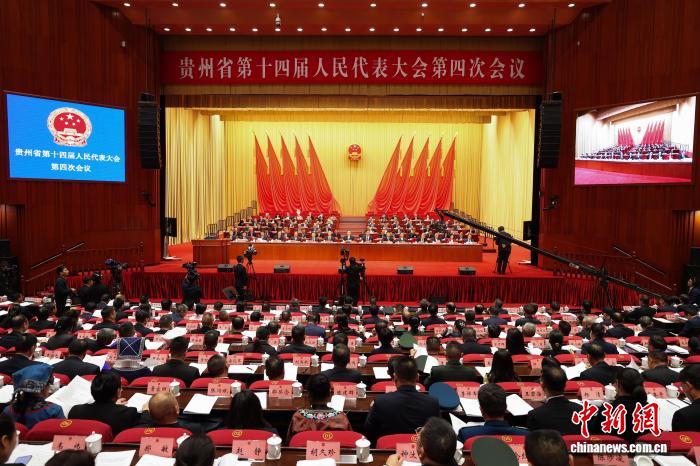
1月27日,贵州省十四届人大四次会议第一次全体会议(开幕会)现场。 中新网记者瞿宏伦 摄 "十五五"贵州:发展新质生产力 瞄准数字经济核心产业 中新网贵阳1月27日电 (记者 张伟 杨茜)贵州省第十四届人民代表大会第四次会议27日在贵阳开幕,贵州 省省长李炳军作政府工作报告。记者会上获悉,"十五五"时期,中国首个国家大数据试验区——贵州预 期发展新质生产力取得重大进展,数字经济核心产业增加值占地区生产总值比重达8%。 为实现上述目标,贵州在政府工作报告中首次明确提出,加快发展算力、数据、人工智能、电子信 息"四大产业"。 截至目前,贵州全省算力规模突破160Eflops(每秒百亿亿次浮点运算),成为中国智算资源最多、能力最 强的地区之一。登顶全球动画票房榜首、创下全球影史单一市场票房第一佳绩的《哪吒2》是贵州算力 应用的案例之一。为《哪吒2》提供超过40%的特效镜头算力保障的贵安超算中心,凭借强大算力,将 渲染任务缩短至几个月,极大提升了影片制作的效率与质量。 本文为转载内容,授权事宜请联系原著作权人 中新经纬版权所有,未经书面授权,任何单位及个人不得转载、摘编或以其它方式使用。 关注中新经纬微信公众号(微信 ...
沈阳向新向优强动能
Xin Lang Cai Jing· 2026-01-26 22:08
Core Viewpoint - Shenyang aims for strategic emerging industries to account for 33.5% of the city's industrial output by 2025, marking a significant increase from previous years and indicating a shift towards innovation-driven economic growth [4][5]. Group 1: Economic Development and Industry Growth - The proportion of strategic emerging industries in Shenyang's industrial output has increased by 2.2 percentage points from the previous year and by 9.2 percentage points since 2020, surpassing the one-third threshold for the first time [5]. - Industrial technological transformation investment in Shenyang is projected to grow by 12.2% by 2025, with the number of technology-based enterprises exceeding 30,000 and "Four Up" enterprises surpassing 10,000 for the first time [5]. - Shenyang is focusing on nurturing new growth drivers while revitalizing traditional industries, aiming to build a resilient and secure modern industrial system [5][11]. Group 2: Technological Innovation and Product Development - Neusoft Medical has launched the first photon-counting CT in China and the world's first 8 cm wide-body photon-counting CT, positioning China as the third country to master this technology [8][10]. - The introduction of innovative products like the 1024-layer ultra-high-definition CT demonstrates Shenyang's commitment to technological advancement in the medical equipment sector [9][10]. - Shenyang's biopharmaceutical and medical equipment sectors are experiencing rapid growth, with companies focusing on innovation rather than price competition, leading to significant advancements in technology and product offerings [10]. Group 3: Strategic Industry Layout - Shenyang's industrial layout is defined by a "3+4+3" strategy, which includes optimizing traditional industries and nurturing four emerging sectors: aerospace, new-generation information technology, biomedicine, and new energy [11][12]. - The city is also focusing on future industries such as embodied intelligence, advanced materials, and deep-sea and deep-space equipment to secure a competitive edge [11][12]. Group 4: Policy Support and Economic Environment - New policies aimed at promoting digital economy development and reducing operational burdens for companies are set to take effect, enhancing the business environment in Shenyang [21][22]. - The "Intelligent Transformation and Digital Transition Action Plan" outlines measures to support manufacturing enterprises in their digital transformation efforts, with specific targets for 2027 [22][23]. - Shenyang is actively working to improve its investment environment and attract talent, aiming to create a city that is friendly to youth development and innovation [26].

打好产业强省建设攻坚战
Xin Lang Cai Jing· 2026-01-26 22:08
Core Viewpoint - Yunnan Province is prioritizing the construction of a modern industrial system through the "14th Five-Year Plan," focusing on key industries and investment to establish itself as a strong industrial province [1][2]. Group 1: Key Industry Development Directions - The industrial blueprint emphasizes three categories: "4+5+6," where "4" includes strengthening resource-based industries such as green aluminum, silicon photovoltaic, phosphorus chemical, and non-ferrous and rare metals [1]. - "5" focuses on consolidating and enhancing five characteristic advantageous industries: plateau characteristic agriculture, cultural tourism, green energy, tobacco, and modern logistics [1]. - "6" targets six key breakthrough areas: biomedicine, new materials, advanced equipment manufacturing, digital economy, low-altitude economy, and biomanufacturing, aiming to develop strategic emerging industries and future industries [1]. Group 2: Implementation and Strategic Focus - The plan requires local governments and departments to understand and implement the strategy effectively, as these selected industries contribute over 90% of the province's industrial added value [2]. - The focus on resource-based industries like aluminum and silicon is based on solid foundations, with an emphasis on extending and strengthening supply chains and improving quality [2]. - The strategy aims to convert resource advantages into industrial strengths, with a focus on major projects that drive significant industrial breakthroughs, particularly in the non-ferrous and rare metals sectors [3].