
通讯器材

Search documents
经济数据点评:总量降温结构优化,关注政策加码可能
Huafu Securities· 2025-09-15 09:23
Consumption Data - In August, the total retail sales of consumer goods increased by 3.4% year-on-year, marking a slight decline of 0.3 percentage points from July, the lowest monthly growth rate this year[3] - Retail sales of goods and catering services showed a divergence, with growth rates of 3.6% and 2.1% respectively, indicating a decline in catering services compared to July[3] - The retail sales of durable goods saw a year-on-year decline of 0.5 percentage points to 2.6%, the lowest since December 2024[3] Investment Trends - Fixed asset investment in August fell by 7.1% year-on-year, deepening by 1.8 percentage points, with all three major sectors showing weakness[4] - Real estate development investment saw a year-on-year decline of 19.5%, worsening by 2.5 percentage points[4] - Infrastructure investment also declined by 4.6% year-on-year, with significant drops in the electricity, heat, gas, and water supply sectors[4] Real Estate Market - Residential sales area decreased by 9.7% year-on-year, worsening by 2.6 percentage points, while new construction area fell by 18.3%, a decline of 9.1 percentage points[5] - The completion area saw a slight narrowing of the decline to 28.8% year-on-year[5] - National new and second-hand residential prices fell by 0.3% and 0.6% month-on-month respectively, with first-tier cities experiencing a 1.0% drop in second-hand housing prices[5] Industrial Output - The industrial added value growth rate fell by 0.5 percentage points to 5.2% year-on-year, with mining, utilities, and manufacturing sectors showing varied performance[6] - The manufacturing sector remains in a high growth range despite the impact of "anti-involution" on upstream industrial products[6] Economic Outlook - The report highlights a continued cooling in consumption, investment, and the real estate market, with potential policy measures expected to stimulate the economy[6] - There is a focus on the possibility of increased fiscal expansion to boost consumption and effective investment, alongside potential monetary policy easing to stabilize real estate market expectations[6]
2025年8月经济数据点评:8月经济:逆风破局的政策信号
Minsheng Securities· 2025-09-15 06:58
Economic Overview - In August, the industrial added value increased by 5.2% year-on-year and 0.37% month-on-month, while the total retail sales of consumer goods reached 39,668 billion yuan, growing by 3.4% year-on-year and 0.17% month-on-month[1] - Fixed asset investment (excluding rural households) from January to August totaled 326,111 billion yuan, with a year-on-year growth of 0.5%[1] Investment Trends - Investment in the manufacturing sector showed a negative growth of -1.3% in August, worsening from -0.3% in July, indicating weakened investment momentum[4] - Infrastructure investment faced significant pressure, with broad infrastructure growth declining from -2.0% in July to -6.4% in August, primarily due to adverse weather conditions[7] Consumption Insights - The retail sales growth rate continued to decline to 3.4% in July, with the "old-for-new" subsidy effect diminishing, leading to a potential increase in consumption pressure[8] - The upcoming release of the last batch of "national subsidy" funds in October is expected to stimulate consumption policies, focusing on wage growth and reducing consumption restrictions[8] Employment Concerns - The urban survey unemployment rate is expected to rise, particularly among youth, with the number of college graduates increasing to 12.22 million this year, up from 11.79 million last year[3] Policy Implications - The report suggests that expectations for a new round of policy easing are likely to intensify, particularly with the anticipated rollout of new financial tools aimed at stabilizing investment and promoting consumption in the fourth quarter[2]
8月社零同比增长3.4%,增速再下降0.3%|快讯
Hua Xia Shi Bao· 2025-09-15 02:38
Group 1 - In August 2025, the total retail sales of consumer goods reached 39,668 billion yuan, with a year-on-year growth of 3.4% and a month-on-month increase of 0.17% [2] - The retail sales in urban areas amounted to 34,387 billion yuan, growing by 3.2% year-on-year, while rural retail sales were 5,281 billion yuan, with a growth of 4.6% [2] - The retail sales of goods reached 35,172 billion yuan, increasing by 3.6%, and catering revenue was 4,496 billion yuan, growing by 2.1% [2] Group 2 - From January to August, the total retail sales of consumer goods were 323,906 billion yuan, reflecting a year-on-year growth of 4.6% [3] - The national online retail sales reached 99,828 billion yuan, with a year-on-year increase of 9.6%, and the physical goods online retail sales were 80,964 billion yuan, growing by 6.4% [3] - The proportion of online retail sales of physical goods accounted for 25.0% of the total retail sales of consumer goods [3]

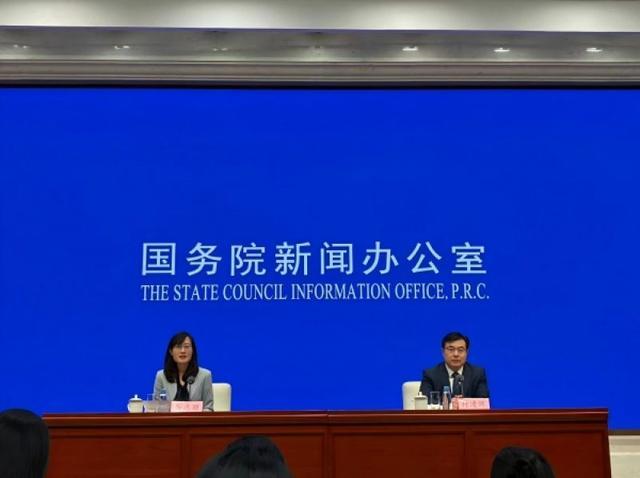
国家统计局:8月限上单位家用电器和音像器材类零售额同比增14.3%
Guo Jia Tong Ji Ju· 2025-09-15 02:15
Group 1 - In August, the industrial added value of enterprises above designated size increased by 5.2% year-on-year and by 0.37% month-on-month [1] Group 2 - In August, the total retail sales of consumer goods reached 39,668 billion yuan, with a year-on-year growth of 3.4% and a month-on-month growth of 0.17% [2] - Urban retail sales amounted to 34,387 billion yuan, growing by 3.2% year-on-year, while rural retail sales reached 5,281 billion yuan, increasing by 4.6% [2] - Retail sales of goods were 35,172 billion yuan, up by 3.6%, and catering revenue was 4,496 billion yuan, growing by 2.1% [2] - Sales of basic living goods and some upgraded products showed strong growth, with retail sales of daily necessities, grain and oil food, and sports and entertainment products increasing by 7.7%, 5.8%, and 16.9% respectively [2] - The effects of the consumption upgrade policy continued to show, with retail sales of furniture, home appliances, audio-visual equipment, cultural and office supplies, and communication equipment increasing by 18.6%, 14.3%, 14.2%, and 7.3% respectively [2] - From January to August, the total retail sales of consumer goods reached 323,906 billion yuan, with a year-on-year growth of 4.6% [2] - National online retail sales reached 99,828 billion yuan, growing by 9.6%, with physical goods online retail sales at 80,964 billion yuan, increasing by 6.4%, accounting for 25.0% of total retail sales [2] - From January to August, service retail sales increased by 5.1%, with significant growth in cultural and recreational services, tourism consulting and leasing services, and transportation services [2]
7月消费市场稳中有优:新能源车渗透率过半 以旧换新显效
2 1 Shi Ji Jing Ji Bao Dao· 2025-08-25 15:53
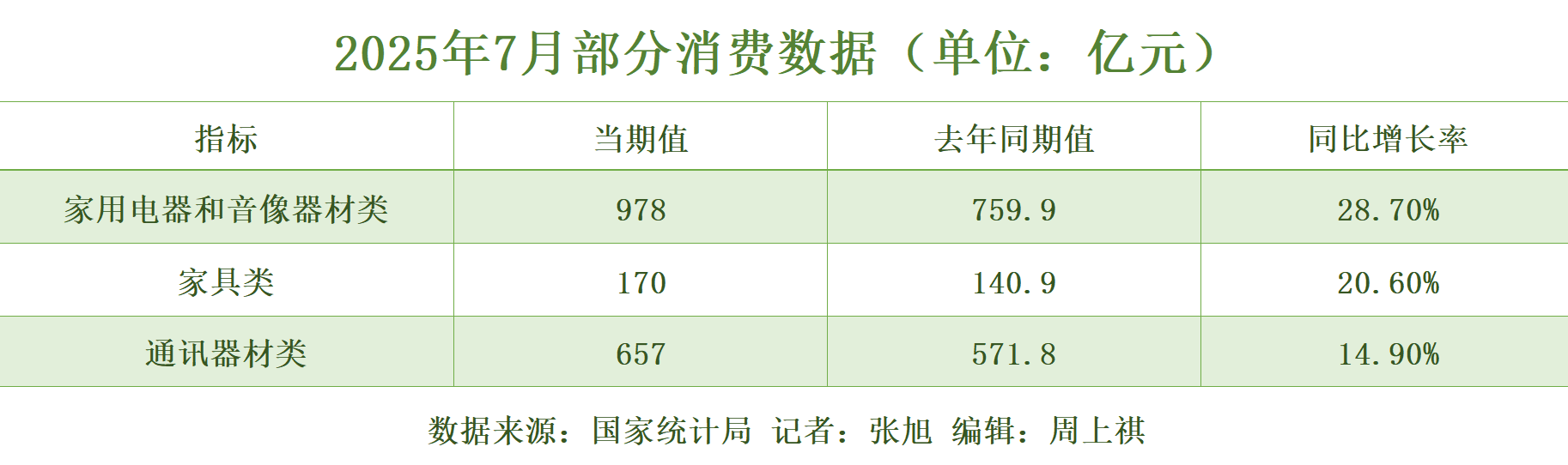
Group 1: Overall Consumption Trends - The consumption market in China has shown a "generally stable and structurally optimized" development trend this year, supported by policy and internal dynamics [1] - In July, the total retail sales of consumer goods reached 3.88 trillion yuan, a year-on-year increase of 3.7%, which is 1 percentage point higher than the same period last year [1] - From January to July, the total retail sales of consumer goods amounted to 28.42 trillion yuan, with a year-on-year growth of 4.8% [1] Group 2: Policy-Driven Consumption - Policy-driven consumption, particularly in home appliances, furniture, and communication equipment, has shown strong performance, with retail sales increasing by 28.7%, 20.6%, and 14.9% respectively in July [1][7] - The State Council's meeting on August 22 emphasized the effectiveness of large-scale equipment updates and the "old-for-new" consumption policy in stabilizing investment and expanding consumption [1][7] Group 3: New Energy Vehicles - The penetration rate of new energy vehicles reached 54% in July, with retail sales of new energy passenger vehicles growing by 12% [5][6] - The total retail sales of passenger vehicles from January to July reached 12.728 million units, a year-on-year increase of 10.1% [5] - The decline in oil and petroleum product consumption is closely related to the accelerated transformation of the energy structure and changes in transportation methods [5][6] Group 4: E-commerce and Digital Transformation - Online retail sales increased by 9.2% from January to July, with physical goods online retail growing by 6.3% [10] - The growth in e-commerce has effectively boosted consumption and promoted the digital transformation of industries [10] - The rural logistics system has improved significantly, with over 19.5 million rural online merchants by the end of July [10][11]
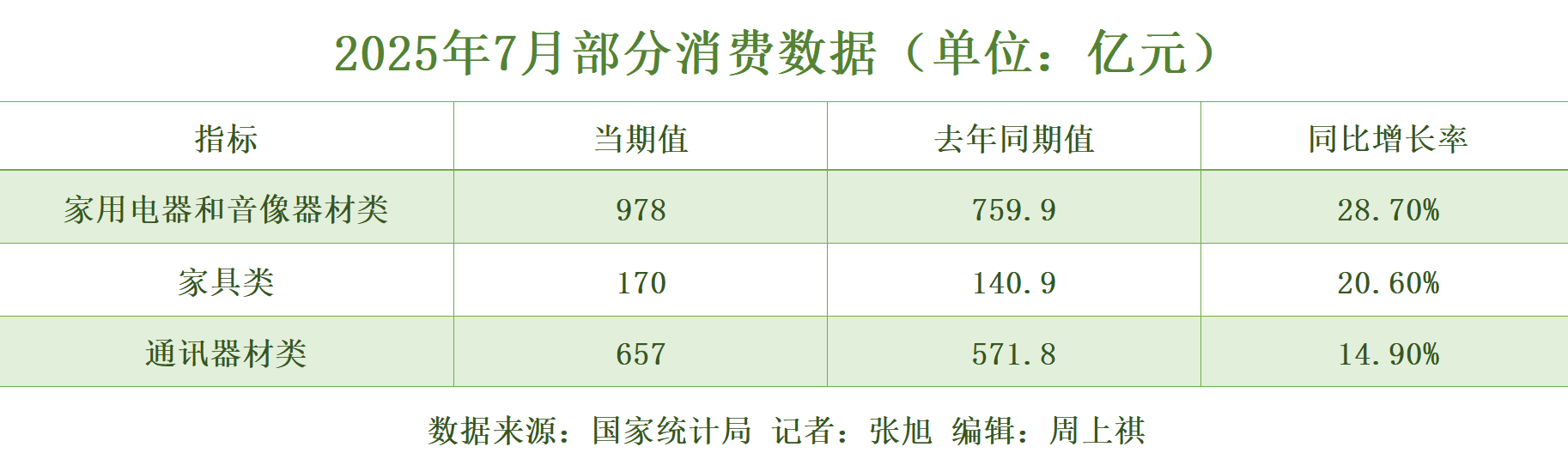
7月消费市场稳中有优:新能源车渗透率过半,以旧换新显效
2 1 Shi Ji Jing Ji Bao Dao· 2025-08-25 11:57
Group 1: Overall Consumption Trends - The consumption market in China has shown a "generally stable and structurally optimized" development trend this year, supported by policy and internal dynamics [1] - In July, the total retail sales of consumer goods reached 3.88 trillion yuan, a year-on-year increase of 3.7%, which is 1 percentage point higher than the same period last year [1] - From January to July, the total retail sales of consumer goods amounted to 28.42 trillion yuan, with a year-on-year growth of 4.8% [1] Group 2: Policy-Driven Consumption - Policy-driven consumption, particularly in appliances and furniture, has shown strong performance, with retail sales of major household appliances, furniture, communication equipment, and cultural office supplies increasing by 28.7%, 20.6%, 14.9%, and 13.8% respectively in July [1][7] - The State Council's meeting on August 22 emphasized the effectiveness of large-scale equipment updates and the "old-for-new" consumption policy in stabilizing investment and expanding consumption [1][7] Group 3: New Energy Vehicles - The penetration rate of new energy vehicles reached 54% in July, with retail sales of new energy passenger vehicles growing by 12% year-on-year [5][6] - In the first seven months, the cumulative retail sales of passenger vehicles reached 12.728 million units, a year-on-year increase of 10.1% [5] - The decline in oil and petroleum product consumption, which fell by 8.3% year-on-year in July, is closely related to the transformation of energy structure and changes in transportation methods [5][6] Group 4: E-commerce and Digital Transformation - Online retail sales increased by 9.2% year-on-year from January to July, with physical goods online retail growing by 6.3% [10] - The growth of e-commerce has significantly contributed to boosting consumption and promoting industrial digital transformation [10] - The rural logistics system has improved, with over 19.5 million rural online merchants by the end of July, enhancing rural consumption [10][11]
以旧换新补助监管再加码 严防政策套利漏洞
Zhong Guo Jing Ying Bao· 2025-08-25 07:12
Group 1 - The Ministry of Commerce emphasized the need to strengthen regulation and prevent risks in the nationwide consumer goods replacement policy, ensuring the safety of funds and optimizing policies to stimulate consumption growth [2] - The National Development and Reform Commission (NDRC) reported that over half of the 300 billion yuan allocated for the consumer goods replacement program has been disbursed, with strict measures against fraudulent practices being implemented [2] - The NDRC announced that the third batch of 69 billion yuan in special bonds for consumer goods replacement has been fully allocated, with a fourth batch planned for October, aiming for a total of 300 billion yuan by year-end [2] Group 2 - The consumer goods replacement policy has significantly boosted sales, with over 1.7 trillion yuan in sales generated this year, and retail sales of major appliances and communication devices increasing by 30.7% and 24.1% respectively [3] - The demand for steel in manufacturing sectors such as automotive, home appliances, and shipbuilding has shown strong resilience due to the policy [3] - The "Two Major" construction projects have received 800 billion yuan in funding, with 735 billion yuan from the central budget also being allocated, indicating a strong push for infrastructure development [3]
强化财税金融支持 以旧换新政策加力可期
Zhong Guo Zheng Quan Bao· 2025-08-24 20:10
Core Viewpoint - The recent meetings by the State Council and the national conference on the promotion of the old-for-new consumption policy signal increased policy support for expanding consumption and stimulating demand in the market [1][3]. Policy Effects - The old-for-new policy has shown significant effects this year, with retail sales in various categories such as home appliances and communication equipment growing at rates of 28.7%, 13.8%, 20.6%, and 14.9% year-on-year in July, outpacing overall retail sales growth [1]. - The policy has also positively impacted the automotive sector, with new energy vehicle sales expected to grow by 81.7% from April 2024 to July 2025 [1]. - The Ministry of Finance has allocated 300 billion yuan in special long-term bonds to support the old-for-new consumption policy [1]. Funding and Support Measures - The Ministry of Finance has announced the distribution of 69 billion yuan in the third batch of special long-term bonds to support local governments in implementing the old-for-new policy [2]. - Various regions are enhancing subsidy measures, such as Heilongjiang increasing subsidies for electric vehicles and Chongqing allocating an additional 300 million yuan for vehicle replacement subsidies [2][3]. - Adjustments in subsidy distribution methods have been made to improve accessibility for consumers, such as changing from daily limited vouchers to centralized distribution [2]. Policy Optimization - Local governments are addressing supply-demand imbalances in subsidy vouchers and enhancing fund utilization efficiency [3]. - Adjustments to the old-for-new policy are being made based on the availability of national funding, with a focus on ensuring the effective release of consumer potential [3][4]. - The central government has reiterated its commitment to support the old-for-new policy, emphasizing its role in stabilizing investment and expanding consumption [3][4]. Future Expectations - There is an expectation for further expansion of the old-for-new policy into service consumption and public consumption sectors to maximize overall consumer potential [4]. - Analysts predict that the scale of funding for the old-for-new policy may be increased, with potential adjustments to the types of products eligible for subsidies [5]. - The Ministry of Finance is implementing a monitoring mechanism to ensure effective use of subsidy funds and prevent misuse [5].
1—7月杭州经济稳中向好
Sou Hu Cai Jing· 2025-08-24 03:17
Group 1: Economic Performance - Hangzhou's economy shows strong recovery with a total retail sales of consumer goods reaching 527.1 billion yuan, a year-on-year increase of 5.1% from January to July [1] - Upgrading consumption trends are evident, with retail sales of home appliances and audio-visual equipment increasing by 86.3%, and communication equipment by 34.5% [1] - The retail sales of new energy vehicles grew by 23.7%, indicating a shift towards green and smart consumption [1] Group 2: Foreign Trade - The total import and export volume reached 515.4 billion yuan, with exports at 368 billion yuan, marking a growth of 12.3%, surpassing the national average [2] - Exports of mechanical and electrical products amounted to 174 billion yuan, growing by 11.5%, while high-tech product exports reached 55.8 billion yuan, increasing by 10.9% [2] - Private enterprises played a significant role, with exports totaling 282 billion yuan, accounting for 76.6% of the city's total exports [2] Group 3: Industrial Growth - The industrial added value for large-scale enterprises reached 261.3 billion yuan, with a year-on-year growth of 6.9% [3] - Key industries such as computer communication and electronic equipment manufacturing saw substantial growth, with increases of 17.0% and 30.1% respectively [3] - New momentum in high-tech and strategic emerging industries showed added value growth rates of 8.3% and 9.7%, indicating a robust industrial transformation [3] Group 4: Service Sector Development - The revenue of large-scale service industries reached 1,094.4 billion yuan, with an 8.6% year-on-year increase [3] - The information transmission, software, and IT services sector grew by 12.7%, while scientific research and technical services increased by 6.2% [3] - The digital economy's core industries and high-tech services saw revenue growth of 12.6% and 11.8%, respectively, highlighting the sector's importance in economic growth [3] Group 5: Future Outlook - Hangzhou's economy is maintaining a stable operation, with a focus on high-quality development [4] - The city aims to enhance innovation, reform, and openness to ensure effective qualitative improvements and reasonable quantitative growth [4]
加快释放内需潜力 政策效果将继续显现
Jing Ji Ri Bao· 2025-08-21 03:19
Group 1: Economic Policy and Internal Demand - The central government emphasizes the need to effectively release internal demand potential to support economic growth [1] - The contribution rate of internal demand to GDP growth reached 68.8% in the first half of the year, with final consumption expenditure contributing 52% [2] - Policies such as the consumption upgrade program have been implemented to stimulate consumer spending, with significant retail growth in various categories [2] Group 2: Service Consumption Growth - Service consumption has been growing rapidly, with the proportion of per capita service consumption expenditure reaching 46.1% in 2024, contributing 63% to overall consumption growth [3] - Households are increasingly spending on services like home care, fitness, and tourism, surpassing spending on goods [3] - Strategies to activate consumption demand include creating immersive consumption scenarios and issuing targeted consumption vouchers [3] Group 3: Investment Expansion - The government has allocated 800 billion yuan for key construction projects and 735 billion yuan for central budget investments this year [4] - Infrastructure investment in key sectors has seen rapid growth, with water management and information transmission investments increasing by 12.6% and 8.3%, respectively [4] - Manufacturing investment grew by 6.2% in the first seven months, driven by traditional industry upgrades and new equipment purchases [4] Group 4: Structural Optimization of Investment - There is a need to optimize investment structure to meet changing demands, focusing on areas like education, healthcare, and quality housing [5] - Major projects should lead and stimulate upstream and downstream industry development, while also adapting to consumer demand changes [5] - Recommendations include improving investment efficiency by aligning social welfare improvements with effective investment strategies [5] Group 5: Reform and Market Integration - The economy is recovering, but internal demand remains a significant constraint, necessitating continued policy focus on stabilizing employment and market expectations [6] - Effective release of internal demand requires precise policies and resource allocation, focusing on high-quality and efficient investment projects [6] - The government aims to deepen reforms to enhance market integration and address supply-demand mismatches [6][7]