
加密货币

Search documents
Bitcoin’s Plunge to $90K – Here’s the Low and High End
Yahoo Finance· 2025-11-18 20:09
24K-Production / Shutterstock.com The recent move we've seen in Bitcoin (CRYPTO:BTC) has truly brought about a level of concern in this sector I haven't seen in some time. Quick Read Bitcoin (BTC) has declined more than 30% from its peak amid broader risk asset selloffs. Bitcoin exhibits high correlation with tech-heavy indexes like the Nasdaq. The author sets a one-year Bitcoin price target of $75,000 with a potential range of $50,000 to $150,000. If you’re thinking about retiring or know someon ...
"Capitalize on Tailwinds:" Bitcoin's Long-Term Bull Case Amid Short-Term Volatility
Youtube· 2025-11-18 20:00
And now I'd like to welcome in Austin King, the co-founder of Nomina to discuss more on Bitcoin with Bitcoin right now having seen this pressure. Of course, I know October was a bit of a disappointment, but walk us through what you think is leading to some of this sign weakness and really why we're seeing this persist I think a bit longer than the bulls would have hoped. Yeah, I think as an asset class at large, crypto is very much still seen as a riskon asset class.And you know, when the we're seeing the l ...


贝莱德向Coinbase存入3064枚比特币,价值约2.8亿美元
Ge Long Hui· 2025-11-18 14:35
(责任编辑:郭健东 ) 【免责声明】本文仅代表作者本人观点,与和讯网无关。和讯网站对文中陈述、观点判断保持中立,不对所包含内容 的准确性、可靠性或完整性提供任何明示或暗示的保证。请读者仅作参考,并请自行承担全部责任。邮箱: news_center@staff.hexun.com 据Onchain Lens监测,贝莱德向Coinbase存入3064枚比特币(价值约2.8亿美元)和64707枚以太坊(价 值约1.987亿美元)。 ...


为什么本轮周期总有大利好,你的币却一直跌?
3 6 Ke· 2025-11-18 11:10
Core Insights - The cryptocurrency market has not responded positively to recent institutional interest and regulatory clarity, leading to a disconnect between potential and actual market performance [3][8] - The market's current valuation of cryptocurrencies, particularly altcoins, appears to be based on speculative trading rather than sustainable economic value [15][23] Market Dynamics - Despite significant developments such as the launch of ETFs and increased institutional participation, the market has not seen corresponding price increases, indicating that positive news may already be priced in [3][6] - The total market capitalization of altcoins is approximately $1.5 trillion, but their underlying narratives are considered weaker compared to Bitcoin, which has a market cap of about $1.9 trillion [4][5] Valuation Concerns - Ethereum's market cap is around $400 billion, with annual revenue from fees and MEV estimated at $1-2 billion, leading to a price-to-sales ratio of 200-400 times, which is deemed unsustainable [13][14] - Solana, with a market cap of approximately $75-80 billion, generates over $1 billion in annual revenue, resulting in a more reasonable price-to-sales ratio of 20-60 times [13][14] Revenue Sustainability - The income generated by major Layer 1 blockchains is characterized as highly cyclical and speculative, akin to casino revenues, rather than stable, predictable cash flows [10][14] - The industry must transition from speculative trading to generating real, recurring economic value to justify current valuations [15][23] Future Outlook - The cryptocurrency sector is still in its early stages, but there is a pressing need to focus on real user adoption and sustainable business models rather than speculative trading [17][21] - The next decade may see significant opportunities in integrating cryptocurrency technology into established businesses, provided it can demonstrate cost efficiency and improved functionality [20][22]

币圈“极度恐慌”,市场为比特币跌向“80000美元”做准备
华尔街见闻· 2025-11-18 10:43
Core Viewpoint - Bitcoin is experiencing a significant decline, with traders preparing for further downturns as the cryptocurrency market faces extreme fear and pressure from macroeconomic factors [1][6][14]. Group 1: Market Performance - Bitcoin dropped below $90,000, marking a seven-month low, with the total cryptocurrency market capitalization falling by over $1.2 trillion in the past six weeks [2]. - Ethereum has also seen a decline, falling to $2,975, with a 24% drop since early October [12]. Group 2: Trader Sentiment - There is a notable increase in protective demand for put options at key levels of $90,000, $85,000, and $80,000, with the size of bearish bets exceeding $740 million for contracts expiring in late November [4]. - The sentiment index from CoinMarketCap indicates that cryptocurrency participants are in a state of "extreme fear," with many investors unable to buy more due to significant losses [6]. Group 3: Impact on Crypto Companies - Digital asset "treasury companies" are under pressure, having accumulated large amounts of cryptocurrency earlier this year in an attempt to become concept stocks in the crypto market [8][9]. - Despite some companies like Michael Saylor's Strategy purchasing $835 million worth of Bitcoin, many peers are facing increasing pressure to sell assets to protect their balance sheets [10]. Group 4: Macroeconomic Factors - Broader economic forces, including Federal Reserve policy expectations and discussions around the AI bubble, are contributing to negative market sentiment for cryptocurrencies and risk assets [14][15]. - The cryptocurrency market has been volatile since a significant liquidation wave in early October, which wiped out approximately $19 billion in crypto assets [16].

短短六周,币圈“蒸发”了1.2万亿美元
美股IPO· 2025-11-18 10:16
Group 1 - The current sell-off in the cryptocurrency market began due to concerns over high valuations of tech stocks and the direction of U.S. interest rate policies [1][2] - Bitcoin's price has dropped over 28% from its peak on October 6, reaching its lowest level since April, completely erasing its gains for the year [2] - The total market capitalization of over 18,000 cryptocurrencies has decreased by 25% during this period, with high-risk small-cap tokens suffering the most [1][5] Group 2 - Concerns regarding whether the Federal Reserve will cut interest rates in December have intensified market fears, as lower rates typically enhance the appeal of cryptocurrencies and other risk assets [4] - The cryptocurrency market is experiencing a severe adjustment, with total market capitalization plummeting by over $1.2 trillion in the past six weeks [5] - The next support level for Bitcoin is projected to be $75,000, which could be reached if market volatility remains high [6] Group 3 - The market crash on October 10 marked a turning point in the current decline, with $20 billion in cryptocurrency leverage positions being liquidated, the largest single-day liquidation on record [7] - Investors in the cryptocurrency market are known for their love of leverage, often taking excessive risks, believing that the situation will be different this time [8] - The MarketVector Digital Assets 100 Small Cap Index has fallen to its lowest level since November 2020, indicating a sharp decline in investor risk appetite for speculative assets [10] Group 4 - Among the top 20 cryptocurrencies by market capitalization, six have seen declines exceeding 40% this year, with Dogecoin, Sui, and Avalanche each dropping around 50% [10] - Over the past five years, the small-cap coin index has decreased by nearly 8%, while the large-cap coin index has surged approximately 380% [10] - The current market conditions are described as the "continuation of the October liquidation event," with larger positions and deeper leverage requiring longer liquidation times [8]

刚刚,全线大跳水!超18万人爆仓!发生了什么?
券商中国· 2025-11-18 08:28
Core Viewpoint - The cryptocurrency market is experiencing a significant downturn, with Bitcoin and Ethereum both dropping over 6%, leading to a total market capitalization loss exceeding $1 trillion since October 7. Analysts suggest that the bearish trend may continue as traders are increasingly pessimistic in the options market [1][10][12]. Cryptocurrency Market Performance - Bitcoin fell to approximately $89,501.3, erasing all gains made in 2023, while Ethereum dropped to $2,986.19. Other cryptocurrencies like XRP, Solana, and Cardano also saw declines, with XRP down nearly 6% and Solana over 4% [4][5]. - In the last 24 hours, the total liquidation amount in the cryptocurrency market reached $10.15 billion, affecting 183,500 traders, with long positions accounting for $7.24 billion of the liquidations [6][8]. Market Sentiment and External Factors - The market sentiment has turned negative as expectations for a Federal Reserve interest rate cut have diminished, leading to a broader sell-off in risk assets. The probability of a 25 basis point rate cut in December is now at 42.9%, with a 57.1% chance of maintaining current rates [8][12]. - Analysts indicate that the recent sell-off is a result of profit-taking by long-term holders, outflows of institutional funds, macroeconomic uncertainties, and the liquidation of leveraged long positions [10][13]. Investor Behavior and Market Dynamics - There is a growing concern that the cryptocurrency sell-off could force retail investors to liquidate other assets to meet margin calls, potentially creating a feedback loop of selling across different markets [1][10][13]. - The options market shows a significant increase in protective bets against further declines, with traders focusing on downside levels of $90,000, $85,000, and $80,000, indicating a bearish outlook [12][13].

全球市场恐慌:日本股债汇三杀,纳指期货跌1%,比特币跌破9万美元大关,金价跌破4000美元
Ge Long Hui A P P· 2025-11-18 08:19
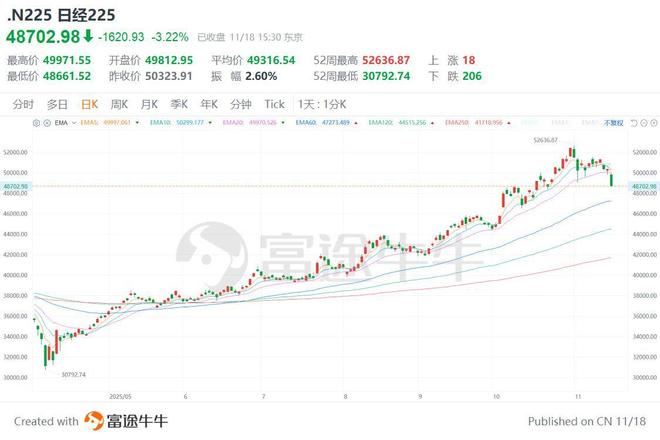
Core Viewpoint - Global markets experienced widespread sell-offs, with significant declines in U.S. stock futures and cryptocurrencies, driven by concerns over interest rate outlook and technology stock valuations [1]. Market Performance - The Nikkei 225 index in Japan fell by 3.2%, marking its largest single-day drop since April, amid worries over government spending and geopolitical factors [1]. - The KOSPI index in South Korea dropped by 3.32%, led by declines in semiconductor stocks [2]. - A-shares also saw declines, with the Shanghai Composite Index down 0.81%, the ChiNext Index down 1.1%, and the Shenzhen Component Index down 0.92%. The Taiwan Weighted Index fell by 2.5% [3]. - U.S. stock futures showed significant declines, with the Nasdaq 100 futures down over 1%, Dow futures down 0.5%, and S&P 500 futures down 0.7% [4]. Interest Rate and Commodity Impact - The probability of a 25 basis point rate cut by the Federal Reserve in December dropped to 42.9%, leading to a decrease in optimistic sentiment towards gold, which fell below the $4,000 mark [1][5]. - Bitcoin experienced intensified selling pressure, dropping to a low of $89,253 per coin, with traders betting on further declines to $85,000 and even $80,000 [5][13].
暴跌中逆势加仓!Strategy(MSTR.US)上周豪掷8.4亿美元购入比特币
Zhi Tong Cai Jing· 2025-11-18 07:24
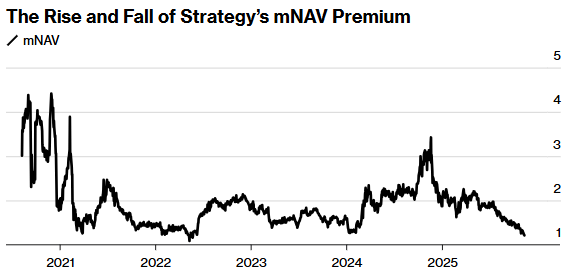
Core Insights - Strategy has purchased $835.6 million worth of Bitcoin, marking its largest acquisition since July, bringing its total holdings to 649,870 Bitcoins valued at approximately $6.17 billion [1] - The recent Bitcoin price drop of nearly 30% since early October contrasts with previous market expectations of increased stability due to deeper Wall Street involvement and favorable White House policies [1][3] - The company's market net asset value (mNAV) has plummeted from over 2.5 to 1.2, indicating a significant decline in its valuation relative to Bitcoin holdings, which complicates the buying opportunity for institutional investors [2] Company Actions - Strategy raised €620 million (approximately $716.8 million) through the issuance of euro-denominated perpetual preferred stock, significantly exceeding its initial target of €350 million [6] - The company has shifted its funding strategy from selling common stock to issuing convertible bonds and now to preferred stock, reflecting investor concerns over equity dilution [6] Market Dynamics - The cryptocurrency market has experienced a significant downturn, with approximately $19 billion in digital asset value wiped out since early October, leading to a decline in open interest in cryptocurrency futures [7] - The demand for protective options has surged, particularly for price levels of $90,000, $85,000, and $80,000, indicating a bearish sentiment among traders [3]

特朗普家族又添赚钱新项目
Guo Ji Jin Rong Bao· 2025-11-18 06:08
Core Insights - The Trump family business has partnered with Saudi Arabia's largest private real estate developer, Dar Al Arkan, to develop a luxury hotel project in the Maldives, combining real estate development and cryptocurrency trading [1][3] - The project will feature 80 ultra-luxury villas and is expected to redefine local luxury standards while innovating real estate investment through tokenization [3][6] Real Estate Development - Dar Global, a subsidiary of Dar Al Arkan, plans to build the luxury villas, which will be accessible by a 25-minute speedboat ride from the capital, Male, with the hotel expected to open by the end of 2028 [3] - This Maldives project is not the only collaboration between the Trump Group and Dar Global, with additional projects planned in Oman, Qatar, UAE, and Saudi Arabia [3] Financial Aspects - The Trump family typically does not invest their own funds in projects but licenses their brand to increase property values, earning millions in fees and profit shares from related sales [4] - In the past year, Trump reportedly earned over $20 million from transactions with Dar Al Arkan [4] Tokenization in Real Estate - The new project involves real estate tokenization, allowing investors to purchase fractional ownership through digital tokens on a blockchain platform, broadening the investor base [6][7] - This innovative financing structure reduces reliance on traditional bank loans and leverages the Trump family's political influence for commercial advantage [6] Cryptocurrency Engagement - The project marks a new chapter for the Trump family in the cryptocurrency sector, with previous ventures including the establishment of a cryptocurrency company and various asset applications related to digital currencies [9] - The Trump family's involvement in cryptocurrency has led to a more favorable regulatory environment, contrasting with the Biden administration's stance [9][10]