
汽车制造业

Search documents
上汽集团1-11月累销超410万辆,新能源同比增长38.79%
Ju Chao Zi Xun· 2025-12-02 14:23
Core Insights - SAIC Motor Corporation reported a slight year-on-year decline in vehicle production and sales for November, but both cumulative production and sales for the year have achieved double-digit growth, driven primarily by the performance of new energy vehicles, SAIC Maxus, and Zhiji Auto [2] Production and Sales Data - In November, SAIC Motor's total vehicle production was 463,300 units, a decrease of 4.84% from 486,854 units in the same month last year; cumulative production for the year reached 4,222,198 units, up 18.84% from 3,552,698 units [2][3] - Total vehicle sales in November were 460,818 units, down 3.75% from 478,767 units year-on-year; cumulative sales for the year reached 4,108,067 units, an increase of 16.38% from 3,529,993 units, marking a steady growth trend [2][3] Segment Performance - New energy vehicles produced 207,168 units in November, a year-on-year increase of 23.85%; cumulative production for the year was 1,547,412 units, up 40.99% from 1,097,512 units [6] - In November, SAIC Maxus achieved a production increase of 62.15% to 24,642 units, with cumulative production of 203,919 units, up 22.27% [5] - Zhiji Auto saw a remarkable production increase of 104.92% in November, producing 16,324 units, with cumulative production of 72,424 units, up 19.01% [6] Overseas Performance - In November, SAIC's overseas sales reached 107,210 units, a 13.87% increase from 94,153 units year-on-year; cumulative overseas sales for the year were 969,397 units, up 3.40% from 937,493 units [7]


上汽乘用车张亮:汽车业下半场竞争核心是AI
2 1 Shi Ji Jing Ji Bao Dao· 2025-12-02 13:56
Core Insights - The automotive market is expected to face intense competition in the first half of next year, particularly in the first quarter, due to policy rollbacks and preemptive consumer spending [1] - The company aims to shift from scale competition to a focus on brand value and operational efficiency, emphasizing value marketing rather than engaging in price wars [1] - The company’s brand positioning for Roewe is centered around "quality technology and exceptional trust," ultimately aiming for reliability [1] Group 1 - The Roewe M7 DMH has quickly become the third best-selling model in the B-class hybrid market, following BYD Qin L and Galaxy A7, with 82% of sales coming from high-end models [1] - The M7 DMH utilizes advanced technologies such as the DMH 6.0 super hybrid system and semi-solid state batteries to achieve high cost-effectiveness while controlling costs [1] - The integration of engine control within the PICU allows for precise energy management, showcasing the company's unique position in hybrid engine control [2] Group 2 - The recent OTA update for the Roewe M7 DMH has significantly increased the daily usage rate of its voice function from 60% to 90%, indicating successful integration of advanced technology [2] - The company is transitioning from a connectivity-focused approach to an AI-driven model, with the core competitive advantage of the deep thinking model being its ability to understand context and user emotions [3] - The introduction of AI in the automotive sector marks a shift towards a more intuitive user experience, with the company aiming to redefine its influence in the mainstream Chinese automotive market through technology and value recognition [3]
喜娜AI速递:今日财经热点要闻回顾|2025年12月2日
Sou Hu Cai Jing· 2025-12-02 11:20
Group 1 - The Federal Reserve is expected to lower interest rates by 25 basis points in December due to a weak labor market and indications from policymakers [2] - The Bank of Japan's hint at a potential interest rate hike has caused significant market fluctuations, with the Nikkei index dropping nearly 1000 points and Bitcoin prices plummeting [2] - Silver prices have reached a historical high, with spot silver rising over 5% and year-to-date gains exceeding 100%, while gold has also hit a six-week high [2] Group 2 - The A-share market has experienced a downturn, with a report suggesting that earnings may fall below market consensus, although some foreign investors remain optimistic about a rebound in 2026 [3] - Leading lithium iron phosphate companies have raised price demands, with one company increasing processing fees by 3000 yuan per ton starting January 1, 2026, amid supply-demand imbalances [3] - The intense competition in the food delivery sector has led to significant losses for platforms, with Meituan, Alibaba, and JD.com collectively spending over 614 billion yuan on sales and marketing, prompting calls for a return to rational consumption [3] Group 3 - Michael Burry, known as the "Big Short," has expressed skepticism about Tesla's valuation, questioning its business strategy and shareholder dilution due to Elon Musk's compensation plan [4] - The animated film "Zootopia 2" has achieved a cumulative box office of 1.92 billion yuan, setting records for imported animated films in China and significantly outperforming North America [5] - The AI model DeepSeek has released new versions, acknowledging a widening gap between open-source and closed-source models, with plans for future improvements [5] Group 4 - ST Suwu has been forced to delist due to financial fraud, with its stock price plummeting over 90% this year, affecting nearly 68,000 shareholders [5]
晚间公告|12月2日这些公告有看头
Di Yi Cai Jing· 2025-12-02 10:21
Group 1 - Daoming Optics announced that it currently has no AI mobile phone-related business despite recent media discussions [2] - Daimay Co. received an insurance compensation of $14.7 million for a fire incident, which will be recorded as non-operating income in the 2025 financial statements [3] - MengTian Home has seen its stock price deviate over 100% in the last 10 trading days, and may apply for a trading suspension if the price continues to rise abnormally [4] Group 2 - Daming City reported that 10.13% of shares held by its controlling shareholder are under judicial freeze and marking, but this will not affect the company's operations or governance [5] - Guomai Culture announced an investment loss of approximately RMB 40 million in a film project, which represents over 10% of its audited net profit for 2024 [6] - Pingtan Development's stock price has increased significantly in a short period, raising concerns about irrational speculation, although the company's fundamentals remain unchanged [7] Group 3 - Xiamen Tungsten plans to invest RMB 942 million in the second phase of its motor industrial park, with completion expected by September 2029 [8] - Shunhao Co. reported stock price fluctuations and noted that its investment in a project has uncertainties, but it does not expect significant impact on its 2025 performance [9] - Haowei Group's controlling shareholder plans to donate 2.48% of the company's shares to a university foundation [10] Group 4 - Ningbo Port expects a 10.8% year-on-year increase in container throughput in November 2025, reaching 4.49 million TEUs [12] - Yutong Bus reported production and sales growth in November 2025, with production up 11.21% and sales up 8.62% year-on-year [13] Group 5 - Weisheng Information won three electricity project contracts totaling RMB 65.32 million, which will positively impact the company's performance [21] - Design Institute recently won 17 projects with a total bid amount of approximately RMB 251 million, covering various engineering services [22]
钧达股份港股跌3.27%创新低 2023年A股募27.76亿
Zhong Guo Jing Ji Wang· 2025-12-02 09:49
中国经济网北京12月1日讯 钧达股份(02865.HK)港股今日收报16.57港元,跌幅3.27%,盘中最低至 16.45港元,创港股上市以来股价新低。 2023年6月16日,钧达股份发布的2022年向特定对象发行股票并在主板上市上市公告书显示,截至 2023年5月30日,本次发行获配的13名发行对象已将本次发行认购的全额资金汇入华泰联合证券在中国 工商银行股份有限公司深圳振华支行开设的账户。本次发行不涉及购买资产或者以资产支付,认购款项 全部以现金支付。 钧达股份2025年5月8日在港交所上市,最终发售价及配发结果公告显示,钧达股份发售股份数目 63,432,300股,其中,香港公开发售的最终发售股份数目6,343,300股,国际发售的最终发售股份数目 57,089,000股。 根据中汇会计师事务所(特殊普通合伙)2023年6月1日出具的《向特定对象发行股票认购资金到位情 况验证报告》(中汇会验[2023]7633号),截至2023年5月30日止,华泰联合证券累计收到钧达股份向特定 对象发行股票认购资金总额(含获配投资者认购保证金)为人民币2,776,000,000.00元。上述认购资金总额 均已全部缴存于 ...

港股收盘 | 恒指收涨0.24% 汽车股走势分化 博彩股、手机产业链表现活跃
Zhi Tong Cai Jing· 2025-12-02 08:41
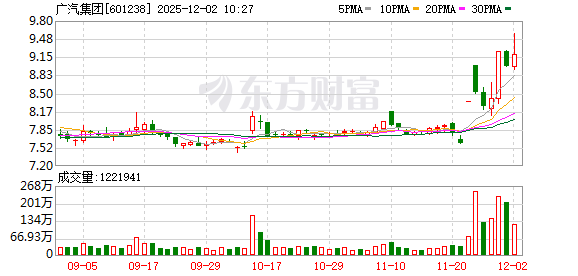
Market Overview - Hong Kong stocks opened higher but closed lower, with the Hang Seng Index rising 0.24% to 26,095.05 points and a total turnover of HKD 178.25 billion [1] - The Hang Seng Tech Index fell 0.37% to 5,624.04 points, while the Hang Seng China Enterprises Index increased by 0.11% to 9,182.65 points [1] Blue Chip Performance - Galaxy Entertainment (00027) led blue-chip stocks, rising 2.81% to HKD 40.98, contributing 3.88 points to the Hang Seng Index [2] - Other notable blue-chip performers included Hengan International (01044) up 2.69% and Budweiser APAC (01876) up 2.35% [2] - WuXi AppTec (02359) fell 3.13%, dragging the index down by 2.2 points, while SMIC (00981) decreased by 1.15%, contributing a drop of 5.66 points [2] Sector Highlights - The gaming sector saw a rise, with Macau's November gaming revenue reaching MOP 210.9 billion, a 14.4% year-on-year increase, exceeding market expectations [4] - The mobile phone supply chain remained active, with notable gains in companies like AAC Technologies (02018) and BYD Electronics (00285) [4][5] - The automotive sector showed mixed results, with BYD (01211) up 2.19% while Xpeng Motors (09868) fell 5.52% [5][6] Notable Stock Movements - Conant Optical (02276) surged 10.58% after announcing its role as the exclusive lens supplier for Alibaba's AI glasses [7] - Giga Biologics (02367) rose 8.53% following a share buyback announcement [8] - GAC Group (02238) increased by 7.32% due to positive management updates regarding new battery technology and partnerships [9] - Longpan Technology (02465) saw a 4.1% rise amid industry price adjustments in lithium iron phosphate [10] - 3SBio (01530) faced pressure, dropping 4.61% after announcing a share placement to raise HKD 31.15 billion for R&D and operational expenses [11]


小鹏汽车-W(09868.HK):11月交付36,728辆汽车 同比增长19%
Ge Long Hui· 2025-12-02 08:36
小鹏汽车-W(09868.HK)11月交付36,728辆汽车,同比增长19%。2025年1月至11月,小鹏汽车累计交付 量达391,937辆,同比增长156%。 ...
北汽新能源取得气囊装置以及车辆专利,有利于降低乘员受到高压气囊本体伤害的风险
Jin Rong Jie· 2025-12-02 06:41
Group 1 - Beijing New Energy Automobile Co., Ltd. has obtained a patent for an airbag device and vehicle, with the patent number CN223605583U, applied for on December 2024 [1] - The patent describes an airbag device that includes an airbag body, a first body, and a second body, which together define a gas storage chamber. The first body is designed with a bending structure [1] - The airbag device features a pull strap located outside the airbag body, which breaks when the internal gas pressure reaches a preset value, allowing the airbag to deploy effectively and reduce the risk of injury to occupants during a collision [1] Group 2 - Beijing New Energy Automobile Co., Ltd. was established in 2009 and is primarily engaged in the automotive manufacturing industry, with a registered capital of approximately 1.506 billion RMB [2] - The company has invested in 28 enterprises, participated in 1,264 bidding projects, and holds 676 trademark records and 5,000 patent records, along with 97 administrative licenses [2]
【高端访谈】广汽国际化将从全球布局步入全面精耕细作——访广汽国际总经理卫海岗
Xin Hua Cai Jing· 2025-12-02 02:26
Core Viewpoint - GAC Group is nearing the completion of its internationalization strategy, with a focus on deepening its presence in local markets and enhancing brand influence globally [2][3] Group 1: Internationalization Strategy - Internationalization is the core strategic direction for GAC Group, with GAC International serving as the main vehicle for this initiative [3] - GAC International has three main missions: enhancing global brand influence and overseas sales, constructing a global R&D, production, supply, and service loop, and promoting the transition of Chinese automotive brands from "product export" to "industry integration" and "brand elevation" [3] - In the first ten months of this year, GAC Group's self-owned brand vehicle exports increased by 36% year-on-year, indicating that international markets are becoming a significant growth point [3] Group 2: Market Focus and Expansion - Australia is identified as a key market for GAC International, serving as a benchmark for the Australia-New Zealand and South Pacific regions, and as a hub for building a new energy ecosystem in the Southern Hemisphere [5][6] - GAC International plans to launch three representative models in Australia and aims to introduce over 10 new products within five years, achieving full coverage of powertrains and product categories [6] - The company has established nine sales outlets in major Australian cities, with plans to expand to 100 outlets in the next five years [6] Group 3: Ecosystem Development - GAC International is transitioning from "product export" to "ecosystem export" and "system export," focusing on a collaborative model that includes technology, ecology, and culture [8] - The company has invested over 58 billion yuan in R&D, emphasizing advancements in smart technology, safety, and power [8] - GAC aims to replicate its successful domestic manufacturing practices, such as the "lighthouse factory" model, in international markets like Thailand [8] Group 4: Sustainable Development and Corporate Responsibility - GAC is committed to becoming a leader in integrated energy solutions, promoting global green energy development through a comprehensive energy network [9] - The company adheres to ESG principles and actively participates in social responsibility projects in various countries, aiming to respect local cultures and integrate into local societies [9]

长安汽车:11月汽车总销量28.3万辆,同比增长2.3%
Mei Ri Jing Ji Xin Wen· 2025-12-02 00:45
每经AI快讯,12月2日,长安汽车(000625)官方微博发布销售数据显示,11月汽车总销量28.3万辆, 同比增长2.3%。11月新能源汽车再创新高,销售12.5万辆,同比增长23%。 ...
