
装备制造业

Search documents
8月份PMI三大指数均有所回升
Zheng Quan Ri Bao· 2025-08-31 17:24
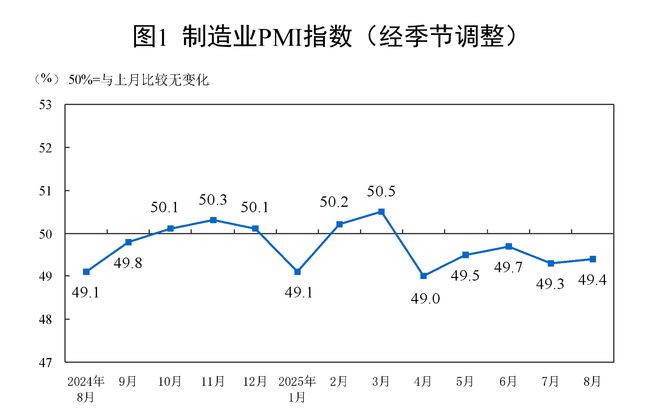
Group 1: Manufacturing Sector - In August, the manufacturing PMI rose to 49.4%, indicating an improvement in economic conditions compared to July [2] - The production index reached 50.8%, up 0.3 percentage points from July, marking an acceleration in manufacturing production [2] - The new orders index increased to 49.5%, reflecting a slight recovery in demand [2] - High-tech manufacturing and equipment manufacturing PMIs were 51.9% and 50.5%, respectively, showing continued strength in these sectors [3] - The prices of major raw materials and factory output prices rose to 53.3% and 49.1%, respectively, indicating an overall improvement in market prices [2][3] Group 2: Non-Manufacturing Sector - The non-manufacturing business activity index was 50.3%, a 0.2 percentage point increase from July, indicating continued expansion [5] - The service sector's business activity index reached 50.5%, the highest point of the year, reflecting a significant recovery [5] - The construction sector's business activity index fell to 49.1%, down 1.5 percentage points from July, due to adverse weather conditions [6] - The business activity expectation index for the service sector was 57.0%, suggesting optimism among service enterprises regarding future market prospects [5] Group 3: Market Expectations - The production and business activity expectation index was 53.7%, up 1.1 percentage points from July, indicating increased confidence among manufacturing enterprises [4] - Analysts expect that the combination of policy support and market self-recovery will continue to release domestic demand potential in the coming months [6]
8月份中国制造业采购经理指数为49.4%
Yang Shi Wang· 2025-08-31 16:10
Core Viewpoint - The Purchasing Managers' Index (PMI) for China's manufacturing and non-manufacturing sectors showed signs of improvement in August, indicating a recovery in economic activity [1][2]. Manufacturing Sector Summary - The manufacturing PMI for August is reported at 49.4%, an increase of 0.1 percentage points from the previous month, reflecting an improvement in manufacturing sentiment [4]. - The production index for August stands at 50.8%, up by 0.3 percentage points, remaining above the critical point for four consecutive months, indicating accelerated production activities [4]. - Key industries such as high-tech manufacturing and equipment manufacturing saw their PMIs rise to 51.9% and 50.5%, respectively, with increases of 1.3 and 0.2 percentage points compared to the previous month, highlighting the strengthening of new growth drivers [4]. - Large enterprises continue to show expansion in their PMI, with an acceleration in the pace of growth, while small enterprises also experienced an improvement in their economic sentiment [4]. Non-Manufacturing Sector Summary - The non-manufacturing business activity index for August is at 50.3%, up by 0.2 percentage points from the previous month, indicating ongoing expansion in the non-manufacturing sector [5]. - The service industry business activity index reached 50.5%, an increase of 0.5 percentage points, marking the highest point of the year [5].

8月PMI:涨价的预期与现实(申万宏观·赵伟团队)
赵伟宏观探索· 2025-08-31 16:06
Core Viewpoint - Supply contraction expectations continue to boost prices, but actual production remains relatively strong, necessitating attention to the effects of "anti-involution" policies [2][69]. Manufacturing Sector - In August, the manufacturing PMI slightly improved, with a rise of 0.1 percentage points to 49.4%, aligning with seasonal performance. The major raw material purchase price index increased by 1.8 percentage points to 53.3%, and the factory price index rose by 0.8 percentage points to 49.1% [2][8][70]. - The production index increased by 0.3 percentage points to 50.8%, while the new orders index saw a modest rise of 0.1 percentage points to 49.5%. Internal demand and new export orders both experienced slight increases [14][70]. - High-energy-consuming industries and equipment manufacturing saw PMIs rise to 48.2% and 50.5%, respectively, driven by price increases and improved external demand. High-tech manufacturing PMI rose by 1.3 percentage points to 51.9% [21][70]. Non-Manufacturing Sector - The service sector PMI improved significantly, rising by 0.5 percentage points to 50.5%, driven by summer travel. However, the construction sector PMI fell by 1.5 percentage points to 49.1%, marking a five-year low [24][71][29]. - The new orders index in the service sector increased by 1.4 percentage points to 47.7%, while the construction new orders index dropped sharply by 2.1 percentage points to 40.6% [62][71]. Future Outlook - Price indices have shown continuous improvement, but supply has not exhibited significant contraction, remaining better than demand. Future focus should be on the effects of "anti-involution" policies [33][71]. - Unlike the supply-side reform in 2016, the current situation requires attention to mid- and downstream supply, especially in cases where upstream price transmission to downstream is ineffective [33][71].
8月PMI:涨价的预期与现实(申万宏观·赵伟团队)
申万宏源宏观· 2025-08-31 12:41
Core Viewpoint - Supply contraction expectations continue to boost prices, but actual production remains relatively strong, necessitating attention to the effects of "anti-involution" policies [2][69] Manufacturing Sector - In August, the manufacturing PMI slightly improved, with a 0.1 percentage point increase to 49.4%, aligning with seasonal performance [2][70] - Major raw material purchase price index rose by 1.8 percentage points to 53.3%, and the factory price index increased by 0.8 percentage points to 49.1%, indicating a significant rebound in prices [2][70] - The production index rose by 0.3 percentage points to 50.8%, while the new orders index only increased by 0.1 percentage points to 49.5%, suggesting that production is outpacing new orders [2][70] - High-energy-consuming industries saw a PMI increase of 0.2 percentage points to 48.2%, and equipment manufacturing PMI also rose by 0.2 percentage points to 50.5% [3][21] - High-tech manufacturing PMI increased by 1.3 percentage points to 51.9%, with both production and new orders indices rising to around 54% [3][21] Non-Manufacturing Sector - The service sector PMI improved significantly, rising by 0.5 percentage points to 50.5%, driven by summer travel and capital market services [3][71] - The construction sector PMI fell by 1.5 percentage points to 49.1%, marking the lowest level in nearly five years, with the new orders index dropping by 2.1 percentage points to 40.6% [3][29][62] - Despite the decline in construction, the service sector's new orders index rose by 1.4 percentage points to 47.7% [3][53] Future Outlook - Price indices show continuous improvement, but supply has not shown significant contraction, and production remains better than demand, highlighting the need to monitor the effects of "anti-involution" policies [4][33] - The focus should shift to mid- and downstream supply, especially in cases where upstream price transmission to downstream is ineffective [4][33]
制造业向好基础继续巩固 景气水平有所改善
Yang Shi Wang· 2025-08-31 12:06
Core Viewpoint - The manufacturing purchasing managers' index (PMI) in China for August is reported at 49.4%, indicating a slight improvement in manufacturing activity compared to the previous month [1] Group 1: Manufacturing Activity - The production index for August stands at 50.8%, which is an increase of 0.3 percentage points from the previous month, marking the fourth consecutive month above the critical point [1] - The PMI for high-tech manufacturing and equipment manufacturing is reported at 51.9% and 50.5% respectively, with increases of 1.3 and 0.2 percentage points compared to last month [1] Group 2: Business Confidence - The manufacturing production and business activity expectation index has risen for two consecutive months, indicating that most manufacturing enterprises are increasingly confident about future market conditions [1] - Large enterprises continue to show expansion in their PMI, with an acceleration in the pace of growth [1]
8月制造业PMI升至49.4%,产需指数均有回升
2 1 Shi Ji Jing Ji Bao Dao· 2025-08-31 11:12
Core Viewpoint - The manufacturing Purchasing Managers' Index (PMI) in China for August 2025 is reported at 49.4%, indicating a slight improvement from the previous month, with production and demand indices showing recovery [1][5]. Manufacturing PMI Overview - The manufacturing PMI increased by 0.1 percentage points from the previous month, reflecting an overall improvement in manufacturing sentiment [1][5]. - The production index stands at 50.8%, up 0.3 percentage points, indicating accelerated production expansion for four consecutive months [1][5]. - The new orders index is at 49.5%, showing a slight increase of 0.1 percentage points, suggesting a minor improvement in market demand [1][5]. Sector Performance - High-tech manufacturing PMI is at 51.9%, and equipment manufacturing PMI is at 50.5%, both showing increases of 1.3 and 0.2 percentage points respectively, indicating sustained expansion in these sectors [2][7]. - The consumer goods sector PMI is at 49.2%, reflecting a decline of 0.3 percentage points, indicating weak terminal demand [7]. - The high-energy consumption sector PMI is at 48.2%, showing a slight increase of 0.2 percentage points, indicating a continuous recovery in this area [7]. Price Indices - The main raw material purchase price index is at 53.3%, up 1.8 percentage points, indicating a return to expansion territory [7]. - The factory price index is at 49.1%, up 0.8 percentage points, but still below the expansion threshold, indicating a slowing decline [7]. - The difference between raw material purchase prices and factory prices is 4.2 percentage points, suggesting a narrowing profit margin in the manufacturing sector [2][7]. Business Confidence - The production and business activity expectation index is at 53.7%, up 1.1 percentage points, indicating improved confidence among manufacturers [2][8]. - This index has reached its highest level since April, reflecting a recovery in business sentiment [8].
【广发宏观郭磊】PMI价格指标连续第三个月回升
郭磊宏观茶座· 2025-08-31 10:01
Core Viewpoint - The August PMI indicates a divergence among industries, with manufacturing stabilizing slightly, service sectors improving significantly, and construction experiencing a notable decline. However, all three sectors show a common trend of improving sales prices [1][5]. Manufacturing Sector - The August manufacturing PMI stands at 49.4, slightly up from 49.3 in July, indicating a need for further support for actual growth [5]. - The production index is above 50 at 50.8, reflecting a stronger production performance compared to new orders, which remain below 50 [9][10]. - The consumer goods sector is a major drag on manufacturing PMI, while high-tech manufacturing shows strength, and both equipment manufacturing and basic raw materials industries show slight improvements [10] - The raw material purchase price index rose to 53.3, up 1.8 points, while the factory price index increased to 49.1, up 0.8 points, marking the third consecutive month of price increases [11][12]. Service Sector - The service sector PMI for August is 50.5, up from 50.0, indicating a positive trend influenced by capital market services, which have seen a business activity index above 70 for two consecutive months [5][10]. - Retail sentiment remains weak, suggesting challenges in consumer spending [10]. Construction Sector - The construction PMI dropped to 49.1 from 50.6, attributed to adverse weather conditions and a slowdown in construction activities [18]. - Fiscal spending on infrastructure showed a year-on-year decline of 3.6% in July, continuing a trend of low spending [18]. Economic Indicators - The three "soft indicators" for August reveal low absolute values, indicating a short-term economic slowdown compared to the first half of the year [19]. - Price indicators show a continuous improvement, which may influence future PPI trends [19]. - The manufacturing inventory index decreased to 46.8, while the raw material inventory index increased to 48.0, reflecting a proactive approach by companies to replenish stocks in response to rising prices [16][15]. Future Outlook - Attention is needed on the government's emphasis on stabilizing construction and actual growth, as well as whether the continuous improvement in PMI price indicators can translate into a rise in PPI [19]. - The manufacturing production expectation index rose to 53.7, the highest since April, indicating improved business expectations possibly linked to price expectations [17].

【新华解读】三大指数均有回升 经济景气水平总体保持扩张——透视8月份PMI数据
Xin Hua She· 2025-08-31 09:54
Group 1 - In August, the manufacturing PMI, non-manufacturing business activity index, and comprehensive PMI output index were 49.4%, 50.3%, and 50.5%, respectively, indicating a slight recovery in economic sentiment [1] - The production index for manufacturing was 50.8%, up 0.3 percentage points from the previous month, marking an acceleration in manufacturing production expansion [2] - The new orders index for manufacturing was 49.5%, showing a 0.1 percentage point increase from last month, with certain sectors like pharmaceuticals and electronics performing significantly better than the overall manufacturing sector [2] Group 2 - The high-tech manufacturing PMI and equipment manufacturing PMI were 51.9% and 50.5%, respectively, both showing increases from the previous month, indicating sustained support and leadership in these sectors [3] - The production and business activity expectation index was 53.7%, up 1.1 percentage points from last month, reflecting increased confidence among manufacturing enterprises regarding future market conditions [3] Group 3 - The non-manufacturing business activity index was 50.3%, with the new orders index rising to 46.6%, indicating a stabilization in supply and demand [4] - The service sector's business activity index reached 50.5%, the highest point of the year, with sectors like capital market services showing particularly strong growth [5] - The construction sector's business activity index fell to 49.1% due to adverse weather conditions, but the business activity expectation index remained slightly above 50 at 51.7% [5]
2025年8月PMI数据点评:三大指数均有回升,景气水平总体扩张
KAIYUAN SECURITIES· 2025-08-31 09:45
Report Industry Investment Rating No information provided. Core Viewpoints of the Report - In the second half of 2025, the economic growth rate may not decline significantly, and structural issues such as prices are trending towards improvement. There will be a continued shift in the stock - bond allocation, with bond yields and the stock market expected to rise continuously [9]. Summary by Related Catalogs Manufacturing - In August, the manufacturing PMI was 49.4%, a month - on - month increase of 0.1 pct and a year - on - year increase of 0.3 pct, indicating an improvement in the manufacturing's prosperity level. Except for the consumer goods industry, other industries' PMIs increased month - on - month. With the implementation of consumption - stimulating policies, the consumer goods industry's PMI is expected to stabilize and rebound [4]. - From the perspective of component indices, the production index was 50.8%, a month - on - month increase of 0.3 pct, and it has been in the expansion zone for 4 consecutive months, indicating an accelerated expansion of manufacturing production. The production and operation activity expectation index was 53.7%, a month - on - month increase of 1.1 pct, rising for two consecutive months, showing a positive market expectation [4]. - In terms of enterprise scale, the PMIs of large and small enterprises increased month - on - month, and the PMI of large enterprises has been in the expansion zone for 4 consecutive months [5]. Non - manufacturing - In August, the non - manufacturing PMI was 50.3%, a month - on - month increase of 0.2 pct and a year - on - year flat, remaining in the expansion zone. The construction industry PMI decreased by 1.5 pct to the contraction zone due to adverse factors such as frequent extreme weather, while the service industry PMI increased by 0.5 pct to the highest point of the year, with an obvious improvement in the prosperity level [6]. - From the perspective of major classification indices, the new order index increased by 0.9 pct month - on - month, and the business activity expectation index increased by 0.4 pct month - on - month, indicating that service enterprises are relatively optimistic about the recent market development prospects [6]. Comprehensive - In August, the comprehensive PMI was 50.5%, a month - on - month increase of 0.3 pct and a year - on - year increase of 0.4 pct, remaining in the expansion zone for 32 consecutive months, indicating an accelerated overall expansion of enterprise production and operation activities [7]. Market - This week, the 10Y treasury bond active bond fluctuated in the range of 1.75% - 1.80%, and the 10Y state - owned development active bond fluctuated in the range of 1.83% - 1.89%. The bond market trading remained insensitive to economic data, with overall fragile sentiment and a stronger sensitivity to negative events than positive events [8].
8月经济运行的三点特征
EBSCN· 2025-08-31 09:00
Manufacturing Sector - August manufacturing PMI increased by 0.1 percentage points to 49.4%, exceeding the market expectation of 49.1%[2] - Production index rose to 50.8%, up 0.3 percentage points from the previous month; new orders index increased to 49.5%, up 0.1 percentage points[5] - Large enterprises' PMI improved significantly to 50.8%, up 0.5 percentage points, while small enterprises' PMI rose to 46.6%, up 0.2 percentage points; medium enterprises' PMI fell to 48.9%, down 0.6 percentage points[5] Export and Import Trends - New export orders index rose to 47.2%, up 0.1 percentage points, indicating stabilization in export momentum[20] - Import index increased to 48.0%, up 0.2 percentage points, reflecting ongoing production expansion[20] Price Indices - Raw material purchase price index rose to 53.3%, up 1.8 percentage points; factory price index increased to 49.1%, up 0.8 percentage points, indicating a potential upward trend in PPI[25] - Raw material inventory index increased to 48.0%, up 0.3 percentage points, while finished goods inventory index decreased to 46.8%, down 0.6 percentage points[25] Service Sector - Service sector business activity index rose to 50.5%, up 0.5 percentage points from the previous month, and higher than last year's 50.2%[29] - The business activity expectation index for the service sector increased to 57.0%, indicating positive market sentiment[29] Construction Sector - Construction sector business activity index fell by 1.5 percentage points to 49.1%, continuing a downward trend for two consecutive months[32] - The decline in construction activity is attributed to adverse weather conditions and reduced demand from real estate and infrastructure investments[32]