光模块

Search documents
茅台罕见跌出前五!最新基金重仓股出炉
中国基金报· 2025-10-28 15:31
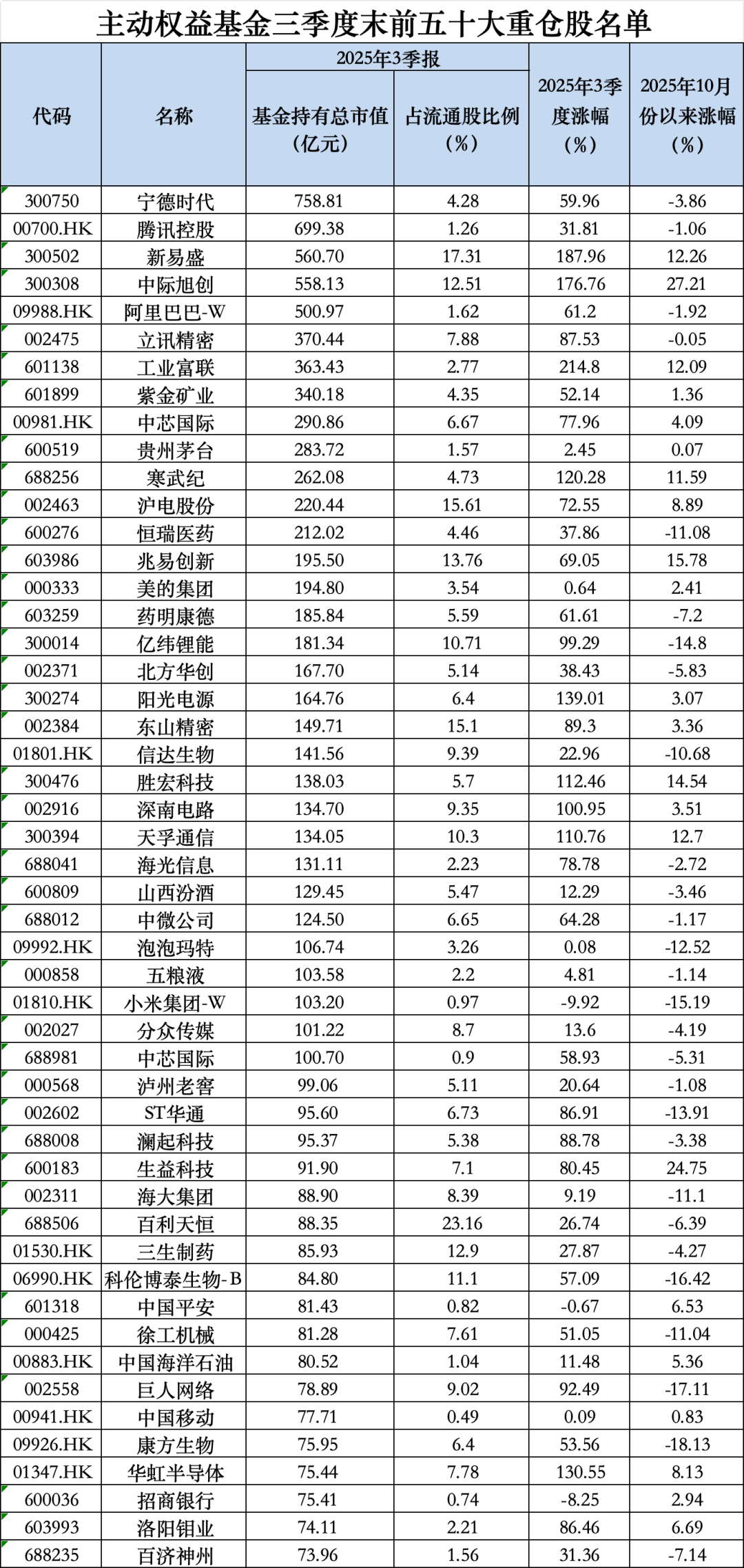
Core Viewpoint - The third quarter saw a significant reshuffling of heavy holdings in active equity funds, with Ningde Times replacing Tencent Holdings as the top holding, while Kweichow Moutai fell to the tenth position due to prolonged underperformance in the liquor sector [2][4][8]. Group 1: Heavy Holdings Changes - The top ten heavy holdings for active equity funds as of the end of the third quarter include Ningde Times, Tencent Holdings, New Yisheng, Zhongji Xuchuang, Alibaba-W, Luxshare Precision, Industrial Fulian, Zijin Mining, SMIC, and Kweichow Moutai [4][6]. - Kweichow Moutai's position in the top ten has significantly declined, marking its lowest ranking in recent years, with a holding value of 28.372 billion yuan, down 3.3% from the previous quarter [8]. Group 2: Technology Sector Performance - The technology sector performed exceptionally well, with several tech stocks entering the top ten heavy holdings, including New Yisheng and Zhongji Xuchuang, which are part of the optical module sector [2][8]. - Active equity funds have significantly increased their holdings in Zhongji Xuchuang and New Yisheng, with Zhongji Xuchuang's stock price soaring by 176.76% and New Yisheng's by 187.96% during the third quarter [10][14]. Group 3: Fund Adjustments - Active equity funds have reduced their holdings in consumer and traditional dividend stocks, with Xiaomi Group experiencing the largest reduction, where the number of funds holding it dropped by 216 to 145, and the holding quantity decreased by 45.90% [16][19]. - Other notable reductions include Midea Group, which saw a decrease in fund holdings by over 8.851 billion yuan, and several banks and power sector stocks also faced sell-offs [16][19].






茅台罕见跌出前五!最新基金重仓股出炉
Zhong Guo Ji Jin Bao· 2025-10-28 15:21
Core Insights - The third quarter saw a significant reshuffling of the top holdings in actively managed equity funds, with Ningde Times replacing Tencent as the top holding, while Kweichow Moutai fell to the tenth position, marking its lowest ranking in recent years [2][3][6]. Group 1: Major Changes in Top Holdings - Ningde Times (300750) regained its position as the top holding with a total market value of 758.81 billion yuan, experiencing a 45.78% increase in fund holding value [4][11]. - Kweichow Moutai (600519) saw a decrease in its market value to 283.72 billion yuan, down 3.3% from the previous quarter, with a reduction in the number of funds holding its shares [6][12]. - New entrants to the top ten include New Yisheng (300502) and Zhongji Xuchuang (300308), both from the optical module sector, reflecting a strong performance in technology stocks [2][3][6]. Group 2: Fund Adjustments and Sector Trends - Actively managed equity funds have significantly increased their holdings in technology stocks, particularly in the optical module sector, with Zhongji Xuchuang and New Yisheng being the top two stocks added to the funds [8][11]. - The number of funds holding Zhongji Xuchuang increased from 392 to 746, a rise of over 90%, while its stock price surged by 176.76% [10][11]. - Conversely, traditional sectors such as consumer goods and banking saw substantial reductions in fund holdings, with Xiaomi Group experiencing the largest decrease in fund support [12][16]. Group 3: Performance Metrics of Key Stocks - New Yisheng's stock price increased by 187.96%, with its market value held by funds rising to 560.70 billion yuan [11]. - Industrial Fulian (601138) and Lixun Precision (002475) also saw significant increases in their fund holdings, reflecting a broader trend of investment in technology and industrial sectors [9][11]. - The overall trend indicates a shift away from consumer and traditional dividend stocks, with funds reallocating towards high-growth technology companies [12][16].

公募十大重仓股出炉!这些股票被增持
Zhong Guo Zheng Quan Bao· 2025-10-28 15:00
Core Insights - Public funds have disclosed their top ten holdings for Q3 2025, with CATL (宁德时代) returning as the largest holding, followed by Tencent and several other tech stocks [1][2] Group 1: Top Holdings - CATL regained its position as the largest holding among public funds with a market value of 75.881 billion yuan [2] - Tencent Holdings dropped to the second position with a market value of 69.938 billion yuan [2] - New entrants to the top ten holdings include Zhongji Xuchuang and Industrial Fulian, while Midea Group and Xiaomi Group exited the list [1][2] Group 2: Increased Holdings - The most significant increases in holdings for Q3 were seen in Zhongji Xuchuang and New Yisheng, with increases of 40.174 billion yuan and 36.930 billion yuan, respectively [2] - Industrial Fulian, Alibaba-W, and CATL also saw substantial increases, each exceeding 20 billion yuan [2] Group 3: Decreased Holdings - Xiaomi Group was the most significantly reduced holding, with a decrease of 10.834 billion yuan [3] - Other notable reductions included Midea Group, China Merchants Bank, and SF Express, each with reductions exceeding 7 billion yuan [3][5] Group 4: Sector Performance - The technology sector performed exceptionally well in Q3, with many of the top increased holdings being tech stocks, particularly in AI-related fields [4] - Zhongji Xuchuang, New Yisheng, and Industrial Fulian saw stock price increases of over 170%, 180%, and 210%, respectively [4] Group 5: Fund Manager Insights - Fund managers express optimism about the technology sector, particularly regarding AI and its related investment opportunities [8] - There is a cautious approach towards the long-term outlook of tech stocks due to uncertainties in competition and technology evolution [8]




睿远基金旗下明星经理持仓出炉!看好人工智能浪潮 增持阿里巴巴(09988)等
智通财经网· 2025-10-28 13:47
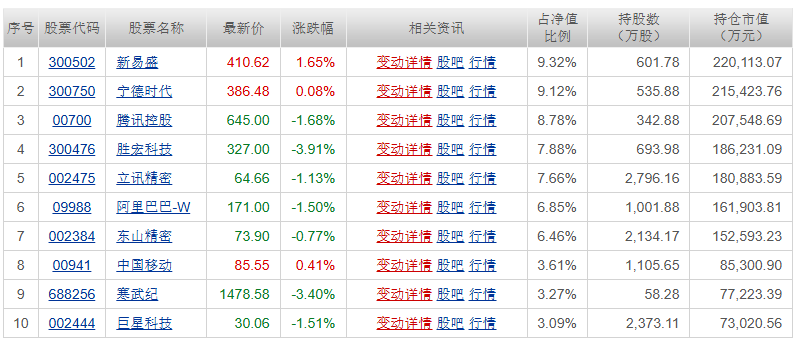
Core Viewpoint - The report highlights that prominent fund managers from Ruifeng Fund have increased their holdings in leading technology companies like Alibaba, indicating a strong belief in the potential of artificial intelligence as a major technological transformation following the internet era [1]. Group 1: Fund Performance - The Ruifeng Growth Value Mixed Fund, managed by Fu Pengbo and Zhu Lin, saw a net value increase of over 50% in Q3, with A-class shares rising by 51.09%, outperforming the benchmark by 14.82%, marking the highest quarterly record since its inception in 2019 [1]. - The top ten holdings of the fund included three stocks that doubled in price during Q3: Xinyi Technology (300502.SZ), Shenghong Technology (300476.SZ), and Cambricon Technologies (688256.SH), although these stocks were reduced in holdings [1][2]. - The fund maintained a high stock asset allocation, with over 90% in equities, and the top ten holdings accounted for 66% of the net value, showing a significant increase from Q2 [2][3]. Group 2: Stock Holdings and Adjustments - The fund reduced its positions in long-held stocks that experienced rapid price increases due to misleading news, indicating a cautious approach to valuation adjustments [3]. - The Ruifeng Balanced Value Three-Year Holding Mixed A Fund, managed by Zhao Feng, achieved a net value growth rate of 19.29% in the reporting period, outperforming the benchmark by 5.59% [3][4]. - Zhao Feng's fund maintained a stable portfolio with slight increases in leading internet companies focused on AI and undervalued home appliance companies with stable profit growth prospects [3][4]. Group 3: Sector Focus and Future Outlook - The fund managers expressed optimism about AI, emphasizing its rapid integration across various industries and daily life, with significant growth in AI-related investments [5][6]. - Despite the unclear future returns from substantial investments in foundational models and data centers, leading internet companies are well-positioned to support their capital expenditures due to strong cash flows [6]. - The report notes that traditional industries with low historical valuations and stable free cash flows are becoming increasingly attractive, suggesting a lower risk of decline and potential for recovery in demand [6].
历史重现,十年首次
3 6 Ke· 2025-10-28 12:27
Group 1 - The A-share market has seen a significant milestone with the Shanghai Composite Index breaking the 4000-point barrier for the first time in a decade, indicating a major shift in investor sentiment towards the market [1][2][4] - The recent rally is primarily driven by the "technology bull" market, with sectors such as AI, lithium batteries, and innovative pharmaceuticals leading the charge, contrasting with traditional sectors like consumption and real estate which have underperformed [5][12] - The market's performance is characterized by a "slow bull" trend, where the structural features of the technology sector have significantly influenced investor risk appetite and market dynamics [4][12] Group 2 - Recent data shows that the technology sector remains the strongest market driver, with significant interest in areas like AI and communication technologies, as evidenced by partnerships and collaborations in the North American AI space [7][8] - The performance of technology stocks has been robust, with companies in the optical module sector reporting substantial profit growth, indicating a strong recovery and potential for further investment [8][11] - The market is expected to continue focusing on technology-driven sectors, with government policies supporting strategic emerging industries and technological breakthroughs [15][16] Group 3 - The narrative surrounding the A-share market has shifted from mere corporate earnings improvement to broader themes such as technological breakthroughs and anti-involution, which are now key variables influencing market risk preferences [12][19] - External capital is increasingly optimistic about the Chinese stock market, with forecasts suggesting a potential 30% increase in major indices by the end of 2027, driven by favorable macroeconomic conditions and valuation discrepancies [12][23] - The market is witnessing a rotation in investment focus, with technology and anti-involution themes gaining traction, suggesting a new phase in market dynamics as the index stabilizes above 4000 points [21][22][23]

创业板人工智能逆市上涨!159363迭创新高,资金进场!三季报业绩预期驱动,光模块有望延续强势?
Xin Lang Ji Jin· 2025-10-28 11:50
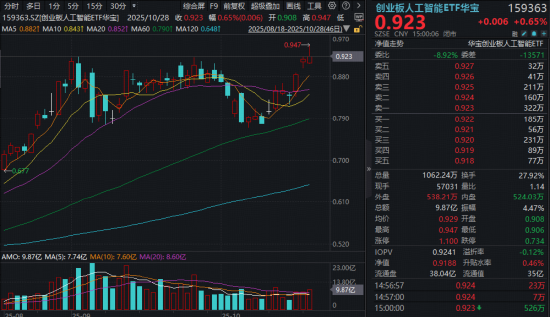
Core Insights - The AI sector, particularly in the context of optical modules, is experiencing significant growth, with the ChiNext AI index showing a year-to-date increase of 93% as of October 28, 2025, outperforming other AI-themed indices [3][4] - Major companies in the optical module space, such as NewEase and Zhongji Xuchuang, are reaching historical highs, driven by increased demand for 1.6T optical modules due to the rapid growth in AI training and inference network bandwidth requirements [3][4] Group 1: Market Performance - The ChiNext AI index has risen by 93% year-to-date, leading other AI indices like CS AI and Sci-Tech AI [3] - The largest and most liquid ETF tracking the ChiNext AI index (159363) saw a 0.6% increase, with a net subscription of 28 million units on the same day [3][4] - Key stocks in the sector, including LianTe Technology, surged over 15%, while others like XieChuang Data and Guotou Intelligent rose over 3% [3] Group 2: Industry Developments - Qualcomm launched AI chips, AI200 and AI250, expected to be commercially available in 2026 and 2027, respectively, intensifying competition with Nvidia in the data center market [3] - Recent research indicates that overseas clients have increased their 2026 procurement plans for 1.6T optical modules from 10 million to 20 million units, driven by the deployment of GB300 and the upcoming Rubin platform [3] - The demand for 800G optical modules is expected to continue its rapid growth, benefiting leading companies like Zhongji Xuchuang and NewEase [3][4] Group 3: Investment Recommendations - Analysts recommend focusing on the AI computing power sector, particularly the optical module segment, as the industry is still in its early stages of development with significant growth potential [4] - The first ETF tracking the ChiNext AI index is highlighted as a key investment vehicle, with over 70% of its portfolio allocated to computing power and over 20% to AI applications [4]

国信证券荀玉根:“买好的”看科技主线 “买得好”关注地产、券商、白酒消费
Zhi Tong Cai Jing· 2025-10-28 11:47
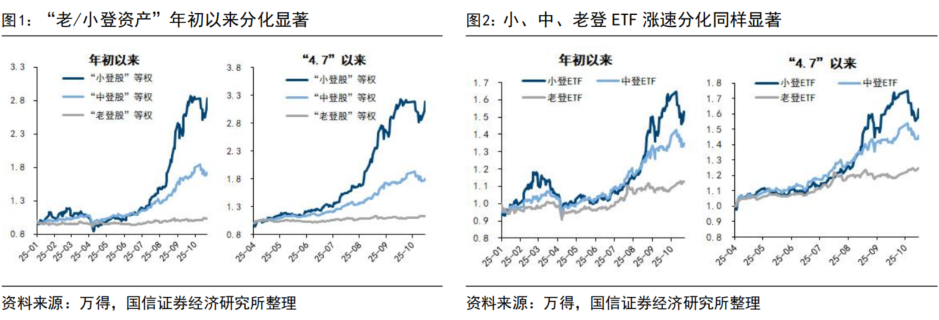
Core Viewpoint - The report by Guosen Securities highlights an extreme divergence between "old" and "new" assets in the market, emphasizing that high growth does not necessarily equate to high investment returns, and that finding fundamentally sound valuation opportunities can lead to significant returns [1][2]. Group 1: Performance Divergence - Since 2025, "small new stocks" have significantly outperformed "old stocks," with the "small new stock" portfolio rising by 183.8% compared to just 3.9% for "old stocks" [2]. - From April 7, 2025, "small new stocks" surged over 200%, while "old stocks" only increased by 13.6% [2]. - The "small new ETF" has risen by 53.1% since 2025, while the "old ETF" has only seen a 13.1% increase [2]. Group 2: Valuation and Market Activity - As of October 24, the PE ratio for "small new" sectors like electronics and computing is at the 99th percentile since 2019, while "old" sectors like real estate and liquor are at the 56th percentile [8]. - The trading volume for "small new" sectors has increased to 33%, while "old" sectors have dropped to below 2.8%, indicating a significant divergence in market activity [8]. Group 3: Investment Strategy - The report stresses the importance of not only selecting high-quality stocks ("buy good") but also ensuring they are purchased at favorable valuations ("buy well") to achieve high returns [11]. - Historical examples illustrate that higher growth does not guarantee better returns, as seen in the comparison between IBM and New Jersey Standard Oil from 1950 to 2003 [11][12]. - The banking sector has shown resilience, with a decline of only 3.9% compared to a 31.1% drop in the overall market, highlighting the potential for finding undervalued stocks with solid fundamentals [15]. Group 4: Market Trends and Seasonal Effects - The current market is characterized by a "small new stock" era, but there are seasonal opportunities for "old stocks," particularly in real estate, liquor, and brokerage sectors [20][29]. - Historical bull markets have shown that each cycle has a leading sector that aligns with prevailing economic trends, with AI and technology being the current focus [21]. - Seasonal effects suggest that value sectors may outperform in the fourth quarter, with historical data indicating a 64% success rate for value over growth during this period [23].

CPO龙头股再创新高,莫海波等基金经理跑路了?算力硬件、国产替代仍是科技重头戏!
市值风云· 2025-10-28 10:08
Core Viewpoint - The article discusses the performance and strategic adjustments of fund manager Mo Haibo, particularly focusing on his investments in the technology sector and the recent shifts in his portfolio amidst market volatility [3][5][21]. Group 1: Fund Performance - Many fund managers have benefited from heavy investments in innovative pharmaceutical stocks and AI hardware, achieving significant net value increases this year, with some funds doubling their value and rising over 50% [3]. - Mo Haibo's fund has seen a net value increase of over 60% this year, positioning him as a leading fund manager with a scale of 131 billion [5][8]. - Despite the strong performance, there has been a notable increase in market volatility in October, leading to questions about the sustainability of high valuations in the CPO sector [5][16]. Group 2: Portfolio Adjustments - In the third quarter, Mo Haibo maintained a strong focus on technology, with significant allocations to the communication and electronics sectors, holding 38.1% and 35.5% respectively, both up nearly 8 percentage points from the previous quarter [9][21]. - There was a substantial reduction in holdings of key stocks such as New Yisheng and Zhongji Xuchuang, with reductions of 61% and 52% respectively, indicating a strategic shift within the technology sector [11][20]. - The article notes that many public funds have taken profits by significantly reducing their holdings in high-performing stocks during the third quarter [16]. Group 3: Market Outlook - Mo Haibo expressed optimism about the domestic computing opportunities, particularly in light of the ongoing U.S.-China trade tensions, emphasizing the urgent need for self-sufficiency in computing technology [20][21]. - The coal sector has been highlighted as a new area of focus, with Mo Haibo reducing exposure to agricultural stocks and reallocating to coal, anticipating a reversal in supply-demand dynamics and potential price increases due to low inventory levels [21][22]. - Overall, the article suggests that the technology sector remains a primary focus for Mo Haibo, with ongoing adjustments reflecting market conditions and investment opportunities [22].

历史重现!十年首次!
Ge Long Hui· 2025-10-28 10:05
Group 1 - The A-share market has seen a significant milestone with the Shanghai Composite Index breaking the 4000-point barrier for the first time in a decade, signaling a major shift in investor sentiment towards the market [1][3][5] - The rise from 2700 to 4000 points in just one year highlights a complete transformation in confidence towards the A-share market, particularly driven by the technology sector [3][5] - The current market rally is characterized by a "technology bull" trend, with sectors such as AI, lithium batteries, and innovative pharmaceuticals leading the charge, contrasting with traditional sectors like consumption and real estate [5][6] Group 2 - The technology sector has emerged as the main driver of the market, with significant gains in sub-sectors like AI, communication, and electronics, while traditional non-bank sectors have underperformed [6][8] - Recent developments in the AI sector, including major collaborations and increased demand for computing power, are expected to further boost the performance of technology stocks [9][10] - The positive cycle of capital expenditure expansion and commercialization in the AI sector is providing strong momentum for the performance of the supply chain, particularly in optical module companies [10][18] Group 3 - The market is expected to continue focusing on technology as the Shanghai Composite Index reclaims the 4000-point level, with strategic emerging industries highlighted in the recent policy announcements [18][19] - Future industries such as quantum computing, bio-manufacturing, and hydrogen energy are anticipated to attract significant investment, reflecting a shift towards new production capabilities [19][20] - The ongoing emphasis on reducing competition and improving profitability in various sectors is likely to enhance the long-term investment value of the market [22][23]
历史重现!十年首次!
格隆汇APP· 2025-10-28 09:33
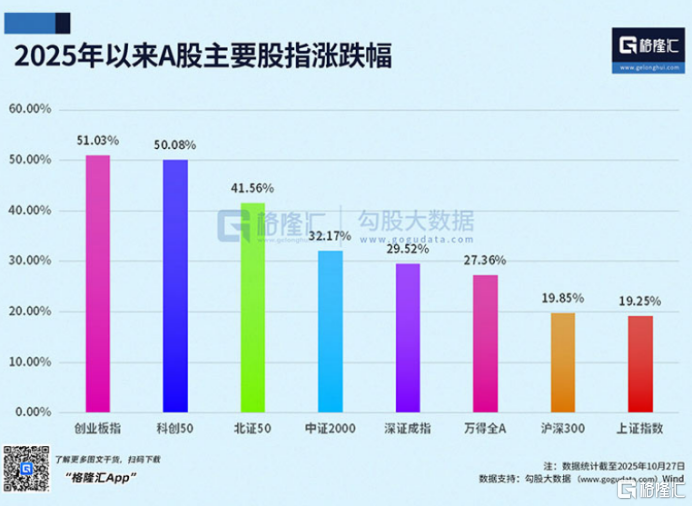
Core Viewpoint - The A-share market has shown significant confidence, with the Shanghai Composite Index breaking the 4000-point mark for the first time in a decade, indicating a major shift in investor sentiment towards the market [2][4][5]. Market Performance - After briefly surpassing 4000 points, the index experienced increased volatility, closing at 3988.22 points, down 0.22% [3]. - The past year has seen the Shanghai Composite Index rise from 2700 to 4000 points, reflecting a complete transformation in market confidence [5]. Sector Analysis - The technology sector has emerged as the main driver of the market, with indices like the ChiNext and STAR Market showing even greater gains than the Shanghai Composite [6][10]. - Key sectors leading the market include AI, lithium batteries, innovative pharmaceuticals, and non-ferrous metals, with significant performance from communication, electronics, and computing sectors [9][10]. Market Dynamics - The current market rally is characterized as a "technology bull market," driven by structural changes in the economy, technological breakthroughs, and shifts in investor risk appetite [8][21]. - The recent recovery in risk appetite has been crucial for the technology sector, with positive market movements following successful US-China trade talks [14]. Future Outlook - The long-term outlook for the A-share market appears optimistic, with foreign investors expressing bullish sentiments and expectations of a 30% increase in major indices by the end of 2027 [22][23]. - The focus on future industries, including quantum technology, bio-manufacturing, and hydrogen energy, is expected to attract investment and drive market growth [26][28]. Policy and Economic Environment - Recent government policies aimed at reducing competition and improving industry profitability are anticipated to enhance the long-term investment value of sectors affected by "de-involution" [31][32]. - The market is expected to continue evolving, with a shift towards technology and innovation as key themes, supported by favorable macroeconomic conditions and industry dynamics [35].