
交通运输

Search documents
前三季度海南全省经济运行总体平稳
Sou Hu Cai Jing· 2025-10-28 00:46
Core Insights - Hainan's GDP for the first three quarters of the year reached 568.64 billion yuan, with a year-on-year growth of 3.9% [1] - The primary industry contributed 23.4% to economic growth, with an increase of 5% year-on-year, while the secondary and tertiary industries contributed 13.7% and 62.9% respectively [1] - Industrial production in Hainan showed robust growth, with an industrial added value of 66.52 billion yuan, growing by 10%, surpassing the national average by 3.9% [2] Economic Performance - The overall economic operation in Hainan is stable, with a month-on-month recovery trend observed, peaking in September [1] - The agricultural, forestry, animal husbandry, and fishery sectors achieved an added value of 122.51 billion yuan, growing by 5.3%, which is 1.3 percentage points higher than the national average [1] Sector Contributions - The financial sector's added value reached 39.90 billion yuan, with a year-on-year growth of 5.1%, slightly above the national average [2] - The real estate sector, along with resident services and education, showed growth rates of 4.1%, 11.4%, and 5.4% respectively, all exceeding the overall GDP growth rate [2] Consumer Trends - Social retail sales in Hainan increased by 8.6% year-on-year, driving the wholesale and retail sector's added value up by 7.4% [2] - The transportation, warehousing, and postal sectors also saw a growth of 9%, outperforming the national average by 3.2% [2]
创两个月最大涨幅,人民币升值或继续助推资产重估
Xuan Gu Bao· 2025-10-27 23:59
Industry Insights - The appreciation of the RMB is expected to lead to a revaluation of Chinese assets, with the stock market likely to maintain a bullish atmosphere due to marginal economic stabilization and relatively loose liquidity [1] - Industries such as transportation, non-ferrous metals, petrochemicals, machinery, home appliances, electronics, and power equipment are anticipated to benefit from the appreciation of the RMB, considering factors like exchange gains and losses, foreign currency liabilities, northbound holdings, and raw material imports [1] - For industries like aviation and papermaking, where many products are settled in foreign currencies, the appreciation of the RMB will reduce costs and enhance profits [1] Company Highlights - Shanying International is recognized for its leading position in the paper and packaging printing sectors in China [1] - Huaxia Airlines is identified as an independent private airline company that focuses on regional transportation [1]
捷安高科:10月27日召开董事会会议
Mei Ri Jing Ji Xin Wen· 2025-10-27 16:50
Core Viewpoint - The company, Jiean High-Tech, announced its third-quarter report for 2025 during a board meeting held on October 27, 2025, and provided insights into its revenue composition for the first half of 2025 [1] Group 1: Company Financials - Jiean High-Tech's revenue composition for the first half of 2025 is as follows: 40.81% from the vocational education sector, 38.8% from the transportation sector, and 20.39% from other businesses [1] - As of the report, Jiean High-Tech has a market capitalization of 2.3 billion yuan [1]

海峡股份(002320.SZ):前三季净利润1.9亿元 同比下降32.11%
Ge Long Hui A P P· 2025-10-27 13:36
格隆汇10月27日丨海峡股份(002320.SZ)公布三季度报告,前三季营业收入39.2亿元,同比下降0.52%, 归属于上市公司股东的净利润1.9亿元,同比下降32.11%,归属于上市公司股东的扣除非经常性损益的 净利润1.6亿元,同比下降40.06%。 ...

国泰海通|建筑:十五五规划大力实施城市更新,9月广义基建投资降8%
国泰海通证券研究· 2025-10-27 11:33
Group 1 - The Fourth Plenary Session emphasizes accelerating the construction of a strong transportation nation and implementing urban renewal in the 14th Five-Year Plan, focusing on optimizing traditional industries and fostering emerging sectors [1] - The 14th Five-Year Plan anticipates the construction and renovation of over 700,000 kilometers of underground pipelines, with an additional investment demand exceeding 5 trillion yuan [1] Group 2 - In September, the total retail sales of consumer goods grew by 3.0% year-on-year, with a month-on-month decline of 0.4 percentage points [2] - Fixed asset investment decreased by 7.1% year-on-year, maintaining a similar decline compared to August [2] - Exports increased by 8.3% year-on-year, with a month-on-month growth of 4.0 percentage points [2] Group 3 - In September, broad infrastructure investment fell by 8.0%, with the decline expanding by 25.5 percentage points compared to the same month in 2024 [3] - Narrow infrastructure investment decreased by 4.6%, with a year-on-year decline of 6.8 percentage points compared to 2024 [3] - Water conservancy investment dropped by 22.4% year-on-year, while public facilities investment fell by 12.4% [3]


海峡股份:2025年前三季度净利润同比减少32.11%
2 1 Shi Ji Jing Ji Bao Dao· 2025-10-27 11:05
Group 1 - The company reported a revenue of 39.226 billion yuan for the first three quarters of 2025, representing a year-on-year decrease of 0.52% [1] - The net profit attributable to shareholders of the listed company was 190 million yuan, down 32.11% year-on-year [1] - The basic earnings per share were 0.09 yuan, reflecting a year-on-year decline of 32.33% [1]
毕马威重磅发布《大变局:基建与交通运输行业新兴趋势》
Sou Hu Cai Jing· 2025-10-27 02:40
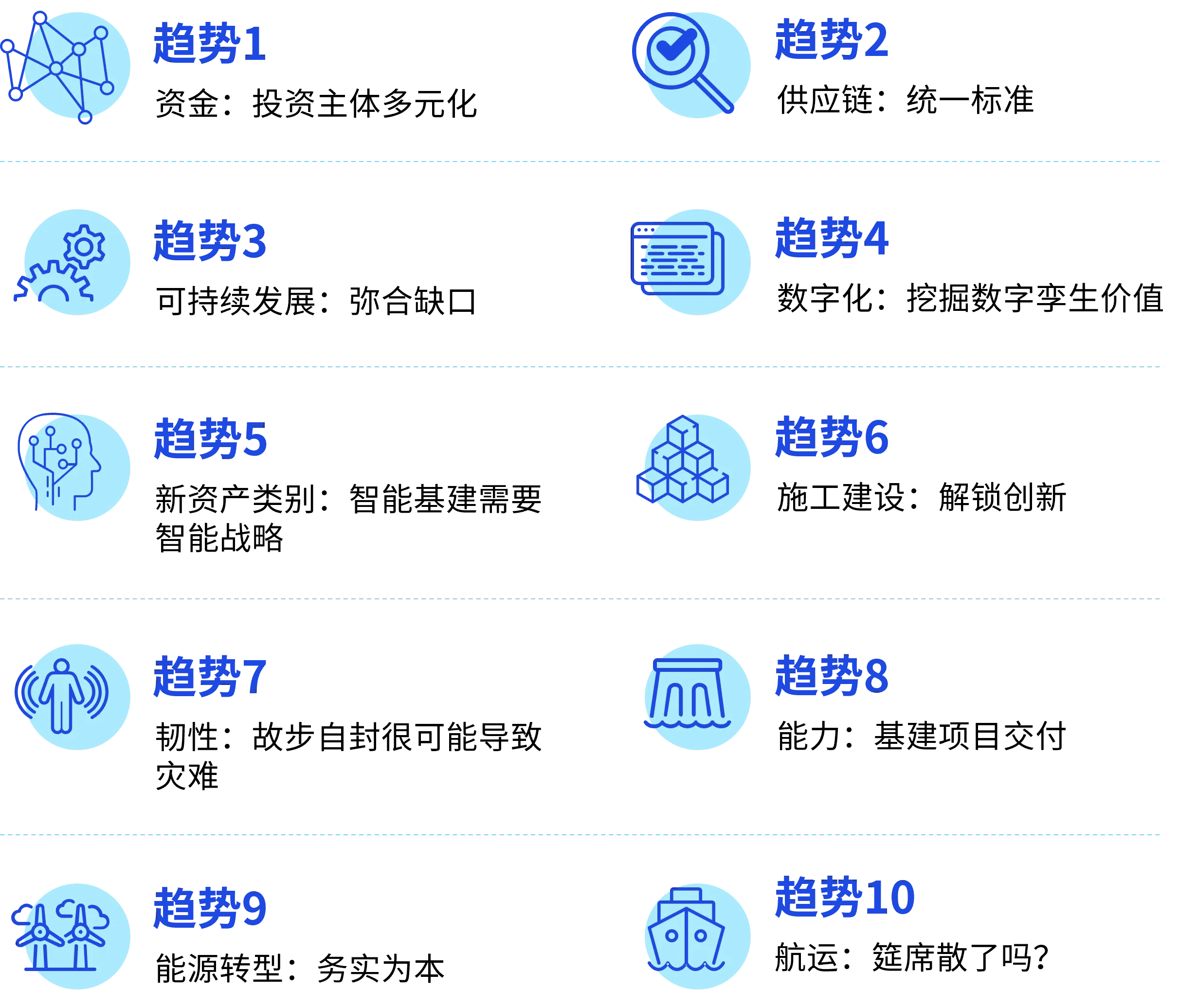
Core Insights - The report by KPMG titled "Transformations: Emerging Trends in Infrastructure and Transportation" analyzes significant changes facing the industry and provides forward-looking predictions for the next year [1] - The report is based on insights from ten senior leaders in the infrastructure sector, offering a deep understanding of the global shifts impacting the industry [1] Key Judgments - By 2025, rising public debt yields, withdrawal of bilateral investments, and a stronger dollar will intensify fiscal pressures, leading to fierce competition among countries for patient capital, making private investment and diversified investment entities crucial trends [6] - Governments will face increased funding costs due to rising public debt yields, while the retreat of bilateral investments and development aid will further weaken the fiscal capacity of emerging markets [7] - The demand for resilient infrastructure and modern services is expected to surge, with governments needing to meet public expectations to ensure social and economic stability [7] Predictions and Recommendations - Countries will compete for patient capital, with some emulating India's National Monetization Pipeline (NMP) to accelerate private investment in specific sectors [8] - Establishing clear asset listing channels with transparent regulatory frameworks will encourage innovation and reinvestment, providing reasonable returns for private investors [8] - Stakeholders must engage with citizens, national pension funds, and institutional investors to identify target assets and conduct due diligence [8] Key Developments in Supply Chain - By 2025, supply chains will face immense pressure due to trade wars and new tariff regulations, necessitating efficiency improvements and stricter evaluations of emissions [11] - The need for supply chain standardization will be recognized, although actual implementation will take time [10][12] - Companies will be compelled to enhance supply chain efficiency through collaboration with government and industry bodies [11] Sustainable Transformation - Governments and enterprises will begin to bridge the gap between actions and goals, ensuring daily operations align with long-term sustainability objectives [13][14] - Major regulations will drive sustainable transformations, with construction owners needing to understand material sources and carbon footprints [15] Digital Twin Technology - By 2025, digital twin technology will become a key tool for enhancing operational efficiency and decision-making due to decreasing costs and increasing demand for insights [16][17] - Companies that do not adopt digital twins will face scrutiny from stakeholders and competitive disadvantages [18] Dynamic Strategic Planning - Enterprises should transition from static annual plans to dynamic strategic planning methods, leveraging real-time data and advanced technologies to improve decision quality and efficiency [19][20] - This shift will enhance performance and profitability while providing significant benefits to all stakeholders [21] Construction Industry Pressures - Construction companies will face exponential growth pressures, particularly in energy and infrastructure sectors, but can leverage technology and AI to improve efficiency and profit margins [22][23] - Companies are advised to invest in technology, enhance supply chains, and adjust operational models to drive innovation [24] Infrastructure Asset Management - Infrastructure asset failures could lead to catastrophic consequences, necessitating comprehensive assessments to evaluate risks and develop operational resilience goals [26][27] - Companies should prioritize high-risk asset updates and protections to avoid future risks and costs [28] Supply Chain Management - Owners of public and private infrastructure investment portfolios will actively engage in supply chain management, establishing long-term relationships with suppliers to address delivery capacity and talent bottlenecks [29][30] - Digitalization and technology will enhance supply chain efficiency, enabling companies to prepare for future disruptions [31] Pragmatism in Financing - Pragmatism will drive companies to strengthen collaboration and develop hybrid financing models to enhance social and environmental project impacts [32][33] - Companies will focus on data capture and reporting to demonstrate project benefits, balancing environmental impact with economic practicality [34] Shipping Industry Adaptation - Shipping companies must adapt to rate fluctuations and sustainability pressures amid trade protectionism and supply chain disruptions [35][36] - Companies are encouraged to reconsider investment strategies, focusing on long-term effective areas and engaging in scenario planning [37]
养老金三季度现身45只股前十大流通股东榜
Zheng Quan Shi Bao Wang· 2025-10-27 01:44
Core Insights - Pension funds have actively invested in the secondary market, appearing in the top ten circulating shareholders of 45 stocks by the end of Q3, with 23 new entries and 7 increased holdings [1][2] - The total shareholding amount of pension accounts reached 379 million shares, with a total market value of 10.011 billion yuan [1] - The most significant holdings include Haiyou Development and Shenzhen Airport, with respective holdings of 65.3843 million shares and 24.2047 million shares [1][2] Summary by Category Shareholding Details - Haiyou Development is the largest holding, with pension funds holding 65.3843 million shares, a 25.49% increase from the previous quarter [2][3] - Shenzhen Airport follows with 24.2047 million shares, maintaining its position [2] - Other notable holdings include Blue Sky Technology (20.7810 million shares, 6.78% of circulating shares) and Spring Wind Power (7.9514 million shares, 5.21% of circulating shares) [2][3] Performance and Sector Distribution - Among the stocks held by pension funds, 30 companies reported net profit growth in Q3, with the highest increase seen in Zhi De Mai, achieving a net profit of 13.4486 million yuan, a 253.49% year-on-year increase [2] - The stocks are primarily distributed across the main board (25 stocks), ChiNext (16 stocks), and STAR Market (4 stocks), with a focus on the machinery equipment and pharmaceutical industries, each having 7 stocks represented [2][3] New Entrants and Changes - A total of 23 new stocks were added to the pension fund's portfolio, with notable new entries including North Copper Industry and Hubei Yihua [3] - The pension fund's longest-held stock is Jiajiayue, which has been in the top ten shareholders for 28 consecutive reporting periods, holding 13.3027 million shares [2]


9家公司重要股东开启增持模式 累计增持29.94亿元(附股)
Zheng Quan Shi Bao Wang· 2025-10-27 01:44
Core Insights - In the past five trading days (October 20 to October 24), a total of 9 companies saw significant shareholder increases, with a cumulative increase of 242 million shares and a total investment of 2.994 billion yuan [1] - During the same period, 107 companies experienced shareholder reductions, amounting to a total reduction of 9.443 billion yuan [1] Summary by Category Shareholder Activity - The top three companies with the highest increase in shareholder investment are Sichuan Road and Bridge, with an increase of 174 million shares and an investment of 1.530 billion yuan; followed by Changjiang Electric Power, with an increase of 49.56 million shares and an investment of 1.366 billion yuan; and Wuzhou Transportation, with an increase of 3.826 million yuan [1][2] - The main board accounted for 9 stocks in the shareholder increase category, with a total increase amount of 2.994 billion yuan [1] Industry Distribution - The significant shareholder increases were primarily concentrated in the steel and construction decoration industries, with 2 stocks each [1] Market Performance - The average increase in stock prices for companies with shareholder increases over the past five days was 1.86%, which was weaker than the overall performance of the Shanghai Composite Index during the same period [1] - Notable stock price increases were observed in Huamao Technology (10.62%), Wuzhou Transportation (2.84%), and China Communications Design (2.63%), while declines were seen in Vanadium Titanium Shares (-1.01%) and Xingfa Group (-0.56%) [1][2] Fund Flow - Among the stocks with shareholder increases, 6 experienced net inflows of main funds, with Changjiang Electric Power leading at a net inflow of 171 million yuan [2] - The stocks with the highest net outflows included Vanadium Titanium Shares and Jiangzhong Pharmaceutical, with outflows of 67 million yuan and 6 million yuan, respectively [2] Performance Metrics - Of the stocks with significant shareholder increases, 2 have released their third-quarter reports, with Jiangzhong Pharmaceutical showing the highest net profit growth of 5.54% year-on-year [2]





公募最新策略看好结构性行情 两类权益资产配置价值凸显
Zhong Guo Zheng Quan Bao· 2025-10-26 23:18
Group 1 - The A-share market is showing resilience amidst a complex environment, with institutional focus on AI technology, cyclical stocks, and large-cap blue chips as key investment directions [1] - The overall liquidity in the domestic market is balanced and slightly loose, leading to a liquidity-driven structural market in A-shares, with significant trading volume in Q3, pushing the Shanghai Composite Index to a nearly ten-year high [2] - The Hang Seng Index is positively influenced by the weakening US dollar and continuous inflow of southbound funds, providing dual support for its valuation and liquidity [3] Group 2 - Two categories of equity assets are highlighted for their investment value: high-dividend blue-chip stocks and high-growth stocks in sectors like renewable energy and AI, which are expected to attract long-term funds [4] - There is an expectation for new policies aimed at expanding domestic demand to be introduced by the end of the year, which could benefit leading companies in sectors like coal, cement, steel, and chemicals [5] Group 3 - The bond market is expected to remain volatile, with the 10-year government bond yield fluctuating around 1.8%, and a cautious defensive strategy is recommended [6] - The bond market's performance is being constrained by the strong equity market, but there are opportunities in certain credit products, particularly in city investment bonds and perpetual bonds [7]