保险

Search documents
稳物价促改革 强监管惠民生
Xin Lang Cai Jing· 2026-02-26 23:51
Core Viewpoint - The Tibet Autonomous Region Development and Reform Commission has achieved significant results in stabilizing price levels, deepening price reforms, regulating market order, and improving people's livelihoods, providing a solid price guarantee for long-term stability and high-quality development in Tibet [1]. Group 1: Price Stability Measures - The price department prioritizes "stabilizing prices" in response to challenges such as imported inflation, high transportation costs, and extreme weather [1]. - From 2022 to 2024, the Consumer Price Index (CPI) in the region is controlled to remain within a 3% increase for three consecutive years [1]. - Monitoring of essential livelihood goods such as grains, oils, meat, vegetables, eggs, fruits, and milk is strengthened, with emergency monitoring initiated during important festivals for early detection and response [1]. Group 2: Electricity and Fuel Pricing - A special electricity policy for border residents and businesses has been implemented, offering a 50% discount on electricity prices [1]. - The price structure for electricity sales has been optimized to reduce social energy costs [1]. - Significant reductions in fuel prices have been made, with the price differences between regions like Chamdo and Ali reduced to 250 yuan/ton and 500 yuan/ton, respectively, addressing the issue of high fuel costs [1]. Group 3: Aviation and Agricultural Pricing - The financial subsidy for flights entering and leaving Tibet has been increased to 30%, benefiting 1.08 million passengers and providing over 1.05 billion yuan in savings [1]. - Comprehensive reforms in agricultural water pricing have been advanced, covering 3.8087 million acres with a water fee recovery rate exceeding 90% [1]. Group 4: Educational and Water Pricing Reforms - The government has set a guiding price for compulsory education subject training and adjusted textbook printing prices [2]. - A tiered pricing system for urban water supply is being promoted [2]. - Collaboration agreements with the insurance industry have been established to support food security and rural revitalization in key production areas [2]. - The pricing directory for the Tibet Autonomous Region has been revised to clarify the boundaries between government and market, stimulating market vitality [2].
平安健康险让健康管理更精细
Xin Lang Cai Jing· 2026-02-26 22:49
Core Viewpoint - Ping An Health Insurance has launched a health nutrition initiative and the "Chang Xiang Ban" health membership card, aiming to integrate health insurance with medical services and transition into a professional health management company [1][2]. Group 1: Health Initiatives - The company introduced a professional and scientific health nutrition initiative for Chinese family kitchens, along with a "health kitchen" online shopping section [1]. - The health nutrition standards were developed in collaboration with authoritative nutrition institutions and industry experts, focusing on nutrition, safety, processing, and cooking [1]. Group 2: Membership Card and Services - The "Chang Xiang Ban" health membership card offers nine service benefits covering health diet, active exercise, and quality medical services, creating a comprehensive health protection system [2]. - The company aims to extend health management from "prevention" to "in-process management," enhancing the precision and professionalism of health management services [2].

资金回流部分宽基ETF 市场主线向“盈利驱动”切换
Zhong Guo Zheng Quan Bao· 2026-02-26 20:28
Group 1 - The South Korea-China Semiconductor ETF (513310) surged by 9.64%, leading the market on February 26, with a premium rate of 21.10% and a turnover rate exceeding 125% [2][3] - The semiconductor equipment sector continues to rise, driven by a sustained "supply-demand imbalance" in the global storage industry, which is expected to maintain its upward trend until after 2027 [2] - The strong performance of the semiconductor design sector is attributed to Nvidia's impressive earnings report and the ongoing demand for AI computing power, alongside accelerated domestic industry development and supportive policies [2] Group 2 - The short-term bond ETF Hai Futong (511360) recorded a transaction volume exceeding 66 billion yuan, ranking first in the market [3] - Several A500 ETFs, including A500 ETF Fund (512050) and A500 ETF Huatai Baichuan (563360), saw significant trading volumes, indicating renewed investor interest in broad-based ETFs [3] - There was a notable net inflow into the Hang Seng Technology and Hong Kong internet-themed ETFs, suggesting a shift in investor sentiment despite market volatility [4] Group 3 - The market is expected to transition from valuation-driven logic to earnings-driven logic, with a focus on the quality of earnings, cash flow, and dividend capabilities of listed companies [5] - The dual focus on cyclical and technology sectors is emerging, with the performance of both sectors likely to depend on the verification of fundamental strengths [5][6] - In the context of economic recovery, the market is anticipated to maintain a volatile upward trend, favoring large and mid-cap blue-chip stocks [6]
湖南金融“二十条”支持“三个高地”建设
Xin Lang Cai Jing· 2026-02-26 19:41
Core Viewpoint - The Hunan Financial Regulatory Bureau has introduced measures to support the construction of three key highlands in Hunan, focusing on advanced manufacturing, technological innovation, and inland reform and opening-up [1][2]. Group 1: Support for Advanced Manufacturing - The initiative aims to establish a dedicated financial service system for the industrial chain, aligning financial resources with the industrial map [1]. - There is a strong emphasis on supporting the development of small and medium-sized enterprises (SMEs) and private enterprises through credit loans and medium to long-term financing [1]. - The plan includes expanding insurance coverage for major technological equipment and the first application of key new materials [1]. Group 2: Support for Technological Innovation - The measures encourage a combination of loans and external direct investment, focusing on early-stage, small, long-term, and hard technology investments [1]. - There is a push to enhance financing mechanisms related to intellectual property pledges, knowledge value loans, and commercial value credit loans [1]. - The initiative aims to strengthen financial services for innovative and entrepreneurial talent, creating a composite technology finance team [1]. Group 3: Support for Inland Reform and Opening-Up - The plan includes innovative financial services for non-economic and trade cooperation, supporting the establishment of specialized branches for non-trade [2]. - It encourages the development of free trade zones and international logistics channels, customizing financial products based on specific functional positioning [2]. - The measures aim to expand the coverage of export credit insurance and promote domestic and international dual circulation through investment and consumption [2].
Trupanion (NasdaqGM:TRUP) Conference Transcript
2026-02-26 18:27
Trupanion Conference Call Summary Company Overview - **Company**: Trupanion (NasdaqGM:TRUP) - **Industry**: Pet Healthcare Insurance Key Points and Arguments 2026 Guidance and Revenue Growth - Trupanion is optimistic about continuing momentum from 2025 into 2026, with pricing contributing to revenue growth but at a lower percentage than in 2025. Headcount is expected to contribute more significantly to revenue in 2026 compared to 2025 [5][6] - The company has not observed significant inflation abatement at the start of the year, but is focused on expense leverage and technology investments, particularly in claims automation [6][7] Customer Acquisition Strategy - The vet channel remains central to Trupanion's customer acquisition strategy, with increased spending aimed at reinforcing brand presence among vets, breeders, and pet parents [9][10] - The strategy includes finding pet parents earlier in their journey, utilizing data to enhance brand visibility and education [10][12] Market Position and Growth Expectations - The pet healthcare insurance market penetration is currently around 4-4.5%, with expectations for continued growth. Trupanion aims to align its growth with market trends while maintaining a focus on member retention and value [14][15] - Trupanion acknowledges that some competitors may be growing faster due to different priorities, but sees ample opportunity for growth in the overall market [16][17] Product Offerings and Market Dynamics - Trupanion is exploring new product offerings to cater to different customer segments, including those seeking lower-cost options while maintaining brand integrity and trust [25][26] - The company has learned from previous product launches (PHI Direct and Furkin) and is now positioned to leverage its brand equity to introduce new products effectively [27][29] Financial Performance and Cash Flow - Trupanion reported approximately $75 million in free cash flow, indicating a strong financial position that allows for aggressive investment in marketing and technology [43][46] - The company aims to maintain a free cash flow of at least 2.5% of revenue, with current figures closer to 5% [46][47] Retention and Customer Loyalty - Trupanion believes its customer base is loyal, with expectations for retention rates to improve over time, particularly as the company refines its member experience and leverages technology [40][41] - The relationship with veterinarians is crucial for customer retention, as vets play a significant role in recommending Trupanion's products [42] Market Sentiment and Future Outlook - Investor sentiment appears positive, with confidence in Trupanion's ability to grow pet count and leverage existing products in a growing market [55][56] - The company is excited about its financial position and the potential for growth in the pet healthcare insurance sector, emphasizing the importance of technology in enhancing operational efficiency and member experience [56] Additional Important Insights - Trupanion is focused on long-term growth rather than short-term market share gains, emphasizing the importance of brand reputation and member trust [18][50] - The company is actively monitoring inflation trends and adjusting pricing strategies accordingly to maintain margins and value propositions [35][38]

A股收评:涨跌不一,科技股领涨!不出意外,明天周五行情这样走
Sou Hu Cai Jing· 2026-02-26 17:44
Market Overview - The market opened with hesitation, with the Shanghai Composite Index slightly declining by 0.01%, while the Shenzhen Component rose by 0.19% and the ChiNext Index fell by 0.29% [2] - The trading day was characterized as a "consolidation day" with minimal volatility, indicating a temporary balance between bullish and bearish sentiments [2] Sector Performance - Technology stocks, particularly those related to "computing power," emerged as the main focus, with significant gains in sectors like "CPO concept," "liquid cooling servers," and "PCB" [3] - The surge in technology stocks was catalyzed by Nvidia's earnings report, which exceeded market expectations and fueled global interest in AI computing power [3] - Conversely, traditional sectors such as finance, real estate, and liquor underperformed, with the real estate index dropping over 2% and insurance stocks showing a clear downtrend [4] Stock Dynamics - Despite the strong performance of technology stocks, the overall market saw more stocks declining than rising, with approximately 2,485 stocks up and 2,870 down by market close [6] - The concentration of gains in a few technology hotspots indicates a lack of broad market enthusiasm, with many investors experiencing a "dark day" if holding non-tech stocks [6] Trading Volume - The total trading volume reached 2.55 trillion yuan, marking a significant increase of 756 billion yuan from the previous trading day, suggesting active trading despite the index's minimal movement [7] - This high volume likely reflects a substantial "reallocation" of funds, with money flowing out of underperforming sectors like finance and real estate into thriving technology stocks [7] Market Sentiment - The market is experiencing a shift in style, moving from cyclical stocks to growth stocks, indicating a change in investor risk appetite and focus on future growth potential [8] - Northbound capital showed a net outflow, which, while not substantial, mirrored domestic capital movements and added pressure to financial stocks [10] Conclusion - The trading day illustrated a tug-of-war between rising technology stocks and declining heavyweight sectors, with a high trading volume indicating significant market activity [11] - The current market dynamics suggest a potential new trend, with funds shifting towards technology, although the sustainability of this shift remains to be observed [8][10]


指数维持震荡,关注市场结构性机会
Xin Lang Cai Jing· 2026-02-26 17:40
Market Performance - The A-share market showed mixed results with the Shanghai Composite Index slightly down by 0.01% closing at 4146.63 points, while the Shenzhen Component Index increased by 0.19% to 14503.79 points, indicating a day of horizontal fluctuations [1] - The trading volume in both markets reached 25,383.61 billion yuan, an increase of 3.09% compared to the previous trading day, suggesting a slight uptick in market activity [1] Sector Performance - Sectors such as components, wind power equipment, and other power supply devices saw significant gains, while industries like film and television, insurance, and real estate experienced declines [1] - Concept sectors including CPO, optical fiber, copper cable high-speed connections, and liquid cooling servers showed active performance, while Hainan Free Trade Zone, short drama games, and duty-free shops underwent adjustments [1] Future Outlook - Analysts from Huatai Securities noted a positive start for the market post-Spring Festival, with the Shanghai Composite Index approaching previous highs and increased trading activity as cautious funds returned to the market [2] - The upcoming National People's Congress is expected to elevate market sentiment and policy expectations, while economic data from the first two months will clarify the macroeconomic situation [2] - Short-term indices may experience fluctuations, but improved market sentiment is anticipated, with structural opportunities becoming more certain [2]
从2.5%到1.25% 分红险保底利率腰斩
Bei Jing Shang Bao· 2026-02-26 16:47
Core Viewpoint - The insurance industry is experiencing a significant shift in the guaranteed interest rates of participating insurance products, with rates dropping to 1.25%, indicating a transition from a "high guarantee" to a "low guarantee + high floating" model [1][5]. Group 1: Market Trends - The current market has seen the introduction of participating insurance products with a guaranteed interest rate of 1.25%, down from the previous standard of 2.5% [1][2]. - The trend of lowering guaranteed interest rates is not isolated, as companies like Zhongying Life have also reduced their rates to 1.25%, reflecting a broader industry movement [2][3]. - The shift in guaranteed rates is a response to the sustained low yields in the investment environment, particularly with 10-year government bond yields around 1.8% [3][4]. Group 2: Structural Changes in Insurance Products - The insurance sector is transitioning from a model that emphasizes high guaranteed returns to one that focuses on lower guarantees with higher potential floating returns [5][6]. - Historically, consumers favored high guaranteed rates for their stability, but the current market signals a shift towards accepting more variable returns as the primary source of income from insurance products [5][6]. - This transformation aims to educate consumers on the new investment landscape, encouraging them to embrace a "low risk, high volatility" approach rather than solely seeking guaranteed returns [5][6]. Group 3: Implications for Insurance Companies - The success of the new "low guarantee + high floating" model heavily relies on the investment capabilities and risk management of insurance companies [6]. - Companies are encouraged to enhance their investment operations to ensure sustainable returns, particularly in the floating dividend portion of their products [6].
看好境内投资资产!2026年险资配置展望来了
Guang Zhou Ri Bao· 2026-02-26 16:36
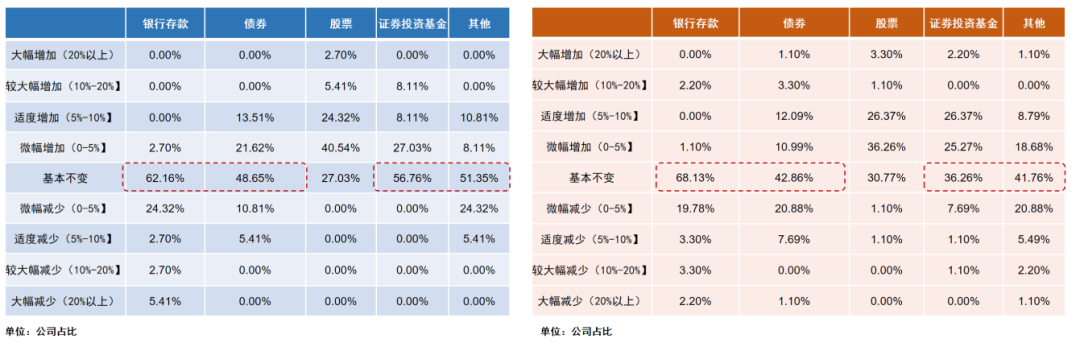
Core Insights - The China Banking and Insurance Asset Management Association released a survey indicating the investment intentions of insurance institutions for 2026, highlighting a positive outlook for domestic stocks and securities investment funds [1] Asset Allocation Overview - A total of 127 insurance institutions participated in the survey, including 36 asset management firms and 91 insurance companies [1] - Most insurance institutions plan to maintain their allocation ratios for bank deposits, bonds, securities investment funds, and other financial assets similar to 2025, with some showing a willingness to slightly increase stock investments [1] Detailed Asset Allocation Plans - In terms of bond market outlook, most insurance institutions hold a neutral stance, expecting 10-year government bond yields to be in the range of 1.8% to 1.9% and 30-year yields between 2.2% and 2.4% [3] - Over half of the institutions anticipate high-grade credit bond yields to center around 2.0% to 2.5%, with overall credit spreads expected to fluctuate [3] - The preferred bond types include high-grade industrial bonds, perpetual bonds, secondary capital bonds, and convertible bonds, with a focus on 10 to 30-year maturities [3] A-Share Market Outlook - Most insurance institutions are optimistic about the A-share market for 2026, favoring stocks in indices such as the Sci-Tech 50, CSI 300, and ChiNext [3] - Key sectors of interest include electronics, non-ferrous metals, power equipment, computers, communications, pharmaceuticals, and basic chemicals, with a focus on themes like semiconductor chips, defense, AI computing power, and high dividends [3] Fund Investment Preferences - For 2026, insurance asset management institutions prefer to allocate to equity funds, secondary bond funds, mixed equity funds, index funds, and ETFs, while insurance companies favor secondary bond funds and growth funds [5] - Nearly half of the insurance institutions plan to slightly increase their allocation to public funds [5] Offshore Investment Preferences - Hong Kong stocks are the most favored offshore investment for insurance institutions in 2026, with gold and US stocks also receiving attention [5] - About half of the asset management institutions plan to slightly increase their allocation to Hong Kong stocks, while 40% of insurance companies intend to maintain their current allocation [5]
AMERISAFE(AMSF) - 2025 Q4 - Earnings Call Transcript
2026-02-26 16:30
Financial Data and Key Metrics Changes - The company reported a strong return on equity (ROE) of 18.5% and a combined ratio of 91.3% for Q4 2025, indicating solid performance in a competitive environment [4] - Net income for Q4 2025 was $10.4 million, or $0.55 per diluted share, while operating net income was $9.8 million, or $0.51 per diluted share [11] - For the full year, net income was $47.1 million, down from $55.4 million in 2024, and net operating income was $41.8 million, compared to $48.4 million in 2024 [11] Business Line Data and Key Metrics Changes - Gross premium written (GPW) grew by 11.7% in Q4 2025, compared to 3.9% growth in Q4 2024, marking the seventh consecutive quarter of top-line growth [5] - Voluntary premium, a primary component of GPW, increased by 10.5% in Q4 and 10.2% for the full year, compared to 4.6% in 2024 [5] - The in-force policy count increased by 10.2% for the year, supported by strong renewal retention of 93.7% for the quarter [6] Market Data and Key Metrics Changes - Payroll growth in the company's classes of business was positive, with wage growth at 6.1% in Q4, contributing to premium growth [7] - The average rate of decline in filed rates is expected to be in the negative mid-single-digit range for 2026 [8] Company Strategy and Development Direction - The company focuses on specialized underwriting for niche industries and emphasizes safety services and personalized claims management to maintain underwriting profitability [4] - The growth strategy includes deepening relationships with targeted agents and enhancing operational efficiency, which has led to increased new business opportunities [5][6] Management's Comments on Operating Environment and Future Outlook - Management noted that the company is in a prolonged soft market with 12 consecutive years of rate decline, making risk understanding and claims management essential for profitability [4] - The company anticipates continued pressure on loss ratios due to increased claim severity and frequency, with a current accident year loss ratio of 72% [9][40] Other Important Information - The investment portfolio's net investment income increased by 2.5% to $77.1 million in Q4, while it decreased by 7.6% to $27 million for the full year [11][12] - The company maintains a strong capital position with approximately $797 million in cash and invested assets [13] Q&A Session Summary Question: Observations on frequency and severity of claims - Management reported a 7.8% increase in reported claims in 2025, with frequency consistent with expectations [17][20] Question: Insights on growth areas - Growth is broad-based across the book, with no significant shifts in industry classes or geographical distribution [25][28] Question: Favorable development in claims - Favorable development was attributed to claims closures and settlements, not related to frequency and severity issues [31][53] Question: Medical inflation observations - Medical inflation remains a concern, particularly in home health and prosthetics, with no signs of easing [61][62] Question: Impact of undocumented workers on claims - No significant changes in claims patterns due to undocumented workers have been observed [73][74]