
外卖

Search documents
外卖市场风云突变,百亿补贴后,美团、阿里、京东谁能笑到最后?
Sou Hu Cai Jing· 2025-09-16 10:40
Core Insights - The fierce competition in the food delivery market among major players like Meituan, Alibaba, and JD has led to significant losses for all involved, with Meituan's profit down by 11.5 billion RMB, JD's by 14.7 billion RMB, and Alibaba's by 10.3 billion RMB compared to the previous year [1][3][4] Group 1: Market Dynamics - The ongoing "hundred billion subsidy war" has resulted in each platform incurring substantial losses, despite the apparent benefits to consumers [1][3] - The average delivery service fee per order has drastically decreased to 3.2 RMB by Q2 2025, exacerbating the financial strain on these companies [4][10] Group 2: Revenue Structure - Meituan's revenue model relies on commissions, advertising fees, and delivery service fees, with the latter consistently falling short of covering delivery costs from 2021 to 2023 [4][5] - Despite the price wars, Meituan has managed to increase the average commission per order, indicating a rise in the prices of goods sold through its platform [7][9] Group 3: Competitive Landscape - The competition has evolved into a battle for "instant retail," where Meituan's expansion into categories like electronics and household appliances directly challenges Alibaba and JD's traditional markets [9][10] - The entry of JD and Alibaba into the food delivery space is primarily aimed at retaining their core user base and adapting to the changing retail landscape [10][11] Group 4: Future Implications - The outcome of this competition will not only determine the leaders in food delivery but also shape the future of retail over the next decade [17] - The shift towards online ordering and rapid delivery could disrupt traditional retail formats, leaving behind those who fail to adapt [13][15]



北水动向|北水成交净买入31.89亿 药捷安康-B(02617)单日股价腰斩 北水抛售近5000万港元
智通财经网· 2025-09-16 10:05
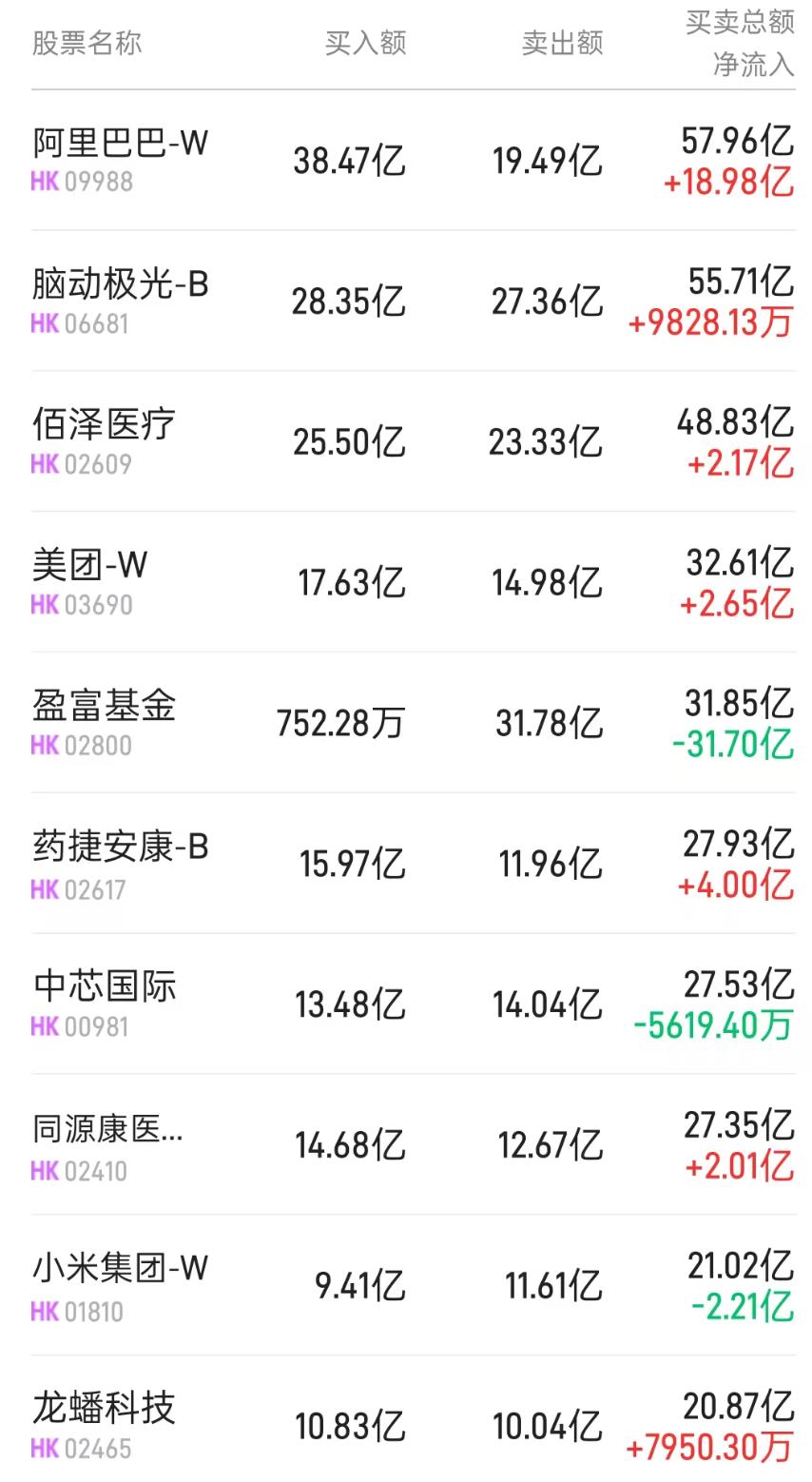
Core Viewpoint - The Hong Kong stock market experienced significant net selling from northbound capital, totaling HKD 31.89 billion on September 16, with the majority coming from the Shanghai-Hong Kong Stock Connect [1] Group 1: Northbound Capital Flow - Northbound capital had a net selling of HKD 29.76 billion through the Shanghai Stock Connect and HKD 2.13 billion through the Shenzhen Stock Connect [1] - The stocks with the highest net buying included Alibaba-W (09988), Meituan-W (03690), and Baize Medical (02609) [1] - The stocks with the highest net selling included the Tracker Fund of Hong Kong (02800), Xiaomi Group-W (01810), and SMIC (00981) [1] Group 2: Individual Stock Performance - Alibaba-W (09988) saw a net inflow of HKD 30.31 billion, supported by recent announcements related to its mapping service and AI developments [4] - Meituan-W (03690) recorded a net inflow of HKD 7.15 billion, bolstered by the successful launch of its international delivery brand Keeta in Kuwait [5] - Baize Medical (02609) and Tongyuan Kang Medical-B (02410) received net inflows of HKD 3.27 billion and HKD 2.96 billion, respectively, following regulatory changes that enhance the clinical trial approval process for innovative drugs [5] Group 3: Notable Net Selling - The Tracker Fund of Hong Kong (02800) faced a significant net outflow of HKD 46.38 billion, with analysts suggesting that while short-term interest rates may benefit the Hong Kong market, the overall outlook remains cautious due to weakening fundamentals [7] - Xiaomi Group-W (01810), SMIC (00981), and Tencent (00700) experienced net outflows of HKD 5.69 billion, HKD 4.12 billion, and HKD 3.86 billion, respectively [8]


港股收盘 | 恒指收跌0.03% 机器人概念多数强势 药捷安康-B单日腰斩
Zhi Tong Cai Jing· 2025-09-16 08:55
Market Overview - The Hong Kong stock market experienced fluctuations with mixed performance among the three major indices. The Hang Seng Index closed down 0.03% at 26,438.51 points, while the Hang Seng China Enterprises Index rose 0.02% to 9,386.39 points, and the Hang Seng Tech Index increased by 0.56% to 6,077.66 points. The total trading volume for the day was HKD 2,940.695 million [1] Blue Chip Performance - Meituan-W (03690) showed strong performance, closing up 3.03% at HKD 100.3 with a trading volume of HKD 9,604 million, contributing 25.48 points to the Hang Seng Index. Meituan's international delivery brand Keeta launched operations in Kuwait, marking its third location in the Middle East [2] - Other notable blue chip stocks included Xinyi Glass (00868), which rose 4.92%, and Trip.com Group-S (09961), which increased by 4.09%. Conversely, Alibaba Health (00241) fell by 3.89%, negatively impacting the index [2] Sector Highlights - Large tech stocks exhibited mixed results, with Meituan rising over 3% and Alibaba declining by 0.71%. The robotics sector saw significant gains, with companies like DCH Motor Holdings (00179) and Sanhua Intelligent Controls (002050) rising by 16.74% and 12.83%, respectively [3] - The photovoltaic sector was active, with notable increases in stock prices for companies like Flat Glass (06865) and Xinyi Glass (00868) [4][5] Real Estate Sector - The real estate sector faced declines, with major companies like R&F Properties (02777) and Sunac China (01918) dropping by 8% and 6.63%, respectively. National statistics indicated a decrease in property sales and investment, with a 4.7% drop in sales area year-on-year [6] Notable Stock Movements - Yaojie Ankang-B (02617) experienced a dramatic drop of 53.73% after reaching a new high earlier in the day. The company confirmed it was unaware of the reasons behind the stock price fluctuations [7] - Yunfeng Financial (00376) fell by 19.1% after announcing a share placement at a discount, while Longpan Technology (603906) surged by 27.62% following a significant procurement agreement with CATL [8][9] - Hesai Technology (02525) debuted with a 9.96% increase, marking the largest IPO in the global lidar industry to date [10]

彭博:马云回归 阿里巴巴盼再次伟大
美股IPO· 2025-09-16 07:08
Core Viewpoint - The return of founder Jack Ma after years of absence is seen as a potential turning point for Alibaba Group, signaling a renewed focus on growth and competition in the tech industry [1][3]. Group 1: Jack Ma's Return - Jack Ma has re-emerged in Alibaba's operations, marking his most active involvement in five years since stepping back due to regulatory scrutiny [3]. - His return is characterized by a strong focus on artificial intelligence (AI) and a strategic response to competitors like JD.com and Meituan [3][4]. - Ma has reportedly invested up to 50 billion RMB (approximately 9 billion SGD) to support Alibaba's initiatives against JD.com's encroachment into the food delivery market [3]. Group 2: Market Dynamics - Alibaba's leadership acknowledges that the company no longer holds the 85% market share it once did, indicating a shift in the competitive landscape [5]. - As of July, Alibaba holds a 43% share of the Chinese food delivery market, trailing behind Meituan's 47% [5].

购物前怕踩坑?想知道售后靠不靠谱?来黑猫投诉看看真实反馈
Xin Lang Cai Jing· 2025-09-16 04:39
Core Insights - The article emphasizes the importance of checking negative information, such as complaints and regulatory penalties, before making a purchase decision to avoid common pitfalls in consumer transactions [1][6]. Group 1: Internal Platform Information - In addition to "positive reviews," consumers should also look at "negative review tags" and arbitration cases on e-commerce, food delivery, or ride-hailing platforms to identify recurring service issues [2]. - Some platforms provide arbitration cases or typical scenarios of "advance compensation," which can help consumers understand the service reliability of a merchant [2]. Group 2: Official Channels - Regulatory bodies regularly publish penalty results and credit information, such as administrative penalty announcements and lists of non-compliant companies in various sectors, which indicate serious issues within those businesses [3]. - Consumers are advised to check official websites for company names before making significant purchases or signing long-term contracts [3]. Group 3: Third-Party Platforms - Third-party complaint platforms, like Black Cat Complaints, have become essential references for consumers, covering various sectors such as e-commerce, finance, education, travel, and real estate [4]. - By searching for a merchant's name, consumers can view the number of complaints, common issues, and resolution progress, which can indicate potential risks in refund and after-sales service [4]. Group 4: Pre-Consumption Research - Consumers often think of filing complaints only after problems arise, which can take weeks or months to resolve; however, spending a few minutes checking complaint information beforehand can prevent unnecessary troubles [5]. - Combining positive and negative information can lead to more informed consumer decisions [5].
外卖大战,战而不休为哪般?
Xin Hua Wang· 2025-09-16 02:57
Core Viewpoint - The ongoing "takeaway war" among delivery platforms is creating a vicious cycle for many restaurants, where participation in subsidy programs leads to losses, while non-participation results in reduced visibility and order volume [2][4]. Group 1: Impact on Restaurants - Many small and medium-sized restaurants are caught in a dilemma of whether to engage in the delivery business, facing significant pressure from high commission fees and low profit margins [5][6]. - For example, a restaurant selling a noodle dish priced at 21.8 yuan ends up with only 11.33 yuan after subsidies and fees, resulting in a meager profit of just 1 yuan [5][6]. - The phenomenon of "increased order volume but stagnant revenue" is prevalent, with many restaurants experiencing a surge in orders without a corresponding increase in income [17][19]. Group 2: Market Dynamics - The competition among platforms is not just about consumer acquisition but also about controlling the market dynamics, which is affecting the livelihoods of millions of workers in the industry [4][16]. - The "takeaway war" is leading to a concentration of resources among large brands, creating a scenario where smaller brands struggle to survive [20][22]. - The market is witnessing a shift where platforms are prioritizing large chain brands, leading to a "big brand breaks price, small brand goes bankrupt" cycle [20][22]. Group 3: Regulatory Response - Regulatory bodies are taking steps to address the irrational competition by proposing rules to protect pricing autonomy for businesses and promote transparency in platform operations [23][25]. - The government is advocating for a shift from price competition to quality competition, suggesting improvements in platform algorithms and reducing the burden on businesses [23][25]. Group 4: Future Outlook - Experts suggest that while the current environment is challenging, there is hope for a future where platforms may compete for merchants as well as consumers, potentially alleviating some pressure on small businesses [8][12]. - The long-term effects of the "takeaway war" could lead to a more balanced market if platforms adopt fairer practices and support smaller businesses [35][39].

彭博:马云“强势回归”,AI、外卖领域都有他的身影
Feng Huang Wang· 2025-09-16 02:42
Core Insights - Jack Ma's return to Alibaba has significantly increased his influence in the company's strategic decisions, particularly in AI and competition with rivals like JD.com [1][2] - Alibaba is implementing a substantial subsidy plan of 50 billion yuan to counter JD.com's unexpected entry into the food delivery market, with Ma playing a crucial role in this decision [2] - The company is experiencing a competitive landscape where it has lost its previous dominance in the e-commerce market, now holding a 43% share in the food delivery sector, trailing behind Meituan's 47% [3] AI Strategy - Jack Ma has been actively involved in Alibaba's AI initiatives, emphasizing the importance of the company's cloud platform and self-developed semiconductor chips [5][7] - Alibaba has committed to investing over 380 billion yuan in AI and cloud infrastructure over the next three years, with recent quarterly results showing a 26% year-on-year growth in cloud revenue [7] Leadership and Management - Ma is relying on seasoned executives like Wu Yongming and Cai Chongxin, as well as rising star Jiang Fan, to help revitalize Alibaba's operations [6] - Wu Yongming is seen as a long-term leader, particularly suited for overseeing AI developments, while Cai Chongxin serves as Ma's main ally on the board [6] - The company is recovering from strategic missteps made during the tenure of former CEO Zhang Yong, who made significant investments in large retail chains that did not yield expected results [8] Market Position and Challenges - Alibaba is working to regain market share lost in recent years, with Ma's involvement seen as a morale booster for employees [9] - Despite Ma's influence, his lack of a formal position complicates the reporting structure within the company, as some employees view him as the ultimate decision-maker [8][9] - The competitive environment in the e-commerce sector is intensifying, with companies vying for customers who demand rapid delivery services [2][3]
西贝发布道歉信,公布九项调整措施;美团Keeta正式在科威特启动运营
Mei Ri Jing Ji Xin Wen· 2025-09-15 23:24
Group 1 - Meituan's international delivery brand Keeta officially launched operations in Kuwait on September 15, marking its third entry into the Gulf region after Saudi Arabia and Qatar. The company aims to deeply integrate into the local ecosystem rather than simply replicating its business model [1] - SF Express's local delivery service "SoFast" has launched in Macau, following its entry into Hong Kong last year. The service has partnered with the largest local lifestyle service platform, "Aomi App," to enhance resource integration and optimize delivery services [2] - Xibei Catering Group issued an apology letter on September 15, announcing nine adjustment measures to be implemented by October 1, 2025. These include switching to non-GMO soybean oil for all dishes and using fresh, hand-cut fish for children's meals, reflecting the company's responsiveness to market and consumer demands [3] Group 2 - Meituan plans to use Keeta as a foothold to deepen its presence in the Middle East while exploring additional overseas markets [1] - The launch of "SoFast" in Macau is expected to enhance SF Express's brand influence and market share in the region [2] - Xibei's adjustments indicate a shift towards meeting consumer preferences and aligning with market trends, particularly in the context of the ongoing competition in the prepared food sector [3]
西贝发布道歉信,公布九项调整措施;美团Keeta正式在科威特启动运营丨未来商业早参
Mei Ri Jing Ji Xin Wen· 2025-09-15 23:21
Group 1 - Meituan's international delivery brand Keeta officially launched operations in Kuwait on September 15, 2025, marking its third entry into the Gulf region after Saudi Arabia and Qatar. The company aims to deeply integrate into the local ecosystem rather than simply replicating its business model [1] - SF Express's local delivery service "SoFast" has launched in Macau, following its entry into Hong Kong last year. The service has partnered with the largest local lifestyle service platform, "澳觅App," to enhance resource integration and optimize delivery services [2] - Xi Bei Restaurant Group issued an apology letter on September 15, announcing nine adjustment measures to be implemented by October 1, 2025. These include switching to non-GMO soybean oil for all dishes and using fresh-cut large yellow croaker for children's fish strips, reflecting the company's responsiveness to market and consumer demands [3] Group 2 - Meituan plans to use Keeta as a foothold to explore more overseas markets while deepening its presence in the Middle East [1] - The launch of "SoFast" in Macau is expected to enhance SF Express's brand influence and market share in the region [2] - Xi Bei's adjustments indicate a shift towards meeting consumer preferences and adhering to market trends, especially in the context of the ongoing competition in the prepared food sector [3]
美团-W(03690.HK):补贴加大拖累经营表现 持续跟踪竞争格局变化
Ge Long Hui· 2025-09-15 20:34
Core Insights - The company reported a significant decline in adjusted profit for Q2 2025, with adjusted profit down 89% year-on-year, reflecting challenges in profitability amidst increased competition and operational costs [1][3] - Core local business remains the primary revenue source, with revenue of 653.5 billion yuan in Q2 2025, showing a year-on-year increase of 7.7%, but operating profit decreased by 75.6% [2][3] - New business revenue grew by 22.8% year-on-year to 264.9 billion yuan, but the operating loss was 18.8 billion yuan, indicating ongoing challenges in achieving profitability [3] Financial Performance - In Q2 2025, the company achieved total revenue of 918.4 billion yuan, a year-on-year increase of 11.7%, but operating profit was only 2.3 billion yuan, down 98% [1] - The adjusted net profit margin was 1.6%, down 14.9 percentage points year-on-year, highlighting pressure on profitability [1][3] - The core local business's operating profit margin was 5.7%, down 19.4 percentage points, indicating a significant decline in profitability [2] Business Segments - The delivery service segment saw revenue of 237 billion yuan, with a growth rate of 2.8%, while the commission and online marketing segments grew by 12.9% and 10.5%, respectively [2] - The takeout business is expected to see double-digit growth in order volume, but average order value (AOV) is projected to decline slightly, leading to low single-digit revenue growth [2] - The company plans to exit underperforming areas in its new business and focus on expanding its core regions, particularly through the small elephant supermarket initiative [3] Future Outlook - The company anticipates significant losses in the core local business in Q3 2025 due to intensified competition and increased strategic investments [3] - Adjusted net profit forecasts for 2025-2027 have been revised downwards, with expected losses of 77 billion yuan in 2025, followed by profits of 318 billion yuan and 466 billion yuan in 2026 and 2027, respectively [4] - The company maintains a medium-term rating of "outperform" against the market, while closely monitoring competitive dynamics in the industry [4]