
MLF(中期借贷便利)

Search documents
A股午评 | 沪指半日放量涨逾1% 有色、钢铁板块大涨 算力硬件股延续强势
智通财经网· 2025-10-27 03:48
Core Viewpoint - The A-share market is experiencing a significant rise, with the Shanghai Composite Index approaching 4000 points, driven by multiple favorable factors including U.S.-China trade negotiations and supportive monetary policy [1][2]. Market Analysis - The A-share market is buoyed by several positive developments: - U.S.-China trade talks have reached a basic consensus, with the U.S. Treasury Secretary stating that there are no plans to impose a 100% tariff on China [2]. - The People's Bank of China has injected 900 billion yuan through Medium-term Lending Facility (MLF) operations to support market liquidity [2]. - There is an increasing expectation of a 25 basis point rate cut by the Federal Reserve, which is enhancing market sentiment [2]. Sector Performance - **Steel and Non-ferrous Metals**: These sectors saw significant gains, with stocks like Xiamen Tungsten hitting the daily limit [2]. - **Computing Power Hardware**: Stocks in this category, including Zhongji Xuchuang, reached historical highs, with Zhongji Xuchuang's stock price surpassing 500 yuan for the first time [2][4]. - **Coal Sector**: The coal sector is recovering, with Zhengzhou Coal Electricity hitting the daily limit [2]. - **Chip Industry**: The chip sector is rebounding, with stocks like Dawi Co. hitting the daily limit [2]. - **Nuclear Fusion Concept**: This concept remains active, with Dongfang Tantalum achieving a historical high [2]. Institutional Perspectives - **Huaxi Securities**: The firm believes that the "slow bull" market trend will continue, supported by recent positive developments in U.S.-China trade talks and other geopolitical factors [6][7]. - **CITIC Securities**: The firm notes a return to performance-driven market dynamics, highlighting two emerging trends: the safety of industrial chains and the expansion of AI from cloud to edge [8]. - **Zhongtai Securities**: The firm maintains a bullish outlook on the index, particularly in technology and manufacturing sectors, and suggests focusing on AI and related fields [9].

央行今天开展9000亿元MLF操作 有何信号?
Sou Hu Cai Jing· 2025-10-27 02:57
Core Viewpoint - The People's Bank of China (PBOC) is maintaining ample liquidity in the banking system through a series of monetary policy tools, including a 900 billion yuan MLF operation scheduled for October 27, 2025, which aligns with market expectations for liquidity support [1][2] Group 1: Monetary Policy Actions - In October, the PBOC will inject a net 200 billion yuan of MLF, following the maturity of 700 billion yuan, resulting in a total net liquidity injection of 600 billion yuan for the month, consistent with the previous month [1][2] - The PBOC's actions reflect a coordinated effort between monetary and fiscal policies to support government bond issuance and meet credit financing needs for enterprises and households [2][3] - The total amount of long-term liquidity remains stable, with MLF net injection being the eighth instance this year, although slightly lower than the previous two months [3] Group 2: Economic Context and Future Outlook - The ongoing large-scale issuance of government bonds and the introduction of new policy financial instruments are driving the demand for liquidity, with expectations of net government bond financing reaching over 1 trillion yuan in October [2] - Analysts anticipate that the PBOC may implement a new round of reserve requirement ratio (RRR) cuts in the fourth quarter to further support economic growth and stabilize employment, alongside continued use of MLF and reverse repos [4][5] - The overall loan growth in the first three quarters of 2025 has exceeded 5 trillion yuan, indicating a robust demand for credit across various sectors, including fixed asset loans and support for small and medium-sized enterprises [6][7]
央行今日开展9000亿元MLF操作,为连续第8个月加量续做|快讯
Sou Hu Cai Jing· 2025-10-27 02:40
Core Viewpoint - The People's Bank of China (PBOC) is implementing a series of monetary policy measures to maintain liquidity in the banking system, including a 900 billion yuan MLF operation and a net liquidity injection of 600 billion yuan in October [2][3]. Group 1: Monetary Policy Actions - On October 27, the PBOC will conduct a 900 billion yuan MLF operation with a one-year term to ensure ample liquidity in the banking system [2]. - With 700 billion yuan of MLF maturing in October, the net MLF injection for the month will reach 200 billion yuan, marking the eighth consecutive month of increased MLF operations [2]. - The total net liquidity injection for October, including 400 billion yuan of reverse repos, amounts to 600 billion yuan, maintaining a high level of net injection compared to the previous month [2]. Group 2: Economic Outlook and Future Measures - Analysts suggest that the PBOC's continued liquidity support signals a sustained accommodative monetary policy stance, especially in light of increasing external volatility and the impact of high tariffs on global trade [2]. - There is an expectation for further monetary policy tools to be employed in the fourth quarter, including potential reserve requirement ratio (RRR) cuts and the resumption of government bond transactions to stabilize economic growth and employment [2][3]. - The PBOC aims to enhance liquidity management through various tools like reverse repos and RRR cuts to meet the demands of government bond issuance and increased credit supply [3].


聚焦“支持性”方向 精准把握货币政策实施力度和节奏
Zhong Guo Zheng Quan Bao· 2025-10-26 22:46
Core Viewpoint - The People's Bank of China emphasizes the construction of a scientific and stable monetary policy system to support high-quality economic development, with a focus on precise timing and effectiveness of policy measures [1] Group 1: Monetary Policy Framework - The central bank will adopt a supportive stance in monetary policy, balancing short-term and long-term goals while ensuring the health of the financial sector [2] - The monetary policy will continue to be "self-centered," addressing both internal and external economic conditions [2] - Experts predict that the central bank will flexibly use tools such as interest rates and reserve requirements to stabilize market expectations [2] Group 2: Liquidity Management - The central bank is expected to enhance liquidity management through various tools, including reverse repos and MLF operations, to support key sectors and strategic areas [3] - There is a suggestion to lower the reserve requirement ratio by 0.5 percentage points, potentially releasing about 1 trillion yuan in liquidity [3] - The focus will also be on reducing financing costs for enterprises and households to stimulate internal financing demand [3] Group 3: Structural Focus - The next five years will prioritize the development of financial technology, encouraging banks to increase loans for technology and innovation [4] - Structural monetary policy tools will be optimized to direct more funds towards technological innovation and industrial transformation [4] Group 4: Policy Transmission - The central bank aims to enhance the effectiveness of monetary policy transmission, with recent data showing a decrease in loan interest rates [5] - Improved communication with the market is crucial for stabilizing expectations and enhancing policy transmission efficiency [6] - Coordination between fiscal and monetary policies is expected to strengthen, supporting both economic growth and structural optimization [6]
央行今天开展9000亿元MLF操作,有何信号?
Sou Hu Cai Jing· 2025-10-26 14:22
Core Viewpoint - The People's Bank of China (PBOC) announced a 900 billion yuan MLF operation to maintain liquidity in the banking system, with a net injection of 200 billion yuan in October, aligning with market expectations [1][4]. Group 1: Monetary Policy and Liquidity Management - The PBOC's MLF operation reflects a coordinated effort between monetary and fiscal policies to support government bond issuance and meet credit demand from enterprises and households [4][5]. - The central bank's continued injection of medium-term liquidity is a response to rising market interest rates and tightening liquidity in the banking system, aiming to stabilize market expectations [4][5]. - The total amount of long-term liquidity remains unchanged despite a slight decrease in the net MLF injection to 200 billion yuan, marking the eighth net injection this year [5][6]. Group 2: Economic Outlook and Future Expectations - Analysts expect the PBOC may implement a new round of reserve requirement ratio (RRR) cuts in the fourth quarter to further support economic growth and stabilize employment [7][8]. - The necessity for increased monetary policy support is rising due to external uncertainties and the high base effect from last year's policies [7][8]. - The overall liquidity in the market is expected to remain stable and ample, with limited upward pressure on market interest rates towards the end of the year [7][8]. Group 3: Loan Growth and Sector Support - In the third quarter of 2025, fixed asset loans increased by 5.06 trillion yuan, with a total balance of 77.55 trillion yuan, reflecting a year-on-year growth of 7% [9][10]. - The balance of loans to small and micro enterprises reached 36.09 trillion yuan, growing by 12.2% year-on-year, indicating strong support for this sector [10]. - The PBOC's focus on supporting technology-oriented small and medium enterprises is evident, with a loan balance of 3.56 trillion yuan, growing by 22.3% year-on-year [10].
央行预告,下周一,9000亿元
Zhong Guo Zheng Quan Bao· 2025-10-25 00:21
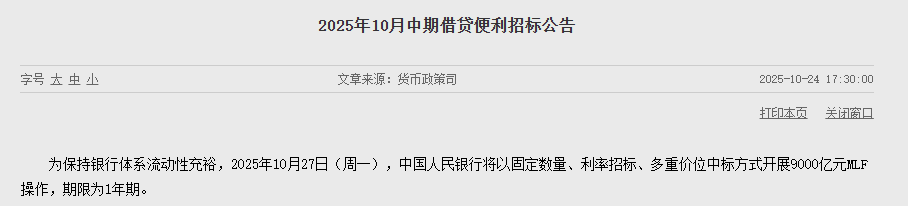
Core Viewpoint - The People's Bank of China (PBOC) is set to conduct a 900 billion yuan MLF operation on October 27 to maintain ample liquidity in the banking system, with a one-year term [1][2]. Group 1: MLF Operations - The PBOC will implement a fixed quantity, interest rate bidding, and multiple price bidding method for the 900 billion yuan MLF operation [1]. - With 700 billion yuan of MLF maturing in October, the net injection of MLF for the month will reach 200 billion yuan, aligning with market expectations [2]. - The continuous net injection of MLF indicates policy consistency and aims to stabilize market expectations while ensuring sufficient liquidity [2]. Group 2: Market Liquidity - In October, the PBOC also conducted a net injection of 400 billion yuan through reverse repos, bringing the total net liquidity injection to 600 billion yuan, consistent with the previous month [2]. - The net injection of medium-term liquidity has been ongoing for five months, with a significant increase in the last three months, primarily due to expected government bond net financing reaching one trillion yuan [2]. - The regulatory authorities are guiding financial institutions to increase credit issuance, while the PBOC's actions signal a sustained commitment to quantitative monetary policy tools [2]. Group 3: Future Monetary Policy - In the near future, the PBOC is expected to utilize various monetary policy tools, including reverse repos and MLF operations, to enhance short- and medium-term market liquidity [3]. - The PBOC aims to optimize the liquidity term structure to meet the demands of government bond issuance and increased credit supply [3]. - The central bank will adapt its monetary policy tools based on macroeconomic conditions to ensure liquidity, support consumption, and stabilize the financial market [3].
LPR连续5个月“按兵不动”,降息窗口仍需等待
Di Yi Cai Jing· 2025-10-20 05:38
Core Viewpoint - The Loan Prime Rate (LPR) remains unchanged for October, reflecting stable policy rates and ongoing pressure on bank interest margins, indicating limited room for LPR reduction in the near term [1][2][3]. Group 1: LPR Stability - The LPR for both 1-year and 5-year terms remains at 3.0% and 3.5% respectively, unchanged for five consecutive months, aligning with market expectations [1][2]. - The stability of the central bank's 7-day reverse repurchase rate at 1.40% since May limits the basis for LPR reduction, as it has not changed [2]. - Bank interest margin pressures are increasing due to ongoing efforts to reduce costs for the real economy, with the net interest margin of commercial banks dropping to 1.42% by Q2 2025, down 10 basis points from the previous year [2]. Group 2: Economic Context - The need for stable growth has increased due to external pressures, such as high tariffs from the U.S. affecting global trade and domestic investment and consumption slowing down [4]. - The People's Bank of China (PBOC) has indicated a commitment to maintaining a moderately loose monetary policy to support consumption and effective investment [4]. Group 3: Future Monetary Policy Directions - Experts suggest that there is potential for targeted LPR reductions before the end of the year to stimulate domestic demand and stabilize the real estate market [5][6]. - The PBOC may utilize various monetary policy tools, including reverse repos and MLF operations, to enhance liquidity and support key sectors [6]. - External factors, such as the potential for continued interest rate cuts by the Federal Reserve, may provide a conducive environment for domestic monetary easing [6][7].
加量操作呵护流动性,央行开展6000亿元买断式逆回购
Sou Hu Cai Jing· 2025-10-15 02:15
Core Viewpoint - The People's Bank of China (PBOC) is conducting a significant amount of reverse repos to maintain liquidity in the banking system, indicating a supportive monetary policy stance amid potential tightening of liquidity conditions [1][2][4] Group 1: Reverse Repo Operations - On October 15, 2025, the PBOC will conduct a reverse repo operation of 600 billion yuan with a term of 6 months, marking the second such operation in October [1] - Earlier in October, the PBOC conducted a reverse repo operation of 1.1 trillion yuan with a term of 3 months [1] - The total amount of reverse repos in October is set to increase by 100 billion yuan compared to the previous month, continuing a trend of injecting medium-term liquidity for five consecutive months [1] Group 2: Market Conditions and Government Actions - The increase in reverse repo operations is partly due to the large-scale issuance of government bonds and the acceleration of new policy financial tools, which are expected to boost loan disbursements [2] - The strong performance of the stock market and the phenomenon of "deposit migration" among residents in October are also contributing to a tightening of liquidity, necessitating support from the PBOC [2] Group 3: Future Expectations - Analysts expect the PBOC to continue using reverse repos and Medium-term Lending Facility (MLF) tools to inject liquidity into the market [4] - There is a possibility of a reduction in the scale of medium-term liquidity injections in the future, as the PBOC may implement a new round of reserve requirement ratio (RRR) cuts in the fourth quarter [4] - The anticipated RRR cuts are linked to external volatility, changes in domestic economic growth momentum, price trends, and efforts to stabilize the real estate market [4]
风口智库|利好!央行再宣布买断式逆回购操作,继续注入中期流动性
Sou Hu Cai Jing· 2025-10-14 11:36
Core Viewpoint - The People's Bank of China (PBOC) is set to conduct a 600 billion yuan buyout reverse repurchase operation on October 15, 2025, to maintain ample liquidity in the banking system [2] Group 1: Monetary Policy Tools - The buyout reverse repurchase is a monetary policy tool introduced by the PBOC on October 28 of the previous year, aimed at injecting liquidity into the market by purchasing bonds from primary dealers [2] - The PBOC has been actively using reverse repurchase operations to adjust short-term liquidity and enhance medium-term liquidity through tools like the Medium-term Lending Facility (MLF) [2][3] - The upcoming 600 billion yuan operation follows the maturity of 800 billion yuan in 3-month buyout reverse repos, helping to smooth short-term funding fluctuations [2] Group 2: Market Impact and Expectations - In October, the PBOC has increased the scale of buyout reverse repos by 400 billion yuan compared to the previous month, indicating a continued effort to inject medium-term liquidity into the market [3] - Analysts suggest that the PBOC's actions are aimed at stabilizing the funding environment amid potential liquidity tightening due to government bond issuances and other market dynamics [4] - Future monetary policy may include a combination of buyout reverse repos and MLF to further support liquidity needs related to government bond issuance and other strategic areas [4][5]

央行加量续作3个月期买断式逆回购 “补水”流动性稳定市场预期
Xin Jing Bao· 2025-10-09 16:39
Core Viewpoint - The People's Bank of China (PBOC) is actively injecting medium-term liquidity into the banking system through various monetary policy tools, including reverse repos and MLF, to maintain a stable and ample liquidity environment in response to potential tightening pressures in the market [1][2][3]. Group 1: Monetary Policy Actions - On October 9, the PBOC conducted a 1.1 trillion yuan reverse repo operation with a term of 3 months, indicating a proactive approach to liquidity management post the "National Day" holiday [1]. - The PBOC is expected to continue with equal or slightly increased amounts of reverse repos and MLF operations in October, marking the fifth consecutive month of such actions [2]. - The PBOC's monetary policy committee emphasized the need for effective monetary policy adjustments to align with economic growth and inflation expectations, aiming to keep liquidity abundant [2]. Group 2: Market Liquidity Outlook - The liquidity environment is anticipated to experience a "first loose, then tight" seasonal pattern in October, influenced by fiscal spending, holiday cash flow, and large-scale government bond issuances [4]. - Market analysts predict that the PBOC will utilize various tools, including reverse repos and MLF, to maintain short-term and medium-term liquidity balance, while also considering potential long-term liquidity injections through reserve requirement ratio (RRR) cuts [3][4]. - The expectation of a new round of growth-stabilizing policies, including a potential RRR cut, is likely to influence the net medium-term liquidity injection scale, which may decrease from the previously high levels [5][6].