可转债ETF博时

Search documents
信用债ETF双周报(20260302-20260313):短融ETF交投活跃,持续获资金净流入-20260318
金融街证券· 2026-03-18 11:07
1. Report Industry Investment Rating No information about the industry investment rating is provided in the report. 2. Core Viewpoints of the Report The report analyzes the credit bond ETF market from multiple perspectives, including index market trends, ETF market trends, liquidity, scale, and risk - return. It indicates that the bond market is expected to be in a volatile state in March, with inflation expectations dominating bond pricing. It recommends a strategy of medium - short duration and high - coupon protection and suggests focusing on the Haifutong Urban Investment Bond ETF (511220.SH), the Haifutong Short - Term Financing ETF (511360.SH), and the Bosera Convertible Bond ETF (511380.SH) [7][64]. 3. Summary by Relevant Sections Index Market Trends - **Bond Index Market Trends**: Pure bond indexes rose slightly, and convertible bond indexes fell. The ChinaBond Financial Bond Index had the best performance in the past two weeks, with a 0.20% increase, while the ChinaBond Medium - and High - Grade Corporate Bond Spread Factor Net Price (Total Value) Index had the lowest increase, at 0.04%. Convertible bond indexes fluctuated downward, with the CSI Convertible Bond and Exchangeable Bond Index and the SSE Investment - Grade Convertible Bond and Exchangeable Bond Index falling by 3.07% and 2.67% respectively in the past two weeks [2][12]. - **Important Credit Bond Index Spread Situation**: The yields of credit bond indexes declined, and the spread trends showed less differentiation. Most credit bond index spreads widened, and credit bonds underperformed interest - rate bonds. The Shanghai Urban Investment Bond Index had the highest estimated yield (1.87%) and the highest spread (28.46bp) on March 13, 2026, while the ChinaBond Financial Bond Index had the lowest spread at 9.50bp [13]. Credit Bond ETF Market Trends - Pure bond ETFs generally rose, and convertible bond ETFs fell. Among the benchmark market - making bond ETFs, the average increase of Shenzhen Market - Making Credit Bonds was higher than that of Shanghai Market - Making Corporate Bonds. Among the science and technology innovation bond ETFs, the Invesco Science and Technology Innovation Bond ETF (159400.SZ) had the highest increase of 0.20%, and the Huaxia Science and Technology Innovation Bond ETF (159112.SZ) had the lowest increase of 0.06%. Among pure bond ETFs, the Dacheng Credit Bond ETF (159395.SZ) had the highest increase of 0.20%. The Bosera Convertible Bond ETF (511380.SH) and the Haifutong Convertible Bond ETF (511180.SH) fell by 3.38% and 2.67% respectively [3][19]. Credit Bond ETF Liquidity - The Haifutong Short - Term Financing ETF (511360.SH) was the most actively traded, with a trading volume of 586.87 billion yuan in the past two weeks, a month - on - month increase of 155.38%, an average daily trading volume of 58.687 billion yuan, and a high turnover rate of 747.23%. The total trading volume of science and technology innovation bond ETFs in the past two weeks was 1205.866 billion yuan, with an average daily trading volume of 120.587 billion yuan and an average turnover rate of 467.30%. The total trading volume of benchmark market - making bond ETFs in the past two weeks was 288.207 billion yuan, with an average daily trading volume of 28.821 billion yuan and an average turnover rate of 254.56%. The total trading volume of convertible bond ETFs in the past two weeks was 157.644 billion yuan, with an average daily trading volume of 15.764 billion yuan and an average turnover rate of 214.11% [4][25]. Credit Bond ETF Scale - The scales of different types of ETFs showed mixed trends. Short - term financing ETFs and urban investment bond ETFs continued to receive net capital inflows, while the scales of science and technology innovation bond ETFs and benchmark market - making bond ETFs continued to decline, and the scale of convertible bond ETFs began to decline. As of March 13, 2026, the scale of the Haifutong Short - Term Financing ETF (511360.SH) was 81.829 billion yuan, a month - on - month increase of 4.604 billion yuan; the scale of the Haifutong Urban Investment Bond ETF (511220.SH) was 33.887 billion yuan, a month - on - month increase of 2.530 billion yuan [4][36]. Credit Bond ETF Risk - Return Analysis - **Unit Net Value**: The unit net values of pure bond ETFs increased, while those of convertible bond ETFs decreased. By March 13, 2026, the unit net values of benchmark market - making bond ETFs exceeded 101 yuan, and those of science and technology innovation bond ETFs exceeded 100 yuan. The unit net value of the short - term financing ETF continued to rise steadily, exceeding 113 yuan, and the unit net value of the urban investment bond ETF rose slightly to 10.29 yuan. The unit net values of the Bosera Convertible Bond ETF (511380.SH) and the Haifutong Convertible Bond ETF (511180.SH) fell to 14.13 yuan and 12.98 yuan respectively in the past two weeks [42]. - **Income**: The coupon rates of component bonds were concentrated, and the urban investment ETF had the greatest coupon rate advantage. Most credit bond ETFs saw a decline in the weighted coupon rate of component bonds at the end of the period compared to the beginning. Convertible bond ETFs had the lowest coupon rates, with the weighted coupon rates of the Bosera Convertible Bond ETF (511380.SH) and the Haifutong Convertible Bond ETF (511180.SH) at 0.24% and 0.23% respectively. The Haifutong Short - Term Financing ETF (511360.SH) had a weighted coupon rate of 1.63%. The weighted coupon rate of benchmark market - making bond ETFs was higher than that of science and technology innovation bond ETFs. The Dacheng Credit Bond ETF (159395.SZ) in benchmark market - making credit bonds had the highest weighted coupon rate of 2.69%, and the Winwin Science and Technology Innovation Bond ETF (511150.SH) in science and technology innovation bond ETFs had the highest weighted coupon rate of 2.29%. The Haifutong Urban Investment Bond ETF (511220.SH) had the highest weighted coupon rate of 3.27%. In terms of capital gains, the weighted yields of pure bond ETFs increased at the end of the period compared to the beginning, and the capital gain income was positive [45]. - **Weighted Duration and Convexity**: Most credit bond ETFs reduced their durations, and the weighted durations of science and technology innovation bond ETFs were differentiated. Affected by inflation expectations, most credit bond ETFs reduced their durations. The China Merchants Science and Technology Innovation Bond ETF (551900.SH) had the longest weighted duration of 3.86, and the Haifutong Short - Term Financing ETF (511360.SH) had the shortest duration of 0.30. The Bosera Credit Bond ETF (159396.SH), the Haifutong Credit Bond ETF (511190.SH), the Southern Credit Bond ETF (511070.SH), and the Winwin Science and Technology Innovation Bond ETF (511150.SH) had significantly higher convexity than other ETFs, mainly due to their allocation of perpetual bonds, which increased the overall convexity. Considering both duration and convexity, the Haifutong Credit Bond ETF (511190.SH) and the Winwin Science and Technology Innovation Bond ETF (511150.SH) had strong anti - decline capabilities [50][51]. - **Credit Risk**: The overall credit risk of credit bond ETFs was low. The component bonds of science and technology innovation bond ETFs, benchmark market - making bond ETFs, the Haifutong Short - Term Financing ETF, and corporate bond ETFs were all rated AAA. On March 13, 2026, in the Haifutong Urban Investment Bond ETF, AAA - rated component bonds accounted for 40.50%, AA + - rated component bonds accounted for 42.70%, and AA - rated component bonds accounted for 16.80%. In the Bosera Convertible Bond ETF (511380.SH), component bonds rated AA - and below accounted for 58.38%, and in the Haifutong Convertible Bond ETF (511180.SH), AA - rated component bonds accounted for 64.04%. Although convertible bonds had low credit ratings, they had conversion options, so the default risk was still low [55]. - **Cost - Effectiveness**: The corporate bond ETF and the Haifutong Short - Term Financing ETF had the highest risk - return ratios. In terms of returns, the Invesco Science and Technology Innovation Bond ETF (159400.SZ) had the highest annualized interval return of 4.12%, and the Bosera Convertible Bond ETF (511380.SH) had the lowest annualized interval return of - 60.52%. In terms of drawdowns, the Bosera Convertible Bond ETF (511380.SH) and the Haifutong Convertible Bond ETF (511180.SH) had higher maximum drawdowns than pure credit bond ETFs due to the fluctuations in the returns of their underlying stocks. Among pure bond ETFs, the Bank of China Science and Technology Innovation Bond ETF (551060.SH) had the largest drawdown, but the overall drawdowns of pure bond ETFs were small. In terms of risk - return ratios, the Haifutong Short - Term Financing ETF (511220.SH) and the corporate bond ETF (511030.SH) had the highest cost - effectiveness in the past two weeks, with Sharpe ratios of 0.91 and 0.87 respectively and Calmar ratios of 0 and 497.88 respectively [58]. Investment Recommendations - Based on the economic fundamentals in February, which showed characteristics of contraction in manufacturing and non - manufacturing, rising inflation, stable social financing growth, and continued rebound and repair of industrial profits, and the tight balance of the capital market, it is expected that the bond market will be in a volatile state in March, with inflation expectations dominating bond pricing. It is recommended to adopt a strategy of medium - short duration and high - coupon protection in March. After comprehensively comparing the durations, convexities, and risk - return ratios of bond indexes and credit bond ETFs, it is recommended to focus on the Haifutong Urban Investment Bond ETF (511220.SH), the Haifutong Short - Term Financing ETF (511360.SH), and the Bosera Convertible Bond ETF (511380.SH) [64].
ETF生态周报:ETF市场整体综合面板-20260317
HWABAO SECURITIES· 2026-03-17 11:03
1. Report Industry Investment Rating No relevant content provided. 2. Core Viewpoints of the Report - The overall trend in the ETF market last week was that domestic equities generally declined, with high - valuation broad - based indices under pressure. Bonds provided a hedge, and sectors with defensive or resource attributes such as electricity were relatively dominant. There was a clear migration of funds from equity broad - based ETFs to gold, fixed - income, and some thematic ETFs, showing an obvious defensive tendency [22][23][33]. 3. Summary According to the Directory 3.1 Scale: Total Expansion and Structural Stratification (Market/Product/Institution) 3.1.1 Product Scale - As of March 13, 2026, the total number of ETFs in the whole market was 1,456, with a total scale of 52,528.30 billion yuan and 33,707.47 billion shares. Stock - type ETFs were the main force in terms of scale, with 1,131 funds, a scale of 30,551.01 billion yuan, and 21,147.17 billion shares. Compared with the previous week, the overall share increased by 400 million, but the scale decreased by 50.2 billion yuan. The number of stock - type ETFs remained unchanged, the share increased by 1.6 billion, but the scale decreased by 33.1 billion yuan [15][16]. 3.1.2 Institution Scale - Last week, the top 20 fund companies managed a total net asset value of 23 trillion yuan, accounting for 62% of the whole market, indicating significant industry concentration. E Fund and China Asset Management led in total scale with a more balanced structure. Tianhong was more focused on the money - market type. The scale fluctuations last week mainly came from the stock - type and ETF segments, with a "reduction" trend in the equity and ETF segments of the market, and more incremental funds concentrated in a few medium - sized institutions [18][19][20]. 3.2 Performance: Differentiated Gains and Losses and Valuation Positions 3.2.1 Major ETFs - Last week, the domestic equity market was generally weak, with broad - based indices generally retreating. The valuation quantiles of medium - and small - cap indices were at relatively high levels, indicating weakening market risk appetite. Structurally, there were obvious differences. The power ETF rose by 3.88%, showing defensive attributes, while the securities ETF fell by 1.68% due to systematic market adjustments rather than high valuations. Bonds strengthened slightly, and cross - border (QDII) ETFs were also weak, with the Hang Seng Tech Index ETF relatively resistant to decline and at a low historical valuation quantile [22][23]. 3.2.2 CITIC First - level Industry Index - Last week, industry performance showed obvious differentiation. Most industries had relatively high valuation quantiles but different trends. Strong industries were concentrated in the high - valuation range, while low - valuation sectors were generally weak [28]. 3.2.3 Representative ETF Products - As of March 13, 2026, in terms of scale, the Huatai - Peregrine SSE 300 ETF ranked first with 205.803 billion yuan. In terms of trading activity, bond - type ETFs were prominent, and in terms of valuation, some ETFs such as the military - leading ETF and the dividend ETF were at historical high levels, while the Hang Seng Tech ETF and the pharmaceutical ETF were at historical low levels, which were attractive for long - term investors [29]. 3.3 Funds: Sector Liquidity and Net Inflow Structure 3.3.1 Overall Market Overview: Scale and Net Redemption - As of March 13, 2026, the total scale of the whole - market ETFs reached 5.25 trillion yuan, slightly shrinking by 0.77 trillion yuan compared with the beginning of the year. The number of listed ETFs increased to 1,452, an increase of 52 compared with the beginning of the year. Stock - type ETFs were still the main force in scale, but their scale decreased by 0.78 trillion yuan compared with the beginning of the year. Commodity - type ETFs performed the best, with a significant increase of 109.841 billion yuan compared with the beginning of the year [36]. 3.3.2 Major Category of Funds: Stocks/Bonds/Commodities/Cross - border - Last week, funds generally showed a defensive tendency. Broad - based ETFs continued to have net outflows, while industry - thematic ETFs and commodity ETFs had net inflows. The SGE Gold 9999 had the largest net inflow, indicating a strong demand for hedging [4][32]. 3.3.3 Internal Equity: Broad - based vs. Industry/Theme vs. Strategy - As of March 13, 2026, the funds of major broad - based ETFs were generally weak, with continuous net outflows. Thematic ETFs and cyclical manufacturing ETFs were the main directions of fund inflows, while broad - based ETFs continued to be under pressure, indicating an obvious migration of existing funds from broad - based to thematic and cyclical directions [49]. 3.3.4 Top 20 Stock - type ETF Redemption Net Inflows - Last week, power and hedging assets were the main directions pursued by funds. The Grid Equipment ETF had the largest net inflow, followed by the Haifutong Short - term Financing ETF and the Free Cash Flow ETF. The Hang Seng Tech ETF did not appear in the top 10 list, indicating a weakening of short - term capital momentum for Hong Kong technology stocks [53]. 3.3.5 Leveraged Funds: Top 20 Net Margin Purchases and the Relationship with Redemption - Last week, the Bosera Convertible Bond ETF had the largest net margin purchase, followed by the Science and Technology Innovation 50 ETF and the E Fund Hong Kong Securities ETF. There were four typical relationships between margin trading and redemption, and the overall resonance of redemption and margin trading in the market was weak last week [55][56]. 3.4 ETF Trading Congestion 3.4.1 Changes in Trading Volume and Top 10 Turnover ETFs - As of March 13, 2026, the total trading volume of the ETF market was about 2.7 trillion yuan, with the increase mainly coming from bond - type ETFs, followed by stock - type ETFs. The trading volume of bond - type ETFs showed high turnover and high trading volume, and the trading congestion of bond - type ETFs was significantly differentiated. In stock - type ETFs, A500 - related ETFs were the most active in trading, and the trading of large - cap styles still dominated the market [60][63][66]. 3.5 Issuance Dynamics - Last week, the ETF issuance market declined. There were 66 funds being issued, a decrease of 14.29% compared with the previous week. 30 funds were established, an increase of 328.57% compared with the previous week, and 0 funds were listed, a decrease of 100% compared with the previous week. It is expected that 10 ETFs will be listed in the next two weeks, mainly stock - type, covering multiple themes. New products in some directions may be able to承接 existing capital enthusiasm, while the short - term trading activity of new products in some directions may be limited [76][78].
ETF市场日报 | 中韩半导体ETF暴涨9.64%,短融ETF成交破660亿
Sou Hu Cai Jing· 2026-02-26 08:15
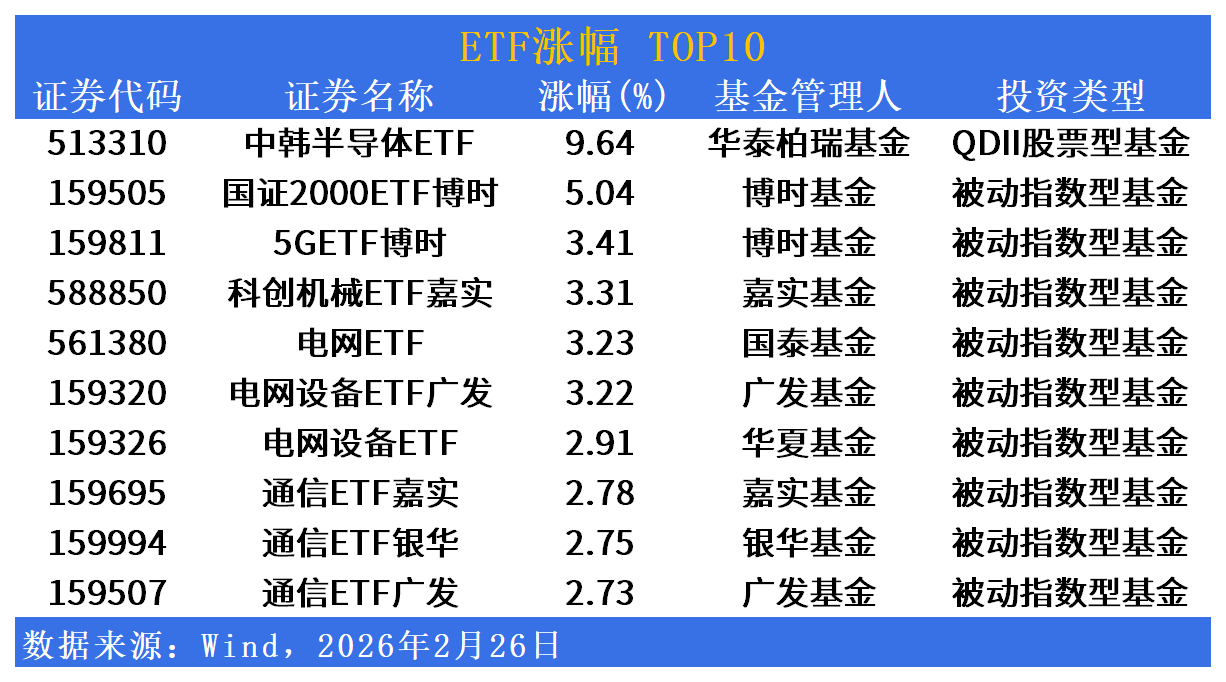
Market Overview - A-shares showed mixed performance with the Shanghai Composite Index down 0.01%, Shenzhen Component Index up 0.19%, and ChiNext Index down 0.29% as of market close [1] - Total trading volume in Shanghai, Shenzhen, and Beijing reached 25,568 billion, an increase of 756 billion from the previous day [1] ETF Performance - The China-Korea Semiconductor ETF surged by 9.64%, leading the market, driven by the recovery in the semiconductor supply chain [2] - The National 2000 ETF rose by 5.04%, indicating a rebound in small-cap growth stocks [2] - The Electric Grid sector performed well, with the Electric Grid ETF up 3.23% and the Electric Grid Equipment ETFs rising by 3.22% and 2.91% respectively [2] Communication Sector - The communication sector also saw gains, with ETFs in this category rising between 2.73% and 2.78% [3] Declining Sectors - The pharmaceutical sector faced a broad retreat, with the Hang Seng Biotechnology ETF showing the largest decline at -3.89% [4] - Other related ETFs in the healthcare and biotechnology sectors also experienced significant drops, indicating a market shift from defensive sectors to technology growth [4] Trading Activity - The Short-term Bond ETF had a trading volume exceeding 66 billion, leading in activity among ETFs [5] - The top traded ETFs included the Short-term Bond ETF at 661.12 billion and the Silver Day Benefit ETF at 167.16 billion [5] Turnover Rates - Cross-border products showed high trading activity, with the Brazil ETF and China-Korea Semiconductor ETF having turnover rates of 171.99% and 125.76% respectively [6][7] - The National Debt ETF also maintained a strong turnover rate of 88.09%, indicating active trading in interest rate bonds and cross-border assets [7] New ETF Launch - A new Technology Growth ETF by Industrial Bank is set to launch on February 27, with a focus on hard technology and a multi-factor strategy targeting the top 50 securities in various tech sectors [8]

1月14只ETF扩容逾百亿 释放什么信号?
2 1 Shi Ji Jing Ji Bao Dao· 2026-02-03 13:07
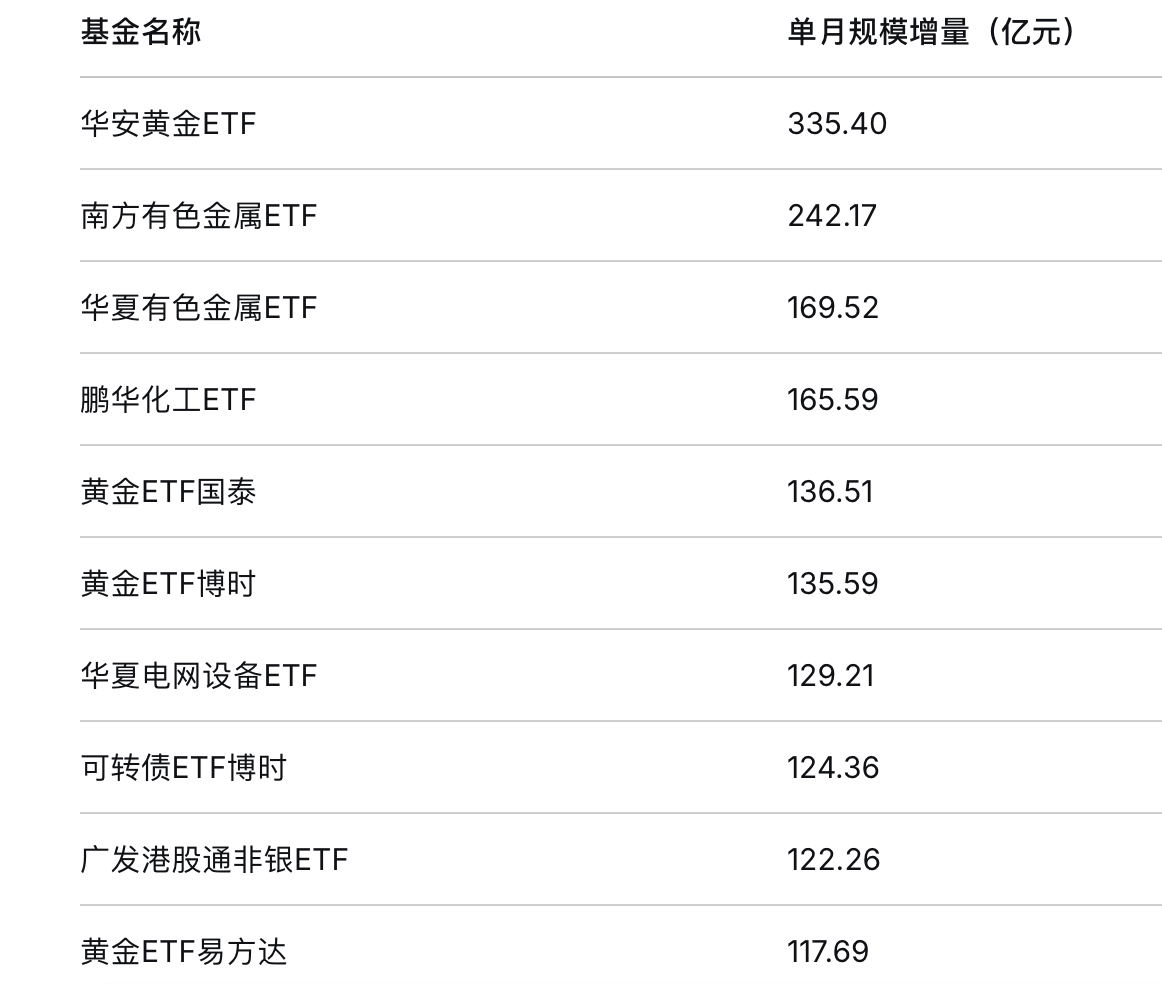
Core Insights - In early 2026, ETF fund flows showed significant divergence, with core broad-based ETFs experiencing large net outflows, while industry-themed ETFs gained popularity and saw substantial inflows [1][9] - The preference for industry-themed ETFs highlights a consensus among investors regarding the support from industrial policies and the positive fundamentals in specific sectors [1][6] ETF Performance - As of January 31, 2026, 14 ETFs had their scales increase by over 10 billion yuan, including 7 stock ETFs, 4 commodity ETFs, 2 cross-border ETFs, and 1 bond ETF [3] - Notable increases in scale included the Huaan Gold ETF (335.4 billion yuan), Southern Nonferrous Metals ETF (242.17 billion yuan), and Huaxia Nonferrous Metals ETF (169.52 billion yuan) [4][7] - The stock ETFs that saw significant scale growth were primarily industry-focused, indicating a market signal for bullish sentiment in related sectors [5][6] Market Trends - The overall ETF fund flow in January 2026 reflected a structural shift, with significant net outflows from core broad-based ETFs and inflows into industry-specific ETFs and gold [9][10] - The A-share market experienced a transition from exuberance to cooling, with the Shanghai Composite Index surpassing 4100 points before entering a consolidation phase [9][11] Investment Strategies - Institutions suggest that the market in February will likely experience volatility, with a focus on "growth and cyclical" dual strategies while being cautious of overheating sectors [11][12] - Recommended investment strategies include focusing on global manufacturing recovery, traditional industry improvements, and technology growth, particularly in AI applications and robotics [12][13]
多只ETF、LOF罕见跌停
Xin Lang Cai Jing· 2026-01-30 12:51
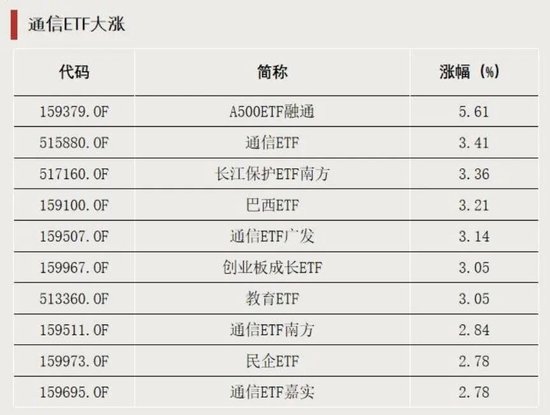
Group 1 - The precious metals, industrial metals, and minor metals sectors experienced a significant decline, with multiple gold and colored ETFs hitting the limit down [1][2][9] - Several LOF funds that had previously hit the limit up faced a limit down after resuming trading, indicating market volatility [10][18] - On January 29, gold and colored ETFs attracted substantial net inflows, while semiconductor-related ETFs also saw reverse positioning [11][15] Group 2 - The communication ETF sector showed a general increase, with several ETFs related to communication and artificial intelligence rising significantly [12][13] - Low-valuation sectors such as agriculture, forestry, and paper-making led the market gains, contrasting with the overall decline in precious metals [12] - The trading volume for gold ETFs surged, with the gold ETF reaching a transaction volume of 257.78 billion, significantly higher than the previous week's average of 71.07 billion [4][14] Group 3 - On January 29, various ETFs related to colored metals and gold saw net inflows exceeding 10 billion, indicating strong investor interest [15][17] - The semiconductor sector, despite its recent declines, attracted significant reverse investments, with notable inflows into semiconductor equipment ETFs [16][17] - The core logic supporting gold prices remains unchanged, driven by high geopolitical risks and the weakening of the dollar's credibility due to high U.S. government deficits [8][19]
最新!超480亿元 “跑了”
Zhong Guo Ji Jin Bao· 2026-01-28 06:29
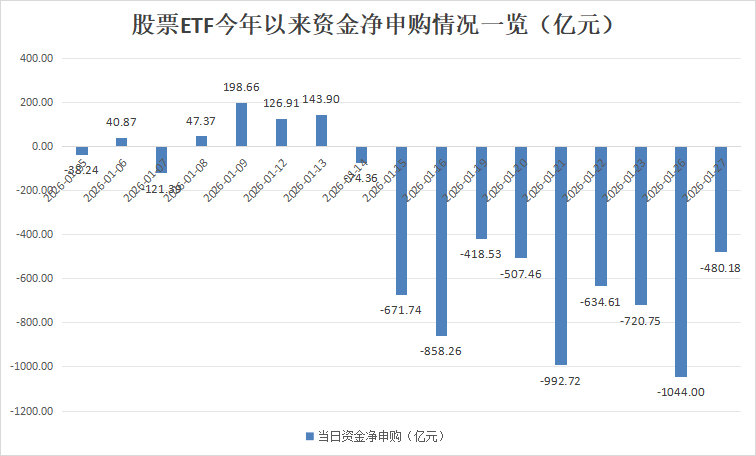
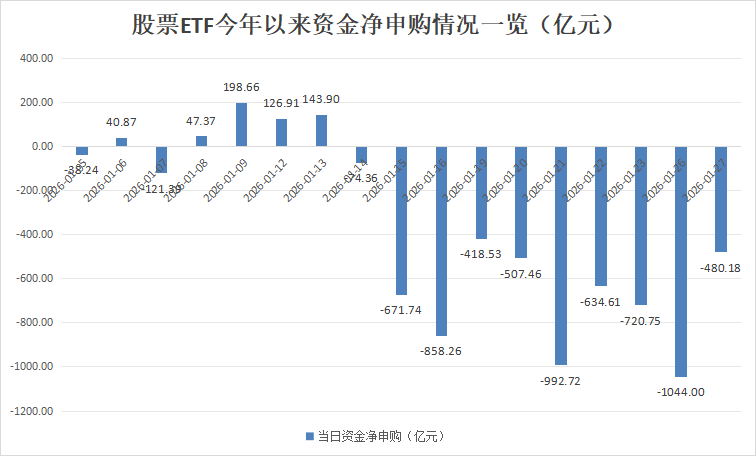
Core Viewpoint - The stock ETF market has experienced a significant outflow of funds, totaling over 640 billion yuan in the last ten trading days, indicating a bearish sentiment despite the Shanghai Composite Index maintaining above 4100 points [1]. Group 1: ETF Market Overview - As of January 27, the total scale of all stock ETFs (including cross-border ETFs) reached 4.19 trillion yuan, with a net outflow of 480.18 billion yuan on that day alone [1]. - The outflow trend has persisted for ten consecutive trading days, with a cumulative net outflow exceeding 640 billion yuan [1]. Group 2: ETF Performance by Type - Industry and commodity ETFs saw net inflows of 72.18 billion yuan and 41.26 billion yuan, respectively, while broad-based ETFs faced significant outflows, totaling 570 billion yuan [3]. - The SGE Gold 9999 index ETFs led the inflows with a net inflow of 35.7 billion yuan, while the ETFs tracking the CSI 300 index saw a net outflow of 385.49 billion yuan [3]. Group 3: Notable ETF Inflows - The Huaxia Nonferrous Metals ETF and Gold Stock ETF recorded the highest single-day net inflows of 16.57 billion yuan and 5.45 billion yuan, respectively [4][5]. - The E Fund Gold ETF also saw a net inflow of 8.75 billion yuan, contributing to the overall strength of gold-related ETFs [6]. Group 4: Notable ETF Outflows - The top ten ETFs with the highest net outflows were all broad-based ETFs, with three CSI 300 ETFs collectively experiencing over 330 billion yuan in net outflows [8]. - The CSI 500 ETF had a significant net outflow of 93.23 billion yuan, indicating a trend of investors pulling back from broader market exposure [8]. Group 5: Market Outlook - Analysts from Guotai Fund suggest that the recent rise in gold prices is driven by its safe-haven appeal and concerns over U.S. asset confidence, alongside a potential interest rate cut cycle [7]. - The outlook for the non-ferrous sector remains positive, with supply disruptions and strong demand expected to support prices for metals like copper and lithium [7].
最新!超480亿元,“跑了”
Zhong Guo Ji Jin Bao· 2026-01-28 06:14
Core Viewpoint - The stock ETF market has experienced a continuous outflow of funds for ten consecutive trading days, totaling over 640 billion yuan, indicating a bearish trend despite the Shanghai Composite Index stabilizing above 4100 points [1][2]. Group 1: Market Overview - As of January 27, the total scale of the stock ETF market (including cross-border ETFs) reached 4.19 trillion yuan, with a net outflow of 480.18 billion yuan on that day [2]. - The recent ten-day period has seen a cumulative net outflow exceeding 640 billion yuan from stock ETFs [1]. Group 2: ETF Performance by Type - Industry theme ETFs and commodity ETFs saw net inflows of 72.18 billion yuan and 41.26 billion yuan, respectively, while broad-based ETFs experienced significant outflows, totaling 570 billion yuan [4]. - The broad-based ETF scale decreased by 507.34 billion yuan during this period [4]. Group 3: Specific ETF Insights - ETFs tracking the SGE Gold 9999 index saw a net inflow of 35.7 billion yuan, while those tracking the CSI 300 index faced a net outflow of 385.49 billion yuan [4]. - Major fund companies like E Fund and Huaxia Fund reported significant net inflows in their gold and commodity ETFs, with E Fund's gold ETF attracting 8.8 billion yuan and Huaxia's non-ferrous metal ETF attracting 16.57 billion yuan [5][7]. Group 4: Sector Analysis - The gold and non-ferrous metal sectors are currently the most attractive for investors, with substantial inflows into related ETFs [6][7]. - Factors supporting the gold price include its safe-haven appeal, a potential Fed rate cut cycle, and geopolitical tensions, while the non-ferrous sector is bolstered by supply disruptions and strong demand [8].