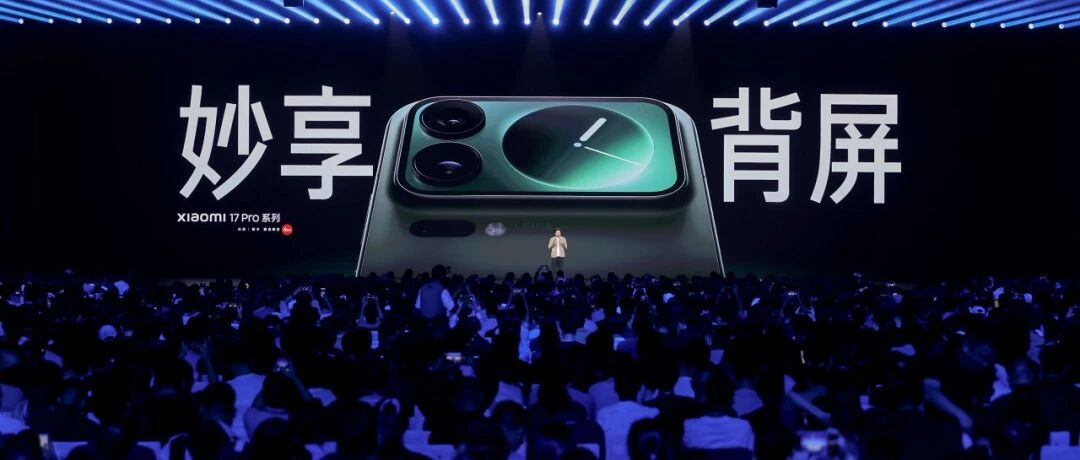
小米17 Pro系列

Search documents
成本12美元收费119美元?iPhone17电池利润惊人
Guan Cha Zhe Wang· 2026-02-10 08:39
Group 1 - The core point of the article highlights the significant profit margin Apple achieves from its battery replacement service for the iPhone 17 Pro Max, with a net profit of $100 per battery replacement, resulting in a profit margin of 89% [3] - The cost of the battery for Apple is approximately $12, while the replacement price for consumers is $119 in the US and 969 yuan in China, indicating a substantial markup [3] - Apple's service revenue for the fiscal year 2025 exceeded $108.6 billion, with a gross margin of 75%, and the first quarter of fiscal year 2026 saw service revenue surpassing $30 billion, growing 14% year-over-year with a gross margin of 76.5% [3] Group 2 - The article compares Apple's battery replacement costs with those of competitors, noting that OPPO Find X9 Pro's battery replacement costs 249 yuan, while Xiaomi 17 Pro and Vivo X300 series are priced at 199 yuan, highlighting the disparity in revenue potential [7]



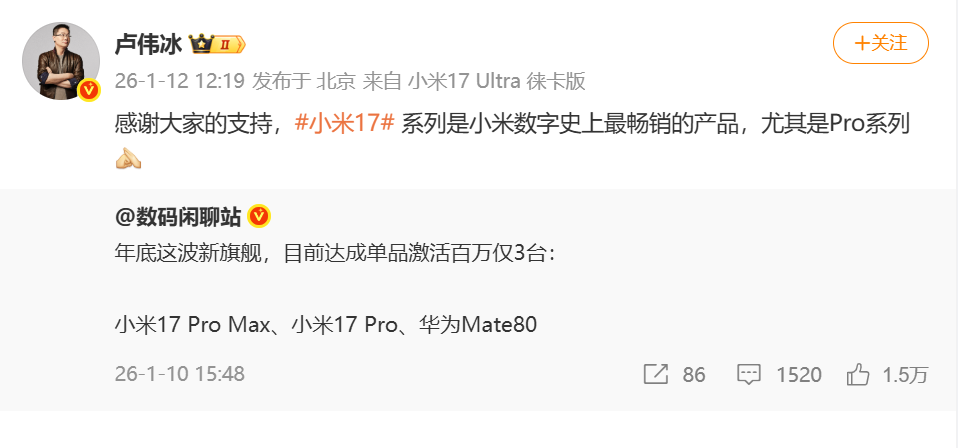
卢伟冰:17 系列是小米数字史上最畅销的产品
Huan Qiu Wang· 2026-01-12 08:11
Group 1 - The core message indicates that the new flagship models, including Xiaomi 17 Pro Max, Xiaomi 17 Pro, and Huawei Mate 80, have only achieved one million activations for three models by the end of the year [1] - Xiaomi's 17 series is reported to be the best-selling product in the company's digital history, particularly the Pro series [3] - The Xiaomi 17 series will undergo significant product line adjustments in 2025, transitioning to a new high-end market matrix with standard, Pro, and Pro Max models [3] Group 2 - The Xiaomi 17 series will globally debut the fifth-generation Snapdragon 8 Supreme version, utilizing a 3nm process, with CPU performance comparable to A19 Pro and significantly improved GPU performance [3] - The "Miao Xiang Back Screen" feature in the Xiaomi 17 Pro series is highlighted as a core innovation aimed at redefining smartphone interaction experiences [3]
雷军:未来五年 2000亿元研发投入
Shang Hai Zheng Quan Bao· 2026-01-08 05:30
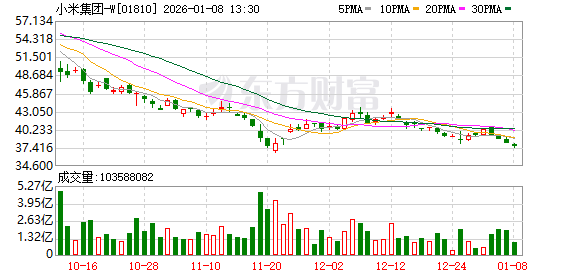
Core Insights - Xiaomi Group held its annual "10 Million Technology Award" ceremony, recognizing outstanding engineers and teams, with a total of 75 million yuan awarded since 2019 [2] - The highest award this year was given to the "Xuanjie O1" team, which has received positive feedback from users and media [2] - The 2025 award received submissions from 154 projects across ten departments, with 66 projects entering the review phase, marking a record high in both quantity and quality [2] Group 1 - In 2026, Xiaomi plans to achieve a milestone by integrating self-developed chips, operating systems, and AI models in a single terminal, while also advancing its robotics business [3] - The company emphasizes that mastering core technologies is essential for its success in smart manufacturing and technological innovation [3] - Award-winning projects include the Xiaomi 17 Pro series, 2200MPa ultra-strong steel, and various innovations in battery technology and AI systems [3] Group 2 - Xiaomi is experiencing a comprehensive breakthrough in core technologies, focusing on advancements in chips, materials, and battery structures [4] - The company values engineer culture as a source of continuous innovation and aims to provide a top-tier platform for talented engineers [4] - As of Q3 2025, Xiaomi has over 24,000 R&D personnel, with a cumulative R&D investment of approximately 105 billion yuan in the first five years of the new decade [5] Group 3 - Xiaomi commits to investing 200 billion yuan in core technology R&D over the next five years, focusing on chips, operating systems, and AI [5] - The company aims to build a robust ecosystem encompassing "people, vehicles, and homes" as part of its strategic vision [5]
回到台前的雷军 回应一切的小米
Bei Jing Shang Bao· 2026-01-04 15:57
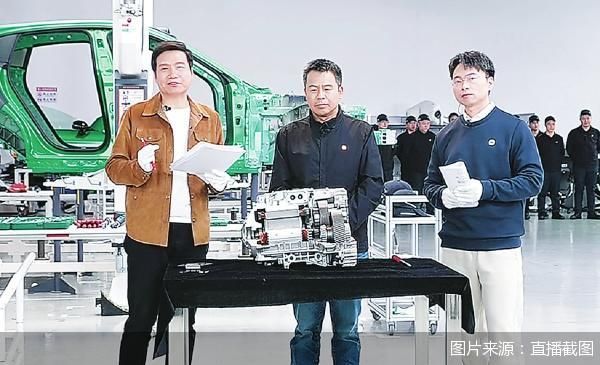
Core Viewpoint - Xiaomi is actively addressing product-related controversies and shifting its communication strategy to regain control over its narrative, as demonstrated by a recent live-streamed event where CEO Lei Jun and other executives responded to public concerns and showcased the YU7 vehicle [1][3][4]. Group 1: Live Stream Event - The live stream, initially scheduled for New Year's Eve, featured a detailed disassembly of the YU7 vehicle, allowing Xiaomi's engineers to explain design concepts and technical details [1][3]. - Lei Jun acknowledged the company's previous reluctance to respond to product criticisms, emphasizing a new approach to engage with consumers and address their concerns directly [3][4]. - The event lasted over four hours and included a segment dedicated to addressing various criticisms that had circulated online, marking a strategic shift for the company [1][4]. Group 2: Communication Strategy - Xiaomi's new communication strategy aims to proactively address public concerns and clarify misconceptions, with Lei Jun stating that this is just the beginning of a series of planned responses [4][5]. - The company is encouraging open discussions and evaluations from industry peers, with executives like Xu Jieyun advocating for transparency in product assessments [5][6]. - Lei Jun and Xu Jieyun highlighted the importance of combating misinformation and malicious attacks, revealing that legal actions have been taken against individuals spreading false information about the company [6][7]. Group 3: Future Strategy and Investment - Xiaomi has committed to investing over 200 billion yuan in research and development over the next five years, focusing on generative AI and enhancing its product ecosystem [8][9]. - The company reported a 30% increase in sales for the new 17 series compared to the previous 15 series, indicating strong market performance and consumer interest [9].

回到台前的雷军,回应一切的小米
Sou Hu Cai Jing· 2026-01-04 11:33
Core Viewpoint - Xiaomi is actively addressing product-related controversies and shifting its communication strategy to enhance transparency and regain consumer trust, as demonstrated by a recent live-streamed event where company leaders directly responded to criticisms and showcased product details [2][5][10]. Group 1: Live Stream Event - The live stream, initially delayed due to the illness of CEO Lei Jun, featured key executives including Vice President of Xiaomi Auto, Li Xiaoshuai, and General Manager of Industrial Design, Li Tianyuan, who participated in a detailed disassembly of the YU7 vehicle [1][2]. - The event lasted over four hours and focused on dismantling the YU7 while addressing various criticisms surrounding Xiaomi's products, marking a strategic shift from the company's previous stance of minimal public engagement [2][4][5]. Group 2: Response to Criticism - Lei Jun acknowledged that Xiaomi had previously refrained from addressing product-related criticisms, believing that "good products speak for themselves," but decided to take a more proactive approach in response to ongoing negative sentiments [4][5]. - The company plans to systematically address various issues raised by consumers, with the YU7 disassembly being the first step in a broader communication strategy [5][10]. Group 3: Future Strategy - Xiaomi has committed to investing over 200 billion yuan in research and development over the next five years, focusing on generative AI and enhancing its product ecosystem [12]. - The company reported a 30% increase in sales for the new Xiaomi 17 series compared to the previous generation, indicating strong market performance and consumer acceptance [12].
雷军直播推迟,vivo预热跨年,OPPO开售新品
Sou Hu Cai Jing· 2025-12-31 06:17
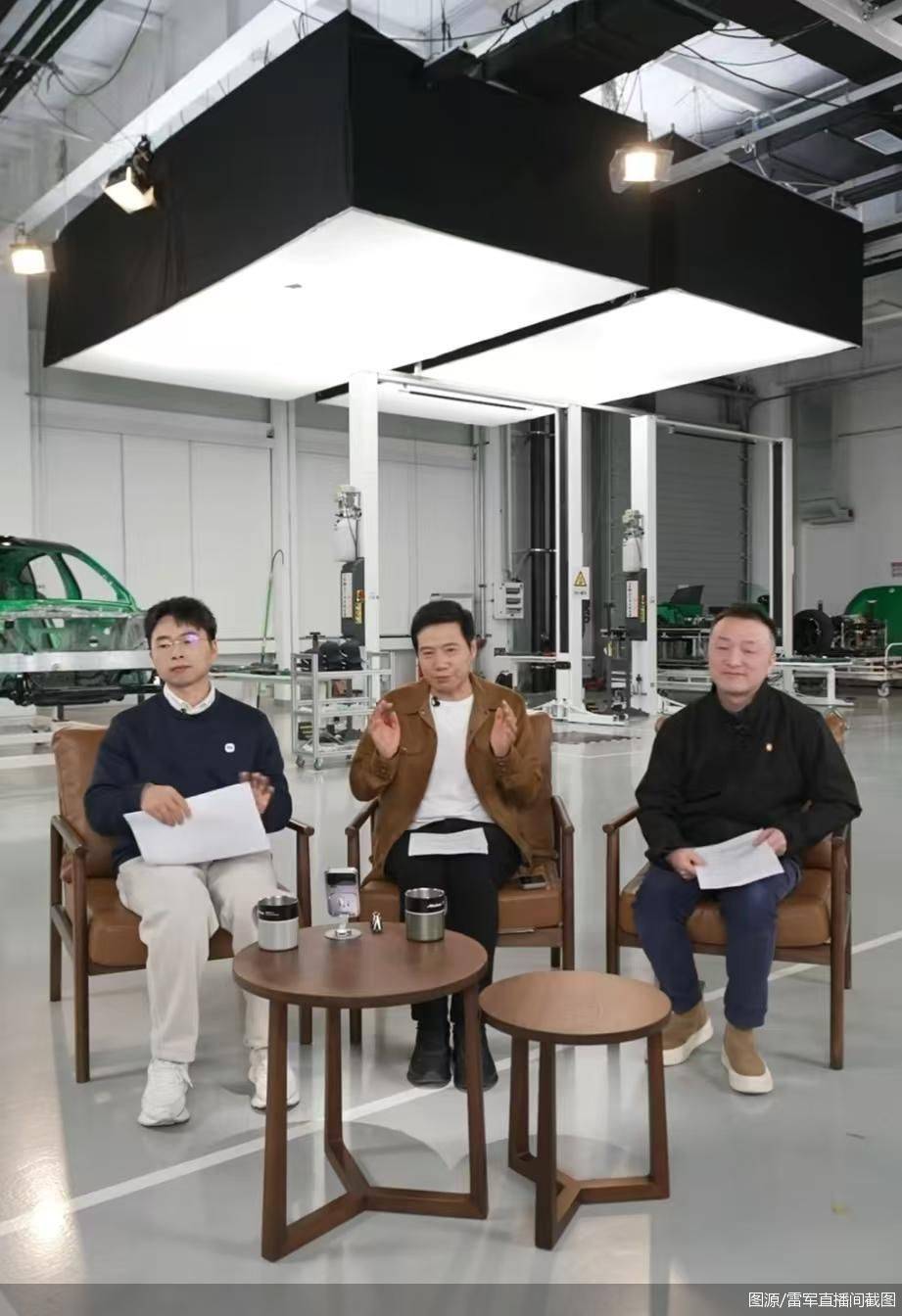
Group 1 - Lei Jun postponed the New Year's Eve live broadcast due to illness, rescheduling it to January 3 at 7 PM, and is giving away 15 Xiaomi 17 Ultra phones as a gesture of goodwill [3] - Xiaomi launched a new feature for Xiaomi 17 Pro series users, allowing them to create personalized New Year goal templates for their device's back screen [3] - Xiaomi is distributing 1 million "New Year postcards" featuring highlights from the Leica imaging competition at its physical stores [3] Group 2 - OPPO released multiple new products, including the OPPO Pad Air5, priced from 1899 yuan, featuring a 12.1-inch LCD screen, MediaTek Dimensity 7300-Ultra processor, and a 10050 mAh battery with 33W fast charging [5] - The new color variant "Starry Pink" of the OPPO Reno15 is now available, maintaining the same specifications as the original version [5] Group 3 - Vivo is collecting photos taken with its phones during New Year's Eve celebrations, promoting its devices as ideal for capturing such events [7] - The Vivo X300 and S50 series are currently available for purchase, with expected discounts during the New Year period [7] Group 4 - Honor is promoting the Honor Power2, which has received IP68 and IP69K ratings for water and dust resistance, and is set to be the first new device launched in 2026 [9]
五年千亿研发淬炼,小米携手粤港澳大湾区共筑“同心圆”
Sou Hu Cai Jing· 2025-10-18 04:44
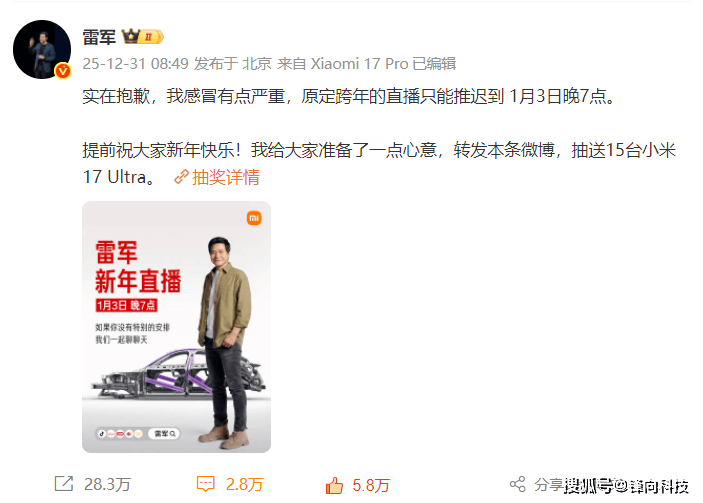
Core Insights - The 2025 Guangdong-Hong Kong-Macao Greater Bay Area Artificial Intelligence Technology Development Forum was held in Zhuhai, focusing on the latest trends in AI technology and its industrial applications in the region [1][3] - The forum gathered experts, scholars, and entrepreneurs from the Greater Bay Area to discuss how AI can empower industrial upgrades and promote cross-regional collaboration [1][11] Group 1: Forum Highlights - The forum served as a significant platform for discussing the integration of technology within the Greater Bay Area's development blueprint [3] - Zhuhai has established a strong foundation for technological innovation, with 2 provincial laboratories and 19 provincial key laboratories, alongside initiatives like the "Tianqin Plan" and "AI Supercomputing Center" [3][12] - The city has nurtured 11 national-level manufacturing champions and over 2,900 high-tech enterprises, showcasing its commitment to fostering a robust tech ecosystem [3][12] Group 2: AI Industry Development - Zhuhai's AI industry has surpassed a scale of 12.4 billion yuan, demonstrating strong growth momentum [13] - The local government has implemented a series of supportive policies to enhance the AI industry, including the establishment of a 500 million yuan "computing power voucher" and a 100 million yuan "model voucher" [13][15] - The city aims to create a comprehensive AI ecosystem covering foundational, technical, and application layers, positioning itself as a key player in the AI sector [13][15] Group 3: Xiaomi's Role - Xiaomi's significant investment in R&D, exceeding 100 billion yuan over the past five years, highlights its transition from an internet company to a hard-tech powerhouse [12] - The launch of the Xiaomi 17 series smartphones, featuring advanced technology, underscores the company's commitment to innovation in AI and smart devices [12] - Xiaomi's "human-vehicle-home ecosystem" strategy emphasizes AI as a core driving force for its business model, contributing to the region's industrial intelligence upgrade [12][9]
宗馥莉辞职原因曝光!商标使用不合规,将独立经营娃小宗;曹德旺回应做慈善慷慨但对员工苛刻:用的个人的钱;微软新一轮裁员补偿N+4
雷峰网· 2025-10-11 00:27
Group 1 - Cao Dewang responded to criticism about being generous in charity but strict with employees, stating that his charitable donations come from personal funds, not company funds. He emphasized that the average monthly salary for employees is around 10,000 yuan, which is slightly above the industry average, to maintain competitiveness and risk resilience [3][5]. - The resignation of Zong Fuli from Wahaha Group was attributed to trademark usage non-compliance, leading her to independently operate her brand "Wawa Xiaozong" [8][9]. - ByteDance announced a new employee support scheme for those laid off due to organizational adjustments, offering up to 7.2 million yuan in transitional subsidies over six months [9][10]. Group 2 - Qualcomm is under investigation by China's market regulator for allegedly failing to report its acquisition of Autotalks, which may violate antitrust laws [10]. - Longxin Technology has completed its IPO counseling, with a valuation exceeding 140 billion yuan, positioning itself as a leading player in the DRAM market [27]. - BYD's 14 millionth new energy vehicle was rolled off the production line in Brazil, with the Brazilian president becoming the owner of this vehicle [25].




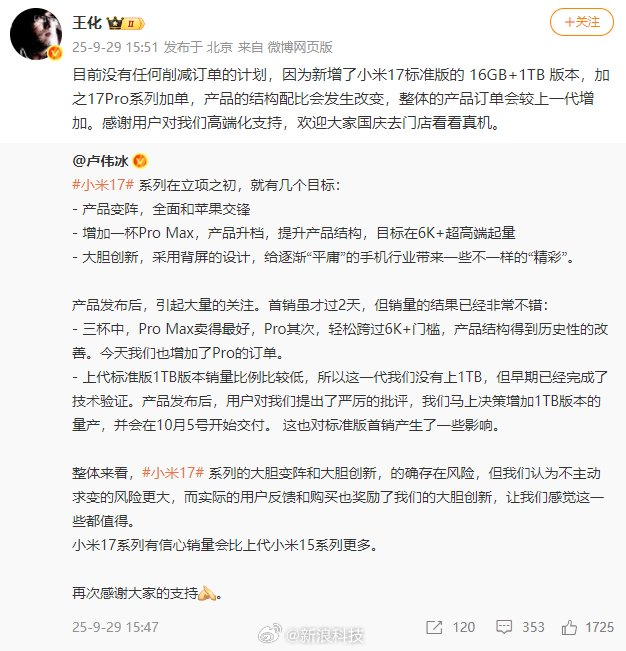
小米王化称产品结构配比改变整体订单将增加
Xin Lang Ke Ji· 2025-09-29 08:58
Core Viewpoint - Xiaomi has no plans to reduce orders for its products, as the introduction of the Xiaomi 17 standard version with a 16GB+1TB configuration and increased orders for the 17 Pro series will lead to a change in product structure and an overall increase in product orders compared to the previous generation [1][2]. Group 1 - The Xiaomi 17 series aims to compete directly with Apple by enhancing product structure and targeting the high-end market starting from 6,000+ [3]. - Initial sales results for the Xiaomi 17 series have been promising, with the Pro Max model performing the best among the three variants, indicating a significant improvement in product structure [4]. - The company has decided to increase the production of the 1TB version of the standard model due to user feedback, with deliveries set to begin on October 5 [4]. Group 2 - The company acknowledges the risks associated with its bold innovations and changes in the Xiaomi 17 series but believes that the risk of not adapting is greater [4]. - User feedback and purchasing behavior have validated the company's innovative approach, reinforcing confidence that the Xiaomi 17 series will outperform the previous Xiaomi 15 series in sales [4].
国产手机18年的逆袭密码,藏在一块背屏里
凤凰网财经· 2025-09-28 14:40
Core Viewpoint - The article highlights Xiaomi's significant shift from being a follower in the smartphone industry to a leader, particularly with the launch of the Xiaomi 17 Pro series, which directly competes with Apple's iPhone Pro series, marking a pivotal moment for Chinese smartphone brands in the high-end market [3][4][21]. Group 1: Innovation and Market Position - Xiaomi's launch of the "Miao Xiang Back Screen" in the Xiaomi 17 Pro series represents a new era of innovation, redefining user interaction and addressing common user pain points [5][8]. - The Xiaomi 17 series achieved record sales, with the entire series selling out in just five minutes, and the Pro Max model accounting for over 50% of the series' sales [4][19]. - The introduction of dual-screen interaction signifies a shift in the definition of innovation, moving away from Western dominance in smartphone interaction [8][10]. Group 2: Technological Advancements - Xiaomi's advancements in screen technology, battery design, and imaging capabilities have enabled the dual-screen feature while overcoming industry challenges such as power consumption and structural integrity [9][10]. - The M10 light-emitting technology used in the Xiaomi 17 series has achieved an international leading position in luminous efficiency, reducing power consumption by 30% [9]. - The L-shaped battery design has improved space utilization by 15%, allowing for a two-day battery life under normal usage conditions [9][10]. Group 3: Strategic Transformation - Xiaomi's strategic shift from being an "internet company" to a "hardcore technology company" has led to a significant increase in R&D investment, with plans to invest 100 billion yuan over five years [11][13]. - The company has seen its R&D expenditure rise from 9.3 billion yuan in 2020 to an expected 30 billion yuan in 2025, with a cumulative investment exceeding 102 billion yuan over five years [13][14]. - The development of the self-designed 3nm flagship chip "Xuanjie O1" positions Xiaomi among the top players globally in chip design capabilities [14][16]. Group 4: Ecosystem Development - Xiaomi's strategy has evolved to encompass a "human-vehicle-home ecosystem," expanding beyond smartphones to include automotive and home appliance sectors [17][19]. - The company has established a strong presence in the high-end smartphone market, while also achieving significant sales in the automotive sector with the SU7 series [19]. - Xiaomi's extensive IoT platform, nearing 1 billion connected devices, creates a competitive barrier that integrates smartphones, vehicles, and home appliances seamlessly [19][20]. Group 5: Industry Impact - The transformation of Xiaomi reflects a broader trend in the Chinese technology industry, showcasing a shift from reliance on imports to achieving technological independence and leadership [21][23]. - The article emphasizes that innovation is not exclusive to any single company but is a result of sustained investment and commitment to breakthroughs [23][24].