
消费拉动经济

Search documents
从春节数据看中国经济增长底气
Zheng Quan Ri Bao· 2026-02-25 15:47
Group 1 - The longest Spring Festival holiday in history has ended, showcasing the continuous release of vitality in the Chinese economy through robust consumption during the holiday [1] - During the 9-day Spring Festival holiday, over 2.8 billion people traveled across regions, with an average of 311 million people per day, marking a year-on-year increase of 8.2% and setting a historical record for travel scale [1] - Domestic tourism reached 596 million trips, an increase of 95 million trips compared to the 8-day holiday in 2025, with total spending of 803.483 billion yuan, up 126.481 billion yuan year-on-year, both figures hitting historical highs [1] Group 2 - Restaurant revenue during the Spring Festival holiday grew by 31.2% year-on-year, with dine-in services increasing by 26.5% and snack services seeing a significant rise of 42.1% [1] - WeChat's data report indicated that transaction volumes for travel and entertainment during the Spring Festival increased by over 20%, reflecting the strong vitality of the consumption market and the deep integration of the digital economy with the real economy [2] - The Chinese economy is characterized by stability, multiple advantages, resilience, and significant potential, with consumption playing an increasingly crucial role as an economic stabilizer [2] Group 3 - The consumption market during the Spring Festival is a direct reflection of the continuously released potential of domestic demand, indicating a solidifying trend of sustained economic improvement in China [3]
最新!全国城市GDP20强来了
Sou Hu Cai Jing· 2026-02-04 15:06
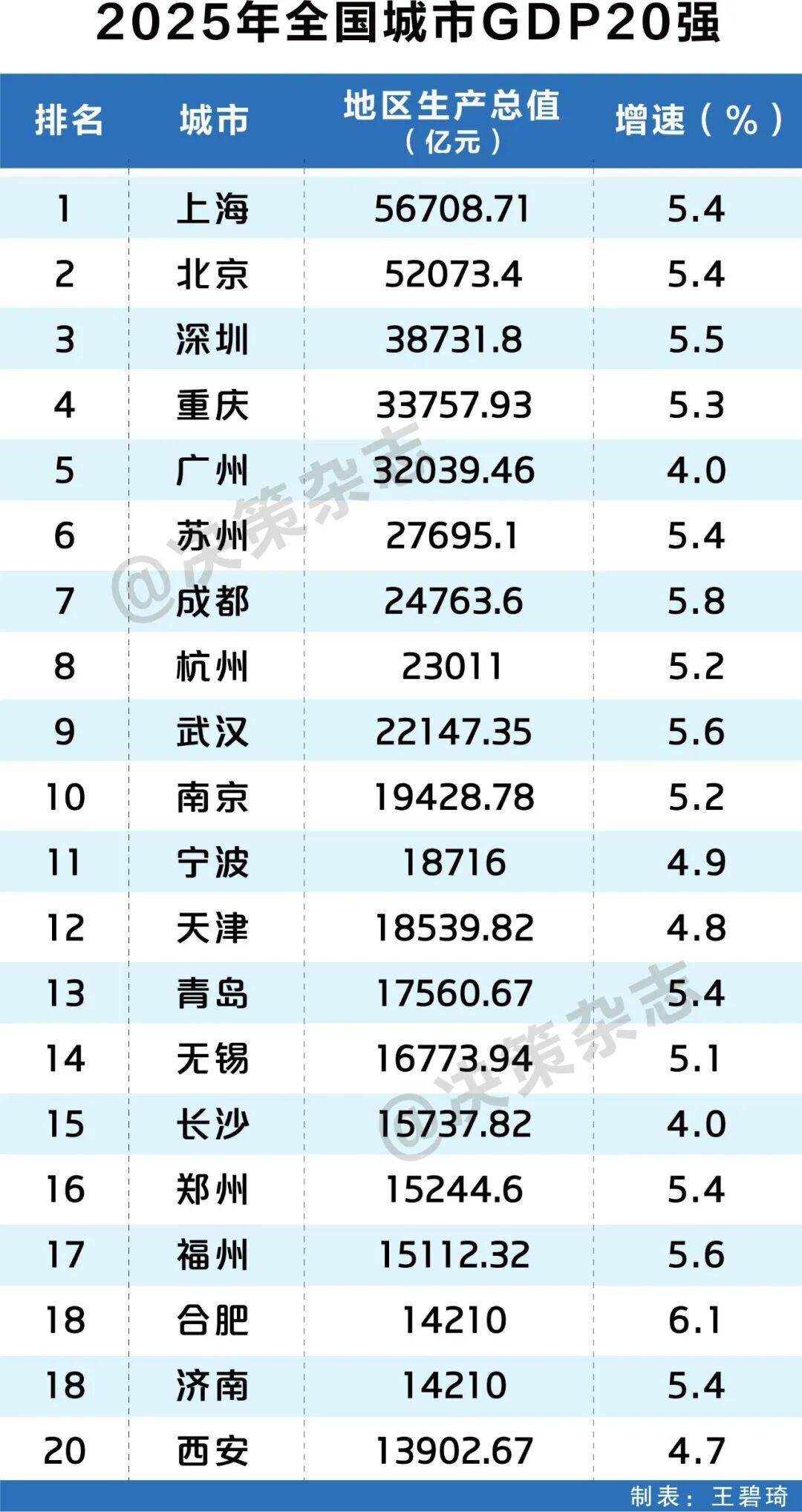
Core Insights - The latest GDP rankings reveal that Shanghai maintains its leading position with an economic total of 56,708.71 billion yuan, while Beijing becomes China's second city to surpass the 50 trillion yuan mark [1][4] - Hefei has made significant progress, ranking 18th in the top 20 cities and achieving a growth rate of 6.1%, the highest among these cities [1][12] GDP Rankings and Growth Rates - Shanghai: 56,708.71 billion yuan, growth rate 5.4% [2] - Beijing: 52,073.4 billion yuan, growth rate 5.4% [2] - Shenzhen: 38,731.8 billion yuan, growth rate 5.5% [2] - Chongqing: 33,757.93 billion yuan, growth rate 5.3% [2] - Guangzhou: 32,039.46 billion yuan, growth rate 4.0% [2] - Hefei: 14,210 billion yuan, growth rate 6.1% [3][12] Economic Structure and Key Industries - In Shanghai, the integrated circuit, biomedicine, and artificial intelligence sectors are projected to grow by 9.6%, with total output surpassing 2 trillion yuan [3] - Beijing's GDP is supported by key industries such as information transmission, software, IT services, finance, and industrial value-added, which together account for 51.8% of its GDP [4] - Shenzhen's new industries contribute significantly, with emerging sectors accounting for 43.0% of its GDP [5] - Chongqing's new energy vehicle sector shows a growth of 13.4%, contributing 60.9% to its industrial economy [5] Consumption and Market Dynamics - Cities with GDPs over 20 trillion yuan typically exhibit strong manufacturing bases, high-income populations, and large populations, which support rising consumption [9] - The consumption market in cities like Chengdu continues to grow, with retail sales reaching 1.14 trillion yuan [6] - The distinction of being a "trillion consumption city" is evident, with cities like Shanghai, Beijing, and Shenzhen leading the way [9] Hefei's Economic Performance - Hefei's industrial value-added grew by 17.6%, with significant contributions from sectors like computer and communication equipment manufacturing [14] - The city's total import and export volume reached 455.18 billion yuan, growing by 20.2% [15] - Fixed asset investments in advanced manufacturing and high-tech services are also on the rise, indicating a shift towards higher efficiency and growth [15]

商务部:2025年消费持续发挥经济发展主引擎的作用
Xin Hua Wang· 2026-01-26 09:16
Core Viewpoint - The Chinese retail sales of consumer goods are projected to exceed 50 trillion yuan in 2025, with consumption contributing 52% to GDP growth, highlighting its role as a key driver of economic development [1] Group 1 - The retail sales of consumer goods are expected to surpass 50 trillion yuan for the first time in 2025 [1] - The contribution rate of consumption to GDP growth is anticipated to reach 52% [1] - Consumption is expected to continue playing a significant role as the main engine of economic development [1]
2026年稳投资政策或加码
2 1 Shi Ji Jing Ji Bao Dao· 2026-01-20 23:15
Economic Performance Overview - In 2025, China's GDP is projected to exceed 140 trillion yuan, achieving a growth rate of 5.0% at constant prices, meeting the annual target despite challenges from U.S. tariff policies and the transition of old and new economic drivers [1] - The economic growth rate for 2025 was 5.4% in Q1, followed by a decline to 5.2%, 4.8%, and 4.5% in subsequent quarters, ultimately stabilizing at 5.0%, consistent with the growth rate of 2024 [1] Consumption Insights - Social retail sales growth reached 3.7% in 2025, slightly above the 3.5% growth in 2024, with goods consumption growing by 3.8%, surpassing the restaurant revenue growth of 3.2% for the first time in three years [1] - The increase in consumption was driven by the expansion of the "old-for-new" policy, which significantly boosted durable goods consumption [2] Export Dynamics - Exports in 2025 grew by 5.5% in USD terms, despite the impact of U.S. tariff policies on global trade [2] - China's trade diversification strategy has been effective, with the country becoming a major trading partner for over 150 nations, focusing on high-tech and high-value-added products as the main drivers of export growth [2] Investment Trends - Fixed asset investment in 2025 saw a decline of 3.8%, with infrastructure investment down by 2.2% and real estate development investment down by 17.2% [2] - The decrease in investment is attributed to the weakening of old economic drivers, particularly in the real estate market, while investments in high-tech manufacturing and services remained robust [2] Policy Measures and Future Outlook - The Central Economic Work Conference in 2025 emphasized "stabilizing and recovering investment," proposing measures such as increasing central budget investment and optimizing local government bond usage [3] - For 2026, it is anticipated that investment growth will rebound due to policy support and base effects, with consumption continuing to play a crucial role [3] - The government plans to shift from broad "old-for-new" subsidies to more targeted measures, alongside initiatives to increase urban and rural residents' income, which will further stimulate consumption [3] - Export resilience is expected to continue, supported by improved global economic forecasts and China's strong manufacturing capabilities [3][4]
新年开新局丨460.3亿元!湖南消费市场“热辣”开局
Xin Lang Cai Jing· 2026-01-04 00:26
Group 1 - Hunan achieved a total consumption of 46.03 billion yuan from December 31, 2025, to January 2, 2026, representing a year-on-year growth of 24.27% [1] - The "old-for-new" consumption policy, effective from January 1, 2026, covers various sectors including automobiles, home appliances, and digital products, stimulating consumer spending [5] - During the New Year period, over 124,000 orders for old-for-new home appliances and digital products were recorded, generating sales of 516 million yuan, with home appliances accounting for 322 million yuan and digital products for 194 million yuan [5] Group 2 - The "福满星城" shopping festival in Changsha involved a municipal investment of 10 million yuan in consumer vouchers, leading to over 300 million yuan in consumer benefits [5] - Retail sales in Changsha on January 1 exceeded 124 million yuan, marking a 42.43% increase compared to the same period last year [5] - The "株洲好物节" attracted over 350,000 visitors, with sales in home improvement categories increasing by 35% [5] Group 3 - The dining market in Hunan saw significant activity during the New Year, with various food festivals and events catering to diverse consumer preferences [10] - In Xiangtan, the dining sales on January 1 increased by 36.26% compared to the previous year, driven by local food festivals [10] - The overall sales of monitored dining enterprises in Hunan during the holiday period grew by 12% year-on-year [10]
生娃“奖房子”,真金白银鼓励生育
Xin Jing Bao· 2025-12-27 11:46
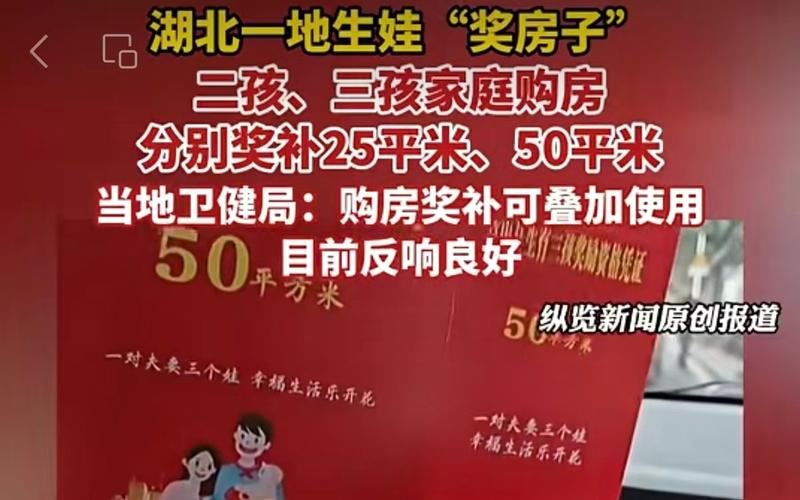
Core Viewpoint - The policy in Zhushan County, Hubei, which rewards childbirth with housing subsidies, aims to address the declining birth rate and alleviate the financial burden of raising children, thereby encouraging young families to have more children [2][3]. Group 1: Policy Details - The policy offers a housing subsidy of 25 square meters for a second child and 50 square meters for a third child, which can be combined for a maximum of 75 square meters [2]. - The estimated subsidy value exceeds 300,000 yuan based on local housing prices of 4,000 to 5,000 yuan per square meter [2]. - The initiative is part of a broader trend where local governments are shifting from merely advocating for childbirth to providing tangible incentives to lower the costs associated with raising children [2][3]. Group 2: Economic Implications - The policy is expected to reduce the housing burden for families with multiple children and send a clear signal of governmental support for childbirth [2]. - The implementation of this policy may also help in reducing real estate inventory and facilitate the urbanization of agricultural migrants, particularly in smaller cities with urgent urbanization needs [3]. - Similar policies in other regions, such as Tianmen City, have shown positive results, including a 14-month streak of leading real estate investment growth in Hubei and a 13.7% increase in fiscal revenue [4]. Group 3: Sustainability and Challenges - The policy requires a sustainable investment mechanism to ensure that the financial support for childbirth does not become ineffective [3][4]. - There are concerns regarding the fairness of the subsidy, as it is limited to designated properties, which may lead to issues related to property quality and pricing [4]. - Ensuring that the subsidized housing is affordable and of good quality is crucial for the success of the policy and its intended outcomes [4].
迟福林:如何让大家愿消费、敢消费、能消费?
和讯· 2025-11-24 09:49
Core Viewpoint - The article emphasizes the importance of enhancing social security and public services to boost consumer confidence and spending in China, particularly in the context of achieving common prosperity and addressing income distribution reform [3][4][5]. Group 1: Social Security and Consumer Confidence - The experience of observing full restaurants in Australia led to the realization of the importance of a legally confirmed social security net, which enhances consumer confidence [3][20]. - There has been significant investment in basic social security in China, resulting in noticeable growth in guaranteed income, but further legal confirmation of social security is necessary to stabilize consumer expectations [3][20]. - The need for a robust social security system is highlighted as a foundation for increasing consumer spending and ensuring a sense of safety among the populace [9][20]. Group 2: Income Distribution Reform - The "two-fold doubling plan" proposed by the National Committee aims to double national income and the middle-income group, which is seen as crucial for achieving common prosperity [3][4]. - The article discusses the necessity of narrowing the income gap between urban and rural residents, with recent improvements noted in rural income levels [16][17]. - Future reforms should focus on increasing the proportion of labor remuneration in national income, targeting a rise from 50% to 60% over the next decade [17]. Group 3: Economic Growth and Consumption - The article suggests that increasing the service consumption ratio from 46.1% to 60% could generate an additional 40 trillion yuan in consumer demand, indicating a significant opportunity for economic growth [8]. - The current economic model is criticized for being overly reliant on traditional investment, with a call for a shift towards a consumption-driven economy [9][10]. - The importance of investing in human capital, particularly in education, healthcare, and elder care, is emphasized as a means to stimulate service consumption and improve quality of life [11][12]. Group 4: Public Services and Urbanization - The "15th Five-Year Plan" aims to enhance the equality of basic public services, which is essential for urbanization and addressing the needs of a growing population [4][19]. - The article stresses the need for a balanced approach to investment in both physical infrastructure and human services to meet the evolving demands of society [10][14]. - Achieving basic public service equality is seen as a long-term goal that requires sustained effort and legal frameworks to ensure fairness and security for all citizens [19][21].

差距再次拉大,2023年美国GDP为27.37万亿美元,中国呢?
Sou Hu Cai Jing· 2025-11-11 07:40
Economic Performance - The US economy showed strong performance in 2023 with a total output of $27.37 trillion, reflecting a 2.5% year-on-year growth after adjusting for inflation, which is an increase of $1.65 trillion compared to 2022 [1][3] - Consumer spending was a significant driver, with retail sales increasing by 3.2% for the year and a notable 5.6% year-on-year jump in December [1][3] - The Michigan Consumer Sentiment Index surged nearly 30% from November to January, marking the fastest increase since the 1990s [1] Government Spending and Debt - The US national debt rose from $23 trillion in 2019 to $34 trillion in 2023, with an increase of $11 trillion over four years, largely due to government stimulus measures [3] - The quarterly GDP figures for 2023 were $6.55 trillion, $6.8 trillion, $6.93 trillion, and $7.09 trillion, each surpassing the annual output of Japan or Germany [3] Comparison with China - China's total output in 2023 was 126.06 trillion yuan, equivalent to approximately $17.89 trillion, reflecting a year-on-year growth of 5.2%, which is more than double the US growth rate [3] - The gap between the US and China widened from $5.77 trillion two years ago to $9.48 trillion, with China accounting for only 65.36% of the US economy [3] - China's consumer contribution rate reached a historic high of 82.5%, while the export surplus was $822.3 billion [3] Investment and Market Trends - Corporate investment showed signs of recovery, particularly in the tech sector, with the Dow Jones index rising by 13.7% over the year [4] - The US economy's resilience is attributed to consumer spending, which constitutes nearly 80% of the total economic output [3][4] Future Projections - For 2024, the US GDP is projected to rise to $29.18 trillion, with a growth rate of 2.8%, while China's GDP is expected to reach 134.91 trillion yuan (approximately $18.80 trillion) with a growth rate of 5.0% [7] - The International Monetary Fund forecasts China's growth at 4.8% for 2024, while the US is projected to grow at 1.9% in 2025 [7][9] Structural Challenges - The US economy benefits from strong consumer demand and low unemployment, while China faces challenges such as real estate debt, low consumer confidence, and high youth unemployment [9] - The structural differences between the two economies are highlighted by the US's reliance on consumer spending and investment, while China's economy is more dependent on exports and manufacturing [9]

中国银行行长张辉:消费拉动给中国银行发展带来非常好的支撑
Xin Lang Cai Jing· 2025-11-04 05:42
Core Insights - The International Financial Leaders Investment Summit was held on November 4, 2025, highlighting the importance of domestic consumption in China's economic growth [1] - Zhang Hui, Vice Chairman and President of the Bank of China, stated that domestic final consumption expenditure contributed 53.5% to economic growth in the first three quarters, driving GDP growth by 2.8 percentage points [1] - The Bank of China's research institute predicts that this contribution could rise to 60% in the future, indicating a significant role of consumption in the economy [1] - Zhang emphasized that China's consumption has a solid foundation, and with the growth of residents' income, the consumption potential will gradually expand, particularly in the service sector [1]

常州经开区税务局:精准赋能“微主体” 激活消费“新活力”
Sou Hu Cai Jing· 2025-11-03 06:17
Core Insights - Consumption is a vital engine for economic growth, and individual businesses play a crucial role in stimulating economic microcirculation [1] - The Changzhou Economic Development Zone Tax Bureau focuses on providing precise and efficient services to support the development of individual businesses [1] Group 1: Tax Services and Support - A tax law promotion event was held at Gelin Park, a new commercial complex in Changzhou, featuring 18 first stores and 54 stores from the eastern city [1] - The "Jing Tax Pioneer" service team from the Tax Bureau provided personalized policy guidance and detailed explanations of tax-related processes to individual businesses [1][2] - The Tax Bureau launched a "one-on-one service" for first-time store owners to assist with tax-related business and invoice adjustments [2] Group 2: Event Outcomes - The event distributed over 120 tax promotional materials and provided policy consultations to 60 individuals, assisting 32 taxpayers with specific tax guidance [2] - Gelin Park achieved a cumulative sales revenue of over 380 million yuan within 9 days of opening, attracting over 880,000 visitors [2] - The Tax Bureau aims to continuously optimize tax services and enhance proactive outreach to effectively support market entities [2]