
新能源汽车等

Search documents
对A股的几点理解:持股过节还是持币过节?
Yin He Zheng Quan· 2026-02-08 09:58
Group 1 - The pricing environment of the A-share market has not undergone a significant shift, reflecting the dynamic relationship between macroeconomic totals and the A-share market. Economic recovery signs are evident for 2025, but the pace of recovery in 2026 will require time [2][4] - The A-share market exhibits a notable "calendar effect" around the Spring Festival, with historical trends indicating a preference for high-dividend, consumer, and defensive sectors before the festival, while small-cap and growth styles tend to perform better post-festival [2][12] - The current valuation levels of the A-share market are relatively high, with the overall A-index PE (TTM) at 23.04 times, placing it in the 93.71 percentile since 2010, while the PB (LF) is at 1.90 times, in the 54.40 percentile [2][17] Group 2 - Two important supports for the A-share market are policy stability and liquidity. Since September 2024, a series of policies have been introduced to stabilize expectations and increase market liquidity, aimed at promoting high-quality development in the capital market [2][4] - The A-share market's upward momentum remains strong, with a significant probability of an increase post-Spring Festival. A cautious strategy of "lightly holding stocks during the festival" is recommended to mitigate risks while retaining opportunities for participation in the spring market [2][4] - Key investment directions include sectors benefiting from improved supply-demand dynamics and industry profit recovery, such as non-ferrous metals, basic chemicals, steel, cement, and construction materials, as well as focus areas like semiconductors, artificial intelligence, new energy, and aerospace [2][4][31]
50万亿元不是中国消费故事的全部
Jing Ji Ri Bao· 2026-02-05 22:11
Group 1 - The core viewpoint emphasizes that the true nature of the consumer market in China is complex and multifaceted, requiring a comprehensive understanding beyond just total volume data [1][2][4] - By 2025, China's total retail sales of consumer goods are projected to exceed 50 trillion yuan, with a year-on-year growth of 3.7%, highlighting the sustained role of consumption as a key driver of economic development [1][4] - The growth in retail sales is attributed to a combination of policy initiatives, supply-demand collaboration, and structural optimization, with significant contributions from the replacement of old consumer goods and the rise of green and smart products [1][2] Group 2 - The shift in the consumption structure indicates that service consumption is becoming a significant source of growth, with service retail sales expected to grow by 5.5% year-on-year by 2025, outpacing goods retail sales [2][4] - The proportion of service consumption expenditure in per capita consumption is projected to reach 46.1%, reflecting a transition towards a dual-driven model of "goods + services" [2][4] - The government is actively responding to this trend by focusing on key areas such as transportation, home services, and digital consumption, aiming to cultivate new growth points in service consumption [2][4] Group 3 - New consumption formats and models are emerging, with innovations such as AI and VR enhancing consumer experiences, leading to a shift from mere transactions to experiential consumption [3][4] - The rise of personalized and quality-driven consumption trends, including the popularity of domestic products and rural consumption growth, illustrates the evolving landscape of the consumer market [3][4] - The emphasis on domestic demand and the construction of a robust domestic market is identified as a primary task for economic work in 2026, focusing on optimizing consumption environments and enhancing consumer capabilities [4]
中三省去年GDP总值达15.4万亿,产业竞争力显著提升
第一财经· 2026-02-04 12:43
Economic Performance - The total GDP of the "Central Triangle" formed by Hunan, Hubei, and Jiangxi reached 153,989.55 billion yuan in 2025, an increase of 6,543.09 billion yuan compared to 2024 [2] - Jiangxi's GDP was 36,020.0 billion yuan with a year-on-year growth of 5.2%, while Hubei's GDP was 62,660.90 billion yuan, growing by 5.5%. Hunan's GDP surpassed 55,000 billion yuan, reaching 55,308.65 billion yuan, with a growth rate of 4.8% [2] Industrial Competitiveness - Hubei's industrial competitiveness has significantly improved, with a comprehensive technology innovation index ranking 7th nationally and 1st in Central China. The industrial contribution to economic growth reached 36.1% [4] - Hunan's advanced manufacturing industry is projected to account for 51.7% of the manufacturing value added by 2025, with high-tech manufacturing growing by 11.2%, surpassing the national average by 1.8 percentage points [4] - Jiangxi's industrial value added grew by 7.5%, with key industries like automotive manufacturing and electronics showing significant growth rates of 21.5% and 12.9%, respectively [5] Consumer Market - The total retail sales of consumer goods in the three provinces reached 62,565.91 billion yuan, with Hubei at 27,938.62 billion yuan, Hunan at 21,204.59 billion yuan, and Jiangxi at 13,422.7 billion yuan [7] - Consumption policies, such as trade-in programs, have been effective in boosting demand, with significant growth in retail sales of smart devices and home appliances across the provinces [7][8] Foreign Trade - Hubei's total import and export value reached 834.01 billion yuan, growing by 18.2%, while Hunan's reached 541.41 billion yuan, increasing by 10.8%. Jiangxi's foreign trade totaled 482.3 billion yuan, with a growth of 2.7% [10] - Jiangxi's exports of high-tech products showed strong growth, with high-end equipment and electronic components increasing by 39.7% and 43.1%, respectively [10][11] - Hunan's electric vehicle exports saw a remarkable increase, with total automotive exports exceeding 30 billion yuan for the first time, reaching 33.84 billion yuan, a growth of 26.8% [10][11]

山东挑大梁,工业焕新机
经济观察报· 2026-01-31 02:16
Core Viewpoint - The economic performance of major provinces in 2025 reflects both the expectation and capability of these provinces to drive national economic growth, with a notable contribution to GDP from the top ten provinces [2][4]. Economic Growth Performance - In 2025, seven major provinces achieved GDP growth rates between 5.3% and 5.6%, surpassing the national average growth rate of 5% [2]. - Shandong, as a key economic province, has shown significant growth, with its GDP share of the national total increasing from 7.19% to 7.36% during the "14th Five-Year Plan" period [2]. Industrial Strength - Shandong is the only province in China with all 41 industrial categories, and its industrial added value is expected to grow by 7.6% in 2025, exceeding the national average by 1.7 percentage points [3][6]. - The province's manufacturing sector is undergoing transformation, with high-tech industries accounting for over 55% of industrial output [3][7]. Government Initiatives - The 2026 Shandong government work report emphasizes the importance of economic growth, industrial optimization, and green transformation, targeting a GDP growth of 5.5% and reaching a total of 10.3 trillion yuan [4][10]. - Shandong plans to implement 12 key industry growth plans and aims to complete over 3,000 technology transformation projects in 2026 [10][11]. Technological Innovation - The focus on technological innovation is crucial for Shandong's industrial development, with the province's artificial intelligence sector growing at an annual rate of over 30% [11]. - The government aims to enhance traditional industries while fostering new and future industries, contributing to a stable economic environment [11].
广东刚刚官宣:14.58万亿元,连续37年全国第一
新华网财经· 2026-01-30 06:30
Economic Overview - In 2025, Guangdong's GDP reached 145,846.76 billion yuan, growing by 3.9% year-on-year at constant prices, with the primary industry increasing by 4.5%, the secondary industry by 2.4%, and the tertiary industry by 4.7% [2] Agriculture - The total output value of agriculture, forestry, animal husbandry, and fishery increased by 4.9%, with grain production reaching 13.188 million tons, a 0.4% increase, and grain yield per mu at 393.3 kg, up by 0.5% [3] Industry - The industrial added value for large-scale enterprises grew by 3.0%, with manufacturing increasing by 3.2% and significant growth in sectors like automotive manufacturing at 10.1% and high-tech manufacturing at 6.2% [4] Services - The service sector's added value rose by 4.7%, with financial services and other services growing by 7.7% and 6.2%, respectively. The revenue from major service industries also showed strong growth, particularly in internet services at 12.2% [5] Market Sales - Retail sales of consumer goods increased by 2.8%, with urban retail sales growing by 3.1% and rural sales by 0.7%. Notably, sales of upgraded consumer goods surged, with sports and entertainment goods rising by 28.6% [6] Investment - Fixed asset investment decreased by 17.3%, but investment in equipment and tools rose by 3.7%. Infrastructure investments in water and air transport grew by 5.2% and 12.7%, respectively [7] Consumer Prices - The Consumer Price Index (CPI) fell by 0.2%, while the core CPI, excluding food and energy, increased by 0.4%, indicating a slight inflationary trend [8] Income - Per capita disposable income reached 53,669 yuan, a nominal increase of 4.3%, with rural residents seeing a higher growth rate of 5.4% compared to urban residents [10] Population - The resident population in Guangdong grew to 128.59 million, with an urbanization rate of 76.58%, reflecting ongoing demographic changes [11]

三省份地区生产总值超十万亿元 地区经济迎难而上向新向优
Jing Ji Ri Bao· 2026-01-28 23:29
Economic Growth Overview - In 2025, 31 provinces have released their economic growth data, showing a steady improvement in economic operations despite external challenges and domestic difficulties [1] - 20 provinces achieved growth rates that met or exceeded the national average, with several provinces reaching new economic milestones [1] Key Economic Contributors - The top ten provinces by GDP in 2025 are Guangdong, Jiangsu, Shandong, Zhejiang, Sichuan, Henan, Hubei, Fujian, Shanghai, and Hunan, collectively contributing over 60% of the national GDP with a total of approximately 85.5 trillion yuan [2] - Guangdong's GDP reached 14.58 trillion yuan, growing by 3.9%, maintaining its position as the largest economy in the country for 37 consecutive years [2] - Jiangsu's GDP surpassed 14 trillion yuan for the first time, achieving 14.23515 trillion yuan [2] - Shandong's GDP crossed the 10 trillion yuan mark, reaching 10.3197 trillion yuan, making it the third province to do so [2] - Zhejiang's GDP reached 9.4545 trillion yuan, marking significant growth [2] Growth Rates - Tibet led the growth with a 7.0% increase, while Gansu and Henan both grew by 5.8% and 5.6%, respectively [4] - Other provinces with notable growth rates include Hebei, Shandong, Zhejiang, Sichuan, Hubei, and others, all showing growth rates around 5.5% [4] New Economic Drivers - The development of new productive forces is emphasized as a key requirement for high-quality growth, with a focus on integrating technological and industrial innovation [5] - Traditional industries are undergoing significant upgrades, with Shandong's investment in equipment and tools increasing by 22.6% in 2025 [5] - Emerging industries are also thriving, with Beijing's strategic emerging industries and high-tech manufacturing sectors growing by 15.5% and 7.5%, respectively [5] Product Output Growth - Guangdong's production of drones increased by 39%, while industrial robot production grew by 31.2% [6] - Zhejiang saw substantial growth in the production of virtual reality devices, lithium-ion batteries, and new energy vehicles, with increases of 96.8%, 65.2%, and 49.8%, respectively [7] Investment and Consumption Trends - In Hunan, private investment accounted for 65.2% of total investment, reflecting economic vitality [7] - Jiangsu's retail sales of consumer goods reached 4.6 trillion yuan, leading the nation [7] Future Economic Planning - As 2026 marks the beginning of the "14th Five-Year Plan," provinces are focusing on expanding domestic demand, developing new productive forces, and optimizing the business environment [8] - Key areas of focus include enhancing support for service consumption and promoting major projects to attract private capital [8] - The emphasis on technological innovation and improving the business environment is evident in various provincial government reports [9]
利好来了!刚刚,深圳重磅发布!
券商中国· 2026-01-28 11:29
Core Viewpoint - The article discusses the "Three-Year Action Plan for Optimizing the Consumption Environment in Shenzhen (2026-2028)", which aims to enhance consumer experience and promote various sectors such as digital consumption, home improvement, and health services [1][2][4]. Group 1: Digital Consumption - The plan emphasizes the innovation and development of digital consumption, including the promotion of e-sports, social e-commerce, live-streaming e-commerce, and unmanned retail stores [1][3]. - It encourages the integration of AI into home appliances and smart home products, aiming to create flagship products in the smart home sector [4]. Group 2: Quality of Consumption - The action plan aims to improve consumption quality by promoting high-quality products and establishing quality grading zones in e-commerce platforms and large supermarkets [2]. - It also focuses on enhancing service quality in sectors like hospitality, health, and tourism through comprehensive evaluation metrics [2]. Group 3: Green Consumption - The plan promotes green consumption by expanding the scale of green electricity consumption and improving the service system for green electricity certificates [3]. - It encourages the development of a recycling system for used products and the promotion of second-hand trading in appliances and clothing [3]. Group 4: Home and Health Consumption - The plan aims to boost home consumption by creating smart home experience centers and promoting home renovation activities [4]. - It also focuses on developing international medical services and integrating health management for the elderly with various wellness activities [5]. Group 5: Financial Support and Credit Services - The plan includes measures to enhance financial support for service consumption and the elderly care industry, such as increasing consumer loan limits and extending loan terms [5]. - It proposes the expansion of credit application scenarios, offering flexible payment arrangements to consumers [6]. Group 6: Infrastructure and Internationalization - The plan outlines the development of multi-level commercial districts and consumer support facilities to enhance the shopping experience [6]. - It aims to create an international consumption environment by improving services for international visitors and expanding direct international flight routes [7].
从2025年“成绩单”看嘉兴经济社会稳中提质
Xin Lang Cai Jing· 2026-01-24 00:00
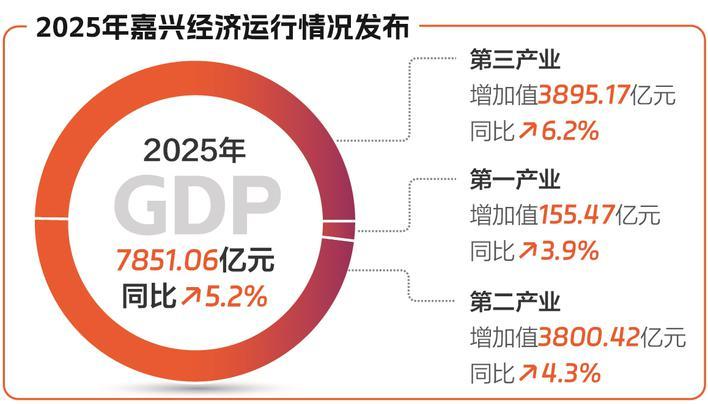
Core Viewpoint - The economic performance of Jiaxing in 2025 shows a robust growth trajectory with a GDP of 785.1 billion yuan, reflecting a 5.2% year-on-year increase, indicating resilience and structural optimization in a complex environment [3][4]. Group 1: Stability - The 5.2% growth is attributed to effective responses to internal and external risks, showcasing Jiaxing's strong economic foundation and high-quality development pace [4]. - The agricultural sector remains a cornerstone, with grain planting area and total output reaching 2.39 million acres and 1.0361 million tons, respectively, maintaining the top position in the province for 20 consecutive years [4]. - Industrial production is stable, with a 5.4% increase in industrial added value, and over 60% of 34 major industry categories achieving positive growth [5]. - The third sector's added value growth reached 6.2%, further solidifying its dominant role in the economy [5]. - Jiaxing's foreign trade performed well, with total import and export value reaching 495.72 billion yuan, a 2.9% increase, ranking among the top four in the province [5]. - The Consumer Price Index (CPI) rose slightly by 0.1%, indicating overall price stability, which supports social harmony and livelihood security [5]. Group 2: Progress - The economic pulse of Jiaxing is characterized by structural breakthroughs and systematic reshaping of development momentum [6]. - High-tech manufacturing added value increased by 13.6%, with significant growth in digital economy sectors, indicating a shift towards quality improvement [6]. - Retail sales of consumer goods grew at the fastest rate in the province, with online retail sales surging by 55.8% [6]. - Investment in high-tech and digital economy sectors grew by 29.1% and 25.0%, respectively, reflecting a focus on future-oriented investments [7]. - Equipment investment surged by 33.3%, indicating a strong willingness for enterprise transformation and upgrading [7]. Group 3: Quality - Economic development in Jiaxing emphasizes improving the well-being of residents, with rural per capita disposable income reaching 54,939 yuan, a 5.1% increase, maintaining the top position in the province [8]. - The income gap between urban and rural residents has narrowed, with the ratio improving to 1.48, showcasing progress towards common prosperity [8]. - Logistics efficiency is highlighted by a 21.6% increase in highway freight volume and the highest growth in container throughput at Jiaxing Port among coastal ports in the province [8]. - Overall, Jiaxing's economy in 2025 reflects a positive trend of stability, progress, and quality enhancement, laying a solid foundation for high-quality development in the "14th Five-Year Plan" [8].
智联招聘平台数据显示:新质生产力蓄势赋能 人才市场开新局
Zheng Quan Ri Bao Wang· 2026-01-23 10:48
Group 1: Emerging Industries - The new generation of information technology, high-end equipment, new materials, new energy vehicles, and aerospace are driving strong talent demand, creating a more optimized employment landscape [1][2] - In the AI and smart hardware sectors, talent demand is projected to grow by 19.0% and 11.5% year-on-year by Q4 2025, indicating deep integration of digital technology with the real economy [1] - The demand for algorithm engineers has surged by 110.1%, leading the growth in the AI sector, while embedded software developers and hardware engineers have seen increases of 17.6% and 6.8% respectively [1] Group 2: High-end Equipment Manufacturing - The robotics and industrial automation sectors have experienced a 37.3% year-on-year increase in job postings, highlighting the widespread adoption of intelligent production solutions [2] - The demand for robotics debugging engineers and industrial robot engineers has surged by 64.1% and 60.6%, respectively, reflecting a critical need for skilled technical talent [2] - Traditional mechanical roles are evolving with the integration of intelligent design and digital simulation, leading to a reassessment of job value and increased requirements for talent [2] Group 3: New Materials - The new materials sector has achieved a 28.1% increase in recruitment by Q4 2025, with a focus on R&D and process engineering talent [2] - Positions in polymer materials and other cutting-edge fields are becoming salary benchmarks due to their importance in original innovation [2] - The demand for process engineers has exploded, with a growth rate of 83.1%, emphasizing the critical role of process innovation in industry competitiveness [2] Group 4: Aerospace - The aerospace sector has seen a 12.3% year-on-year increase in job postings, driven by the expansion of the low-altitude economy and diverse high-level talent needs [3] - Traditional fields such as aircraft design and engine manufacturing continue to see stable growth in demand for high-end engineering talent [3] - The rapid maturation of the drone industry has led to a 59.4% increase in demand for drone engineers, showcasing significant employment creation potential [3] Group 5: New Energy Vehicles - The new energy vehicle industry has established a leading global market scale, with a 53.7% increase in demand for automotive structure engineers, indicating increased investment in core product competitiveness [4] - There is a strong demand for high-quality engineers in the "three electric" systems (electric drive, control, and battery) and key manufacturing processes [4] Group 6: Modern Service Industry - The online life services sector has experienced a remarkable 62.7% increase in job postings, with other sectors like gaming and pet services also growing by over 15% [4] - The rapid development of the modern service industry provides diverse employment opportunities and acts as a stabilizer in the job market, complementing the new quality productivity sectors [4]
“压舱石”作用愈发凸显 创新动能持续壮大
Xin Lang Cai Jing· 2026-01-21 22:36
Core Viewpoint - The industrial economy in China is showing steady growth, with significant contributions to overall economic performance, and the government is committed to advancing new industrialization by 2025 [1][8]. Group 1: Industrial Growth and Performance - The industrial added value of large-scale enterprises increased by 5.9% year-on-year, with manufacturing value added maintaining the world's top position for 16 consecutive years [1]. - The added value of equipment manufacturing and high-tech manufacturing increased by 9.2% and 9.4% year-on-year, respectively [2]. - The telecommunications business volume grew by 9.1% year-on-year, indicating robust performance in the industrial and information sectors [1]. Group 2: Support for Small and Medium Enterprises - The government is implementing reforms to reduce burdens on enterprises and ensure the implementation of policies that benefit businesses, fostering a supportive environment for development [3]. - A total of 17,600 specialized and innovative "little giant" enterprises have been cultivated, along with over 140,000 specialized and innovative small and medium enterprises [3]. Group 3: Innovation and New Growth Drivers - Significant advancements in technology are highlighted, including breakthroughs in humanoid robots and major equipment like large-diameter shield machines [4]. - The added value of industries such as integrated circuits and electronic materials is projected to grow by 26.7% and 23.9% year-on-year, respectively, by 2025 [5]. - The scale of artificial intelligence computing power in China has reached 1,590 EFLOPS, with applications expanding across key industries [5]. Group 4: Digital Economy and Industrial Upgrading - The integration of the digital economy with the real economy is enhancing industrial transformation, with over 23,000 "5G + industrial internet" projects established [6]. - New business models such as "black light factories" and "smart ports" are emerging as key drivers for upgrading traditional industries [6]. Group 5: Future Industrial Strategy - The government aims to stabilize growth, strengthen innovation, promote integration, optimize governance, and prevent risks as part of the new industrialization strategy [8]. - Focus areas include enhancing the adaptability of consumer goods supply and demand, promoting green and low-carbon transitions, and developing new energy solutions [8].