星辰

Search documents
金蝶国际(00268):利润拐点已至,NDR改善,AI应用打开新空间
GF SECURITIES· 2026-03-18 05:23
Investment Rating - The investment rating for the company is "Buy" with a current price of HKD 9.48 and a fair value of HKD 22.35 [3]. Core Insights - The company has reached a profit inflection point, with significant improvements in NDR (Net Dollar Retention) and new opportunities opened up by AI applications. The overall revenue for 2025 is projected to be approximately RMB 70.1 billion, representing a year-on-year growth of 12% [10][19]. - The company has successfully signed AI contracts worth RMB 3.56 billion, leveraging its deep understanding of ERP industry scenarios and extensive enterprise-level data assets [10][19]. - The forecasted revenue for 2026-2028 is expected to be RMB 79.13 billion, RMB 89.01 billion, and RMB 99.39 billion, with growth rates of 12.9%, 12.5%, and 11.7% respectively [20]. Summary by Sections Financial Performance - In 2025, the company achieved total revenue of approximately RMB 70.06 billion, a year-on-year increase of about 12%. The net profit was RMB 0.93 billion, with an adjusted net profit of approximately RMB 2.32 billion, marking a return to profitability [8][11]. - The cloud service revenue accounted for 82.5% of total revenue, amounting to approximately RMB 57.82 billion, with subscription revenue growing significantly by 20.9% to RMB 35.56 billion [8][10]. NDR and AI Applications - The NDR for the company's key products has shown significant improvement, with the "Cang Qiong" product achieving a NDR of 110% in 2025, up from 105.3% in 2023 [10][19]. - The company has launched nearly 20 independent AI-native intelligent bodies covering various scenarios, including financial analysis and contract review, which are expected to enhance its competitive edge in the AI era [10][19]. Profit Forecast and Valuation - The company is projected to maintain a strong growth trajectory, with expected revenue growth rates of 12.9%, 12.5%, and 11.7% for the years 2026, 2027, and 2028 respectively [20]. - Based on comparable company valuations, the company is assigned a PS (Price to Sales) ratio of 8x for 2026, leading to a fair value estimate of approximately HKD 22.35 per share [20].
金蝶国际:订阅ARR增长稳健,出海扩张加速,预测全年营业收入69.00~70.44亿元,同比增长10.3%~12.6%
Xin Lang Cai Jing· 2026-02-12 12:12
Group 1: Financial Performance Forecast - The expected revenue for Kingdee International is projected to be between 6.9 billion to 7.044 billion yuan, representing a year-on-year growth of 10.3% to 12.6% [1][5] - The forecasted net profit ranges from 71 million to 201 million yuan, indicating a significant year-on-year increase of 150.0% to 241.8% [1][5] - The adjusted net profit is anticipated to be 155 million yuan [1][5] Group 2: Subscription and Revenue Growth - The subscription ARR reached 3.86 billion yuan with a net addition of 130 million yuan, indicating stable incremental growth [3][7] - The NDR performance for various products is stable, with figures of 105% for Cangqiong & Xinghan, 95% for Xingkong, 93% for Xingchen, and 88% for Jingdouyun [3][7] - Cloud subscription revenue grew by 22.1% year-on-year, while ARR increased by 18.5% [8] Group 3: Market Position and Expansion - Kingdee International maintains a leading market share of 15.7% in the low-code and no-code software market, with a market size of 2.29 billion yuan, expected to grow to 12.98 billion yuan by 2029 [4][8] - The company has signed a cooperation agreement with Malaysia's revitalization group, marking its direct engagement with local enterprises, with expectations for overseas revenue to increase to 5%-10% [3][4] - Kingdee has consistently ranked first in multiple segments, including SaaS ERP and financial cloud, for 21 consecutive years [4][8] Group 4: AI Integration and Financial Metrics - The company has embraced AI, with contracts related to AI exceeding 150 million yuan, and has launched several AI-native intelligent agents [8] - In the first half of 2025, Kingdee achieved revenue of 3.192 billion yuan, reflecting a year-on-year growth of 11.24%, while the gross profit margin increased by 2.38 percentage points [4][8] - The balance of contract liabilities grew by 24.7% year-on-year, indicating strong future revenue potential [8]

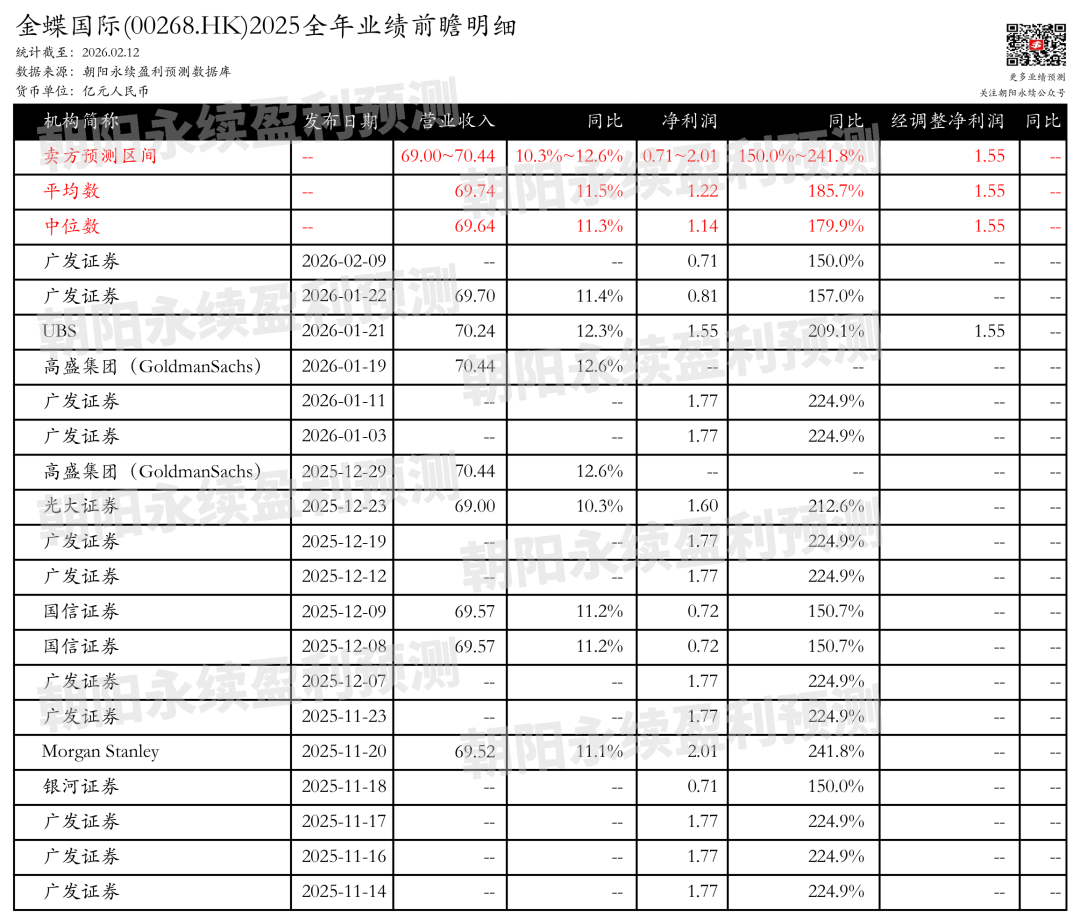
人民日报权威发布:两个万亿元,标注国资央企创新刻度
Ren Min Ri Bao· 2026-01-29 02:22
Core Insights - The central enterprises in China are projected to achieve significant financial milestones by 2025, including a total profit of 2.5 trillion yuan, fixed asset investments of 5.1 trillion yuan, and tax contributions of 2.5 trillion yuan, with total assets exceeding 95 trillion yuan by the end of 2025 [5][19]. Group 1: Financial Performance - By 2025, central enterprises are expected to realize a total profit of 2.5 trillion yuan and complete fixed asset investments of 5.1 trillion yuan [5][19]. - The total assets of central enterprises are projected to surpass 95 trillion yuan by the end of 2025 [5][19]. - The average annual growth rate of total assets during the 14th Five-Year Plan period is 6.9%, with a total value added of 51.3 trillion yuan, marking a 44.6% increase compared to the previous five-year period [6][20]. Group 2: R&D and Innovation - Central enterprises are set to invest 1.1 trillion yuan in R&D by 2025, with a notable increase in the number of scientific and technological talents by nearly 50% [8][22]. - The cumulative R&D investment during the 14th Five-Year Plan period exceeded 5 trillion yuan, with a 0.27 percentage point increase in R&D intensity [6][20]. - Central enterprises led or participated in all 22 national major science and technology projects in 2025, achieving breakthroughs in 121 leading technologies [8][22]. Group 3: Strategic Emerging Industries - Revenue from strategic emerging industries is expected to exceed 12 trillion yuan by 2025, with an annual growth of 1 trillion yuan for three consecutive years [9][23]. - Investment in strategic emerging industries will account for 41.8% of total investments, with cumulative investments exceeding 10 trillion yuan since the beginning of the 14th Five-Year Plan [9][23]. Group 4: Transformation and Upgrading - Central enterprises are focusing on the transformation and upgrading of traditional industries, establishing 70 advanced intelligent factories and 39 projects recognized as national green low-carbon advanced technology demonstration projects [11][25]. - The integration of artificial intelligence technologies is being actively pursued, with significant investments in new infrastructure and the development of over 1,000 application scenarios in key industries [12][26]. Group 5: Regulatory and Governance Enhancements - The central enterprises are implementing a personalized assessment system, with 76% of individual indicators for the 2025 assessment and 79% for the 2025-2027 term being customized [13][27]. - A nationwide state-owned assets system property information database has been established to enhance the scientific and effective regulation of state-owned enterprises [14][28]. Group 6: Future Directions - In 2026, the focus will be on ensuring continuous growth in value added, aligning with national GDP growth, and enhancing the quality of technological supply through increased investment in key technologies [15][29]. - Central enterprises will accelerate the establishment of pilot platforms for testing and validation, aiming to convert more innovative results into productive forces [15][29].
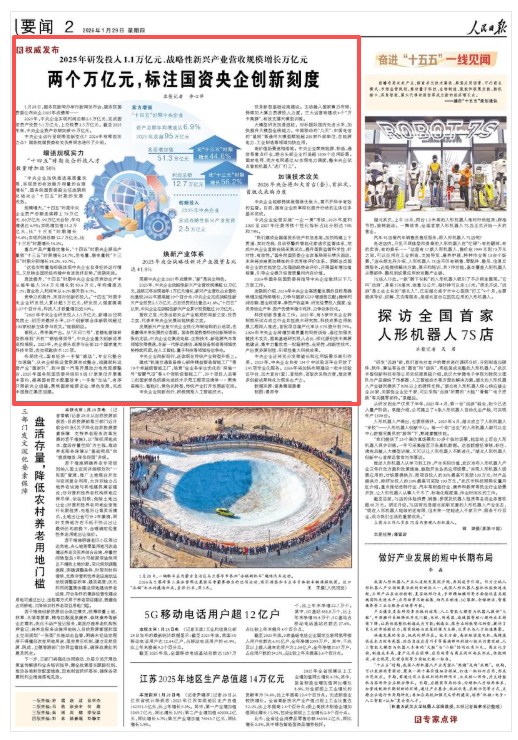
两个万亿元 标注国资央企创新刻度
Ren Min Ri Bao· 2026-01-29 01:42
Core Insights - The central enterprises in China are projected to achieve a total profit of 2.5 trillion yuan and fixed asset investment of 5.1 trillion yuan by 2025, with total assets exceeding 95 trillion yuan by the end of 2025 [1] Group 1: Scale and Performance - During the 14th Five-Year Plan period, the total assets of central enterprises increased significantly, reaching over 90 trillion yuan with an average annual growth rate of 6.9% [2] - The added value of central enterprises reached 51.3 trillion yuan, a 44.6% increase compared to the previous five-year period, while total profits grew by 56.2% to 12.7 trillion yuan [2] - Key product outputs, such as crude oil and electricity generation, saw substantial increases of 24.7% and 38.2% respectively during the same period [2] Group 2: Innovation and R&D Investment - Central enterprises invested over 5 trillion yuan in R&D during the 14th Five-Year Plan, with R&D intensity increasing by 0.27 percentage points and a nearly 50% rise in the number of technology talents [4] - By 2025, R&D investment is expected to reach 1.1 trillion yuan, with significant achievements in major technological projects and innovations [4] - Central enterprises are leading or participating in all 22 national major science and technology projects, overcoming 121 key technologies [4] Group 3: Strategic Emerging Industries - Revenue from strategic emerging industries is projected to exceed 12 trillion yuan by 2025, with a continuous annual growth of 1 trillion yuan [5] - Investment in strategic emerging industries will account for 41.8% of total investments, reflecting a shift towards new industry structures [5][6] - Central enterprises are focusing on sectors such as integrated circuits, biotechnology, and new energy vehicles, while also enhancing their positions in high-end equipment manufacturing and artificial intelligence [6] Group 4: Traditional Industry Transformation - Central enterprises are actively transforming traditional industries by establishing smart factories and promoting green technologies [7] - The construction of intelligent factories and the implementation of advanced technologies are opening new development spaces for traditional sectors [7] Group 5: Future Goals and Regulatory Framework - In 2026, central enterprises will enhance procurement efforts for first sets and batches of products, aiming for continuous growth in value added and alignment with national GDP growth [9][10] - A more precise evaluation system will be implemented to improve the quality and internal value of state-owned enterprises [10] - The focus will be on increasing high-quality technological supply and advancing original technology development [11]
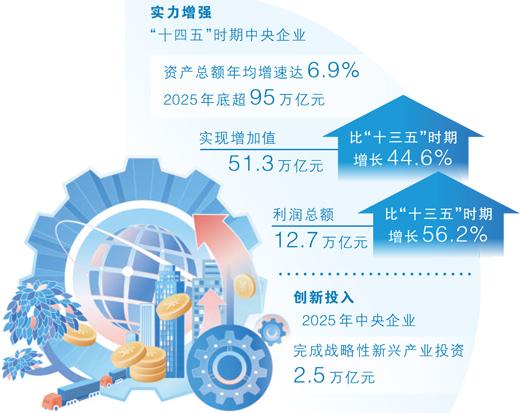
两个万亿元,标注国资央企创新刻度
Ren Min Ri Bao· 2026-01-29 00:13
Core Insights - The central enterprises in China are projected to achieve a total profit of 2.5 trillion yuan and fixed asset investment of 5.1 trillion yuan by 2025, with total assets exceeding 95 trillion yuan by the end of 2025 [1] Group 1: Financial Performance - During the 14th Five-Year Plan period, the total assets of central enterprises increased significantly, with an average annual growth rate of 6.9%, reaching over 90 trillion yuan [2] - The added value of central enterprises reached 51.3 trillion yuan, a 44.6% increase compared to the previous five-year period [2] - Total profits for central enterprises during this period amounted to 12.7 trillion yuan, reflecting a 56.2% increase from the previous five years [2] Group 2: R&D and Innovation - Central enterprises are set to invest 1.1 trillion yuan in R&D by 2025, with significant achievements in innovation, including participation in 22 national major technology projects and overcoming 121 leading technologies [3] - Cumulatively, central enterprises invested over 5 trillion yuan in R&D during the 14th Five-Year Plan, with a nearly 50% increase in the number of scientific and technological personnel [2][3] Group 3: Strategic Emerging Industries - By 2025, revenue from strategic emerging industries is expected to exceed 12 trillion yuan, with a continuous annual growth of 1 trillion yuan [4] - Investment in strategic emerging industries will account for 41.8% of total investments, with cumulative investments exceeding 10 trillion yuan since the beginning of the 14th Five-Year Plan [4] Group 4: Technological Advancements - Central enterprises are actively embracing artificial intelligence and new infrastructure construction, enhancing their capabilities in various sectors such as energy and manufacturing [6] - The establishment of over 70 intelligent factories and the development of numerous advanced technology demonstration projects highlight the focus on high-end, intelligent, and green transformation [5] Group 5: Future Directions - In 2026, central enterprises will focus on ensuring continuous growth in added value and optimizing various financial metrics, including profit totals and labor productivity [8] - The emphasis will be on enhancing technological innovation, with plans to increase the proportion of basic research investment and tackle key technologies [8]
【新华解读】国资央企交2025年“成绩单” 今年工作重点将会有哪些?
Xin Hua Cai Jing· 2026-01-28 15:37
Core Insights - The central enterprises' total assets are expected to exceed 95 trillion yuan by the end of 2025, with a profit target of 2.5 trillion yuan and fixed asset investments of 5.1 trillion yuan [1] - The focus of state-owned enterprise reform has shifted from foundational reforms to aligning with national strategies and fostering new productive forces, with strategic emerging industries becoming the core engine of development [3][4] Group 1: Reform and Governance - The reform actions have achieved systematic breakthroughs in optimizing layout, improving governance, and strengthening supervision, with over 70% of revenue from central enterprises linked to national security and economic lifelines [2] - The enhancement of governance effectiveness is a key highlight, with the implementation of a personalized assessment mechanism where 76% of indicators are tailored to individual enterprises, promoting a shift from scale expansion to quality and efficiency [2][4] - The next steps will focus on further deepening reforms to address systemic barriers and prominent issues [2] Group 2: Strategic Emerging Industries - Central enterprises are expected to invest 2.5 trillion yuan in strategic emerging industries by 2025, accounting for 41.8% of total investments, with revenue from these sectors projected to exceed 12 trillion yuan [4] - Mergers and acquisitions are emphasized as crucial for industrial upgrades, with significant consolidations occurring in key sectors [4] - The integration of artificial intelligence with the real economy is creating new industrial opportunities, with initiatives like the "AI+" program being implemented [5] Group 3: Innovation and Technology - The focus on enhancing innovation capabilities includes increasing investment in basic research and establishing platforms for technology transfer [5][6] - Central enterprises are expected to play a significant role in the supply of intelligent computing facilities and AI solutions, creating vast market opportunities in various sectors [5][6] - The government is drafting policies to support the cultivation of emerging pillar industries, aiming to create a comprehensive system for technology sourcing and industrial incubation [6] Group 4: Future Development Goals - The State-owned Assets Supervision and Administration Commission (SASAC) has outlined five key work deployments for 2026, emphasizing high-quality development and ensuring value-added growth aligns with GDP growth [7] - The focus will be on optimizing layouts in sectors like renewable energy, low-altitude economy, and quantum technology, while also enhancing the integration of technology and industry [7][8] - Risk prevention and reform efforts will be synchronized, with mechanisms established to mitigate investment, debt, and overseas business risks [7]
中央企业“AI+”专项行动取得积极进展
Xin Hua She· 2026-01-28 08:22
Core Viewpoint - The State-owned Assets Supervision and Administration Commission (SASAC) is actively promoting the "AI+" initiative among central enterprises, achieving significant progress in key areas such as application, computing power, data, and models [1][2] Group 1: Achievements in AI+ Initiative - Central enterprises have created over 1,000 application scenarios focusing on key industries like energy, manufacturing, and communications [1] - Examples include the State Grid and Southern Power Grid utilizing AI for intelligent management in power dispatch and fault prediction [1] - Central enterprises are integrating into the national computing power layout, with three major telecom operators establishing four "ten thousand card clusters" to support large model training [1] Group 2: Support for AI Development - General models like "Jiutian" from China Mobile and "Xingchen" from China Telecom have empowered over 200 external units, accelerating applications in energy and industrial manufacturing [1] - The "Huanxin Community" initiated by SASAC provides over 2,000 domestic intelligent computing chips for free, gathering over 4,000 models and 800 datasets to promote the widespread application of AI technology [1] Group 3: Future Directions - Central enterprises will intensify efforts in the "AI+" initiative, focusing on enhancing investment traction, deepening scenario cultivation, and optimizing data supply [2] - The goal is to become a key provider of intelligent computing infrastructure, a significant enabler of AI across various industries, and an organizer of systematic industrial layout [2]


国务院国资委:聚焦具身智能等领域,建“AI+”产业共同体
Nan Fang Du Shi Bao· 2026-01-28 05:59
Core Viewpoint - The State-owned Assets Supervision and Administration Commission (SASAC) is focusing on advancing the "AI+" initiative in key sectors such as embodied intelligence and energy, aiming to create an "AI+" industrial community and enhance the openness of application scenarios [1][3]. Group 1: Progress in AI Applications - Central enterprises have launched over 1,000 application scenarios in key industries like energy, manufacturing, and telecommunications, utilizing AI for tasks such as power dispatch and fault prediction [3][4]. - The integration of AI in traditional industries is seen as a crucial driver for transformation, with examples including the use of intelligent robots in manufacturing and advanced models in rail transport [3][4]. Group 2: Infrastructure and Computational Power - Central enterprises are actively contributing to the national computing power layout, with significant investments in computational resources, including the establishment of four "ten-thousand card clusters" by major telecom operators [3][4]. - Platforms like "Xirang" and "Computing Network Brain" are being developed to provide standardized computing power services, emphasizing low-cost and high-intelligence solutions [3][4]. Group 3: Model Development and Collaboration - The development of large models is accelerating, with companies like China Mobile and China Telecom enhancing their capabilities and empowering over 200 external units in various sectors [3][4]. - SASAC has initiated the "Renewal Community" to support young entrepreneurs and tech enthusiasts by providing over 2,000 domestic intelligent computing chips and access to a vast array of models and datasets [4][5]. Group 4: Future Directions - The next steps for state-owned enterprises include strengthening investment strategies, focusing on the construction of integrated computing networks, and optimizing data supply in key areas such as transportation, energy, and finance [5]. - The aim is to enhance the quality of industrial development through effective investments and to foster a collaborative environment for AI applications across various sectors [5].
国资委最新部署!加强上市公司质量和市值管理、大力推进重组并购
FOFWEEKLY· 2025-12-26 03:58
Core Viewpoint - The article emphasizes the importance of enhancing the quality and market value management of listed companies, promoting strategic and specialized restructuring, and high-quality mergers and acquisitions to ensure the effective start of the 15th Five-Year Plan [4]. Group 1: Central Enterprises' Performance - In the first eleven months, central enterprises achieved a value-added of 9.5 trillion yuan, representing a year-on-year growth of 1.4% [6]. - The fixed asset investment (excluding real estate) reached 3.3 trillion yuan, with a year-on-year increase of 0.7% [6]. - R&D investment amounted to 890.16 billion yuan, with an R&D intensity of 2.62%, indicating steady improvement in innovation capabilities [7]. Group 2: Strategic Focus for 2026 - The meeting outlined five key tasks for central enterprises in 2026, focusing on improving quality and efficiency, optimizing economic layout, enhancing independent innovation capabilities, deepening state-owned enterprise reforms, and ensuring social stability [9]. - Emphasis was placed on stabilizing operations and improving efficiency by utilizing big data models to capture potential market demands and enhance product and service quality [9]. - The article highlights the importance of strategic and specialized restructuring, with examples of successful integrations such as China Yajiang Group and China Chang'an Automobile [10]. Group 3: Reform and Innovation - The meeting stressed the need to advance reforms to a new level, with a focus on improving the modern enterprise system and enhancing management and operational frameworks [12]. - The article mentions the ongoing deepening of three system reforms, which aim to improve management levels and enhance the contractual management of managerial staff [13]. - Central enterprises are positioned as leaders in innovation-driven development, with plans to enhance the management of research organizations and foster a talent-friendly corporate ecosystem [13].

国资委最新部署!加强上市公司质量和市值管理、大力推进重组并购
证券时报· 2025-12-24 01:49
Core Viewpoint - The central enterprises' meeting held on December 22-23, 2023, outlined key tasks for 2026, emphasizing stability, quality improvement, and efficiency enhancement in reform and development efforts [1][6]. Group 1: Key Tasks for 2026 - The meeting identified five key tasks for central enterprises in 2026, including enhancing the quality and market value management of listed companies, promoting strategic and specialized restructuring, and improving the contractual management level of managerial staff [1][6]. - A focus on stabilizing operations and improving efficiency was emphasized, with plans to utilize big data models to capture market demand and enhance product and service quality [6][7]. Group 2: Economic Performance - From January to November 2023, central enterprises achieved a value-added output of 9.5 trillion yuan, reflecting a year-on-year growth of 1.4% [3]. - Fixed asset investment (excluding real estate) reached 3.3 trillion yuan, with a year-on-year increase of 0.7% [3]. Group 3: Innovation and Industry Upgrading - Central enterprises invested 890.16 billion yuan in R&D, with an R&D intensity of 2.62%, indicating steady improvement in innovation capabilities [3]. - The "Artificial Intelligence+" initiative has created nearly a thousand application scenarios across 16 key industries, enhancing collaboration with over 200 external units [3]. Group 4: Reform and Management - The meeting highlighted the need for further deepening of reforms, including the improvement of the modern enterprise system and management operations [9]. - The focus will be on enhancing the market-oriented research management system and fostering a talent-friendly corporate ecosystem [9].