有色金属ETF国泰

Search documents
有色板块盘中走高,有色金属ETF国泰(159881)盘中涨超3%
Sou Hu Cai Jing· 2026-02-27 05:24
Group 1 - The industrial metals sector is experiencing a rise in expectations for interest rate cuts, leading to anticipated volatility in prices [1] - For copper, short-term expectations of Federal Reserve rate cuts are supporting prices, while long-term demand from new energy sources is expected to widen the supply-demand gap [1] - In the aluminum market, seasonal factors may lead to price fluctuations, but strong demand from new energy sources is likely to keep prices stable [1] Group 2 - The Guotai Nonferrous Metals ETF (159881) tracks the CSI Nonferrous Metals Index (930708), which includes listed companies involved in mining, smelting, and processing within the nonferrous metals sector [1] - The index reflects the overall performance of listed companies in the nonferrous metals industry, covering industrial metals, precious metals, and rare metals [1]
有色金属ETF国泰(159881)盘中涨超0.8%,全球局势动荡背景下,有色金属行业景气度持续
Mei Ri Jing Ji Xin Wen· 2026-02-06 07:05
Core Viewpoint - The non-ferrous metals industry is experiencing sustained prosperity amid global turmoil, driven by significant supply constraints and a clear demand outlook from emerging industries [1] Supply Constraints - Mining difficulties for copper have increased, with frequent accidents in upstream mining areas leading to tighter supply, supporting a long-term price uptrend [1] - Countries are tightening control over strategic metals, further intensifying upward price pressure [1] Demand Outlook - Rapid development in emerging industries such as artificial intelligence, electric vehicles, and renewable energy is creating unprecedented standards for material performance and purity [1] - A significant qualitative change in demand for metals is occurring, as many are evolving into "critical strategic materials," providing clear long-term support [1] Industry Overview - The Guotai Non-Ferrous Metals ETF (159881) tracks the CSI Non-Ferrous Metals Index (930708), which selects listed companies involved in the mining, smelting, and processing of non-ferrous metals [1] - The index reflects the overall performance of listed companies in the non-ferrous metals sector, with a balanced structure covering various sub-sectors such as copper, gold, aluminum, rare earths, and lithium [1]
昨天跌傻了,今天涨爽了,高波动率下进行技术性修正
Sou Hu Cai Jing· 2026-02-04 00:56
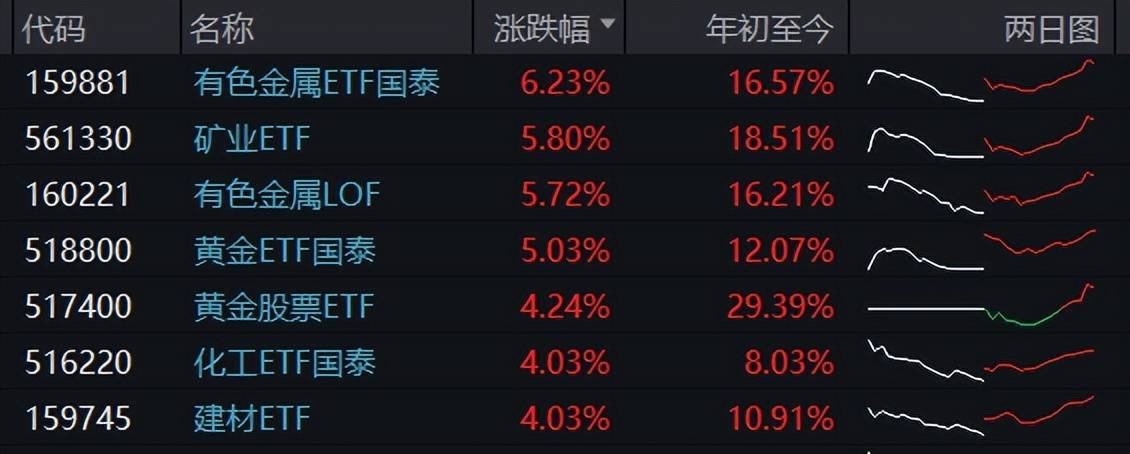
Core Viewpoint - The recent surge in various ETFs, particularly in the metals and mining sectors, indicates a recovery in market sentiment following a period of volatility, driven by technical corrections and strategic reserve initiatives by major economies [1][2][4]. ETF Performance - The following ETFs have shown significant gains: - Cathay Metals ETF: +6.23% YTD +16.57% - Mining ETF: +5.80% YTD +18.51% - Cathay Metals LOF: +5.72% YTD +16.21% - Cathay Gold ETF: +5.03% YTD +12.07% - Gold Stocks ETF: +4.24% YTD +29.39% - Cathay Chemical ETF: +4.03% YTD +8.03% - Building Materials ETF: +4.03% YTD +10.91% [1]. Market Dynamics - The rebound in gold prices, reaching a peak of $4,949.99, and silver prices above $87, reflects a shift in market dynamics, with short positions being closed and new buying interest emerging [2]. - The increase in holdings of the iShares Silver Trust by 1,023.23 tons marks the third-largest single-day increase in its history, indicating strong investor interest [3]. Strategic Reserve Initiatives - The Chinese government is exploring the expansion of its copper strategic reserve, which may support copper prices, similar to the U.S. strategic reserve initiatives [3]. - Trump's plan to initiate a $12 billion mineral reserve aims to bolster U.S. manufacturing against supply disruptions, reflecting a shift towards prioritizing security over efficiency in resource management [4]. Future Outlook - The expectation of a resource bull market remains, supported by historical patterns where extreme volatility in gold prices often precedes significant upward trends [5]. - Long-term factors such as monetary easing, the safe-haven appeal of gold, and the trend of de-dollarization are expected to sustain gold's upward trajectory [6]. - Investors are advised to adopt differentiated strategies, balancing short-term opportunities with long-term value, while being cautious of market volatility [7]. Related Investment Opportunities - Key ETFs to consider include: - Largest Oil ETF: 561360 - Unique Coal ETF: 515220 - Cathay Chemical ETF: 516220 - Largest Building Materials ETF: 159745 [9][10].

银价3天累计跌幅达40%,金价累计跌幅约20%
Shen Zhen Shang Bao· 2026-02-02 21:07
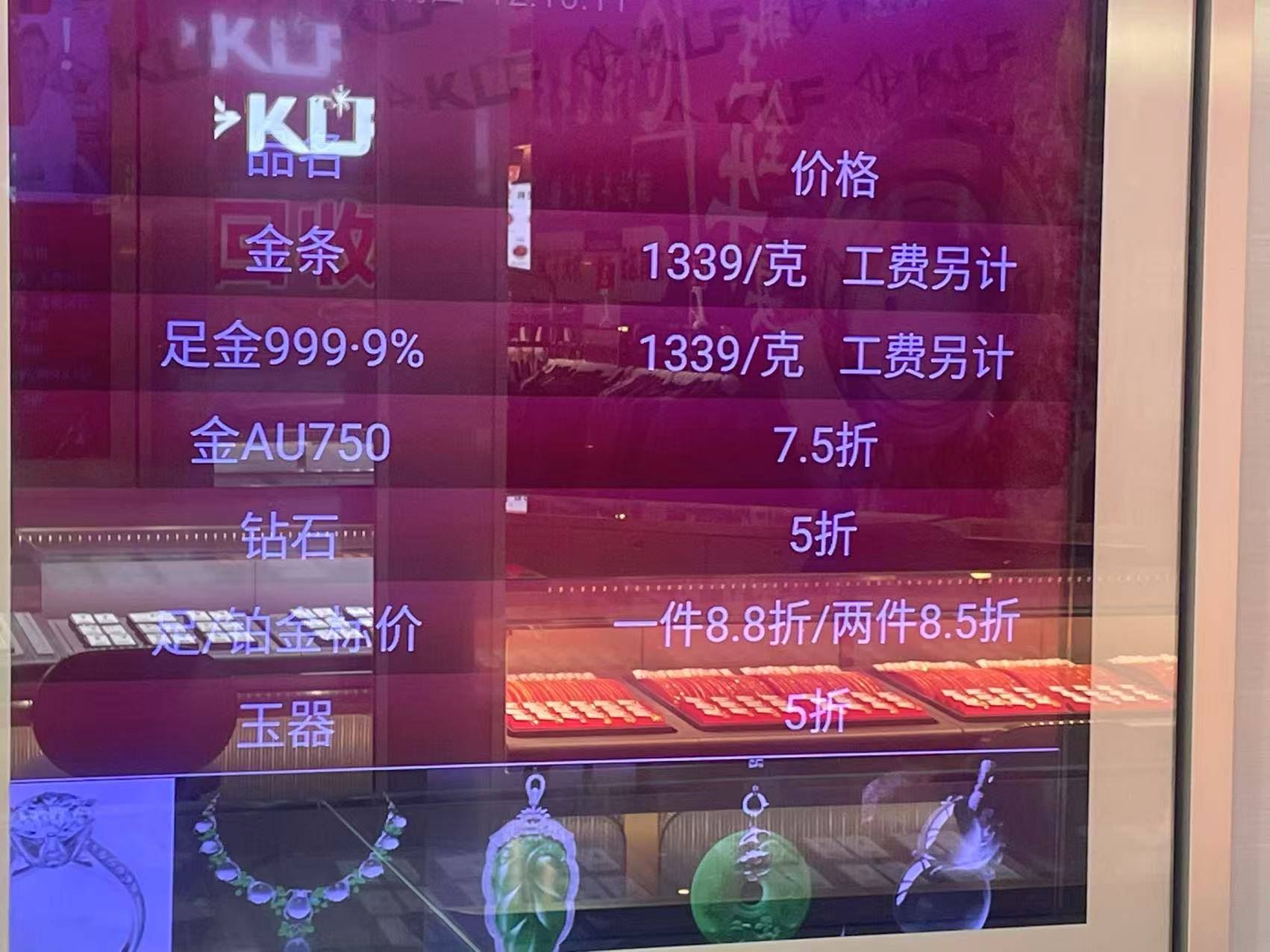
Group 1: Market Trends - International gold and silver prices experienced a significant drop, with gold futures falling below $4500 per ounce and silver futures dropping to $72.35 per ounce on February 2 [2] - In January, gold and silver prices surged, reaching historical highs of $5626.80 per ounce and $120.57 per ounce respectively, with monthly increases of approximately 29.89% and 72% [2] - Following the peak, gold and silver prices faced volatility, with gold prices declining by about 20% and silver by 40% over three days, erasing January's gains [2] Group 2: Stock Market Impact - The decline in gold and silver prices negatively impacted the stock market, with the Shanghai Composite Index closing down 2.48% on February 2 [4] - Precious metal stocks were heavily affected, with companies like Xiaocheng Technology (down 18.96%) and others experiencing significant losses, including 29 stocks hitting the daily limit down [4] - In the Hong Kong market, the Hang Seng Index fell by 2.23%, with notable declines in gold-related stocks [4] Group 3: Commodity Valuation Concerns - Citigroup's research indicated that gold valuations have reached extreme levels, with global gold expenditure as a percentage of GDP rising to 0.7%, the highest in 55 years [3] - A potential return to historical gold allocation ratios could lead to a significant price drop, with estimates suggesting a "halving" risk for gold prices [3] - The price of gold jewelry also saw a decline, with prices dropping to 1339 yuan per gram, a decrease of over 100 yuan from the previous day [3] Group 4: Regulatory Adjustments - The Shanghai Gold Exchange announced adjustments to the margin levels and price limits for silver contracts due to high volatility, increasing the margin from 20% to 26% [5] - The adjustments aim to mitigate market risks amid significant price fluctuations in silver [5] Group 5: Future Outlook - Some institutions believe the recent price corrections in gold and silver are temporary, with predictions of strong demand from central banks and expected net inflows into gold ETFs [5] - UBS forecasts a net purchase of 950 tons of gold by global central banks in 2026, indicating a strong appetite for gold reserves [5] - Analysts suggest that the recent price declines can be viewed as a market cooling phase rather than panic selling, which may help to stabilize the market for future growth [5]
金银大跌,资源品板块等待降波后低吸机会
Sou Hu Cai Jing· 2026-02-02 15:23
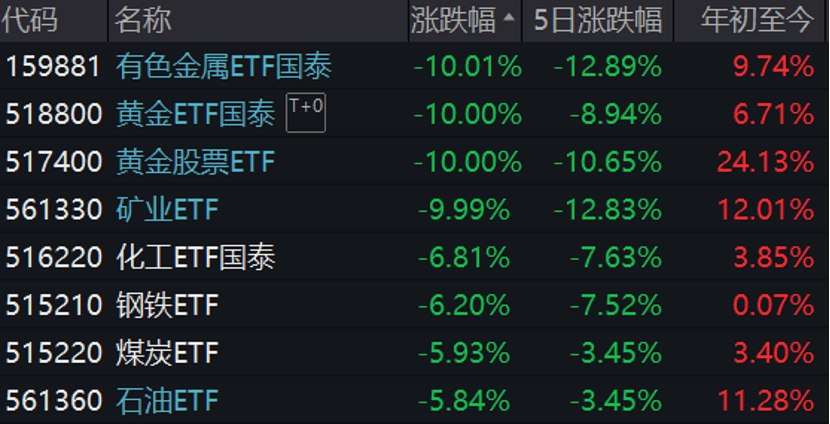
Group 1: Market Performance - The performance of various ETFs shows significant declines, with the Nonferrous Metals ETF down by 10.01% over five days and 12.89% year-to-date, while the Gold ETF is down by 10.00% over five days and 8.94% year-to-date [1] - Gold and silver prices experienced a sharp drop, with gold spot prices falling to nearly $4,400 per ounce and silver approaching $71 per ounce, marking a historic decline of 9.25% on January 31 [1] Group 2: Market Dynamics - The Chicago Mercantile Exchange raised margin requirements for metal futures, increasing gold margin from 6% to 8% and silver from 11% to 15%, which significantly impacts market liquidity and may force speculative investors to liquidate positions [4] - The recent surge in gold prices above $5,500 per ounce and silver above $120 per ounce was driven by a combination of factors, including geopolitical tensions and a shift in investor confidence towards precious metals [4] Group 3: Investment Outlook - The long-term outlook for gold remains strong, supported by monetary easing, its safe-haven status, and the trend of de-dollarization globally, despite short-term volatility [9][10] - Central banks worldwide, including China, continue to increase their gold reserves, indicating sustained demand for gold as a strategic asset [10][13] - The potential for a super cycle in commodities is anticipated, driven by economic recovery and expansionary fiscal policies, particularly in the context of the upcoming U.S. midterm elections [18]
贵金属“疯狂月”终结:金价3天跌20%,银价跌40%,月内涨幅被抹平
Sou Hu Cai Jing· 2026-02-02 10:48
Group 1 - International gold and silver prices experienced a significant drop on February 2, with gold futures falling below $4,500 per ounce and silver futures dropping to $72.35 per ounce. This followed a record high in January where gold reached $5,626.80 per ounce and silver hit $120.57 per ounce, marking increases of approximately 29.89% and 72% respectively [1] - The domestic commodity futures market saw most major contracts decline, including metals like silver, nickel, copper, palladium, and platinum, as well as oil products. Bitcoin also fell to $74,532 per coin, the lowest since April 2025. Analysts noted that the previous surge in gold prices is now facing a severe "value reassessment" due to tightening global liquidity and the collective decline of Bitcoin and commodities [1] - On February 2, gold jewelry prices in Shenzhen dropped to 1,339 yuan per gram, a decrease of over 100 yuan from the previous day [3] Group 2 - Citigroup's latest commodity report warned that gold valuations have reached extreme levels, with global gold expenditure as a percentage of GDP soaring to 0.7%, the highest in 55 years. If the gold allocation ratio returns to its historical norm of 0.35%-0.4%, gold prices could face a "halving" risk [2] - The A-share market reflected the volatility in precious metals, with the Shanghai Composite Index closing down 2.48% on February 2. The precious metals sector was heavily impacted, with numerous stocks hitting the daily limit down, including companies like Xiaocheng Technology, which fell by 18.96% [5] - The Shanghai Gold Exchange announced adjustments to the margin levels and price limits for silver contracts due to significant price fluctuations. The margin for silver contracts was raised from 20% to 26%, and the price limit was adjusted from 19% to 25% [7] - Some institutions believe that the recent pullback in gold and silver prices is temporary. UBS forecasts that global central bank gold net purchases will reach 950 tons in 2026, indicating strong demand for gold reserves. Additionally, net inflows into gold ETFs are expected to reach 825 tons, significantly exceeding the average from 2010 to 2020 [7]
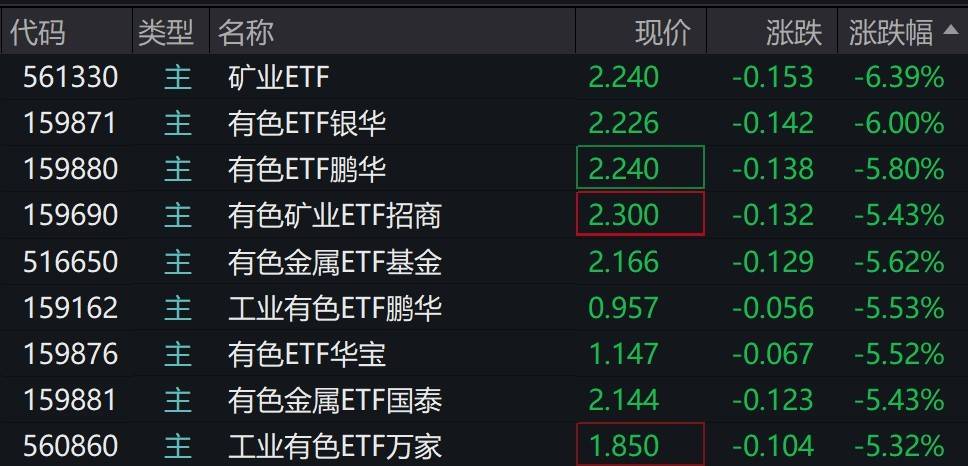
有色金属概念股走弱,矿业、有色相关ETF跌超5%
Sou Hu Cai Jing· 2026-02-02 02:08
Group 1 - The core viewpoint of the news highlights a significant decline in the performance of non-ferrous metal stocks, with companies like Shandong Gold and Zhongjin Gold hitting the daily limit down, and Northern Rare Earth dropping over 5% [1] - Mining and non-ferrous related ETFs have also seen a decline of over 5% due to market influences [1] Group 2 - Recent reports indicate that not only precious metals like gold and silver have risen significantly, but industrial metals such as copper and aluminum, as well as energy metals like cobalt and lithium, have also shown good growth, with multiple metals reaching historical or phase highs [2] - The super cycle of non-ferrous metals is attributed to three main factors: the weakening trend of the dollar due to the Federal Reserve's interest rate cuts, supply-demand gaps caused by declining ore grades and rising marginal costs in major mines, and domestic policies aimed at optimizing excess capacity [2]