欧元稳定币

Search documents
代币化欧元的市值超过 120 亿美元,创下历史新高
Xin Lang Cai Jing· 2026-02-12 04:52
Group 1 - The market capitalization of tokenized euros has surpassed $12 billion, with the number of holders exceeding 240,000, both reaching historical highs [1] - The market capitalization of off-chain euros stands at $161 trillion, indicating that the euro stablecoin represents a significant market opportunity [1]
欧元稳定币遇冷,美元凭啥占优势?全球需求说了算!
Sou Hu Cai Jing· 2025-10-26 18:51
Core Viewpoint - The European Union (EU) aims to issue more euro stablecoins to counter the rapid expansion of US dollar stablecoins in Europe [1][3]. Group 1: Reasons for the Popularity of US Dollar Stablecoins - Many individuals and businesses in the Eurozone prefer using US dollar stablecoins for payments, savings, and transactions due to their safety, as they are pegged 1:1 to the US dollar and backed by US assets [5]. - The convenience of blockchain technology allows for fast cross-border transactions without the need for traditional banks, enhancing privacy [5]. - Higher interest rates on US dollar deposits compared to European rates incentivize users to hold dollar stablecoins for better returns [5]. - The dominance of the US dollar in global trade, especially in commodities and cryptocurrency transactions, makes it essential for European businesses to use dollar stablecoins for international dealings [5][7]. Group 2: Challenges for Euro Stablecoins - The EU's attempt to promote euro stablecoins faces significant challenges due to the entrenched dominance of the US dollar in the global financial system [8][10]. - The historical context of the US dollar's supremacy, established through systems like Bretton Woods and the petrodollar, has created a robust demand for dollar stablecoins, which merely digitize existing dollar demand [10][11]. - The euro, while the second-largest currency globally, is primarily used within the Eurozone, limiting its appeal for international transactions [13]. - The EU must address internal issues such as building asset pools, ensuring transparency, and gaining user trust before euro stablecoins can compete effectively [17]. Group 3: Current Initiatives and Future Outlook - The EU is currently testing euro stablecoins in specific areas like cross-border e-commerce and internal natural gas transactions to build familiarity and usage within the Eurozone [19]. - The competition between stablecoins is just beginning, with potential opportunities arising from future economic shifts, such as US debt issues or the development of regional stablecoins in Asia-Pacific [19][21]. - The EU's strategy should focus on solidifying the internal market for euro stablecoins before attempting to compete with US dollar stablecoins on a global scale [21].


中美一场暗战打响了
虎嗅APP· 2025-10-15 00:01
Group 1 - The core viewpoint of the article is that major global economies are taking steps to curb the spread of US dollar-backed stablecoins, with Europe and China actively developing their own digital currencies to enhance financial sovereignty and reduce reliance on the dollar [2][3][6]. - A consortium of nine major European banks has announced plans to launch a euro-backed stablecoin to create an alternative to the US-dominated stablecoin market, aiming for strategic autonomy in payment systems [2][3]. - The European Central Bank has expressed concerns that widespread use of dollar stablecoins in the Eurozone could undermine its control over monetary policy, potentially leading to a situation similar to that of emerging economies heavily reliant on the dollar [3][4]. Group 2 - China has launched the Digital Renminbi International Operation Center in Shanghai, along with cross-border digital payment and blockchain service platforms, marking a proactive move in the global digital finance landscape [6][7]. - The internationalization of the Renminbi has been primarily driven by trade and cooperation along the Belt and Road Initiative, but progress has been slow due to traditional settlement system inertia and capital controls [7][8]. - The dominance of dollar stablecoins in the digital finance space highlights the competitive nature of financial rules, with China's absence potentially leading to a loss of influence in setting these rules [8][11]. Group 3 - The article discusses the historical context of the dollar's dominance, which was established through institutional design and international inertia post-World War II, particularly through the Bretton Woods system and the oil dollar system [10][12]. - The reliance on dollar stablecoins in the crypto space indicates that the dollar continues to play a central role even in emerging digital financial systems, posing risks for countries like China that do not participate [11][12]. - The potential systemic risks of over-reliance on the dollar are highlighted, emphasizing that currency is not just a payment tool but also a reflection of institutional and regulatory frameworks [12][13]. Group 4 - The article outlines the challenges China faces in promoting the internationalization of the Renminbi, including the need for a credible asset backing and the risks associated with private stablecoin issuance [16][17]. - The Digital Renminbi, issued by the central bank, is positioned as a sovereign digital currency that does not rely on external assets, contrasting with privately issued stablecoins [17][18]. - The Digital Renminbi can facilitate faster and cheaper cross-border payments, potentially creating a payment network independent of the SWIFT system, which would enhance financial security [18][19]. Group 5 - Trust and compliance issues are significant hurdles for the global acceptance of the Digital Renminbi, particularly regarding privacy concerns and the need for a widely accepted compliance framework [21][22]. - The integration of the Digital Renminbi into international payment systems requires technological compatibility and regulatory trust among multiple countries [23][24]. - The article emphasizes that the success of the Digital Renminbi as a reserve currency hinges on building a robust asset pool, ensuring liquidity, and establishing a transparent regulatory environment [25][26]. Group 6 - Strategic scenarios for the Digital Renminbi's breakthrough include energy trade settlements and small-scale transactions along the Belt and Road Initiative, which could reduce reliance on the dollar [27][28]. - The article concludes that while the Digital Renminbi may initially serve as a regional settlement currency, it has the potential to gain traction in international reserves over time [28].

中美一场暗战打响了
Hu Xiu· 2025-10-14 22:44
Group 1 - Major global economies are attempting to curb the spread of US stablecoins, with a consortium of nine European banks announcing plans to launch a euro-denominated stablecoin to create an alternative to the US-dominated market [1][2] - The rapid response from Europe follows the passage of the US stablecoin bill, with concerns that widespread use of US stablecoins in the Eurozone could undermine the European Central Bank's control over monetary policy [2][3] - A significant statistic indicates that all top ten stablecoins in the global stablecoin system are backed by the US dollar [2] Group 2 - China has also taken swift action by launching the Digital Renminbi International Operation Center in Shanghai, along with cross-border digital payment and blockchain service platforms [4][5] - The internationalization of the renminbi has been primarily driven by trade and cooperation along the Belt and Road Initiative, but progress has been slow due to traditional settlement system inertia and capital controls [5][6] - The dominance of US stablecoins in the digital finance space highlights the competitive landscape for financial rules, with China needing to actively participate to avoid being sidelined [6][10] Group 3 - The article discusses the historical context of the US dollar's dominance, which was established through the Bretton Woods system and further solidified by the petrodollar system [8][9] - Currently, over 90% of global crypto trading volume relies on stablecoins, predominantly pegged to the US dollar, reinforcing the dollar's role as a universal currency [9][10] - The potential risks of relying heavily on the US dollar for China include systemic impacts if the dollar system restricts access to financial resources [11][12] Group 4 - The article emphasizes the urgency for China to promote the internationalization of the renminbi, particularly through the central bank-issued digital renminbi, as a means to enhance financial security [12][18] - The digital renminbi is positioned as a sovereign digital currency that does not rely on external assets, unlike private stablecoins, which could lead to increased financial risks [16][18] - The digital renminbi can facilitate faster and cheaper cross-border payments, addressing inefficiencies in traditional payment systems [18][19] Group 5 - Trust and compliance challenges are highlighted as significant barriers to the global acceptance of the digital renminbi, particularly regarding privacy and regulatory frameworks [21][22] - The article points out that the depth and liquidity of China's bond market are still insufficient compared to the US, which affects international confidence in holding renminbi assets [22][23] - To become a reserve currency, the digital renminbi must address issues related to asset security, exit mechanisms, and institutional transparency [23][24] Group 6 - The article suggests strategic scenarios for the digital renminbi's breakthrough, such as energy trade and regional payment corridors, to reduce reliance on the US dollar [26][27] - The overall conclusion is that the digital renminbi's path to becoming an international reserve currency will require overcoming significant challenges related to trust, liquidity, and regulatory alignment [26][27]

打造美元替代方案!欧洲九大银行联盟官宣开发欧元稳定币
Zhi Tong Cai Jing· 2025-09-25 07:28
Core Points - Nine European banks have announced a collaboration to develop a euro stablecoin aimed at providing an alternative to the US dollar-dominated market, with plans for a launch in the second half of 2026 [1][2] - The initiative is part of a broader strategy to enhance Europe's strategic autonomy in the payment sector and to create a European alternative in the stablecoin market [1] - A new company has been established in the Netherlands to oversee the project, and the alliance is open to other banks joining the initiative [1] Industry Trends - This development signals a warming attitude towards digital assets among European banks, coinciding with the full implementation of the EU's Crypto Assets Market Regulation [2] - The banking sector is increasingly recognizing the potential of stablecoins as alternative payment channels, with significant profits reported by major stablecoin issuers like Tether [2]
美元稳定币的扩张对非美货币构成怎样的影响
Sou Hu Cai Jing· 2025-07-29 15:50
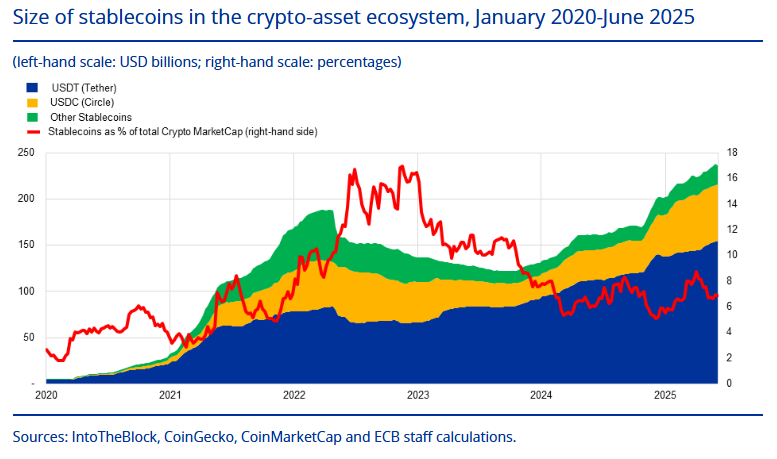
Core Insights - The passage of the GENIUS Act in the U.S. Congress and its subsequent signing by President Trump is expected to accelerate the issuance, payment settlement, and trading of stablecoins, which may significantly impact global monetary policy and exchange markets [2][3] - The European Central Bank (ECB) has expressed concerns that the dominance of U.S. dollar stablecoins could undermine its control over monetary policy, as dollar stablecoins account for approximately 99% of the total stablecoin market, while euro stablecoins remain marginal with a market cap of less than €350 million [2][3] - The potential growth of stablecoin supply is projected to increase from $230 billion in 2025 to $2 trillion by the end of 2028, which could further tilt the balance in favor of the U.S. and raise financing costs in the Eurozone [3][4] Industry Implications - The U.S. financial system, primarily driven by capital markets, contrasts with Europe's bank-dominated system, leading to concerns that the rise of stablecoins may marginalize traditional commercial banks [3][5] - Major U.S. payment organizations like Visa and Mastercard are integrating stablecoins into their global products, while retailers such as Walmart and Amazon are exploring their use, potentially bypassing traditional banking systems [3][5] - The GENIUS Act aims to modernize the U.S. payment and financial systems, reinforce the international status of the dollar, and create new demand for U.S. Treasury bonds, thereby enhancing the dollar's global influence [5][6] Market Dynamics - The efficiency and cost-reduction benefits of stablecoins are expected to strengthen the dollar's international position, creating a cycle of stablecoins, dollars, and U.S. Treasury bonds [6] - The emergence of high-yield stablecoin loans and interest-bearing stablecoin deposits poses challenges to traditional currencies and banking systems [3][4] - The recent enactment of stablecoin regulations in Hong Kong, which are pegged to the U.S. dollar, highlights the need for localized experiments in stablecoin issuance and trading in financial hubs like Shanghai [6]

美国的“金融武器”?欧央行:美元稳定币崛起将削弱欧洲货币政策控制力
Hua Er Jie Jian Wen· 2025-07-29 02:11
Core Viewpoint - The European Central Bank (ECB) warns that a dollar-dominated digital currency system poses a strategic challenge to European monetary sovereignty, potentially undermining financial stability and monetary autonomy if no strategic response is implemented [1] Group 1: Impact of Dollar Stablecoins - Dollar stablecoins dominate the global market, accounting for approximately 99% of the total stablecoin market capitalization, while euro stablecoins remain marginal with a market cap of less than €350 million [1][5] - The potential widespread use of dollar stablecoins in the Eurozone could weaken the ECB's control over monetary policy, especially as stablecoins are increasingly adopted for mainstream payments and commercial transactions [6][7] Group 2: Financial Stability Risks - The ECB has previously warned that stablecoins could pose financial stability risks, particularly if a mainstream stablecoin were to collapse, potentially causing widespread disruption in the financial system [5] - Major U.S. payment organizations like Visa and Mastercard are integrating stablecoins into their global products, which could lead to significant transactions bypassing traditional banking systems [6] Group 3: Strategic Responses for Europe - The ECB has several policy options to counter the challenges posed by dollar stablecoins, including supporting well-regulated euro-denominated stablecoins to meet legitimate market demand and enhance the euro's international role [8] - The digital euro project and private sector innovations should be viewed as complementary elements of a broader European digital payment strategy, with the digital euro potentially serving as a strong defense of European monetary sovereignty [8] - Strengthening global coordination on stablecoin regulation is crucial to avoid a fragmented regulatory landscape that could exacerbate financial instability and the dominance of the dollar [8]
全球经济和大类资产半年报:全球经济进入冲顶期
Ge Lin Qi Huo· 2025-06-26 07:48
Report Information - Report Title: Global Economic and Major Asset Semi-Annual Report [1] - Date: June 26, 2025 [2] - Analyst: Yujunli [3] - Contact Email: yujunli@greendh.com [3] Key Points Global Economic Landscape - Global manufacturing PMI contracted in April and May due to reciprocal tariff impacts [7] - On May 12, China and the US reached an agreement in Switzerland to significantly reduce reciprocal tariffs, with tariffs lowered to 10%, and an additional 24% of reciprocal tariffs to be discussed after 90 days. The 20% tariff imposed by the US on China over fentanyl will be negotiated separately. The first meeting of the China-US economic and trade consultation mechanism in London (June 9 - 10) reached a principled framework agreement [11] Capital Flows - According to a Citi report on May 28, large global funds are collectively "de-Americanizing", reducing allocations in US stocks, bonds, and the US dollar, and increasing allocations in European and Asian stocks, gold, and non-US currencies. Institutions' overall allocation of US stocks has dropped to a neutral level, making it the least favored market globally. There is a consensus among large global funds to "buy Asia and Europe". European and Japanese stocks have been upgraded, and emerging market stocks remain overweight [12] - Institutions generally reduced holdings of US and Japanese bonds and shifted to increasing positions in UK, German, Italian government bonds, and emerging market local bonds [13] - In the foreign exchange market, selling of the US is more evident. The US dollar continues to be under-allocated, while the euro and yen continue to be added to portfolios [14] - According to a report from Bank of America on June 16, global central banks have sold $48 billion worth of US Treasury bonds since the end of March, and foreign investors' holdings in the Fed's reverse repurchase facility have also decreased by approximately $15 billion [15] US Economic Indicators - In May, US manufacturing prices continued to rise rapidly, and service prices accelerated their increase [23] - US retail and food sales reached $715.4 billion, remaining at a high level, with a year-on-year increase of 3.3% in the current month, indicating strong consumer demand [26] - In April, the monthly value of US goods imports recovered to normal at $277.9 billion, mainly affected by reciprocal tariffs [29] - In April, the monthly value of US consumer goods imports recovered to normal at $69.8 billion, with a year-on-year growth rate of 5.2%. US retailers stocked up on a large scale before the implementation of reciprocal tariffs, and imports decreased significantly after the tariffs were imposed in April [32] - In April, the monthly value of US intermediate goods imports was $51.9 billion, showing a significant month-on-month decline due to tariff impacts. Manufacturers stocked up on a large scale before the tariffs [35] - In April, the monthly value of US capital goods imports was $90.5 billion, second only to March, with a year-on-year growth rate of 18.2%, indicating an acceleration in the reshoring of US manufacturing and the "re-industrialization" of the US [38] - In April, the monthly value of the US goods trade deficit decreased significantly to $87.4 billion due to reciprocal tariff impacts [41] - In April, the monthly value of US service exports reached a new high for the year at $98.8 billion, indicating the continued strength of the US service industry [44] - In May, the year-on-year growth rate of the US core CPI was 2.8%, the same as the previous value, with a month-on-month increase of 0.2%. The market expects the Fed to start cutting interest rates in September [47] - In May, the US PPI was 2.6% year-on-year and 0.1% month-on-month [50] - In April, the number of job openings in the US increased to 7.39 million, and the number of hires reached a one-year high, indicating a tightening labor market [53] - In May, the hourly wage of US non-farm enterprises was $36.24, with a year-on-year growth rate of 3.9% [56] - In April, the year-on-year growth rate of US wholesalers' inventories was 2.3%, and that of manufacturers' inventories was 0.9%, indicating an active inventory replenishment phase [59] Other Regions' Economic Indicators - In May, the monthly value of China's manufacturing fixed investment was 2.93 trillion yuan, with a year-on-year growth rate of 7.8%. China continues to make large-scale investments in emerging and future industries [62][65][68] - The ceasefire between Israel and Iran boosted global risk appetite [71] - The China-US reached a phased framework agreement, stabilizing global economic expectations. The final value of the US Markit Manufacturing PMI in June was 52.0, continuing to expand. The manufacturing material procurement price index rose significantly by 5.4 points to 70, the largest increase in four years [72] - The Swiss National Bank cut interest rates by 25 basis points to 0% [73] - China carried out comprehensive rectification of involutionary competition. The European Central Bank has cut interest rates eight times. Germany significantly expanded its military by 30%, driving the recovery of European manufacturing [74] - Elon Musk's Robotaxi was put into operation [75] Major Asset Strategies - The rebound of US stocks after April was mainly driven by retail investors, while institutions withdrew one after another, and short positions of hedge funds reached a new high [78] - The US "Great Beauty" tax cut plan passed in the House of Representatives, and the yield of 30-year US Treasury bonds once exceeded 5% [80] - Inflation in Japan rose, and the yields of 40-year and 30-year Japanese government bonds increased significantly [83] - As a representative of China's offshore assets, the Hang Seng Tech ETF is expected to benefit from the reallocation of global financial assets [86] - Driven by the continuous inflow of various funds, the A-share market is expected to shift from a volatile recovery to a trending upward market. There is a bullish view on Chinese equity assets [89] - The savings of the household sector continue to shift to high-dividend sectors, and the Bank ETF has continuously reached new highs [91] - In May, the issuance of China's 50-year Treasury bonds was oversubscribed, and long-term Treasury bonds are under pressure. The flattening of the domestic yield curve is unsustainable [93] - The ceasefire between Israel and Iran is only a temporary respite, and peace is short-lived. Iran is likely to face a situation similar to Gaza. The pulse increase in crude oil prices in June is likely to be just the first wave [96] - Gold is still in a technical adjustment phase, mainly fluctuating within a range [99] - The RMB is expected to achieve a double surplus in trade and capital accounts, and there is continued optimism about the RMB [102]
一文读懂“稳定币”是否真“稳定”!
私募排排网· 2025-06-21 10:04
Core Viewpoint - The article discusses the rise and significance of stablecoins, particularly in the context of recent regulatory developments and market interest, highlighting their role as a bridge between fiat and cryptocurrencies [4][110]. Group 1: Background and Emergence of Stablecoins - Prior to September 4, 2017, purchasing cryptocurrencies in China was relatively easy, leading to a surge in the issuance of various altcoins, which resulted in significant financial losses for many investors [10][14]. - Following regulatory crackdowns on cryptocurrency exchanges, the concept of over-the-counter (OTC) trading emerged, allowing users to trade without direct involvement from exchanges, although this method faced issues with transaction efficiency due to price volatility [25][37]. - The introduction of "USD stablecoins" provided a solution to the inefficiencies of OTC trading, as these stablecoins are backed by fiat currency, maintaining a stable value around one dollar [57][63]. Group 2: Regulatory Landscape and Market Dynamics - The lack of regulation allowed stablecoin issuers to expand rapidly, often leading to risky practices such as using collateral for speculative investments, which raised concerns about the stability and security of these assets [78][85]. - Regulatory bodies began to take notice, leading to investigations into stablecoin issuers to ensure they maintained adequate reserves, with notable cases resulting in significant fines for mismanagement of funds [90][94]. - The recent passage of the "Hong Kong Stablecoin Regulation" reflects a growing consensus among stakeholders, including large institutions and regulatory agencies, on the need for clear legal frameworks governing stablecoins [108][112]. Group 3: Economic Implications - There are claims that USD stablecoins could help alleviate the U.S. debt crisis, as they are often backed by U.S. Treasury securities, effectively channeling investment into government debt [115][119]. - However, the scale of stablecoins relative to the total U.S. debt is minimal, with the current stablecoin market being insufficient to make a significant impact on the overall debt situation [123][124].
国泰海通|稳定币的六大“误区”
国泰海通证券研究· 2025-06-20 07:10
Core Viewpoint - The article discusses the current state and future prospects of the stablecoin market, highlighting several misconceptions about stablecoins and their impact on global currencies and assets [1]. Misconception 1: Stablecoins Have Absolute Value Stability - Stablecoins are essentially credit extensions tied to underlying assets, meaning their value is not absolutely stable but relatively stable compared to more volatile assets. They can experience technical de-pegging risks and are influenced by the volatility of the assets they are pegged to [5][6]. Misconception 2: All Fiat Currencies Can Issue Stablecoins in Abundance - Not all fiat currencies can support the large-scale issuance of stablecoins. The development of stablecoins is contingent on the acceptance of the underlying fiat currency. The most widely recognized fiat stablecoins may lead to a "winner-takes-all" scenario [8]. Misconception 3: Dollar Stablecoins Undermine Dollar Credibility - The rapid growth of dollar stablecoins does not weaken the credibility of the dollar; rather, it enhances the dollar's status by expanding its functionality and reach. Dollar stablecoins can provide a hedge against currency depreciation in unstable economies [10]. Misconception 4: Dollar Stablecoins Are a Lifeline for U.S. Treasuries - The dollar stablecoin market can only slightly alleviate pressure on short-term U.S. Treasuries, as the short-term debt market is primarily influenced by the Federal Reserve. Dollar stablecoins do not significantly impact the long-term debt market [13][16]. Misconception 5: Dollar Stablecoins Will Significantly Increase Dollar Supply - While the issuance of dollar stablecoins may delegate some monetary authority from the Federal Reserve to issuing companies, it does not lead to a significant increase in the overall dollar supply. The Federal Reserve remains the main regulator of dollar liquidity [18]. Misconception 6: Stablecoins Will Rapidly Develop the RWA Market - Stablecoins primarily support the Real-World Assets (RWA) market at the transaction level, with the market's growth ultimately dependent on the quality of underlying assets. The RWA market is still in its early stages, with a projected total asset scale of approximately $15 billion by the end of 2024 [21].